Why El Niño Boosts Tamil Nadu's Northeast Monsoon: Circulation Dynamics and Impact
While Pacific warming starves India's summer crop belt, altered wind dynamics steer autumn depressions straight into Tamil Nadu's coastline.
Oct, 2026
•9 min read

Overview
While El Niño suppresses India's summer monsoon, it does the exact opposite across Tamil Nadu. The phenomenon alters equatorial circulation patterns and steers rain-bearing Bay of Bengal depressions directly into the Coromandel coast between October and December.
Long-period meteorological analyses confirm that equatorial Pacific warming weakens the nationwide summer Walker circulation. However, it enhances low-level easterly wind anomalies across southern peninsular India during autumn. This structural realignment creates a sharp contrast. While central India faces summer deficits, Tamil Nadu secures essential water replenishment for its winter crop cycle, alongside heightened urban flood exposure across vulnerable coastal corridors.
According to research from the India Meteorological Department, these atmospheric dynamics frequently transform weak tropical easterly waves into intense, moisture-laden rainstorms along the southeastern coast.
Why in the News? Monitoring El Niño and Peninsular Rainfall
The India Meteorological Department closely monitors equatorial Pacific thermal anomalies to assess regional rainfall variability across southern peninsular India. As of October 2026, ongoing surveillance of the El Niño–Southern Oscillation highlights how shifts in oceanic temperatures recalibrate seasonal precipitation patterns across the Bay of Bengal basin.
Global climate assessments from the World Meteorological Organization indicate that while Pacific warming frequently disrupts tropical monsoons, its regional impacts vary sharply by geography. For southeastern peninsular India, particularly coastal Tamil Nadu, an El Niño phase historically correlates with normal-to-above-normal rainfall rather than widespread meteorological drought.
Tracking this divergence remains vital for water resource administration, agricultural planning under state irrigation networks, and urban flood mitigation.
Discuss with Superkalam
What percentage of Tamil Nadu's annual rainfall is delivered by the Northeast Monsoon compared to the Southwest Monsoon?
Ask NowTamil Nadu's Unique Monsoon Calendar: Why the Northeast Monsoon Matters
Tamil Nadu operates on an inverted meteorological calendar compared to the rest of India. The Western Ghats create an imposing topographical barrier, placing the state in a prominent rain-shadow zone during the Southwest Monsoon.
According to the Regional Meteorological Centre Chennai, IMD, this leeward position restricts Tamil Nadu to receiving only about 36% of its annual precipitation, or approximately 328 mm, between June and September. Water security therefore turns toward the autumn retreat of the Inter-Tropical Convergence Zone.
Key seasonal drivers govern this rainfall regime:
- Autumn reliance: The Northeast Monsoon season, spanning October to December, accounts for roughly 48% to 50% of Tamil Nadu's total annual rainfall per findings in the IMD journal MAUSAM.
- Coastal concentration: Coastal districts derive up to 60% of their annual precipitation from this single seasonal window.
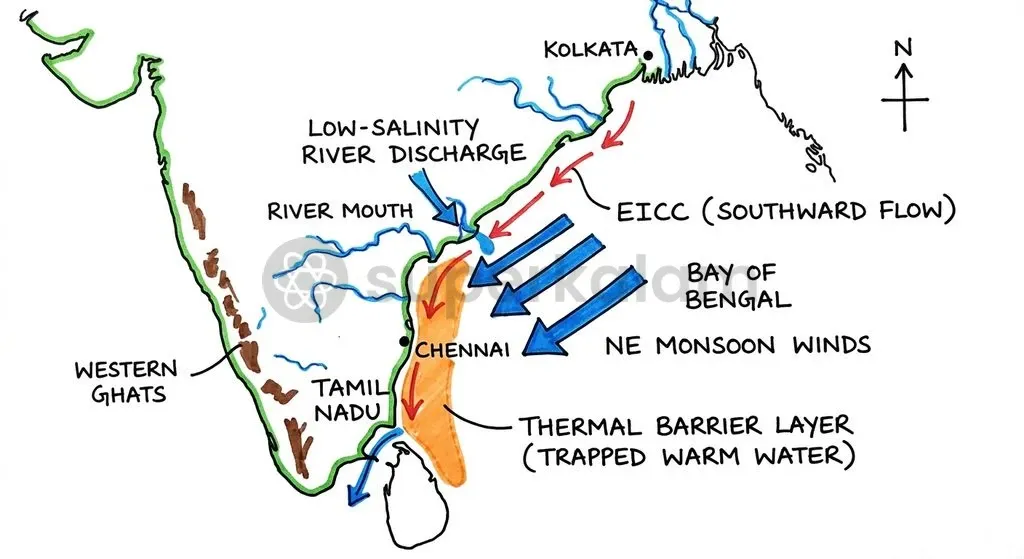
- Current reversal: The Indian Academy of Sciences notes that the East India Coastal Current reverses direction seasonally, flowing northward from February to September before switching southward along the coast between October and January under prevailing northeast trade winds.
- Thermal insulation: Research in the Journal of Geophysical Research: Oceans demonstrates that this southward, low-salinity flow creates sharp upper-ocean stratification, forming a stable barrier layer that inhibits vertical mixing and sustains elevated sea-surface temperatures across the western Bay of Bengal.
How El Niño Normally Affects India: The Southwest Monsoon Pattern
The Southwest Monsoon depends directly on the canonical Pacific Walker Circulation to sustain widespread convective rainfall across the Indian subcontinent. The IMD Meteorological Monograph explains that an El Niño event alters this planetary cell through anomalous warming of the central and eastern equatorial Pacific Ocean.
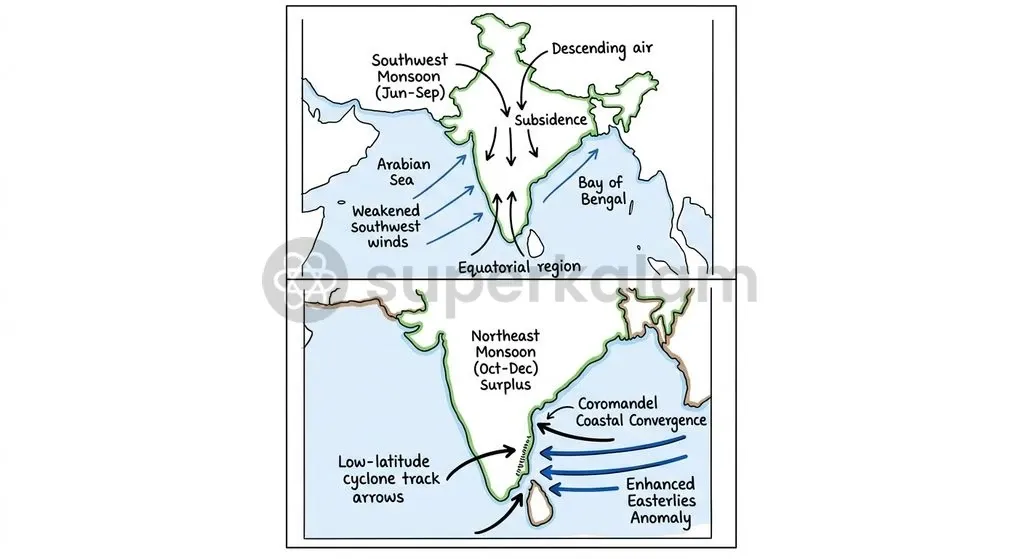
This oceanic heating shifts the ascending branch of the Walker Circulation eastward toward the central Pacific basin. Consequently, anomalous atmospheric subsidence descends across central India and Southeast Asia between June and September, directly suppressing convective cloud formation.
This large-scale downward motion creates widespread moisture deficits and triggers frequent dry spells during the primary summer crop season. For most Indian states, an El Niño summer translates into below-average reservoir replenishment and heightened agricultural distress.
Discuss with Superkalam
Explain how the seasonal reversal of the East India Coastal Current helps sustain warm sea-surface temperatures along the Coromandel coast.
Ask NowThe Mechanism: Why El Niño Often Boosts the Northeast Monsoon
Atmospheric circulation over South Asia undergoes a seasonal reversal that inverts Tamil Nadu's response to Pacific thermal anomalies.
Several physical processes drive this autumn wet phase:
- Wind shift: The IMD Meteorological Monograph details that while Pacific warming weakens summer convection, it shifts the equatorial convective zone southward and enhances low-level easterly wind anomalies across the Bay of Bengal from October to December.
- Southerly storm tracks: As stated in an official press briefing by the Director General of Meteorology, IMD, tropical cyclonic tracks and low-pressure systems during El Niño years are steered along more southerly trajectories toward Tamil Nadu, south coastal Andhra Pradesh, and Sri Lanka, rather than recurving northeastward toward Bangladesh or Myanmar.
- Latent heat fueling: Warm sea-surface temperatures across the Bay of Bengal supply latent heat that intensifies westward-propagating easterly waves, turning regional atmospheric depressions into heavy coastal downpours, as reported by The Hindu.
- Statistical verification: Research published in MAUSAM establishes a statistically significant positive correlation between El Niño events and normal-to-above-normal Northeast Monsoon precipitation in Tamil Nadu. A long-period historical analysis from 1875 to 1997 in MAUSAM confirms that rainfall over southeastern peninsular India remains systematically higher during El Niño years and systematically suppressed during La Niña events.
Comparing the Two Monsoons Under El Niño Conditions
The contrasting physical mechanics of the Southwest and Northeast Monsoons dictate entirely different hydrological responses to El Niño conditions.
| Diagnostic Parameter | Southwest Monsoon (June–September) | Northeast Monsoon (October–December) |
|---|---|---|
| Primary Wind Regime | Southwesterly oceanic surface winds | Northeasterly trade winds and easterly waves |
| Tamil Nadu Orography | Leeward rain-shadow of the Western Ghats | Direct windward coastal exposure to Bay of Bengal |
| Subcontinental Rainfall Share | Supplies |
Supplies 48% to 50% (up to 60% coastal) of annual rain |
| Walker Circulation Impact | Suppressive atmospheric subsidence over central India | Southward shift of the convective zone |
| Storm Trajectories | Systems track northwest across central India | Systems steer along southerly tracks toward Tamil Nadu |
| Statistical Teleconnection | Pronounced negative correlation with rainfall totals | Statistically significant positive rainfall correlation |
Discuss with Superkalam
If global climate surveillance predicts a simultaneous El Niño and Positive Indian Ocean Dipole, how should Cauvery Delta irrigation managers adjust water release schedules from the Stanley Reservoir?
Ask NowOther Climate Drivers: The Interplay with IOD and MJO
Regional oceanic dipoles and intra-seasonal pulses interact directly with El Niño to modify peninsular rainfall totals.
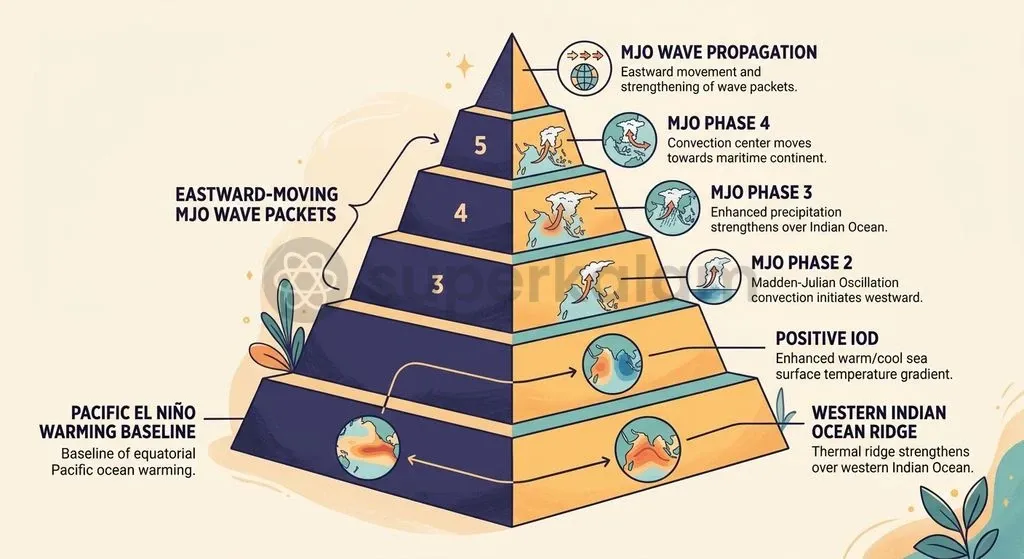
- Positive Indian Ocean Dipole: Scientific reports from IMD Chennai show that a Positive Indian Ocean Dipole—characterised by anomalous warming in the western equatorial Indian Ocean and cooling near Sumatra—acts synergistically with El Niño, substantially increasing moisture transport and convective cloud development across coastal peninsular India.
- Neutral Indian Ocean Dipole: The IMD Seasonal Climate Forecast Bulletin clarifies that the Pacific El Niño signal dominates regional atmospheric dynamics under neutral conditions without constructive or destructive thermal interference from the equatorial Indian Ocean.
- Madden-Julian Oscillation: According to IMD Chennai, the Madden-Julian Oscillation significantly boosts extreme precipitation and cyclogenesis in the Bay of Bengal when its convective core propagates eastward through phases 2, 3, and 4 with an amplitude greater than one.
When these intra-seasonal pulses synchronise with prevailing easterly wind anomalies, coastal Tamil Nadu encounters prolonged, high-intensity precipitation episodes.
Water Security, Crop Cycles, and Urban Flood Vulnerabilities
Agriculture in Tamil Nadu relies fundamentally on timely Northeast Monsoon rainfall to sustain winter foodgrain output.
- Delta paddy cultivation: The Department of Agriculture and Farmers Welfare, Government of Tamil Nadu, indicates that the Samba and Thaladi paddy seasons cover approximately 33 to 34 lakh acres statewide, including roughly 13 to 14 lakh acres within the fertile Cauvery Delta.
- Mettur storage requirements: Cultivators represented by the Cauvery Farmers Protection Association estimated that the Stanley Reservoir at Mettur and major canal systems require approximately 160 thousand million cubic feet (TMC) of water across the multi-month Samba season (as reported by DT Next in November 2025).
- Metropolitan reservoirs: The Chennai Metropolitan Water Supply and Sewerage Board documents that the capital city's primary drinking water reservoirs—comprising Poondi, Cholavaram, Red Hills (Puzhal), Chembarambakkam, Kannankottai Thervoy Kandigai, and Veeranam—derive over half of annual storage inflows exclusively from Northeast Monsoon storms.
Yet this atmospheric bounty carries severe urban vulnerability when extreme downpours overwhelm municipal drainage systems:
- 2015 Chennai floods: During the powerful 2015 El Niño episode, Chennai registered over 1,500 mm of rain between late November and early December. This volume overwhelmed the Chembarambakkam reservoir outflow gates and caused catastrophic inundation across the Adyar basin, according to the Comptroller and Auditor General of India.
- Cyclone Michaung (2023): In December 2023, Cyclone Michaung tracked under strong El Niño conditions and dropped over 50 cm of rain within 48 hours. This caused widespread flooding across northern and southern Chennai drainage basins as documented by Greater Chennai Corporation engineering assessments.
Discuss with Superkalam
Compare the mechanisms by which the Pacific Walker Circulation affects summer rainfall in central India versus autumn rainfall along the southeastern coast.
Ask NowWay Forward: Building Resilient Forecasting and Urban Drainage
Urban disaster resilience requires aligning civil engineering standards with changing rainfall intensities.
Key policy and infrastructure interventions include:
- Drainage design benchmarks: The Thirupugazh Committee, formed by the Tamil Nadu Government following destructive urban inundations, recommended upgrading Chennai's stormwater drainage infrastructure to accommodate a precipitation threshold of 7 to 8 cm per hour, replacing outdated design tolerances of 2 to 5 cm per hour.
- Kosasthalaiyar basin execution: Project documents from the Asian Development Bank confirm the execution of the Integrated Urban Flood Management Project across the Kosasthalaiyar basin, building 767 km of stormwater drains under an outlay of Rs 3,520 crore.
- Southern Chennai catchments: Under the Tamil Nadu Sustainable Urban Development Project, supported by KfW and the World Bank, authorities have expanded stormwater drain networks across more than 360 km throughout the Kovalam, Adyar, and Cooum river basins.
- Digital early warnings: The Tamil Nadu State Disaster Management Authority has operationalised the 'TN-ALERT' mobile platform, delivering hyper-local early warnings compliant with the Common Alerting Protocol to inform vulnerable coastal communities before extreme weather strikes.
Key Takeaways
- Tamil Nadu lies in the rain-shadow of the Western Ghats during the summer, receiving only about 36% (approx. 328 mm) of its annual precipitation from the Southwest Monsoon.
- The Northeast Monsoon supplies 48% to 50% of the state's annual rainfall, rising up to 60% along coastal districts, making it the bedrock of regional agricultural and municipal water security.
- Pacific El Niño conditions weaken the nationwide summer Walker Circulation but enhance autumn low-level easterly wind anomalies, steering Bay of Bengal cyclonic tracks southward toward Tamil Nadu.
- Southward-flowing East India Coastal Current waters transport low-salinity river runoff along the Coromandel coast, creating a barrier layer that sustains elevated sea-surface temperatures and intensifies rain-bearing easterly waves.
- Positive Indian Ocean Dipole conditions and Madden-Julian Oscillation phases 2, 3, and 4 act synergistically with El Niño to intensify extreme rainfall events across coastal districts.
- Urban resilience mandates executing the Thirupugazh Committee's recommended 7 to 8 cm per hour drain design standard, supported by stormwater expansions across the Kosasthalaiyar, Kovalam, and Adyar river basins.
- While Mettur's Samba season irrigation requirement is reported at 160 TMC, local water balances remain contingent on the exact timing and distribution of seasonal rainfall spells.
Mains Question
"While an El Niño event induces widespread moisture deficits across the Indian subcontinent during the summer monsoon, it paradoxically acts as a vital hydrological recharge mechanism for southeastern peninsular India." Elucidate the atmospheric circulation dynamics that underpin this divergent seasonal response. (10 Marks)
Evaluate NowMains Question
The Northeast Monsoon presents a dual challenge of agricultural water security and acute urban disaster vulnerability along the Coromandel coast. In light of past experiences such as the 2015 Chennai floods and Cyclone Michaung (2023), critically analyse the institutional and engineering measures needed to manage extreme precipitation events in coastal urban agglomerations. (15 Marks)
Evaluate NowPractice MCQs
QUESTION 1
With reference to the atmospheric and oceanic dynamics of the Northeast Monsoon over Tamil Nadu, consider the following statements:
- The East India Coastal Current flows northward between October and January under the influence of prevailing northeast trade winds.
- Southward low-salinity flow creates upper-ocean stratification in the western Bay of Bengal, forming a barrier layer that sustains elevated sea-surface temperatures.
- During El Niño years, tropical cyclonic tracks over the Bay of Bengal are steered along more southerly trajectories toward Tamil Nadu rather than recurving toward Bangladesh or Myanmar. Which of the statements given above are correct?
QUESTION 2
Consider the following statements regarding the influence of planetary and regional climate drivers on Indian rainfall:
- During an El Niño event, anomalous atmospheric subsidence descends across central India between June and September, suppressing summer convective cloud formation.
- A Positive Indian Ocean Dipole acts synergistically with El Niño to enhance moisture transport across coastal peninsular India during the Northeast Monsoon.
- The Madden-Julian Oscillation suppresses cyclogenesis and extreme precipitation in the Bay of Bengal when its convective core traverses phases 2, 3, and 4. Which of the statements given above is/are correct?
QUESTION 3
Consider the following statements regarding Tamil Nadu's precipitation and agricultural dynamics:
- Tamil Nadu receives approximately 36% of its annual precipitation during the Southwest Monsoon due to its leeward position behind the Western Ghats.
- Coastal districts of Tamil Nadu derive up to 60% of their annual rainfall during the October to December Northeast Monsoon window.
- Long-period historical analyses from 1875 to 1997 demonstrate that Northeast Monsoon rainfall over southeastern peninsular India is systematically suppressed during El Niño events. Which of the statements given above is/are correct?
QUESTION 4
Which of the following primary drinking water reservoirs supplying Chennai derives over half of its annual storage inflows predominantly from the Northeast Monsoon?
- Poondi
- Chembarambakkam
- Red Hills (Puzhal)
- Stanley Reservoir (Mettur) Select the correct answer using the code given below:
QUESTION 5
Consider the following statements regarding atmospheric circulation anomalies over South Asia during El Niño:
- El Niño weakens the nationwide summer Walker circulation across the Indian subcontinent.
- El Niño conditions enhance low-level easterly wind anomalies across southern peninsular India and the Bay of Bengal between October and December.
- Latent heat supplied by warm sea-surface temperatures across the Bay of Bengal intensifies westward-propagating easterly waves. Which of the statements given above are correct?