West Asia Crisis Explained for UPSC: Map, Key Players and India's Stakes
The West Asia crisis reshapes energy routes, maritime trade, and India's ties with Israel, Iran, and the Gulf. The map, the players, and India's stakes.
Sep, 2026
•10 min read
Overview
India faces a severe foreign policy test as escalating hostilities across West Asia dismantle regional security frameworks, challenging New Delhi’s long-standing strategy of diplomatic de-hyphenation across competing regional power blocs. The structural breakdown of the 2020 normalization initiatives and asymmetric disruptions along major maritime trade corridors have forced India to protect its core national interests through active multi-alignment. While the crisis threatens vital energy transit through maritime chokepoints and stalls major geoeconomic connectivity projects, it also jeopardises substantial diaspora remittances and trade routes. Consequently, India must balance strategic partnerships with Israel, Gulf monarchies, and Iran while upholding its commitment to regional stability and a negotiated Two-State solution.
Why West Asia is at an Unprecedented Geopolitical Inflection Point
West Asian security architectures face systemic instability following multi-front military escalations that erupted in late 2023. The regional order has shifted from uneasy diplomatic accommodation to active, distributed warfare across multiple operational theatres.
The conflict has drawn state and non-state actors into direct confrontation, dismantling previous diplomatic gains and upsetting trade predictability. In response to the initial outbreak of hostilities, the Ministry of External Affairs launched Operation Ajay in October 2023, successfully repatriating 1,309 Indian citizens and several foreign nationals from Israel.
As of mid-2024, the widening conflict continues to disrupt critical shipping corridors and trade infrastructure. For Indian foreign policy, this crisis tests the operational viability of strategic autonomy in an increasingly polarised geography.
Discuss with Superkalam
Which Arab countries formally established diplomatic relations with Israel under the 2020 Abraham Accords?
Ask NowThe Structural Breakdown: How the Post-Abraham Accords Equilibrium Collapsed
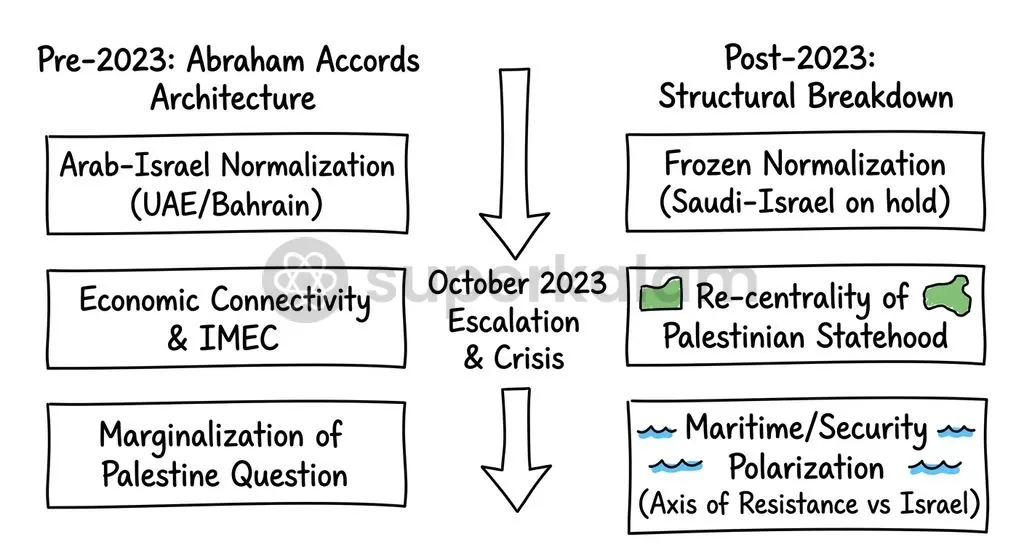
The diplomatic consensus built around the Abraham Accords fractured as direct hostilities re-established the Palestinian question as the central geopolitical fault line. Signed in September 2020, the United States-brokered Abraham Accords established formal diplomatic normalisation between Israel and several Arab nations, including the United Arab Emirates, Bahrain, Sudan, and Morocco.
However, that diplomatic framework operated on the assumption that regional economic integration, technological cooperation, and infrastructure connectivity could advance without resolving the underlying core issue of Palestinian statehood.
According to the Ministry of Foreign Affairs of Saudi Arabia, Riyadh formally paused normalization discussions with Israel, explicitly conditioning any future diplomatic ties on irrevocable steps toward an independent Palestinian State along 1967 borders. This diplomatic shift dismantled the premise that regional commercial integration could bypass the territorial rights of Palestinians.
Discuss with Superkalam
Why has the re-emergence of the Palestinian statehood issue stalled the diplomatic momentum of the Abraham Accords?
Ask NowMapping the Tripartite Fault Lines: Israel, Iran's Resistance Axis, and Arab State Hedging
Regional geopolitical alignment in West Asia has crystallised into three competing blocs with conflicting operational objectives.
The first vector comprises Israel, focused on establishing military deterrence and eliminating non-state armed groups along its borders. The second vector consists of the Iran-aligned Axis of Resistance, an informal network of regional state and non-state actors coordinated to resist Israeli and Western influence across the region. According to United Nations Security Council briefings, this network includes Hezbollah in Lebanon, Ansar Allah (Houthis) in Yemen, Hamas in Gaza, and several Iraqi Islamic Resistance militias.
The third vector comprises the Gulf Cooperation Council (GCC) monarchies, led by Saudi Arabia and the United Arab Emirates. These states pursue a policy of diplomatic hedging to shield domestic economic diversification programmes from regional spillover. While wary of asymmetric militia warfare, these monarchies avoid open alignment with Western military strikes, seeking instead to maintain regional dialogue and avoid direct confrontation with Tehran.
Discuss with Superkalam
If commercial vessels continue to avoid the Bab el-Mandeb Strait, how does the resulting detour around the Cape of Good Hope impact Indian export competitiveness in European markets?
Ask NowChokepoints Under Fire: Red Sea Disruptions, Bab el-Mandeb, and IMEC in Limbo
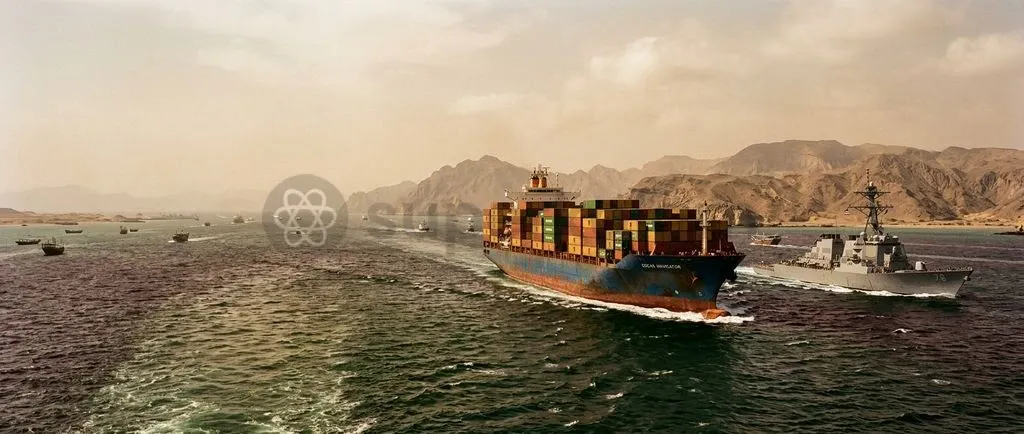
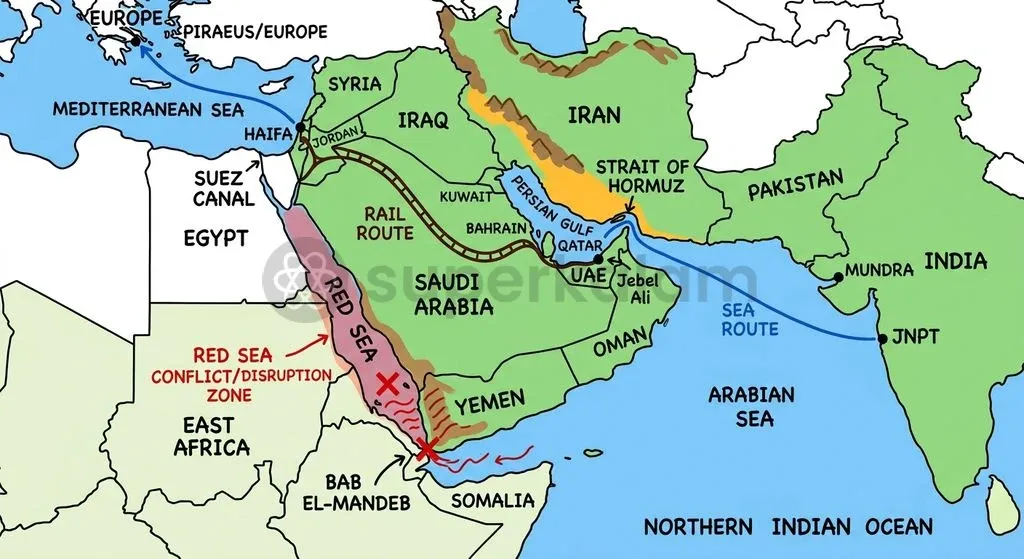
Maritime security in the Red Sea deteriorated significantly following targeted drone and missile strikes by Houthi forces on commercial vessels transiting the Bab el-Mandeb Strait. In response to these commercial disruptions, the United Nations Security Council passed Resolution 2722 (2024), condemning in the strongest terms over two dozen attacks against merchant shipping.
According to a rapid assessment by UNCTAD, shipping interdictions forced commercial cargo carriers to reroute around the Cape of Good Hope, adding 10 to 14 days in transit time and driving up maritime freight and insurance costs for Indian exporters by 30% to 50%.
To safeguard Indian-flagged merchant shipping and secure international sea lanes, the Indian Navy expanded Operation Sankalp. According to the Ministry of Defence, naval deployments involved over 21 warships logging 450 ship-days and escorting more than 15 lakh tons of critical cargo over a 100-day operational phase.
| MARITIME CONNECTIVITY: STRATEGIC CORRIDORS UNDER STRESS |
|---|
| 1. BAB EL-MANDEB STRAIT |
| • Target of Houthi missile and drone interdictions. • Forced global shipping around Cape of Good Hope (10-14 days delay). • Escorted by Indian Navy under expanded Operation Sankalp. |
| 2. STRAIT OF HORMUZ |
| • Primary transit route for 20 million barrels of crude oil daily. • Carries ~60% of Indian crude oil and >70% of LNG imports. |
| 3. INDIA-MIDDLE EAST-EUROPE ECONOMIC CORRIDOR (IMEC) |
| • Multimodal route linking India, UAE, Saudi Arabia, Jordan, Israel. • Stalled due to regional conflict and Haifa Port security risks. |
The regional crisis has also placed the India-Middle East-Europe Economic Corridor (IMEC) into political and physical uncertainty. Launched at the New Delhi G20 Summit in September 2023, IMEC was designed as a multimodal ship-to-rail corridor connecting India to Europe via the UAE, Saudi Arabia, Jordan, and Israel's Haifa Port. Regional military friction has stalled the infrastructure integration required to connect the Arabian Peninsula's railway networks with the Eastern Mediterranean.
Discuss with Superkalam
Compare the competing strategic imperatives India manages between its defence partnership with Israel and its connectivity goals through Iran's Chabahar Port.
Ask NowThe Strategic Stress Test: Why India Cannot Afford to Pick a Side
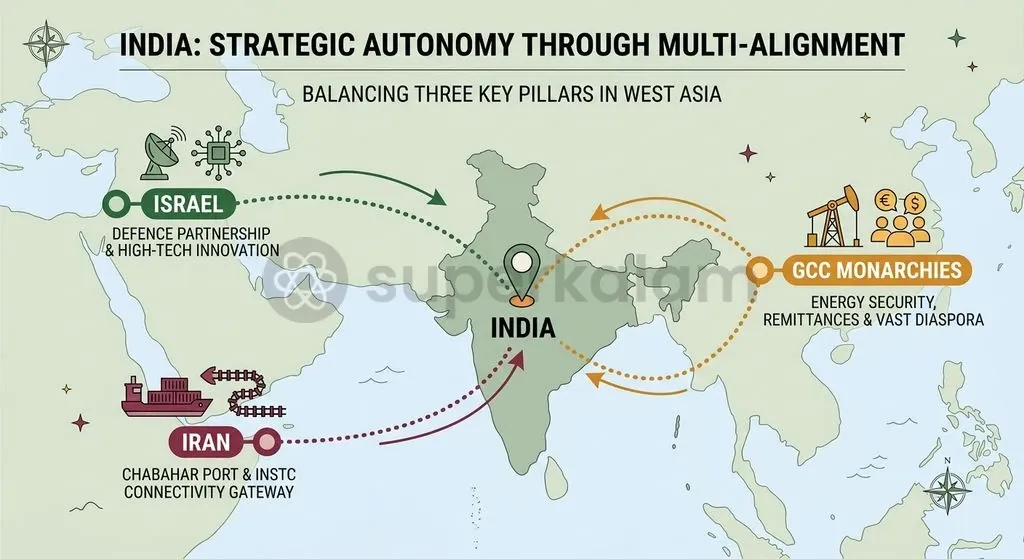
India maintains an official policy of de-hyphenation in West Asia, conducting independent bilateral ties with Israel, Gulf Arab states, and Iran simultaneously. The current escalation places structural strain on this approach, as each partner demands diplomatic alignment.
New Delhi values Israel as a primary supplier of high-technology defence equipment and agricultural innovation, while the Gulf monarchies provide essential trade, sovereign wealth investment, and employment for millions of Indian workers. Concurrently, partnership with Iran remains indispensable for northern transit and regional connectivity into Central Asia.
On 13 May 2024, India Ports Global Limited signed a 10-year long-term contract with Iran's Ports and Maritime Organization to equip and operate the Shahid Beheshti Terminal at Chabahar Port. Under this bilateral agreement, India committed $120 million in grant assistance for port infrastructure and extended a $250 million Line of Credit, taking total project support to $370 million.
Following the agreement, the US Department of State publicly cautioned that business transactions with Iranian entities carry the potential risk of sanctions. India continues to assert its strategic autonomy, preserving Chabahar as an alternative transit corridor bypassing Pakistan to access Afghanistan, Central Asia, and the broader International North-South Transport Corridor (INSTC).
| Strategic Partner | Primary Strategic Pillars | Critical Strategic Imperative |
|---|---|---|
| Israel | Defence technology, homeland security, R&D | Counter-terrorism cooperation and advanced weapon systems. |
| GCC Monarchies (UAE, Saudi) | Crude oil, LNG, trade, inward remittances | Safeguarding 8.5M diaspora and maritime commerce routes. |
| Iran | Chabahar Port, INSTC, Eurasian transit access | Connectivity to Central Asia and regional hedge. |
India exercises a calibrated voting posture in multilateral forums to reflect this diplomatic balance. On 27 October 2023, India abstained on UN General Assembly Resolution ES-10/21 because the text did not explicitly condemn the 7 October terror attacks.
Later, on 12 December 2023, India voted in favour of UN General Assembly Resolution ES-10/22, supporting an immediate humanitarian ceasefire and the unconditional release of hostages.
New Delhi consistently affirms its support for a negotiated Two-State Solution establishing a viable, independent State of Palestine living within secure borders alongside Israel. India also voted in favour of UN General Assembly resolutions condemning illegal settlement activities and renewing the operational mandate of UNRWA.
Discuss with Superkalam
Assess whether India's policy of de-hyphenation remains viable amid escalating polarisation between Israel, Iran, and the GCC.
Ask NowDomestic Stakes: Energy Security, Crude Volatility, and the Gulf Diaspora
The Strait of Hormuz represents India's most acute maritime energy vulnerability in the event of wider regional confrontation. The strait handles over 20 million barrels of crude oil daily, facilitating roughly 60% of India's crude imports and more than 70% of its Liquefied Natural Gas (LNG) supplies.
Any sustained military confrontation that closes the Strait of Hormuz would cause immediate domestic energy shortages and wide fluctuations in domestic fuel pricing.
| Strategic Domain | Core Dependency Data | Key Vulnerability |
|---|---|---|
| Crude Oil Supply | ~60% of total crude imports transit Hormuz | Price spikes and supply bottlenecks |
| Natural Gas (LNG) | >70% of LNG imports transit Hormuz | Industrial and fertiliser sector disruption |
| Expatriate Diaspora | Over 8.5 million Indian nationals in GCC | Mass evacuation logistics and physical safety |
| Remittance Inflows | GCC accounts for 38% of total inward flows | Balance of payments and household income stress |
According to the Ministry of External Affairs, over 8.5 million Indian nationals live and work across the six GCC member states, forming the largest expatriate group in the region.
The Reserve Bank of India reported that GCC nations contributed 38% of India's total inward remittances in FY2023-24, with the UAE alone accounting for 19.2% as the second-largest global remittance source. Widespread conflict across the Persian Gulf would imperil expatriate safety and disrupt critical financial flows underpinning India's external current account balance.
Strategic Way Forward: Protecting Indian Interests Amid Regional Fragmentation
India must adapt its diplomatic doctrine to manage structural fragmentation across West Asia through dynamic multi-alignment.
- Sustain Active Naval Constabulary Missions: The Indian Navy should maintain enhanced forward deployments in the Northern Arabian Sea and Gulf of Aden under Operation Sankalp to secure commercial sea lanes against piracy and asymmetric drone threats.
- Insulate Chabahar and Connectivity Assets: New Delhi must engage international partners diplomatically to safeguard the 10-year Chabahar Port contract from secondary sanctions, ensuring uninterrupted transit corridors into Central Asia.
- Institutionalise Diaspora Contingency Protocols: The Ministry of External Affairs and Ministry of Defence should maintain ready-to-deploy evacuation mechanisms and emergency coordination protocols across GCC missions, building on the operational experience of Operation Ajay.
- Balance Multilateral Economic Platforms: India must keep long-term plurilateral initiatives such as the I2U2 Group functional by focusing on non-sensitive, high-impact sectors like food security and renewable energy.
- Reaffirm Principled Multilateralism: Indian diplomacy should continue championing counter-terrorism while consistently advocating for a negotiated Two-State solution and unhindered humanitarian access.
Key Takeaways
- The West Asian security architecture is undergoing structural disruption as the 2020 Abraham Accords framework proved incapable of bypassing the core Palestinian statehood dispute.
- Houthi maritime interdictions in the Bab el-Mandeb Strait forced commercial shipping around the Cape of Good Hope, raising shipping costs for Indian exporters by 30% to 50% and increasing transit times by 10 to 14 days.
- The Indian Navy's Operation Sankalp provided essential security in the Arabian Sea and Gulf of Aden, deploying over 21 warships and escorting more than 15 lakh tons of cargo.
- India faces severe domestic vulnerabilities in energy security, as the Strait of Hormuz carries roughly 60% of its crude oil and over 70% of its LNG imports.
- Over 8.5 million Indian citizens live in GCC states, generating 38% of national inward remittances in FY2023-24, which requires balanced diplomacy across Israel, Iran, and the Arab monarchies.
- India preserves its strategic autonomy by formalising a 10-year operational contract for the Shahid Beheshti Terminal at Chabahar Port while advancing a balanced Two-State diplomatic posture at the United Nations.
Mains Question
"The structural breakdown of the post-Abraham Accords equilibrium and the disruption of maritime chokepoints have severely tested India's long-standing policy of diplomatic de-hyphenation in West Asia." Critically analyse. (15 Marks)
Evaluate NowMains Question
Highlighting the strategic importance of the 10-year agreement for the Shahid Beheshti Terminal at Chabahar Port, elucidate the challenges faced by India in operationalising its connectivity initiatives in the region. (10 Marks)
Evaluate NowPractice MCQs
QUESTION 1
With reference to the Abraham Accords signed in September 2020, consider the following statements: 1. They were brokered by the United States to establish diplomatic normalisation between Israel and several Arab nations. 2. Sudan, Morocco, Bahrain, and the United Arab Emirates were among the Arab nations involved in the normalisation. 3. The framework made diplomatic ties strictly conditional upon the immediate creation of an independent Palestinian state along 1967 borders. Which of the statements given above are correct?
QUESTION 2
Consider the following statements regarding the geopolitical and maritime developments in West Asia: 1. United Nations Security Council Resolution 2722 (2024) was passed in response to attacks against merchant shipping in the Red Sea. 2. Rerouting commercial shipping around the Cape of Good Hope adds 10 to 14 days in transit time. 3. Under expanded Operation Sankalp, the Indian Navy deployed warships to escort critical cargo and secure maritime routes. Which of the statements given above is/are correct?
QUESTION 3
Regarding the India-Middle East-Europe Economic Corridor (IMEC) and Chabahar Port, consider the following statements: 1. IMEC was launched at the New Delhi G20 Summit in September 2023 as a multimodal ship-to-rail corridor. 2. The multimodal route of IMEC connects India to Europe via Israel's Haifa Port. 3. In May 2024, India Ports Global Limited signed a 10-year contract to equip and operate the Shahid Beheshti Terminal at Chabahar Port. Which of the statements given above is/are correct?
QUESTION 4
Operation Ajay was launched by the Government of India primarily to:
QUESTION 5
Consider the following statements regarding the geopolitical dynamics in West Asia: 1. The informal network termed the 'Axis of Resistance' includes Hezbollah, Ansar Allah (Houthis), and Hamas. 2. The Strait of Hormuz handles approximately 20 million barrels of crude oil daily, carrying around 60% of Indian crude oil imports. 3. India committed a total project support of $370 million for infrastructure and credit for Iran's Chabahar Port. Which of the statements given above are correct?