US Orbital Weapons: Mission Shakti and India's Space Security
As orbital counter-space technologies evolve, India balances kinetic deterrence through Mission Shakti with resilient space domain awareness.
Sep, 2026
•8 min read

Overview
Recent international intelligence disclosures surrounding orbital counter-space capabilities mark a critical shift in modern warfare. Outer space has moved from a peaceful sanctuary into an actively contested operational theatre.
India's national security relies heavily on dual-use satellite networks for communications, maritime surveillance, and border monitoring. Orbital threats now evolve rapidly beyond terrestrial bounds. India must balance strategic deterrence with multilateral diplomacy to protect critical space assets against grey-zone aggression.
Why Orbital Weapons Disclosures Are Making Global Headlines
Intelligence disclosures regarding orbital weapons have renewed global scrutiny on the vulnerabilities of civilian and military satellite networks. Modern space-faring nations depend heavily on Low Earth Orbit platforms for daily operations.
Key functions relying directly on these low-altitude orbital platforms include:
- Early Warning Telemetry: Detecting ballistic missile launches in real time.
- Precision Targeting: Providing precise targeting data for terrestrial armed forces.
- Global Financial Data: Synchronising high-frequency financial transactions and encrypted communications.
Offensive counter-space payloads in orbit pose acute asymmetric risks. Satellites operate along predictable ballistic trajectories with minimal onboard propulsion. Terrestrial strikes remain geographically confined, but an attack in orbit creates indiscriminate kinetic hazards that threaten all orbiting spacecraft across the international community.
The United States government and international defence analysts have voiced concern over counter-space capabilities operating inside legal grey zones. As of April 2024, international monitoring reports from the Secure World Foundation show that major space powers are expanding capabilities across kinetic-physical, non-kinetic physical, electronic, and cyber domains. These rapid advancements challenge orbital stability and undermine global strategic deterrence frameworks.
Discuss with Superkalam
How does the UNIDIR definition distinguish the defensive support of space militarisation from the offensive nature of space weaponisation?
Ask NowMilitarization vs Weaponization: How Space Security Is Shifting
Space security analysis draws a sharp distinction between supportive military satellite usage and the direct deployment of destructive counter-space weapons. According to the United Nations Institute for Disarmament Research (UNIDIR) Space Security Lexicon, space militarisation means using orbital assets to support terrestrial armed forces. This covers reconnaissance, early warning, secure communications, and navigation.
Space weaponisation describes stationing offensive weapons directly in orbit or fielding ground, air, and space platforms to disable or destroy space assets. The international community has long treated militarisation as standard practice, but weaponisation fundamentally threatens outer space as a shared global commons.
| Dimension | Space Militarization | Space Weaponization |
|---|---|---|
| Core Definition | Using orbital assets to support terrestrial armed forces | Deploying offensive systems to damage, destroy, or degrade targets |
| Typical Assets | Communication, Earth-observation, and positioning satellites | Direct-ascent interceptors, co-orbital weapons, directed-energy lasers |
| Intent & Effect | Intelligence gathering, battlefield coordination, and navigation | Active kinetic destruction, electronic jamming, and cyber sabotage |
| Legal Status | Permitted under the 1967 Outer Space Treaty | Nuclear/WMD banned by Outer Space Treaty; conventional systems unregulated |
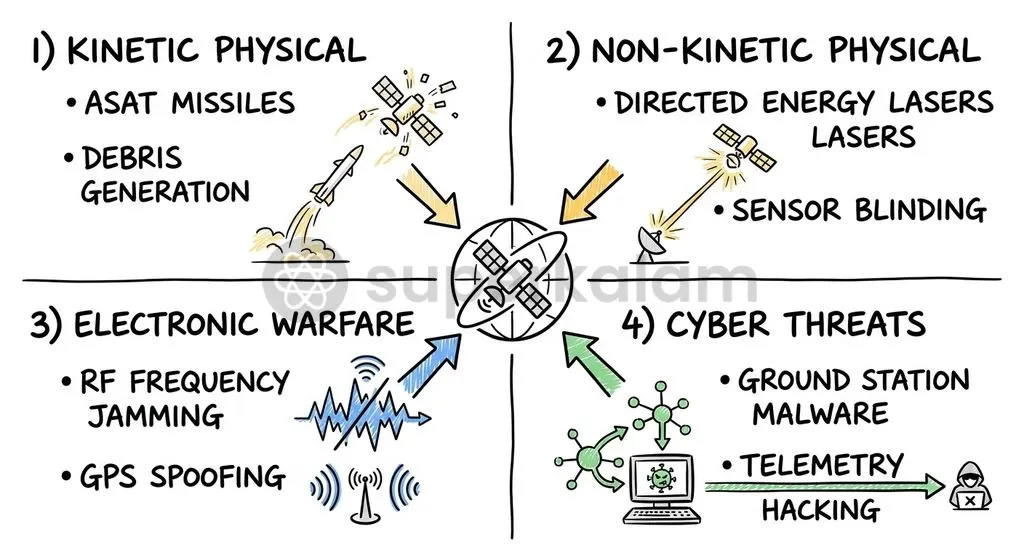
According to the Secure World Foundation, modern counter-space threats fall into four functional categories:
- Kinetic-Physical Threats: Direct-ascent anti-satellite (ASAT) missiles and co-orbital strike vehicles designed to physically collide with targets.
- Non-Kinetic Physical Threats: Ground-based or orbital high-power lasers and high-power microwave systems that blind optical sensors.
- Electronic Countermeasures: Radiofrequency jammers and spoofers that disrupt uplink and downlink communication signals.
- Cyber Warfare: Malware injections and command-link interception targeting ground station control infrastructure.
From Mission Shakti to Defence Space Agency: India's Preparedness
India demonstrated its strategic counter-space capability through Mission Shakti on 27 March 2019. According to a Press Information Bureau release, India successfully launched an indigenous anti-satellite missile that destroyed the live Microsat-R satellite in Low Earth Orbit at an altitude of approximately 283 km in a direct-ascent kinetic hit-to-kill mode.
A monograph published by the Defence Research and Development Organisation (DRDO) confirmed that the interceptor was a three-stage Prithvi Defence Vehicle Mark-II ballistic missile defence interceptor equipped with two solid rocket boosters. The low-altitude interception ensured that generated debris decayed into the atmosphere within weeks, establishing credible technological deterrence while limiting long-term orbital hazards.
Discuss with Superkalam
Analyse how the dual-use nature of modern satellites (like NavIC and GSAT-7) complicates military escalation ladders during an orbital crisis.
Ask NowFollowing the test, the Union Government restructured India's military space architecture to counter modern space threats:
- Defence Space Agency (DSA): Established in Bengaluru as a tri-service operational agency to integrate the space capabilities of the Indian Army, Indian Navy, and Indian Air Force, as detailed in Lok Sabha Unstarred Question No. 1294.
- Defence Space Research Organisation (DSRO): Created as a dedicated technical research wing under the Ministry of Defence to provide advanced scientific and R&D support for DSA operations.
- IndSpaceEx Exercise: Conducted by the Integrated Defence Staff in July 2019, this simulated space warfare exercise assessed joint operational doctrine and counter-space threat contingencies.
- Mission DefSpace: Launched in October 2022 under the Innovations for Defence Excellence (iDEX) framework, releasing 75 dedicated defence challenges across launch systems, satellite communication, and space domain awareness.
The Indian Space Policy 2023 formalised ISRO's focus on advanced research and strategic missions. Simultaneously, it empowered IN-SPACe to integrate non-government entities into commercial satellite manufacturing and launch operations.
The Governance Gap: Outer Space Treaty, PAROS, and Modern Grey Zones
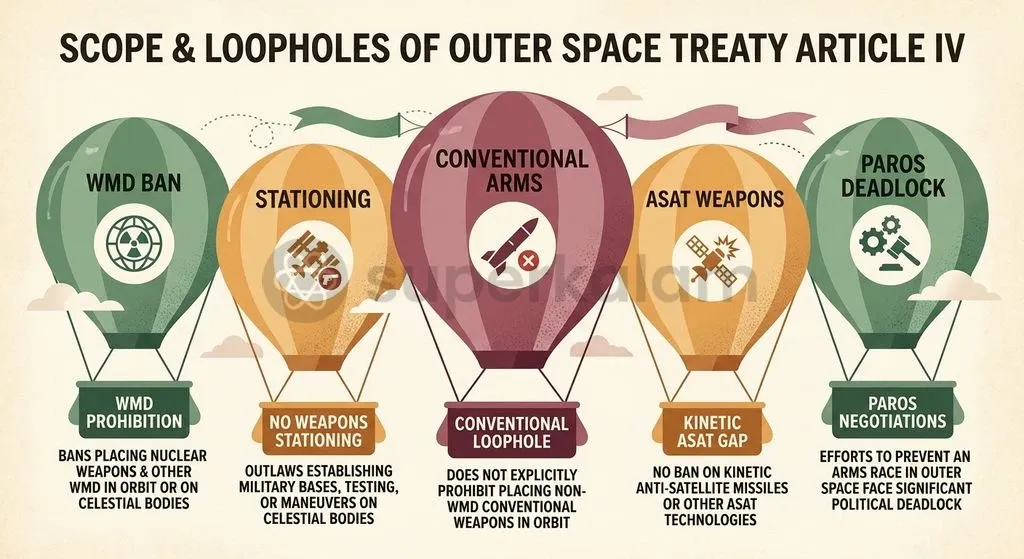
The Outer Space Treaty of 1967 remains the foundational legal instrument governing space security. Under Article IV of the treaty, states parties are prohibited from placing in orbit around the Earth any objects carrying nuclear weapons or any other kinds of weapons of mass destruction, installing such weapons on celestial bodies, or stationing them in outer space in any other manner.
However, existing international frameworks face significant structural limitations:
- Conventional Weapons Exclusion: The 1967 treaty leaves substantial regulatory loopholes, failing to prohibit conventional kinetic weapons, co-orbital interceptors, or directed-energy systems.
- Deadlocked PAROS Negotiations: Discussions on the Prevention of an Arms Race in Outer Space (PAROS) remain stalled at the UN Conference on Disarmament in Geneva over verification disputes.
- Non-Binding Test Bans: UN General Assembly Resolution 77/41 adopted on 7 December 2022 urges states not to conduct destructive direct-ascent ASAT tests, passing with 155 votes in favour, 9 against, and 9 abstentions.
- Focus on Norms: The UN Open-Ended Working Group (OEWG) established under Resolution 76/231 seeks responsible behavioural norms to regulate proximity operations and reduce accidental escalation risks.
Discuss with Superkalam
Weigh the effectiveness of non-binding behavioural norms (such as UNGA Resolution 77/41) against a binding treaty like PAROS in preventing an orbital arms race.
Ask NowStrategic Risks: Space Debris, Escalation Ladders, and Dual-Use Assets
Orbital weapon systems create severe risks of unintended military escalation and environmental destruction in Low Earth Orbit. The primary technical danger is the Kessler Syndrome, a dynamic scenario formulated by NASA scientist Donald Kessler. Under this model, the density of objects in Low Earth Orbit reaches a critical threshold where collisions cause a cascading generation of debris fragments, rendering orbital bands unusable for generations.
Kinetic counter-space engagements produce untrackable hypervelocity fragments that threaten civil and scientific satellites indiscriminately. Because civilian and military functions share orbital bands and frequency spectra, an attack against a dual-use asset can trigger unintended military responses across terrestrial domains.
India operates critical multi-mission space platforms across Low Earth Orbit, Medium Earth Orbit, and Geostationary Orbit. According to the ISRO Annual Report on Space Applications, these assets include:
- NavIC (Navigation with Indian Constellation): Dedicated regional satellite positioning infrastructure vital for military navigation and civilian transport.
- GSAT-7 Series: Specialised naval, air, and ground-force communication satellites that secure tactical command links.
- Cartosat and RISAT Series: High-resolution optical and synthetic aperture radar Earth-observation platforms used for border surveillance and disaster monitoring.
The lack of established escalation thresholds for non-kinetic attacks, such as cyber jamming or ground-based laser dazzling, leaves critical infrastructure vulnerable to grey-zone coercion without clear triggers for retaliation.
Discuss with Superkalam
Propose three institutional and technical measures India could integrate into its Space Situational Awareness framework to safeguard civilian satellites from grey-zone electronic and cyber counter-space threats.
Ask NowWay Forward: Building Deterrence, SSA, and Rules-Based Space Order
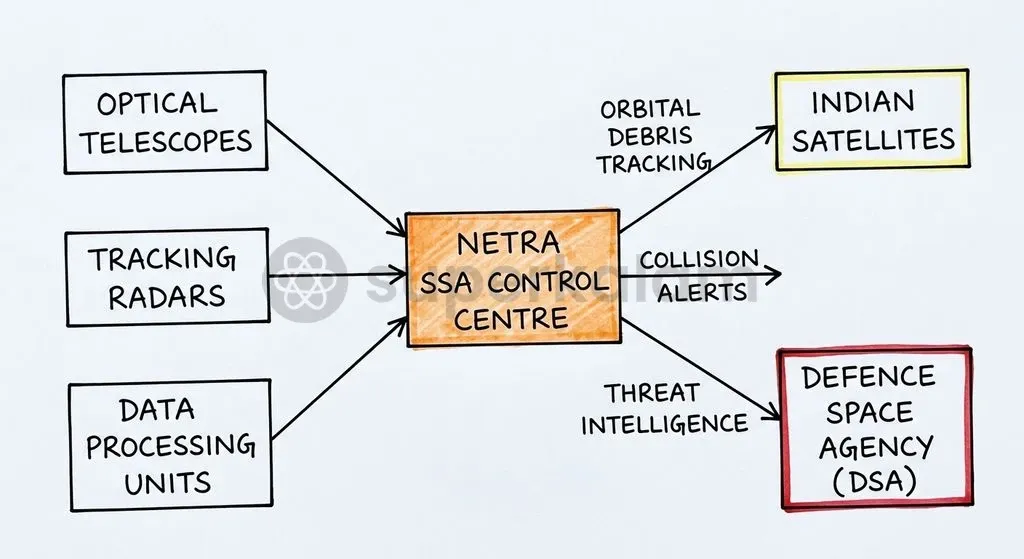
India must pursue a coherent strategy combining defensive resilience, indigenous tracking infrastructure, and proactive multilateral diplomacy. The foundation of modern space defence requires comprehensive Space Situational Awareness to detect, track, and attribute hostile orbital movements in real time.
ISRO established Project NETRA (Network for Space Object Tracking and Analysis) to build a network of high-precision tracking radars, optical telescopes, and data processing centres capable of tracking space debris down to 10 cm in size up to an altitude of 3,400 km. In July 2022, the Ministry of Science and Technology inaugurated the System for Safe and Sustainable Space Operations Management (IS4OM) in Bengaluru to safeguard active Indian satellites against orbital collision hazards.
India's strategic roadmap for outer space security should focus on three operational priorities:
- Developing Resilient Distributed Constellations: Transitioning from large, vulnerable single-point satellites to distributed networks of small satellites ensures graceful degradation and operational continuity during hostile jamming or kinetic strikes.
- Expanding Space Domain Awareness Partnerships: Combining ISRO's Project NETRA sensors with international tracking networks enhances real-time threat attribution and reduces the risk of false alarms.
- Leading Norm-Building in Multilateral Fora: India should actively participate in UN Open-Ended Working Groups to establish transparent operational norms and responsible behaviour guidelines, preventing space from becoming an unregulated battlefield.
Key Takeaways
- Militarization vs Weaponization: Space militarization involves using orbital infrastructure to support terrestrial defence, whereas space weaponization entails deploying offensive systems to degrade or destroy space and ground targets.
- Mission Shakti Demonstration: Conducted on 27 March 2019, Mission Shakti proved India's direct-ascent kinetic ASAT capability at 283 km altitude using a DRDO-developed three-stage PDV Mk-II interceptor.
- Tri-Service Integration: India established the Defence Space Agency (DSA) in Bengaluru and the Defence Space Research Organisation (DSRO) to institutionalise joint space defence doctrine and R&D.
- Legal and Governance Loopholes: Article IV of the 1967 Outer Space Treaty prohibits weapons of mass destruction in orbit but leaves conventional kinetic and electronic counter-space weapons entirely unregulated.
- Environmental and Strategic Stability: Kinetic ASAT weapons increase the risk of the Kessler Syndrome in Low Earth Orbit, necessitating resilient distributed architectures and advanced Space Situational Awareness through ISRO's Project NETRA and IS4OM.
Mains Question
"While Article IV of the Outer Space Treaty of 1967 bans weapons of mass destruction in orbit, it leaves conventional counter-space systems, co-orbital interceptors, and directed-energy weapons in an unregulated legal grey zone." Critically analyse the structural limitations of contemporary international space governance in addressing modern orbital warfare. (15 Marks)
Evaluate NowMains Question
In light of evolving counter-space threats, evaluate the institutional and technological measures undertaken by India to build strategic deterrence and enhance Space Situational Awareness. (10 Marks)
Evaluate NowPractice MCQs
QUESTION 1
With reference to the Outer Space Treaty of 1967 and international space governance, consider the following statements:
- Article IV of the Outer Space Treaty prohibits the placement of nuclear weapons and weapons of mass destruction in Earth's orbit.
- The Outer Space Treaty explicitly prohibits the deployment of ground-based directed-energy laser systems and conventional kinetic anti-satellite interceptors.
- UN General Assembly Resolution 77/41 is a legally binding treaty that mandates the immediate dismantling of all direct-ascent anti-satellite capabilities. Which of the statements given above is/are correct?
QUESTION 2
Consider the following statements regarding India's counter-space test 'Mission Shakti':
- The test targeted the Microsat-R satellite in Low Earth Orbit at an altitude of approximately 283 km.
- The interception was executed using a three-stage Prithvi Defence Vehicle Mark-II interceptor equipped with two solid rocket boosters.
- The high-altitude interception was specifically designed to keep orbital debris suspended in orbit for several decades to establish persistent deterrence. Which of the statements given above are correct?
QUESTION 3
With reference to space security terminology and counter-space categories defined by international research bodies, consider the following statements:
- According to the UNIDIR Space Security Lexicon, space militarisation refers to the use of orbital assets to support terrestrial armed forces for reconnaissance, navigation, and communications.
- Space weaponisation entails placing offensive weapons directly in orbit or fielding platforms to disable or destroy space assets.
- Non-kinetic physical threats include radiofrequency jammers and cyber malware injections aimed at ground control stations. Which of the statements given above is/are correct?
QUESTION 4
Consider the following statements regarding India's institutional and technical space defence initiatives:
- The Defence Space Agency (DSA) is established in Bengaluru as a tri-service operational agency integrating the Army, Navy, and Air Force.
- The Defence Space Research Organisation (DSRO) provides dedicated scientific research and development support to the DSA under the Ministry of Defence.
- ISRO's Project NETRA is designed to track space debris down to 10 cm in size up to an altitude of 3,400 km. Which of the statements given above are correct?
QUESTION 5
Which of the following phenomena describes a scenario where the density of objects in Low Earth Orbit reaches a critical threshold such that collisions trigger a self-sustaining cascade of debris fragments, rendering orbital bands unusable?