Tiger Cat Reclassification: Five New Leopardus Species Explained
Taxonomic split of the Neotropical tiger cat into five Leopardus species uncovers hidden extinction risks, with biodiversity lessons for global and Indian wildlife policy.
Sep, 2026
•8 min read
Overview
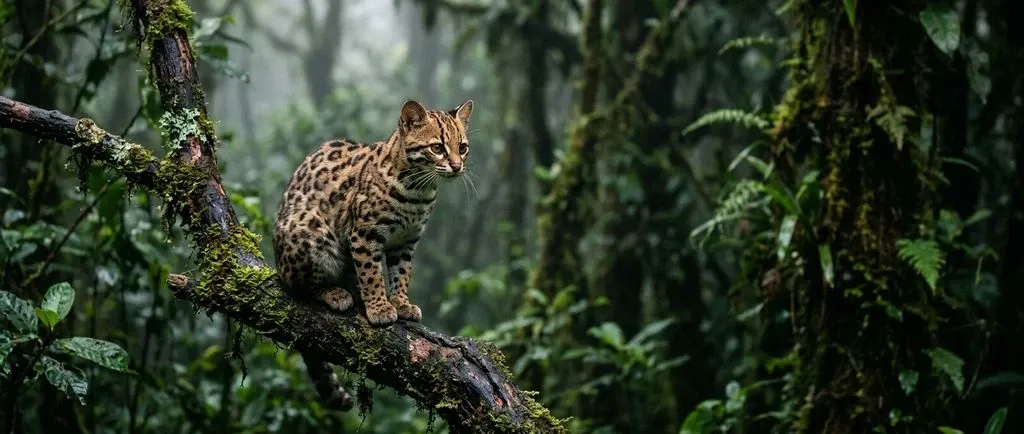
Genomic research has resolved the Neotropical tiger cat complex into five distinct living felids. This discovery reveals that cryptic biodiversity often masks severe extinction risks across isolated South American biomes. As of September 2026, the formal identification of Leopardus tilcayo in the Bolivian Yungas alongside the elevation of Leopardus pardinoides breaks apart the formerly wide-ranging Leopardus tigrinus taxon.
This revision carries serious ramifications for conservation biology and environmental governance. When a single widespread species is divided into smaller populations, each new taxon inherits an acutely elevated threat profile under international criteria. Recognising these discrete lineages compels conservation agencies to shift away from broad macro-regional policies toward habitat-specific interventions.
Why in the News: The Taxonomic Revision of Tiger Cats
Phylogenomic assessments in Current Biology have formally identified and named a novel wild cat species: Leopardus tilcayo (the tilcayo cat), native to the Yungas cloud forests of Bolivia. As of September 2026, this breakthrough builds on earlier genetic work that resolved the historically contentious Leopardus tigrinus complex into distinct lineages.
A central thesis emerges from this scientific advance. Taxonomic splitting reveals that seemingly secure, widespread generalist species often mask fragile, range-restricted populations undergoing severe habitat contraction. By redefining the genetic architecture of Neotropical felids, researchers proved that localised populations face far higher ecological risks than previously recognised under aggregate listings.
Discuss with Superkalam
Recall the five distinct species that now make up the revised Neotropical tiger cat (*Leopardus*) group and their specific habitats.
Ask NowBackground: Who Are the Small Neotropical Tiger Cats?
Small Neotropical wild cats within the genus Leopardus represent an evolutionarily diverse group of carnivores occupying ecological niches across Central and South America. Historically, naturalists grouped these spotted felids under broad designations like the oncilla or northern tiger cat (Leopardus tigrinus). They presumed them to be a single morphological group distributed across diverse biomes.
Several factors historically hindered accurate classification across their range:
- Cryptic behaviour: Nocturnal activity and subtle coat patterns caused frequent misidentifications during field surveys.
- Morphological overlap: Field observations and museum collections struggled to distinguish phenotypic variation from true evolutionary separation.
- Aggregated status: Prior to recent molecular breakthroughs, the International Union for Conservation of Nature (IUCN) Red List evaluated Leopardus tigrinus and the previously separated southern tiger cat (Leopardus guttulus) as Vulnerable with decreasing population trends.
What Changed: From a Single Species Complex to Distinct Taxa
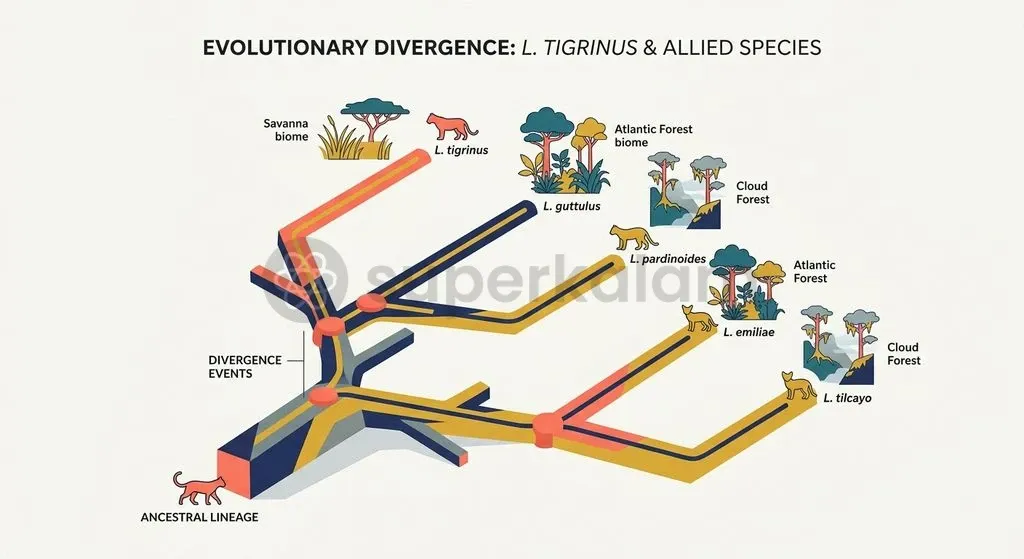
Modern phylogenomics has dismantled the single-species assumption by resolving the tiger cat group into five discrete species. The historical baseline began to fracture when field studies demonstrated reproductive isolation and genetic divergence among geographic populations.
The progression toward the current five-species model developed across four key research milestones:
- Recognition of Southern Lineages: Initial molecular splits isolated Leopardus guttulus in the Atlantic Forest as distinct from northern populations.
- Elevation of the Clouded Tiger Cat: A 2024 study published in Scientific Reports elevated Leopardus pardinoides to a distinct species restricted to high-altitude cloud forests.
- Identification of Eastern and Subspecies Lineages: The recognition of the eastern tiger cat (Leopardus emiliae) and the description of Leopardus tigrinus antisuyo in Peru's Yungas clarified regional evolutionary divergence.
- Discovery of the Tilcayo Cat: Genomic mapping published in Current Biology established Leopardus tilcayo as a discrete species endemic to Bolivia.
Discuss with Superkalam
Explain how cryptic morphology and nocturnal behavior historically masked evolutionary divergence in small wild felids.
Ask NowUnderstanding Leopardus tilcayo and the Redefined Tiger Cat Group
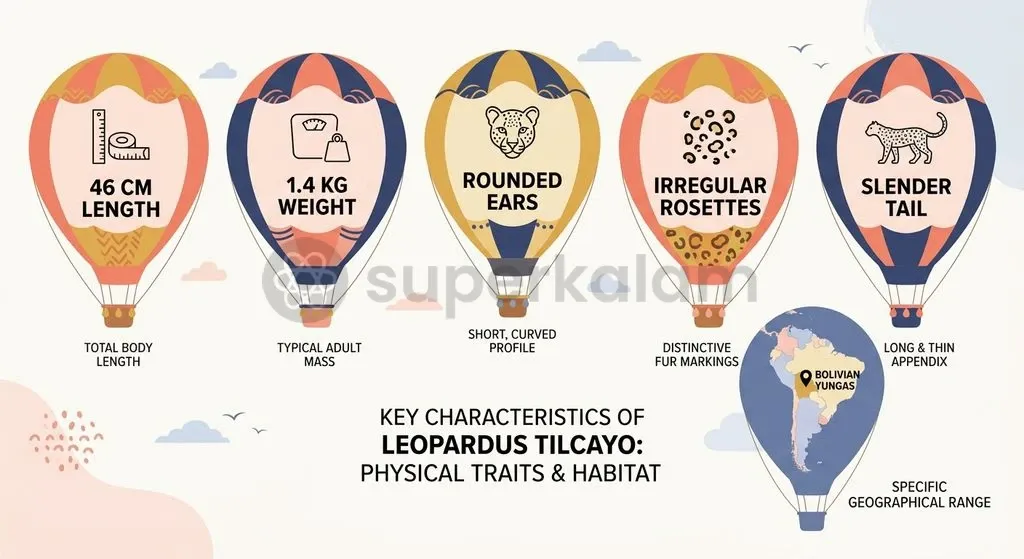
Phylogenomic dating indicates that Leopardus tilcayo diverged from ancestral lineages approximately 1.4 million years ago. This timeline establishes it as an ancient, distinct evolutionary offshoot. Morphologically, L. tilcayo ranks among the smallest wild felids on Earth, measuring approximately 46 centimetres in body length and weighing around 1.4 kilograms.
The species exhibits distinct traits, including light brown fur, irregularly shaped rosettes, rounded ears, and a noticeably slender tail compared to northern tiger cat taxa. The recognised tiger cat complex now spans five distinct species across specialised American biomes:
- Savanna Tiger Cat (Leopardus tigrinus): Inhabits savannas and dry forest formations.
- Atlantic Forest Tiger Cat (Leopardus guttulus): Confined primarily to the heavily altered Atlantic Forest biome.
- Clouded Tiger Cat (Leopardus pardinoides): Restricted to montane cloud forest environments across Central and South America.
- Eastern Tiger Cat (Leopardus emiliae): Occupies distinct semi-arid and tropical tracts in eastern South America.
- Tilcayo Cat (Leopardus tilcayo): Endemic to the specialised Yungas cloud forests of Bolivia.
Comparison: Old vs Updated Classification of the Leopardus tigrinus Group
Taxonomic revisions fundamentally alter how wildlife authorities delineate boundaries, count individuals, and allocate spatial protections.
| Dimension | Historical Baseline (Pre-2024) | Modern Revised Framework (As of 2026) |
|---|---|---|
| Recognised Species | Aggregated primarily under L. tigrinus and L. guttulus | Resolved into 5 distinct species: L. tigrinus, L. guttulus, L. pardinoides, L. emiliae, and L. tilcayo |
| Geographic Scope | Treated as broad, continuous ranges across South and Central America | Fragmented into specialized biomes (e.g., Bolivian Yungas, Atlantic Forest, Savannas) |
| Novel Endemic Taxa | Subsumed within northern clades as regional variants | L. tilcayo identified as an ancient lineage separated by 1.4 million years |
| Subspecies Delineation | Poorly defined regional races | Refined clades including L. tigrinus antisuyo in Peru's Yungas |
| Threat Distribution | Diluted across widespread geographical ranges | Concentrated into smaller, highly vulnerable endemic populations |
Discuss with Superkalam
Analyze why dividing an aggregate species into multiple distinct taxa directly alters its threat status under IUCN Red List criteria.
Ask NowEcological Threats: Habitat Loss, Fragmentation, and Extinction Risks
Ecological niche modelling demonstrates that tiger cat taxa have suffered historical geographic range contractions between 50.4% and 68.2% across their ranges. This spatial shrinkage leaves fragmented populations isolated within micro-habitats. Consequently, these groups become exceptionally susceptible to environmental stochasticity and localised human pressures.
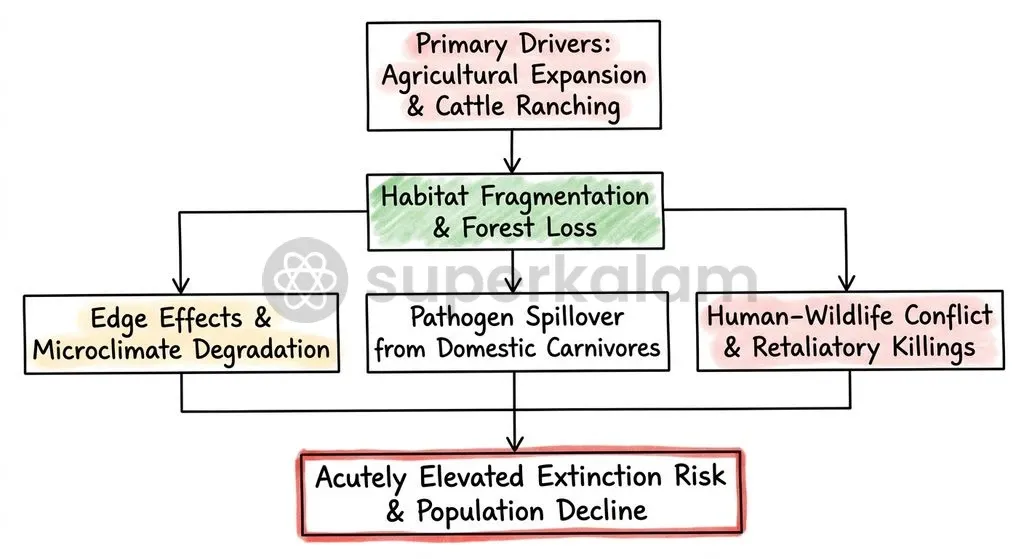
Habitat destruction driven by agricultural expansion and cattle ranching is the leading cause of population decline across the Andes, Yungas, and Atlantic Forest biomes. Deforestation destroys critical canopy cover and disrupts prey base abundance. It also breaks the ecological corridors that maintain gene flow between subpopulations.
Anthropogenic encroachment exposes wild felids to severe secondary threats:
- Pathogen Transmission: Encroaching domestic carnivores expose tiger cats to lethal infectious diseases, including canine distemper, feline panleukopenia, and toxoplasmosis.
- Human-Wildlife Conflict: Expanding rural settlements trigger retaliatory killings of small cats over alleged poultry predation.
- Illegal Exploitation: Despite protection against international commercial trade under CITES Appendix I, small cats face persistent risks from illegal pet trade trafficking and retaliatory snaring.
Conservation Implications and Lessons for Global and Indian Wildlife Policy
Splitting a widespread cryptic species into multiple taxa directly escalates individual extinction risk under IUCN Red List criteria. When a population of tens of thousands is divided into five separate species, each resulting taxon holds only a fraction of the total count.
This dynamic holds direct lessons for biodiversity governance across several key dimensions:
- Elevated Extinction Categories: Dividing aggregate counts frequently triggers uplisting to Endangered or Critically Endangered status based on restricted range sizes and small population thresholds.
- Administrative Pressures in India: Indian small felids like the leopard cat (Prionailurus bengalensis) and rusty-spotted cat (Prionailurus rubiginosus) occupy fragmented ecosystems across the Western Ghats, Eastern Ghats, and Sub-Himalayan belt. Genomic splits here would cause immediate administrative and budgetary strain.
- Statutory and Funding Realignment: India's species recovery mechanisms under the Integrated Development of Wildlife Habitats scheme historically prioritise charismatic megafauna like the tiger (Panthera tigris) and Asiatic lion (Panthera leo persica). A proliferation of micro-endemics would demand swift reassessments of Schedule I listings under the Wild Life (Protection) Act, 1972 alongside targeted funding in production forests.
Discuss with Superkalam
Evaluate the administrative and policy challenges wildlife authorities face when shifting from macro-regional protections to habitat-specific recovery plans.
Ask NowWay Forward for Small Felid Conservation
Conserving newly delineated small felids requires aligning statutory protections with updated genomic taxonomies. Wildlife authorities must accelerate formal reassessments under the IUCN Red List to reflect reduced ranges and heightened extinction risks. National governments must subsequently update domestic wildlife statutes so that new taxonomic names receive full legal protection.
Landscape-level connectivity must take priority over isolated reserve management. Because species like Leopardus tilcayo and Leopardus pardinoides rely on montane cloud forests, transboundary conservation corridors across the Andean and Yungas regions are vital. Key field interventions include:
- Poultry Protection: Integrating community-based coop improvements to minimise retaliatory killings.
- Vaccination Buffers: Expanding domestic animal immunisation to curtail fatal pathogen transmission.
- Corridor Enforcement: Strengthening anti-poaching measures and protecting continuous forest canopies across national borders.
Key Takeaways
- Five Distinct Species: Whole-genome sequencing resolved the Leopardus tigrinus species complex into five distinct species, including the newly named Leopardus tilcayo in Bolivia.
- Ancient Evolutionary Divergence: Phylogenomic dating shows Leopardus tilcayo diverged approximately 1.4 million years ago, possessing unique traits like rounded ears, light brown pelage, and small body dimensions.
- Range Contractions: Ecological niche modelling indicates historical habitat losses between 50.4% and 68.2% across the tiger cat complex.
- Heightened Extinction Risk: Splitting cryptic species complexes divides aggregate numbers into smaller populations, sharply escalating individual extinction risks under IUCN Red List criteria.
- Conservation Trade Protection: While all tiger cats remain protected against commercial international trade under CITES Appendix I, local threats like agricultural deforestation, disease spillover from domestic animals, and retaliatory hunting persist.
Mains Question
"Taxonomic splitting reveals that seemingly secure, widespread generalist species often mask fragile, range-restricted populations undergoing severe habitat contraction." Elucidate this statement in the context of recent genomic discoveries in small felid conservation. (10 Marks)
Evaluate NowMains Question
Ecological niche modeling indicates that small carnivores face severe spatial contractions and secondary anthropogenic pressures. Critically analyse how cryptic biodiversity reassessments impact international conservation listings and national wildlife governance frameworks. (15 Marks)
Evaluate NowPractice MCQs
QUESTION 1
With reference to the newly classified tiger cat species, consider the following pairs:
- Leopardus tilcayo : Yungas cloud forests of Bolivia
- Leopardus guttulus : Atlantic Forest
- Leopardus pardinoides : High-altitude montane cloud forests
- Leopardus tigrinus : Endemic exclusively to Peru's Yungas
How many of the above pairs are correctly matched?
QUESTION 2
Consider the following statements regarding the taxonomic revision of the Neotropical tiger cat (Leopardus) complex:
- Genomic mapping revealed that Leopardus tilcayo diverged from ancestral lineages approximately 1.4 million years ago.
- The reclassification splits a formerly aggregate taxon into five distinct living species across specialized American biomes.
- Splitting aggregate cryptic populations into distinct species generally reduces their individual extinction risk profiles under IUCN Red List criteria.
Which of the statements given above are correct?
QUESTION 3
Consider the following statements regarding threats faced by small Neotropical felids:
- Encroaching domestic carnivores expose wild tiger cats to pathogens such as canine distemper, feline panleukopenia, and toxoplasmosis.
- Small Neotropical cats are entirely excluded from international trade protections under CITES.
- Historical geographic range contractions for tiger cat taxa have been estimated between 50.4% and 68.2% across their ranges.
Which of the statements given above is/are correct?
QUESTION 4
Which of the following physical characteristics accurately describes the newly identified Tilcayo cat (Leopardus tilcayo)?
QUESTION 5
Consider the following statements regarding the historical classification and conservation challenges of the Leopardus tigrinus complex:
- Cryptic nocturnal behaviour and subtle phenotypic variations historically hindered the accurate taxonomic identification of small Neotropical cats.
- Prior to molecular breakthroughs, the IUCN Red List evaluated Leopardus tigrinus as a single secure species of 'Least Concern' with expanding populations.
- Dividing aggregate widespread populations compels conservation planning to shift toward habitat-specific interventions.
Which of the statements given above is/are correct?