Thorium-229 Nuclear Clocks vs Atomic Clocks: Precision Timekeeping Explained
By probing shielded atomic nuclei rather than fragile electron shells, Thorium-229 timekeepers could transform satellite navigation and relativistic geodesy.
Oct, 2026
•9 min read
Overview
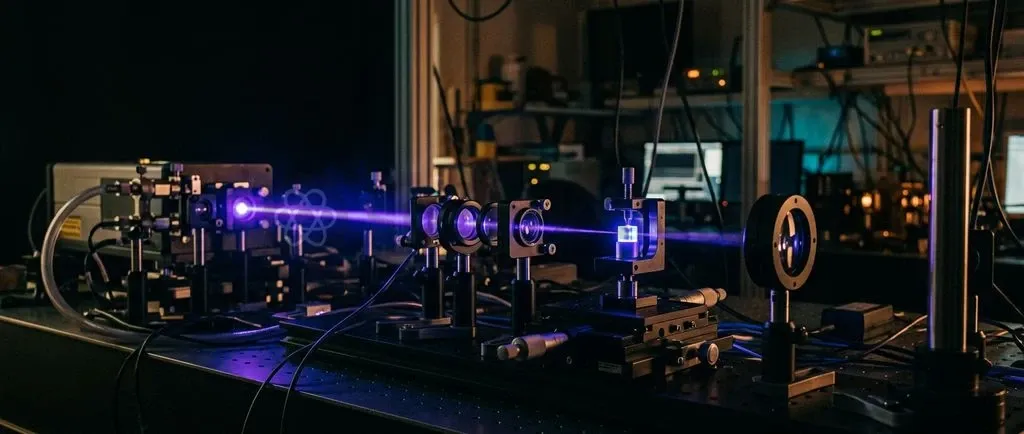
A nuclear clock relies on laser-driven transitions within an atomic nucleus rather than outer electron orbits. By harnessing the uniquely low-energy isomeric state of Thorium-229, the system gains natural resilience against external electromagnetic interference.
Traditional atomic clocks probe electron transitions that stay vulnerable to stray thermal radiation and electromagnetic noise. In contrast, probing nucleons inside a core roughly 100,000 times smaller than an electron cloud provides natural physical shielding.
Independent research teams have demonstrated active continuous-wave laser locking to Thorium-229 embedded in solid-state crystals. This milestone paves the way for drift-resistant navigation architectures in satellite networks like India's NavIC, millimetre-level relativistic geodesy, and lab searches for dark matter.
Why in the News: The Leap from Atomic to Nuclear Precision
Physicists achieved the first operating Thorium-229 nuclear clocks in October 2026. The milestone marks a clean departure from electronic timekeeping. Two independent research teams led by TU Wien with the Physikalisch-Technische Bundesanstalt (PTB) and Tsinghua University reported the breakthrough in Nature.
As of October 2026, these devices prove that active frequency stabilisation to an atomic nucleus works in practice rather than just theory. The advance built on two sequential breakthroughs:
- September 2024 frequency bridge: JILA and National Institute of Standards and Technology (NIST) researchers linked a Thorium-229 transition to a Strontium-87 optical lattice clock.
- October 2026 active locking: The European and Chinese teams demonstrated direct laser locking to Thorium-229 in crystals, delivering operational nuclear clocks.
This platform allows modern physics to test whether fundamental physical constants shift over cosmological epochs.
Discuss with Superkalam
Recall the exact frequency defined by BIPM for the Caesium-133 ground-state hyperfine transition that establishes the SI second.
Ask NowHow Atomic Clocks Measure Time: The Caesium Standard
The International System of Units (SI) defines the second by pinning it to the intrinsic resonance frequency of Caesium-133. Under standards set by the Bureau International des Poids et Mesures (BIPM), the unperturbed ground-state hyperfine transition of Caesium-133 is exactly 9,192,631,770 Hz.
Atomic clocks measure time by matching an external oscillator to the electromagnetic transitions of outer orbital electrons. The basic operating cycle runs through three distinct stages:
- Atomic isolation: Caesium atoms are vaporised and isolated within a vacuum chamber, shielded from outside magnetic and thermal disturbances.
- Microwave interrogation: A quartz-driven microwave oscillator bombards the Caesium atoms with radiation near their resonance frequency.
- Feedback locking: Detectors monitor how many atoms flip their quantum spin state; electronic feedback circuits then steer the microwave frequency to maximise this transition rate, locking the clock's tick rate to an invariant natural constant.
Optical atomic clocks based on elements like Strontium-87 probe transitions in the hundreds of terahertz. They reach fractional frequency uncertainties down to the 10⁻¹⁸ level. Yet optical clocks still depend on delicate atomic vapour traps and vacuum enclosures vulnerable to stray environmental noise.
What Is a Nuclear Clock and How Does Thorium-229 Work?
A nuclear clock keeps time by driving quantum transitions between nucleons inside an atomic nucleus. In almost all nuclei, rearranging protons and neutrons requires massive energy inputs in the kilo-electronvolt or mega-electronvolt range, accessible only via destructive gamma radiation.
Thorium-229 is the solitary exception in the table of nuclides:
- Ultralow excitation threshold: Its first nuclear isomeric state sits between 8.338 and 8.4 electronvolts above ground state.
- Laser accessibility: This gap corresponds to a vacuum ultraviolet (VUV) wavelength of approximately 148 nanometres, reachable with solid-state laser frequency conversion.
- Solid-state integration: Ions can be embedded directly into transparent calcium fluoride (CaF₂) host crystals, creating dense quantum emitters without complex vacuum traps.
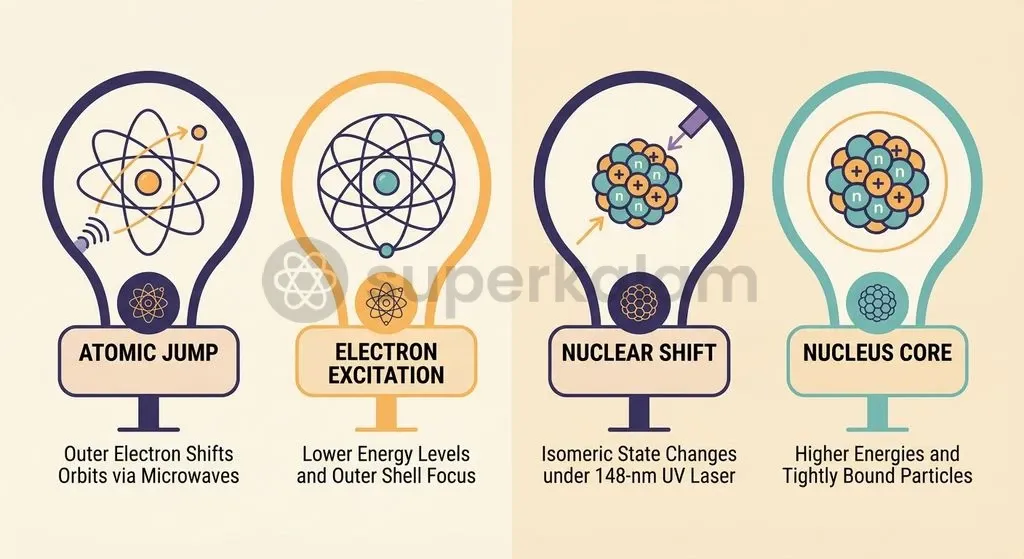
Because atomic nuclei are approximately 100,000 times smaller than electron clouds, the nuclear transitions within Thorium-229 remain heavily shielded by surrounding electron shells against stray electromagnetic fields and blackbody thermal radiation.
Atomic Clocks vs Nuclear Clocks: Key Differences Explained
The structural differences between atomic and nuclear clocks stem directly from whether the quantum interrogation occurs in the outer electron cloud or within the atomic core. Traditional atomic clocks interrogate diffuse electron orbits that deform easily under external physical stress. In contrast, nuclear clocks isolate the timekeeping mechanism inside the strong force regime of the nucleus.
The table below contrasts standard atomic frequency standards with emerging Thorium-229 nuclear clocks:
| Dimension | Standard Atomic Clocks (Caesium-133 / Strontium-87) | Solid-State Nuclear Clocks (Thorium-229) |
|---|---|---|
| Interrogated Quantum Region | Outer electron shells (hyperfine or optical orbital transitions) | Atomic nucleus (isomeric nucleon transition) |
| Driving Radiation | Microwaves (9.19 GHz for Caesium) or visible optical lasers (Strontium) | Vacuum ultraviolet (VUV) laser (~148 nm / ~8.338 eV) |
| Host Medium | Gaseous atomic vapour in high-vacuum chambers | Transparent solid crystals (e.g., CaF₂) or isolated ions |
| Vulnerability to Stray Fields | High sensitivity to magnetic noise and blackbody radiation | Low sensitivity; nucleus is ~100,000 times smaller than the electron cloud |
| Current Performance Status | Fractional frequency uncertainty at 10⁻¹⁸ level | Early working demonstrators with lower short-term stability than optical clocks |
| Theoretical Ultimate Limit | Approaching physical limits imposed by environmental shifts | Theoretical projections indicate potential uncertainty near 10⁻¹⁸ |
Discuss with Superkalam
Explain why embedding Thorium-229 into solid calcium fluoride crystals eliminates the need for bulky vacuum traps required by optical clocks.
Ask NowThe European team demonstrated continuous-wave laser stabilisation to the 148-nm nuclear transition within a room-temperature CaF₂ crystal. They validated the solid-state architecture through direct comparison against an optical atomic reference. This test confirms that solid-state nuclear devices can operate without cryogenic cooling or the large magnetic enclosures required by optical atomic clocks.
Why Scientists Are Excited: From Dark Matter to Fundamental Physics
The Thorium-229 nuclear transition provides an ultra-sensitive testing ground for investigating hypothetical shifts in fundamental physical constants. The nuclear resonance energy results from a near-cancellation between the strong nuclear force and electromagnetic repulsion inside the nucleus.
This balance makes the transition frequency 10,000 to 100,000 times more sensitive to potential temporal variations in the fine-structure constant (alpha) than electronic atomic transitions.
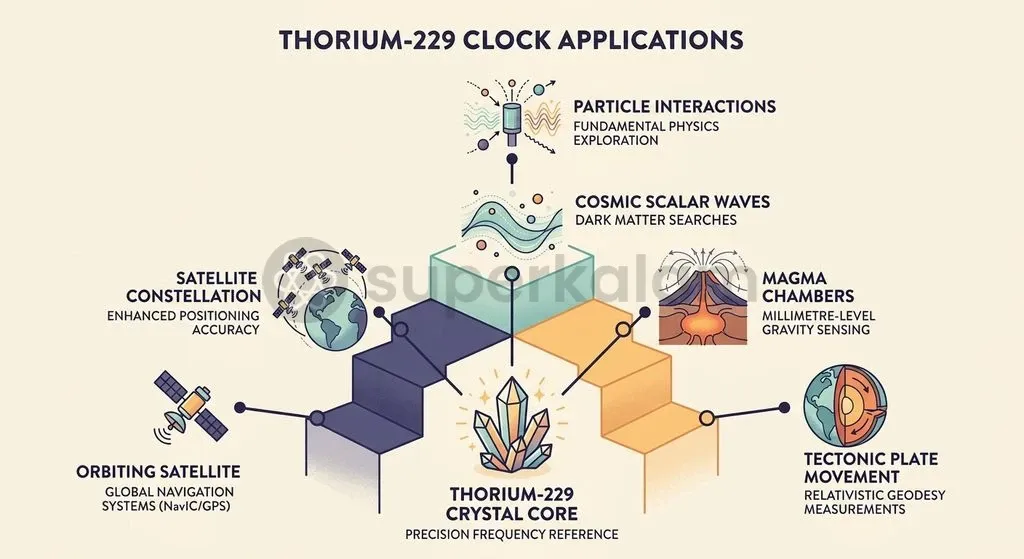
Physicists plan to harness this sensitivity across three primary domains:
- Searching for ultralight dark matter: Oscillating scalar fields or axion-like particles would induce periodic shifts in fundamental coupling constants. Comparing a Thorium-229 clock with a Strontium-87 standard sets tight experimental constraints on these couplings.
- Testing constant stability: Tracking frequency ratios over years tests whether fundamental constants drift across cosmological time.
- Relativistic geodesy: General Relativity dictates that clocks tick slower in deeper gravitational wells, an effect known as gravitational redshift. Reaching extreme fractional stability allows clocks to measure millimetre-scale elevation shifts, tracking magma movement and tectonic strain.
Discuss with Superkalam
Calculate how a 10-nanosecond clock drift on a spaceborne navigation satellite would affect ground positional accuracy.
Ask Now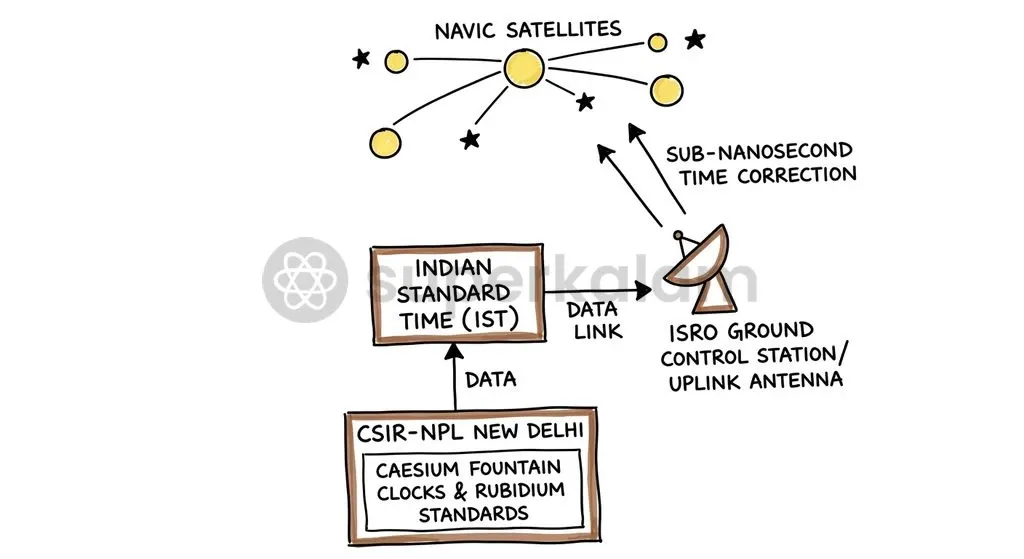
National metrological sovereignty is anchored by the CSIR-National Physical Laboratory (CSIR-NPL) in New Delhi. CSIR-NPL maintains Indian Standard Time (IST) using an ensemble of primary caesium fountain and rubidium atomic clocks.
International timekeeping is already preparing for a major baseline transition:
- Redefining the second: The International Committee for Weights and Measures (CIPM) plans to redefine the SI second around optical transitions instead of caesium microwaves as early as 2030.
- Preventing technological lock-in: Mastering nuclear clock technologies ensures India avoids external hardware dependencies as global metrology moves to higher frequencies.
- Core competencies: Building sovereign capabilities in solid-state vacuum ultraviolet laser systems, frequency combs, and precision crystal doping will keep national critical infrastructure resilient against satellite outages and geopolitical stress.
Discuss with Superkalam
Analyse the physical reasons why nuclear transitions are significantly more resistant to stray electromagnetic fields than electronic transitions.
Ask NowRoadblocks Ahead: Engineering Challenges in Building Practical Devices
Significant technical bottlenecks prevent Thorium-229 clocks from immediately replacing commercial and military atomic standards. Although the first working demonstrators achieved active feedback control, their present frequency instability remains several orders of magnitude above state-of-the-art laboratory optical lattice atomic clocks.
Key engineering hurdles currently include:
- Laser source reliability: Solid-state continuous-wave lasers operating reliably at 148 nm require specialised optical frequency conversion stages that suffer from low power efficiency and rapid degradation.
- Crystal lattice perturbations: Embedding Thorium-229 into solid CaF₂ crystals induces small crystal-field shifts and temperature-dependent lattice distortions that can perturb the nuclear transition frequency.
- Thorium isotope synthesis: Thorium-229 is an artificial, radioactive isotope with a half-life of roughly 7,917 years, requiring dedicated nuclear reactor synthesis and meticulous radiochemical purification.
- Theoretical limits vs practical designs: While theoretical projections indicate optimised single-ion or solid-state nuclear clocks could attain uncertainties reaching the 10⁻¹⁸ level, physical prototypes must first solve baseline laser noise and optical loss.
Engineers must refine crystal manufacturing and develop durable VUV laser diodes. Only then can nuclear clocks transition from specialised optical physics laboratories into operational field environments.
Key Takeaways
- The SI second is currently defined by pinning the unperturbed ground-state hyperfine transition of Caesium-133 to exactly 9,192,631,770 Hz.
- Nuclear clocks probe energy state transitions between nucleons inside the atomic nucleus rather than transitions across fragile outer electron shells.
- Thorium-229 is uniquely suited for nuclear timekeeping because its first isomeric state lies at an exceptionally low energy of 8.338 to 8.4 eV, reachable by a 148-nm vacuum ultraviolet laser.
- Independent teams in Europe and China demonstrated the world's first working Thorium-229 nuclear clocks in October 2026, using solid-state CaF₂ crystals.
- Nuclear clocks offer practical advantages over gaseous atomic traps, including enhanced immunity to stray electromagnetic fields, rugged solid-state integration, and extreme sensitivity to potential variations in fundamental physical constants.
- As of May 2023, India's NavIC constellation relies on space-qualified rubidium and indigenous atomic clocks, highlighting the strategic importance of emerging timing standards for national security and sovereign navigation.
Mains Question
"Probing nucleons inside an atomic core roughly 100,000 times smaller than an electron cloud provides natural physical shielding against environmental noise." In this context, examine the technological advantages of Thorium-229 solid-state nuclear clocks over conventional atomic frequency standards. (10 Marks)
Evaluate NowMains Question
Precision timekeeping forms the backbone of modern satellite navigation and fundamental physics, where "a timing error of one single nanosecond causes roughly thirty centimetres of ranging error." Elucidate how the transition from atomic to solid-state nuclear clocks impacts satellite navigation architectures and cosmological research. (15 Marks)
Evaluate NowPractice MCQs
QUESTION 1
Consider the following statements regarding nuclear and atomic timekeeping standards: 1. Traditional atomic clocks measure time by probing electromagnetic transitions of outer orbital electrons. 2. A nuclear clock interrogates transitions between nucleons within an atomic nucleus. 3. The atomic nucleus is roughly 100,000 times larger than an electron cloud, which exposes it to higher blackbody radiation. Which of the statements given above is/are correct?
QUESTION 2
Consider the following statements regarding the Thorium-229 nuclide: 1. It possesses a uniquely low-energy isomeric state situated between 8.338 and 8.4 electronvolts above the ground state. 2. Its isomeric transition corresponds to a vacuum ultraviolet wavelength of approximately 148 nanometres. 3. Thorium-229 ions can be embedded directly into transparent calcium fluoride (CaF₂) crystals for solid-state clock operation. Which of the statements given above is/are correct?
QUESTION 3
Consider the following statements regarding atomic clocks and international standards: 1. The SI second is defined by the unperturbed ground-state hyperfine transition of Caesium-133 at exactly 9,192,631,770 Hz. 2. Optical atomic clocks using Strontium-87 achieve fractional frequency uncertainties at the 10⁻¹⁸ level. 3. Solid-state Thorium-229 nuclear clocks require bulky high-vacuum chambers and atomic vapour traps to isolate ions. Which of the statements given above is/are correct?
QUESTION 4
Consider the following statements regarding the scientific and practical applications of ultra-precise clocks: 1. A timing error of one nanosecond in satellite navigation systems leads to approximately thirty centimetres of ranging error. 2. The Thorium-229 nuclear transition frequency is 10,000 to 100,000 times more sensitive to temporal variations in the fine-structure constant than electronic transitions. 3. Relativistic geodesy exploits the gravitational redshift to detect millimetre-scale elevation changes. Which of the statements given above is/are correct?
QUESTION 5
Which of the following wavelengths is utilised to drive the isomeric transition in a Thorium-229 nuclear clock?