Thermal Sex Reversal in Amphibians: How Warming Waters Trigger Population Collapse
As warming waters skew frog sex ratios and trigger population collapse, microclimatic shifts pose a severe threat to Western Ghats biodiversity.
Oct, 2026
•7 min read
Context
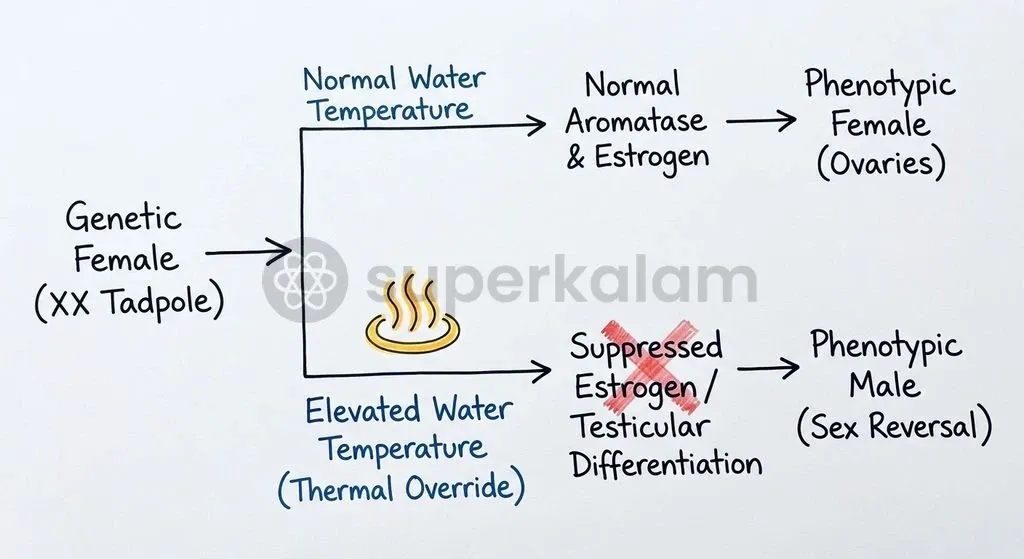
Thermal sex reversal fundamentally destabilises amphibian populations under climate warming. Rising temperatures override chromosomal sex determination and alter demographic balances, driving up local extinction risks.
In species like the Agile Frog (Rana dalmatina), warmer breeding waters downregulate essential hormonal pathways during tadpole development. This disruption transforms genetic females into phenotypic males. As operational sex ratios skew and effective population sizes fall, vulnerable populations enter self-reinforcing extinction vortices.
India's Western Ghats face immediate exposure. Over 80% of amphibian species there are endemic, with life cycles confined to narrow ecological niches.
Why in the News?
Recent research in Science Advances shows that thermal sex reversal generates compounding reproductive and immunological deficits in European agile frogs (Rana dalmatina).
As of September 2026, researchers have established that while sex-reversed XX males remain physiologically fertile, their progeny inherit an elevated propensity for thermal sex reversal and face heightened pathogen susceptibility. This mechanistic discovery proves that global warming threatens vertebrate survival beyond direct thermal death by actively dismantling reproductive systems.
These findings directly affect biodiversity obligations under the Convention on Biological Diversity (CBD).
Meet the Agile Frog: Biology, Habitat, and IUCN Conservation Status
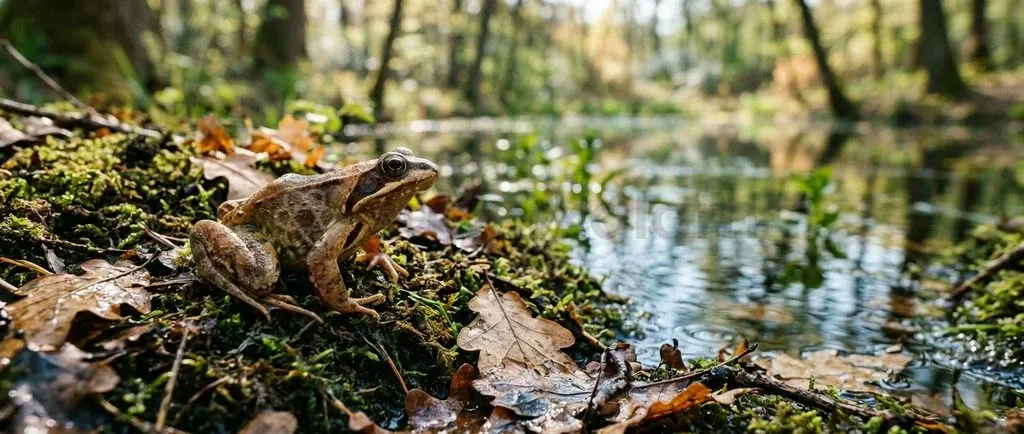
The Agile Frog (Rana dalmatina) is a terrestrial anuran belonging to the family Ranidae within the order Anura. According to the IUCN Red List of Threatened Species, the species is native to central and southern Europe, with its geographic range extending into northern Turkey.
Key ecological characteristics include:
- Habitat Preferences: Deciduous woodlands and open forest meadows.
- Breeding Strategy: Seasonal aquatic breeding in temporary and permanent forest pools.
- Global Status: Classified as Least Concern on the IUCN Red List.
- Local Vulnerability: The IUCN Red List assessment records that isolated agile frog populations are critically endangered on the British Channel Island of Jersey.
Broad classifications often mask severe regional pressures. Anthropogenic habitat fragmentation and local climate anomalies continue to erode the frog's demographic stability.
How Sex Is Decided in Amphibians: Genetic vs Environmental Triggers
Vertebrates determine sex through Genetic Sex Determination (GSD) or Environmental Sex Determination (ESD), predominantly Temperature-dependent Sex Determination (TSD). As detailed in the journal Sexual Development, amphibians primarily utilise genetic sex determination, governed by homomorphic or heteromorphic sex chromosomes through XX/XY or ZZ/ZW genetic systems.
Unlike mammals, amphibian gonadal differentiation retains striking developmental plasticity. Research published in Sexual Development explains that thermal sex reversal occurs when abiotic conditions override chromosomal directives during critical thermo-sensitive developmental windows during larval ontogeny.
| Feature | Genetic Sex Determination (GSD) | Temperature-dependent Sex Determination (TSD) |
|---|---|---|
| Primary Driver | Chromosomal inheritance (e.g., XX/XY, ZZ/ZW) | Ambient developmental temperature |
| Typical Taxa | Mammals, birds, most amphibians | Crocodilians, many turtles, select squamates |
| Plasticity | Rigid under baseline physiological norms | Highly labile across thermal gradients |
| Amphibian Reality | Operates as primary genetic foundation | Acts as an epigenetic override under heat stress |
Amphibian sex differentiation is not an immutable genetic programme. Instead, it represents a fragile physiological balance vulnerable to external thermal disruption.
Discuss with Superkalam
Recall the critical temperature identified in the article that triggers phenotypic masculinisation in larval agile frogs.
Ask NowThe Heat Override: How Warming Waters Trigger Sex Reversal
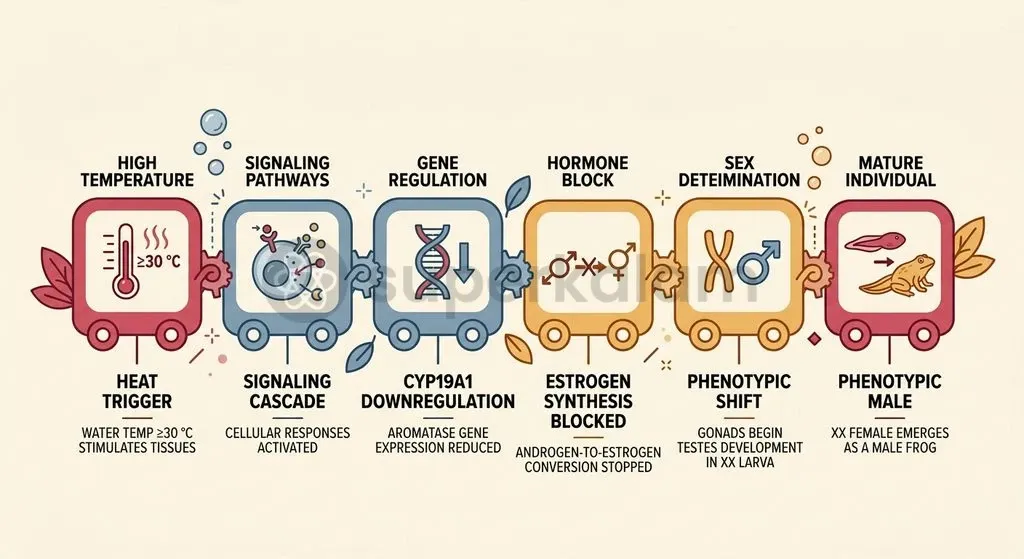
Thermal sex reversal in Rana dalmatina stems from an enzymatic breakdown during larval development. According to research published in Environmental Pollution, elevated ambient water temperatures downregulate the expression of CYP19A1 aromatase.
Aromatase converts androgens into oestrogens, the biochemical trigger required to direct the bipotential gonad into ovarian tissue. When warmer water suppresses CYP19A1 transcription, three events follow:
- Oestrogen biosynthesis halts within developing tadpoles.
- Endogenous androgens dominate the hormonal milieu.
- Genetically female (XX) larvae develop functional male phenotypes, including testes.
According to Environmental Pollution, short-duration heat waves reaching 30 °C during thermosensitive larval windows cause phenotypic masculinisation in genetically female agile frogs.
Human landscape alterations accelerate this dynamic. A study in Molecular Ecology demonstrated that up to 20% of adult phenotypic males in North-Central Hungary possessed female XX genotypes. Furthermore, agile frog populations in anthropogenically altered and agricultural landscapes showed significantly higher rates of female-to-male sex reversal than those in unfragmented, shaded woodlands. According to findings in PubMed, urban populations subjected to urban heat islands show higher sex-reversal rates in common-garden tests, reflecting microevolutionary shifts driven by thermal extremes.
From Skewed Sex Ratios to Population Collapse: The Extinction Vortex
Phenotypically sex-reversed XX male agile frogs are physiologically fertile. They produce viable offspring that possess exclusively female (XX) genotypes, as shown in Science Advances. Yet this reproductive output creates an ecological trap rather than demographic stability.
According to Science Advances, lineages derived from sex-reversed XX males face multi-generational penalties:
- Inherited Thermal Sensitivity: Offspring sired by sex-reversed XX males inherit a significantly higher intrinsic propensity to undergo sex reversal themselves under thermal stress.
- Mating Disadvantages: Sex-reversed XX males realise significantly lower paternity in wild breeding assemblages, driven by female mate choice and intrasexual competition.
- Disease Vulnerability: Progeny produced by sex-reversed XX males had higher viral loads after combined heat stress and ranavirus infection, but did not show increased mortality under laboratory conditions.
These compounding failures collapse the effective population size ($N_e$). A demographic modelling study in BMC Ecology and Evolution found that temperature-driven male-biased sex reversal severely reduces $N_e$, inducing intense inbreeding depression.
Additionally, work in Science of the Total Environment reveals that larval heat waves impair post-metamorphic growth and body condition across European anurans. Rather than maintaining numbers, sex reversal locks wild populations into an extinction vortex.
Discuss with Superkalam
Explain in your own words how the downregulation of CYP19A1 aromatase leads to male phenotypic development in genetically female tadpoles.
Ask NowThe Indian Angle: Why Western Ghats Frogs Face Similar Climate Risks
European findings provide an urgent warning for tropical biodiversity. A UNESCO World Heritage dossier confirms that over 80% of amphibian species in the Western Ghats are endemic, with life cycles tightly tied to narrow microclimatic envelopes.
Indian anurans display extreme ecological specialisation that amplifies their thermal risks:
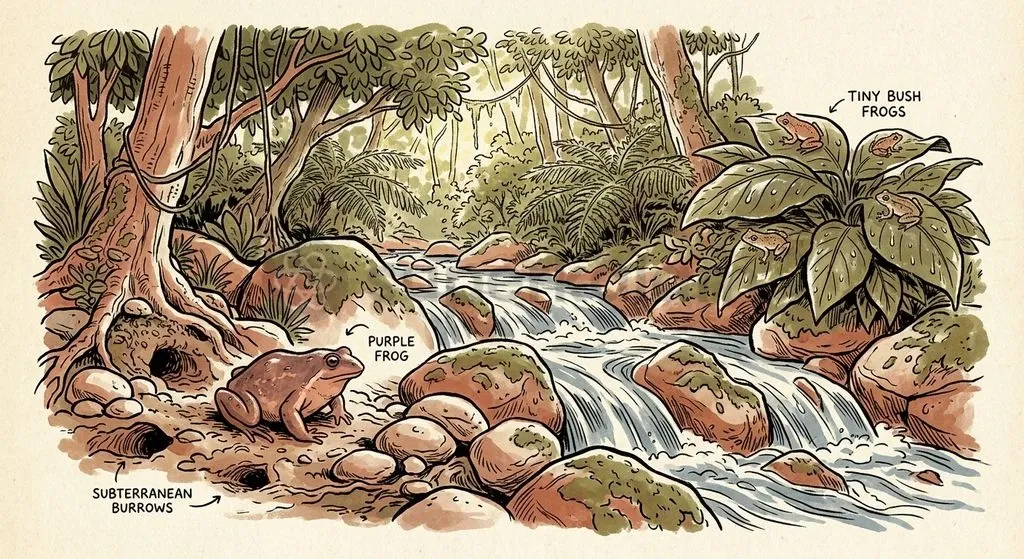
- Fossorial Endemics: The Purple Frog (Nasikabatrachus sahyadrensis), an ancient burrowing anuran endemic to the Western Ghats, is classified as Endangered by the IUCN. It receives strict legal protection under Schedule I of India's Wild Life (Protection) Act, 1972 (amended in 2022). It surfaces for only a few days annually during pre-monsoon rains to breed in torrential streams, where altered thermal regimes could disrupt larval development.
- Direct-Developing Bush Frogs: Endemic bush frogs (Raorchestes spp.) bypass free-swimming tadpole stages entirely. According to Biological Conservation, their terrestrial egg clutches are directly exposed to ambient air temperatures, making them exceptionally vulnerable to microclimatic warming and desiccation.
- Pathogen Compounding: Research from the Rajiv Gandhi Centre for Biotechnology confirmed the presence of ranavirus infections and chytridiomycosis (Batrachochytrium dendrobatidis) among wild Western Ghats anurans.
Because offspring of sex-reversed agile frogs showed higher viral loads under combined heat and infection exposure, without higher laboratory mortality, thermal spikes in the Western Ghats could interact with endemic pathogens to trigger widespread die-offs.
Way Forward: Protecting Microclimates and Vulnerable Amphibians
Addressing thermal sex reversal demands targeted protection for hydrologic microclimates alongside evolutionary resilience in critical watersheds.
Key interventions include:
- Restoring Riparian Buffer Zones: Preserving multi-tier forest canopies and establishing 30-to-50-metre vegetated riparian buffers lowers peak summer water temperatures by 2 °C to 5 °C, according to conservation research in the Western Ghats. This thermal moderation shields larval amphibians from temperatures that trigger CYP19A1 downregulation.
- Commitment to the Kunming-Montreal Global Biodiversity Framework:
- Target 2: Demands that at least 30% of degraded inland water and terrestrial ecosystems be placed under effective ecological restoration by 2030.
- Target 4: Mandates urgent management actions to halt human-induced species extinction and conserve genetic diversity within wild populations.
- Landscape-Scale Connectivity: Eliminating forest fragmentation mitigates urban and agricultural heat island effects, enabling species to persist within shaded habitats.
- Integrated Epidemiological and Thermal Monitoring: Establishing permanent monitoring stations across biodiversity hotspots will help track thermal anomalies alongside chytrid and ranavirus prevalence.
Discuss with Superkalam
How might the phenomenon of thermal sex reversal alter operational sex ratios and breeding dynamics in an isolated tropical wetland?
Ask NowKey Takeaways
- Mechanistic Override: High developmental water temperatures suppress CYP19A1 aromatase, inducing female-to-male (XX) sex reversal in the Agile Frog (Rana dalmatina).
- The Extinction Vortex: Although sex-reversed XX males remain fertile, they realise lower paternity, pass on higher thermal sensitivity, and produce offspring with higher viral loads after heat and infection exposure, without higher laboratory mortality.
- Western Ghats Vulnerability: Over 80% of Western Ghats amphibians are endemic and rely on strict microclimatic conditions; species such as Nasikabatrachus sahyadrensis (Schedule I, Wild Life Protection Act 1972) face severe extinction risks from altered hydrology and thermal stress.
- Microclimate Buffering: Retaining 30-to-50-metre vegetated riparian buffers cools aquatic breeding sites by 2 °C to 5 °C, preserving natural developmental conditions.
- Global Mandates: Conservation actions align directly with Targets 2 and 4 of the Kunming-Montreal Global Biodiversity Framework to restore ecosystems and prevent genetic collapse.
Mains Question
'Global warming threatens vertebrate survival beyond direct thermal mortality by actively destabilising reproductive systems and triggering self-reinforcing extinction vortices.' In this context, elucidate the mechanism of thermal sex reversal in amphibians and discuss its broader ecological consequences. (15 Marks)
Evaluate NowMains Question
Given that over 80% of amphibian species in the Western Ghats are endemic, examine their vulnerability to climate anomalies and pathogen pressures, and outline key microclimatic interventions necessary for their preservation. (10 Marks)
Evaluate NowPractice MCQs
QUESTION 1
With reference to thermal sex reversal in amphibians, consider the following statements:
- It represents an epigenetic override where elevated ambient water temperature suppresses chromosomal sex determination.
- In the Agile Frog (Rana dalmatina), high water temperatures upregulate the CYP19A1 aromatase enzyme, triggering excessive oestrogen synthesis.
- Phenotypically sex-reversed XX males are sterile and incapable of producing viable offspring. Which of the statements given above is/are correct?
QUESTION 2
Consider the following statements regarding the amphibian diversity of India's Western Ghats:
- More than 80% of amphibian species found in the Western Ghats are endemic.
- The Purple Frog (Nasikabatrachus sahyadrensis) is listed under Schedule I of India's Wild Life (Protection) Act, 1972.
- Bush frogs belonging to the genus Raorchestes bypass the free-swimming larval stage through direct development, laying eggs directly exposed to ambient air temperatures. Which of the statements given above is/are correct?
QUESTION 3
With reference to the Kunming-Montreal Global Biodiversity Framework (KMGBF) targets cited in the context of ecosystem restoration and species conservation, consider the following pairs:
- Target 2 : Restoration of at least 30% of degraded inland water and terrestrial ecosystems by 2030
- Target 4 : Urgent management actions to halt human-induced extinction and conserve genetic diversity Which of the pairs given above is/are correctly matched?
QUESTION 4
In the biochemical pathway governing gonadal differentiation in amphibians such as Rana dalmatina, which of the following enzymes is directly downregulated by elevated water temperatures to induce female-to-male sex reversal?