Swaminathan Commission: MSP Formula and Agrarian Reforms Explained
Beyond the C2+50% MSP debate lies a multi-pillar blueprint for land, credit, and market reforms crucial for resolving India's enduring agrarian crisis.
Sep, 2026
•9 min read
Context
The National Commission on Farmers delivered an extensive policy roadmap for Indian agriculture. It argued that remunerative price support through Minimum Support Price can secure rural prosperity only when accompanied by structural reforms in land governance, irrigation, credit, and market connectivity.
Chaired by Professor M.S. Swaminathan, the commission produced five reports investigating the roots of agrarian distress across rural India. Reviving the farm sector requires resolving foundational resource bottlenecks rather than treating agricultural policy as purely a matter of administrative price procurement.
Why in the News? The Ongoing Debate Around Farmers and MSP
Farmer organisations across India continually renew their demand for a statutory price guarantee. As of March 2025, agricultural policy debates remain centred on whether price support alone can ensure sustainable farm income or if agrarian revival demands broader structural interventions.
Three systemic pressures drive this friction:
- Escalating input costs: Cultivators face rising expenses for seeds, diesel, fertilisers, and machinery.
- Volatile market realisations: Market gluts and price swings leave unhedged farmers vulnerable during harvest peaks.
- Federal jurisdictional hurdles: Agriculture sits on the State List under the Seventh Schedule, making unified reform dependent on federal coordination.
Constituted on November 18, 2004, the National Commission on Farmers (NCF) under Professor M.S. Swaminathan mapped the full scope of rural challenges. Public debate often isolates the commission's pricing formula. Its broader mandate, however, sought to rebuild the entire rural economy.
Discuss with Superkalam
Recall the five successive reports submitted by the National Commission on Farmers between 2004 and 2006. Which report specifically detailed the C2+50% formula?
Ask NowBackground: The National Commission on Farmers and Its Mandate
The Union Government set up the National Commission on Farmers in 2004 amid severe agrarian distress and stagnant rural growth. Professor M.S. Swaminathan chaired the body, which was tasked with formulating a comprehensive policy framework to enhance productivity, profitability, and sustainability across Indian farming systems.
Between December 2004 and October 4, 2006, the commission submitted five successive reports titled 'Serving Farmers and Saving Farming: Towards Faster and More Inclusive Growth of Farmers' Welfare'.
The reports traced the agrarian crisis across several distinct areas:
- First Report (December 2004): Outlined immediate relief strategies for distress-prone districts, addressing credit burdens and drought management.
- Second Report (August 2005): Focused on ecological security, soil health, water governance, and rural infrastructure.
- Third Report (December 2005): Examined livestock, fisheries, horticulture, and technological delivery mechanisms for smallholders.
- Fourth Report (April 2006): Addressed agrarian livelihoods, institutional credit restructuring, and global agricultural trade challenges.
- Fifth and Final Report (October 2006): Synthesised a comprehensive National Policy for Farmers, detailing the C2+50% pricing formula and structural reforms.
Beyond C2+50%: The Five Core Pillars of the Swaminathan Reports
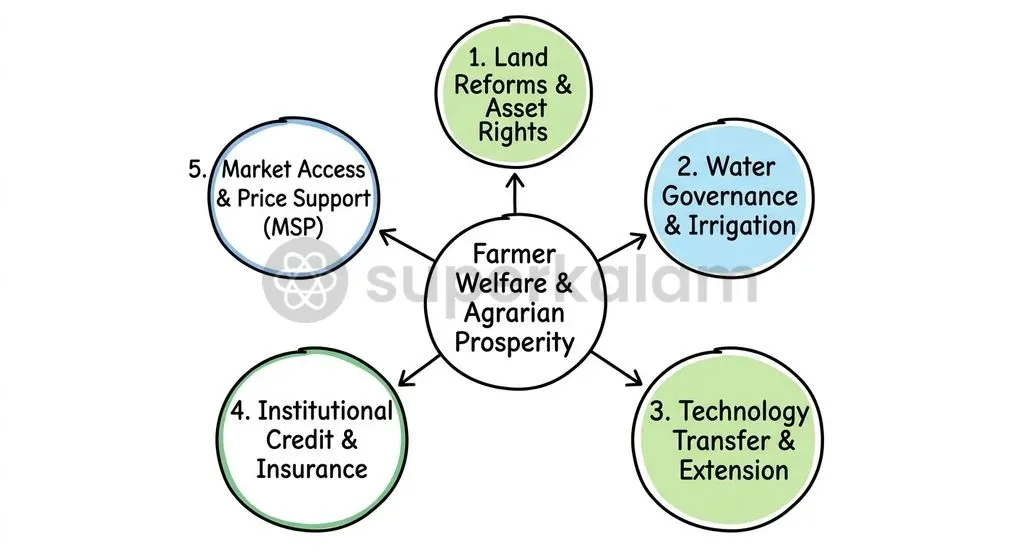
The Swaminathan Commission organised its long-term policy framework around five core pillars to support farm households. These interconnected pillars addressed systemic inequalities and operational deficits across rural India:
- Asset Reform and Land Stewardship: Ensuring equitable access to productive land, securing tenancy rights, and preventing the diversion of prime agricultural land for non-agricultural use.
- Water Security and Climate Resilience: Establishing decentralised water harvesting, expanding aquifer recharge, and guaranteeing timely water access for marginal farmers.
- Technology Transfer and Extension: Bridging the research-to-field gap by establishing local knowledge nodes and advanced soil-testing networks.
- Credit and Risk Mitigation: Providing low-interest institutional finance, universal crop insurance, and disaster relief mechanisms.
- Market Access and Fair Value Chains: Reforming physical mandis, creating a unified domestic market, and establishing direct producer-to-consumer networks.
Treating the commission's output merely as a pricing blueprint overlooks these structural pillars. Sustainable farmer welfare depends on strengthening each component simultaneously.
Discuss with Superkalam
Explain why Cost C2 provides a higher baseline for MSP calculation compared to Cost A2 and Cost A2+FL.
Ask NowLand, Water, and Technology: Fixing the Structural Bottlenecks
Land governance remains the primary operational hurdle for smallholders cultivating tiny, fragmented plots. The Swaminathan Commission recommended distributing ceiling-surplus and government waste lands to landless rural households to build productive asset bases. It explicitly advised preventing prime land diversion and forest clearing for industrial use.
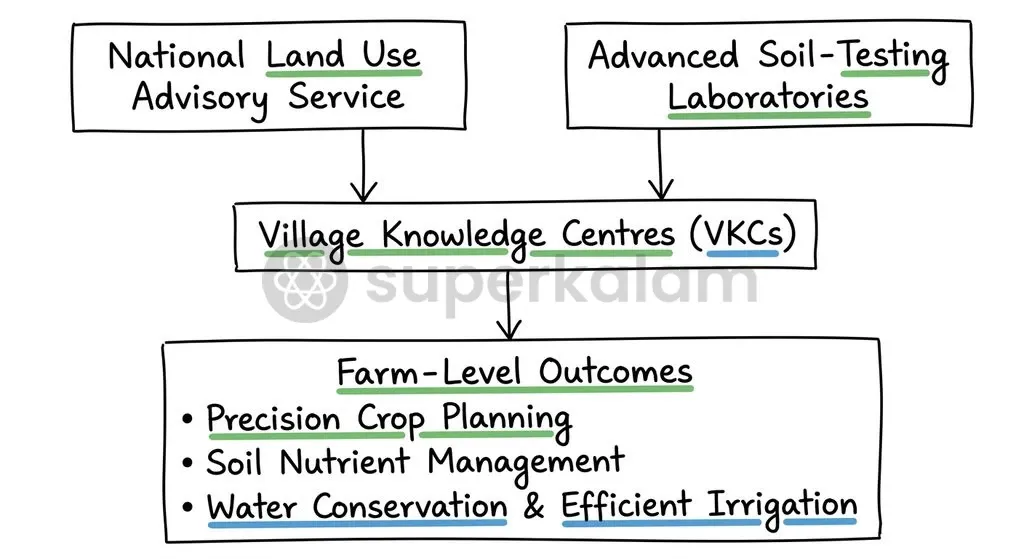
To guide land productivity dynamically, the commission proposed a National Land Use Advisory Service. This body was intended to steer cropping patterns by integrating environmental and commercial indicators.
| Advisory Stream | Integrated Data & Functions |
|---|---|
| Meteorological Data | Monsoon tracking and dry-spell early warnings for sowing |
| Ecological Capacity | Soil capability, water table mapping, and salinity limits |
| Market Price Signals | Demand forecasts and export trends across mandis |
Water governance formed a central focus of the recommendations. The NCF proposed a dedicated 'Million Wells Recharge' programme to revive private open wells, alongside mandatory aquifer recharging and expanded rainwater harvesting infrastructure. These steps aimed to arrest falling water tables in vulnerable agrarian belts.
Village-level extension needs rapid technical upgrades. The commission recommended establishing advanced soil-testing laboratories across all districts to identify micronutrient deficiencies. It also proposed setting up Village Knowledge Centres (Gyan Chaupals) to bridge the lab-to-land gap using information technology and localised agronomic advisories.
Discuss with Superkalam
How can the National Land Use Advisory Service model be applied to manage cropping patterns in drought-prone regions facing groundwater depletion?
Ask NowConnecting the Farm Gate to Markets: Value Chains and Agri-Logistics
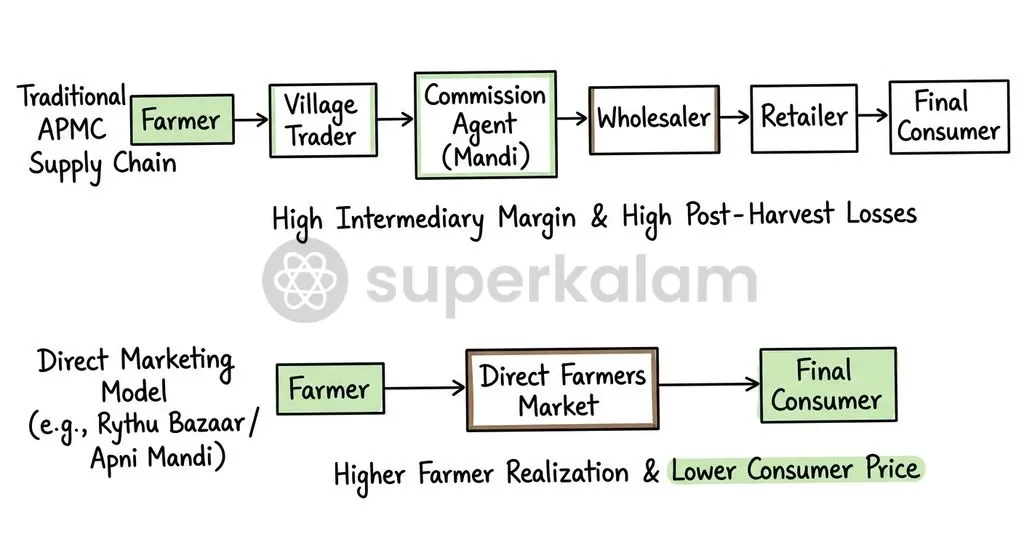
Intermediaries and fragmented supply chains capture a disproportionate share of consumer spending. The commission targeted these distortions through structural market reforms:
- Indian Single Common Market: Dismantling inter-state barriers and reforming state Agricultural Produce Market Committee (APMC) regulations to eliminate trader cartelisation.
- Direct Farm-to-Consumer Sales: Scaling up proven local marketing channels, specifically Apni Mandi in Punjab and Haryana, alongside Rythu Bazaars in Andhra Pradesh.
- Post-Harvest Rural Infrastructure: Investing in cold storage, grading hubs, and local processing facilities close to village clusters.
Improved post-harvest handling minimises produce losses, moderates market gluts during harvest peaks, and expands secondary agricultural processing in rural areas.
Understanding the MSP Calculations: A2+FL Versus C2 Explained
The Commission for Agricultural Costs and Prices (CACP) evaluates three standard cost concepts when analysing production economics. The Swaminathan Commission explicitly recommended fixing the Minimum Support Price (MSP) at a minimum of 50 percent above the comprehensive cost of production (C2 + 50%).
Cost accounting under the CACP framework uses three primary metrics:
- Cost A2: Covers all direct, out-of-pocket operational expenses incurred by the cultivator, including purchases of seeds, fertilisers, pesticides, fuel, irrigation charges, hired agricultural labour, and leased-in land rent.
- Cost A2+FL: Combines actual paid-out costs (Cost A2) with the imputed financial value of unpaid family labour deployed in field activities.
- Cost C2: A comprehensive economic cost metric encompassing Cost A2+FL along with the imputed rental value of owned agricultural land and the interest accrued on owned fixed capital assets.
| Cost Concept | Inclusions | Exclusions | Policy Application |
|---|---|---|---|
| Cost A2 | Direct paid-out costs: seeds, fertilizer, chemicals, fuel, hired labour, irrigation, leased-in rent | Family labour, rent on owned land, interest on fixed capital | Base cash expenditure indicator |
| Cost A2+FL | Cost A2 plus imputed value of unpaid family labour | Rental value of owned land, interest on owned fixed capital | Official benchmark used since Union Budget 2018-19 |
| Cost C2 | Cost A2+FL plus imputed rent on owned land and interest on owned capital | None (comprehensive production cost) | Recommended by Swaminathan Commission (C2+50%) |
The Union Budget 2018-19 introduced an administrative benchmark setting MSPs at 1.5 times the cost of production, basing this calculation on Cost A2+FL rather than Cost C2. Because Cost C2 accounts for land rent and capital interest, it represents a substantially higher baseline than Cost A2+FL.
Discuss with Superkalam
Analyse how APMC market reforms and direct sales models like Rythu Bazaars reduce price volatility for smallholders.
Ask NowWhy Many Recommendations Remain Unimplemented
The Government of India approved the National Policy for Farmers in 2007, incorporating several NCF suggestions while omitting a statutory guarantee for the C2+50% pricing formula. Several structural and economic factors explain why successive governments have resisted making C2+50% legally binding.
Policy analysts highlight four major economic constraints associated with statutory C2-based procurement:
- Fiscal Outlays: Enforcing open-ended statutory procurement across all 22 mandated crops could impose unsustainable burdens on the national budget.
- Food Inflation Risks: Fixing procurement prices at high C2+50% benchmarks across staple grains could drive food inflation higher for vulnerable urban and landless rural consumers.
- Cropping Pattern Distortions: Assured open-ended procurement for water-intensive cereals like paddy and wheat disincentivises crop diversification toward pulses, oilseeds, and millets.
- International Trade Commitments: Substantial price-support procurement risks breaching the Aggregate Measurement of Support (AMS) caps established under the World Trade Organization (WTO) Agreement on Agriculture.
Constitutional arrangements also influence implementation. Agriculture is assigned to the State List under the Seventh Schedule of the Indian Constitution. The Swaminathan Commission suggested transferring agriculture to the Concurrent List (List III) to foster institutional alignment between the Centre and states, but this proposal has not materialised.
Discuss with Superkalam
Evaluate whether legally guaranteeing MSP at C2+50% can resolve agrarian distress without simultaneous structural reforms in credit and water governance.
Ask NowWay Forward: Building a Resilient, Income-Secure Agricultural Economy
Policymakers must adopt a balanced strategy that pairs price stabilisation with productivity gains and non-procurement income support. Direct income support via PM-KISAN and price-deficiency compensation under PM-AASHA provide alternative methods to assist farmers without the market distortions of open-ended physical buying.
Long-term agrarian resilience requires shifting focus toward input-side cost reduction, water conservation, and soil restoration. Reviving extension services through village-level information networks, formalising land leasing rights, and expanding local agro-processing will sustainably enhance farm profitability. The comprehensive recommendations of the Swaminathan Commission provide a balanced blueprint for transforming agriculture from a low-yield enterprise into a dynamic, sustainable livelihood engine.
Key Takeaways
- The National Commission on Farmers was established in November 2004 under Professor M.S. Swaminathan and submitted five reports outlining holistic agrarian reforms.
- The commission recommended fixing the Minimum Support Price at a minimum of 50 percent over the comprehensive cost of production (C2 + 50%).
- The Union Government currently establishes MSPs at 1.5 times the Cost A2+FL, which covers paid-out operational expenses and family labour but excludes owned land rent and capital interest.
- Structural recommendations include the Million Wells Recharge programme, establishing a National Land Use Advisory Service, and decentralising crop insurance to the village panchayat level.
- Promoting rural equity requires extending joint land titles (pattas) and institutional credit cards to women farmers while expanding direct marketing models.
Mains Question
"The National Commission on Farmers argued that remunerative price support can secure rural prosperity only when accompanied by structural interventions in resource governance." In this context, elucidate the core pillars of agrarian reform recommended by the Swaminathan Commission. (10 Marks)
Evaluate NowMains Question
"Treating agrarian distress merely as a matter of administrative price procurement overlooks foundational bottlenecks across credit, input delivery, and value chains." Critically examine the structural solutions proposed by the Swaminathan Commission to insulate farm households from agrarian risks. (15 Marks)
Evaluate NowPractice MCQs
QUESTION 1
With reference to the cost concepts used in Minimum Support Price (MSP) formulations by the Commission for Agricultural Costs and Prices (CACP), consider the following statements:
- Cost A2 covers direct out-of-pocket expenses such as seeds, fertilisers, pesticides, fuel, irrigation charges, hired labour, and leased-in land rent.
- Cost C2 encompasses Cost A2+FL along with the imputed rental value of owned agricultural land and interest on owned fixed capital assets.
- The National Commission on Farmers recommended fixing the MSP at a minimum of 50 percent above Cost A2+FL.
Which of the statements given above are correct?
QUESTION 2
Regarding the credit and risk mitigation measures proposed by the National Commission on Farmers (Swaminathan Commission), consider the following statements:
- It recommended reducing the simple interest rate on crop loans to 4 percent per annum through government interest subvention.
- It proposed shifting the assessment unit for universal crop insurance from talukas to individual village panchayats.
- It recommended issuing joint land titles (pattas) to spouses and distributing Kisan Credit Cards to women cultivators.
Which of the statements given above is/are correct?
QUESTION 3
Consider the following institutional and resource governance mechanisms recommended by the National Commission on Farmers:
- National Land Use Advisory Service to integrate meteorological data, ecological capacity, and market price signals.
- 'Million Wells Recharge' programme to revive private open wells and restore falling water tables.
- Village Knowledge Centres (Gyan Chaupals) to bridge the lab-to-land technical gap using information technology.
Which of the mechanisms given above was/were recommended by the Commission?
QUESTION 4
Which of the following direct farm-to-consumer marketing initiatives were specifically highlighted by the Swaminathan Commission as models to be scaled up?
- Apni Mandi in Punjab and Haryana
- Rythu Bazaars in Andhra Pradesh
- Uzhavar Sandhai in Tamil Nadu
Select the correct answer using the code given below:
QUESTION 5
Under the CACP agricultural cost estimation framework, which component is added to 'Cost A2' to arrive at 'Cost A2+FL'?





