Swachh Vayu Sarvekshan 2026: How Indore and Lucknow Cleaned Their Air
While Lucknow and Indore lead national clean air rankings, isolated municipal gains highlight the urgent necessity of regional airshed governance across India.
Sep, 2026
•7 min read
Context
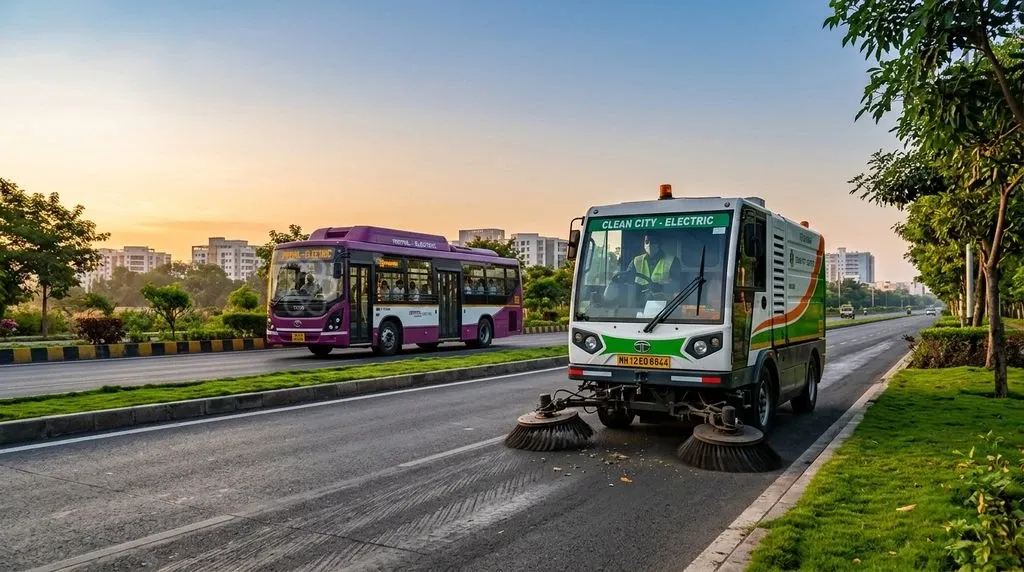
Swachh Vayu Sarvekshan 2026 demonstrates that municipal environmental performance in India is shifting toward systematic execution. Lucknow and Indore secured the top national positions by aligning mechanised dust suppression, waste remediation, and public transport electrification with targeted National Clean Air Programme funding.
As of September 2026, the Ministry of Environment, Forest and Climate Change has expanded this assessment across 130 non-attainment cities to drive competitive federalism. The evaluation rewards verifiable engineering interventions over short-term administrative measures.
Municipal achievements highlight a critical structural reality. Local operational gains must integrate into regional airshed management frameworks to tackle transboundary pollution across the Indo-Gangetic Plain effectively.
Why Swachh Vayu Sarvekshan is in the News
The Ministry of Environment, Forest and Climate Change declared the Swachh Vayu Sarvekshan 2026 rankings on Swachh Vayu Diwas to recognise urban environmental performance. In the Category 1 segment for cities with populations exceeding 10 lakh, Lucknow secured the first rank nationally with a score of 198 out of 200 points, as highlighted in a PIB Delhi release on the 5th Swachh Vayu Sarvekshan Awards.
Indore claimed the second position with 197 points, while Jabalpur finished third with 195 points according to Central Pollution Control Board records on the PRANA portal.
The 2026 edition expanded the monitoring framework down to the grassroots civic tier. Municipal authorities evaluated air pollution mitigation actions across more than 7,400 municipal wards nationwide, introducing dedicated ward-level performance rankings according to official MoEFCC releases.
Discuss with Superkalam
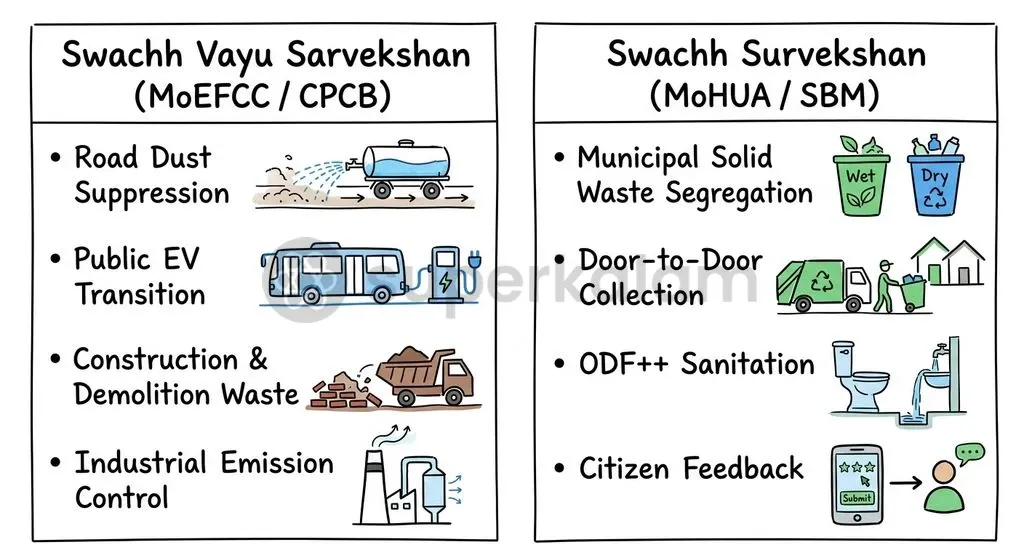
What are the key differences between the institutional anchors of Swachh Vayu Sarvekshan and Swachh Survekshan?
Ask NowWhat is Swachh Vayu Sarvekshan and How Are Cities Ranked?
The Central Pollution Control Board conducts Swachh Vayu Sarvekshan to rank 130 non-attainment cities using a 200-point framework based on validated municipal actions. Non-attainment cities are urban centres that consistently fail to meet the National Ambient Air Quality Standards over a five-year monitoring cycle under the Air (Prevention and Control of Pollution) Act, 1981.
The ranking framework assesses municipal execution across seven distinct environmental domains:
- Road dust suppression: mechanised sweeping, water sprinkling, and paved shoulders.
- Solid waste management: bio-remediation of legacy landfills and stopping open burning.
- C&D waste management: processing infrastructure and construction dust controls.
- Vehicular emission controls: public transport electrification and EV infrastructure.
- Industrial pollution mitigation: emission monitoring and fuel transition.
- Diesel generator regulation: strict operational and emission compliance.
- Public outreach activities: citizen grievance redressal and public campaigns.
| Dimension | Swachh Vayu Sarvekshan | Swachh Survekshan |
|---|---|---|
| Nodal Ministry | Ministry of Environment, Forest and Climate Change | Ministry of Housing and Urban Affairs |
| Primary Assessment Objective | Urban ambient air quality improvement and emissions reduction | Urban sanitation, open defecation-free status, and municipal waste management |
| Executing Agency | Central Pollution Control Board | Quality Council of India / MoHUA |
| Policy Anchor | National Clean Air Programme | Swachh Bharat Mission (Urban) |
| Evaluation Metrics | Dust suppression, fleet transition, biomass control, and 200-point mitigation framework | Door-to-door waste collection, source segregation, processing capacity, and public toilet infrastructure |
The Urban Playbook: What Indore and Lucknow Did Differently
Indore and Lucknow achieved top clean air ranks by replacing piecemeal antipollution drives with institutionalised municipal engineering interventions. Both urban local bodies directed capital expenditure into systemic source-level dust and emission control rather than temporary reactive measures.
Indore Municipal Corporation anchored its clean-air strategy on total legacy waste clearance and infrastructure paving. Indore completed 100% bio-remediation of legacy landfill waste, eliminating recurring subsurface fires and particulate plumes according to the MoEFCC Annual Compendium of Best Management Practices.
Key pillars of Indore's municipal delivery model include:
- Legacy Landfill Remediation: Total bio-remediation of historical dumpsites to prevent subsurface fires.
- Road Shoulder Paving: Elimination of roadside silt resuspension through end-to-end paved shoulders.
- Mechanised Sweeping: Deployment of modern sweeping fleets along all arterial corridors.
- Bio-CNG Fleet Transition: Fueling public bus networks with clean fuel from the Devguradiya Bio-CNG plant.
Lucknow Municipal Corporation focused its interventions on municipal fleet modernisation and road dust suppression. The civic body electrified its municipal solid waste transport fleet to eliminate tailpipe emissions during primary waste collection, cleared legacy dumpsites, and instituted scheduled mechanised road sweeping along major arterial corridors.
Discuss with Superkalam
Explain why municipal-level administrative boundaries fail to effectively control PM2.5 pollution concentrations in Indo-Gangetic Plain cities.
Ask NowUnderstanding the National Clean Air Programme Framework
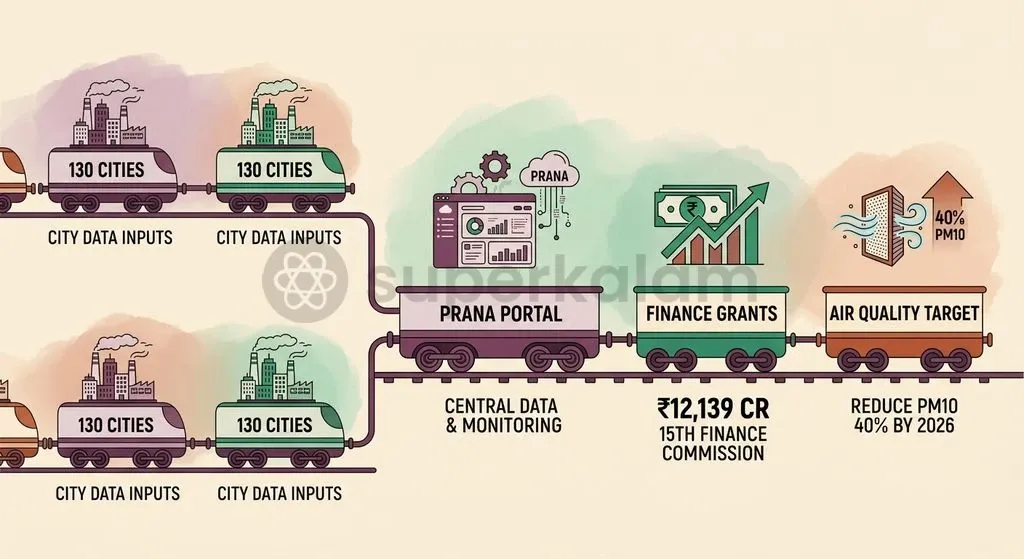
The National Clean Air Programme provides the overarching national policy blueprint to achieve a 40% reduction in particulate matter concentrations across 130 cities by 2026. The Ministry of Environment, Forest and Climate Change launched the programme in 2019 and subsequently raised the mitigation ambition from an initial 20–30% target to a 40% PM10 reduction relative to the 2017–18 base year.
Progress under the programme highlights significant improvements across target cities (FY 2025–26 vs FY 2017–18):
- 108 of 130 cities achieved lower PM10 levels.
- 72 cities achieved reductions exceeding 20%.
- 26 cities achieved reductions exceeding 40%.
Fiscal transfers have reinforced performance incentives across urban local bodies. Under the Million-Plus Cities Challenge Fund, the 15th Finance Commission allocated ₹12,139 crore over FY 2021–22 to FY 2025–26 as performance-tied clean air grants across 42 Million-Plus Urban Agglomerations.
The Central Pollution Control Board tracks physical progress, fund utilisation, and ambient air parameters across all 130 cities through the digital PRANA portal (Portal for Regulation of Air-Pollution in Non-Attainment Cities).
Discuss with Superkalam
Weigh the advantages and limitations of relying on input-based municipal expenditure metrics versus ambient air quality outcomes for Finance Commission urban grants.
Ask NowKey Gaps in India's Urban Air Quality Governance
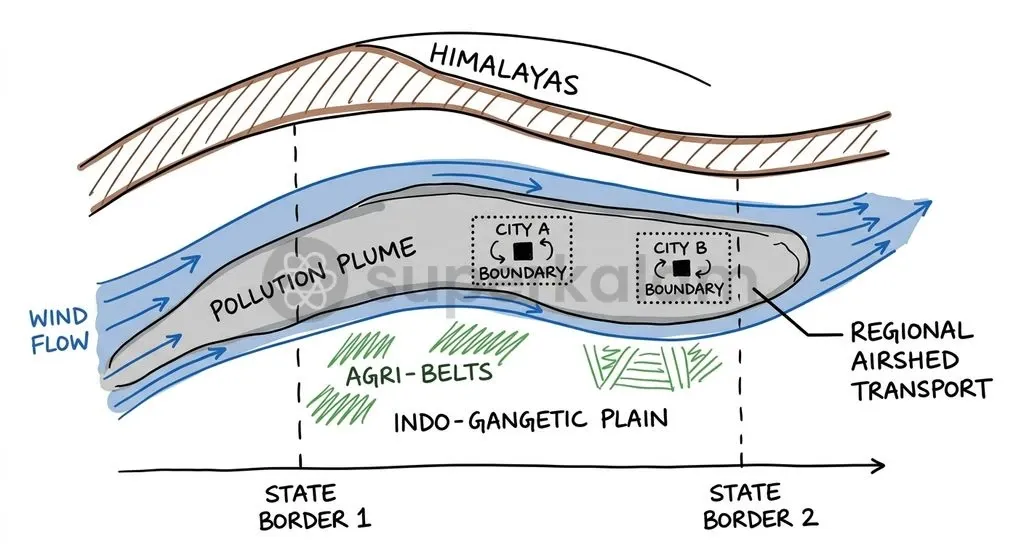
India's air pollution governance faces severe structural limitations because municipal administrative boundaries fail to match geographical airshed dynamics. Urban local bodies implement pollution control measures within municipal limits, whereas atmospheric wind patterns transport pollutants across state and district borders.
| Pollution Source Origin | Share of Urban PM2.5 | Primary Contributing Factors |
|---|---|---|
| Internal Urban Sources | ~66% | Vehicular emissions, road dust, construction, and municipal waste |
| Transboundary Inflow | ~34% | Regional biomass burning, regional industrial belts, and interstate transport |
Scientific source apportionment studies indicate that up to 34% of PM2.5 pollution in major Indo-Gangetic Plain cities originates outside city administrative boundaries due to regional air mass transport.
Statutory frameworks also struggle with institutional fragmentation. The Air (Prevention and Control of Pollution) Act, 1981 empowers State Pollution Control Boards with regulatory authority, but municipal corporations control infrastructure funds, waste management, and road maintenance. This division creates operational bottlenecks during coordinated pollution emergencies.
The Way Forward: Moving from City Action Plans to Regional Airshed Management
The National Clean Air Programme Apex Committee has directed the formulation of regional airshed action plans across eight Indo-Gangetic Plain States and Union Territories to address transboundary pollution. Shifting the administrative paradigm from isolated city action plans to integrated airshed management is essential for durable air quality gains.
Policy interventions must focus on three structural priorities:
- Airshed-Level Coordination Bodies: Establish statutory regional airshed authorities equipped with joint monitoring mandates across urban local bodies, rural departments, and state pollution regulators.
- Outcome-Linked Fiscal Architecture: Align future Finance Commission urban grants with verified ambient air quality improvements rather than purely input-based expenditure metrics.
- Hyper-Local Ward Monitoring: Institutionalise ward-level tracking across all 7,400 municipal wards to ensure rapid detection and penalisation of open waste burning and construction dust violations.
Discuss with Superkalam
Design an inter-state institutional framework for regional airshed governance that bridges the jurisdictional gap between municipal corporations and State Pollution Control Boards.
Ask NowKey Takeaways
The Swachh Vayu Sarvekshan framework establishes an action-oriented benchmark for urban air quality governance across India's non-attainment cities.
- Ranking Outcomes: Lucknow ranked first nationally (198/200) and Indore ranked second (197/200) in Category 1 (>10 lakh population) under Swachh Vayu Sarvekshan 2026.
- Key Municipal Levers: Indore's success relied on 100% bio-remediation of legacy landfills, paved road shoulders, and Bio-CNG bus fleets; Lucknow leveraged fleet electrification and mechanised sweeping.
- National Targets: The National Clean Air Programme targets a 40% reduction in PM10 concentrations by 2025–26 compared to 2017–18 levels.
- Financial Architecture: The 15th Finance Commission committed ₹12,139 crore (FY 2021–22 to FY 2025–26) through the Million-Plus Cities Challenge Fund, monitored via the PRANA portal.
- Governance Challenge: Source apportionment data reveals that up to 34% of PM2.5 in Indo-Gangetic Plain cities is transboundary, requiring multi-state regional airshed management.
Mains Question
"Municipal engineering interventions under the Swachh Vayu Sarvekshan demonstrate that local gains must integrate into regional airshed management frameworks to effectively tackle urban air pollution." Discuss. (15 Marks)
Evaluate NowMains Question
Evaluate the efficacy of the National Clean Air Programme (NCAP) and performance-linked fiscal transfers in mitigating particulate pollution in Indian cities. (10 Marks)
Evaluate NowPractice MCQs
QUESTION 1
With reference to the Swachh Vayu Sarvekshan framework, consider the following statements:
- It is conducted by the Central Pollution Control Board under the aegis of the Ministry of Housing and Urban Affairs.
- Non-attainment cities assessed under the framework are urban centres that consistently fail to meet National Ambient Air Quality Standards over a five-year cycle.
- The evaluation assesses municipal performance using a 200-point framework across domains such as road dust suppression, solid waste management, and vehicular emissions. Which of the statements given above are correct?
QUESTION 2
Regarding the National Clean Air Programme (NCAP) and its financial architecture, consider the following statements:
- The revised NCAP target mandates a 40% reduction in PM10 concentrations across target cities by 2026 relative to the 2017–18 base year.
- Under the Million-Plus Cities Challenge Fund, the 15th Finance Commission allocated performance-tied clean air grants across 42 Million-Plus Urban Agglomerations.
- Physical progress, ambient air quality parameters, and fund utilisation are tracked through the digital PRANA portal. Which of the statements given above is/are correct?
QUESTION 3
Consider the following statements regarding urban air pollution dynamics and governance in India:
- Source apportionment assessments indicate that up to 34% of PM2.5 pollution in major Indo-Gangetic Plain cities is transboundary in origin.
- The Air (Prevention and Control of Pollution) Act, 1981 confers infrastructure funding and municipal road paving powers exclusively on State Pollution Control Boards. Which of the statements given above is/are correct?
QUESTION 4
Consider the following pairs of cities and their municipal clean air interventions highlighted under Swachh Vayu Sarvekshan 2026:
- Indore: 100% bio-remediation of legacy landfill waste and fueling public transport via a Bio-CNG plant
- Lucknow: Fleet electrification of municipal solid waste transport and mechanised arterial sweeping Which of the pairs given above is/are correctly matched?
QUESTION 5
Under the Swachh Vayu Sarvekshan 2026 rankings for Category 1 cities (population exceeding 10 lakh), which city secured the first rank nationally with a score of 198 out of 200 points?