Surya Fleet Support Ship: Features and Role in the Indian Navy
Surya, India's first indigenous fleet support ship, was launched on 6 October 2026. Read how at-sea replenishment supports the Indian Navy.
Oct, 2026
•8 min read
Context
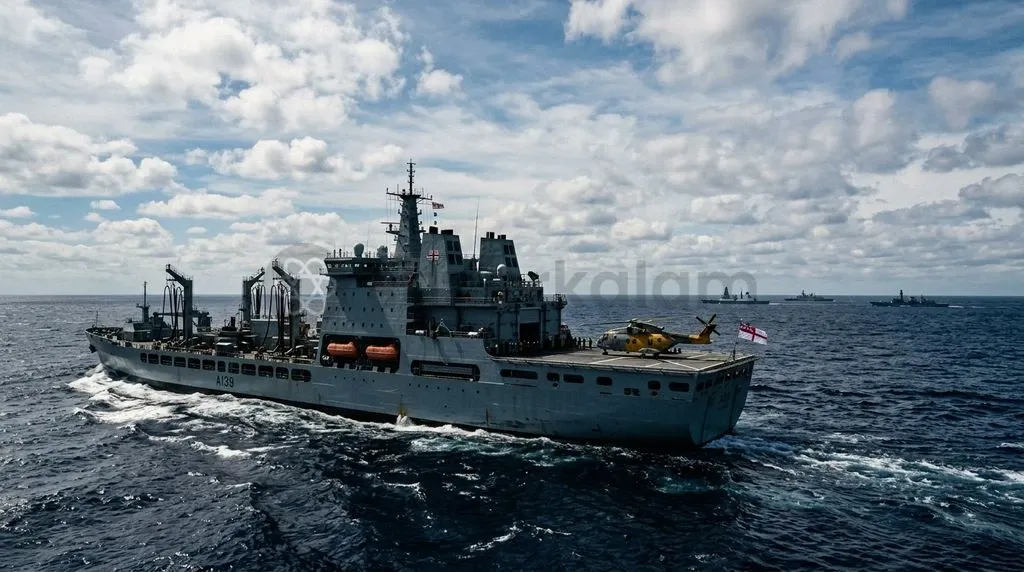
The launch of the 44,000-tonne Fleet Support Ship INS Surya at Hindustan Shipyard Limited marks a decisive structural pivot in India's maritime posture. It provides the persistent logistical endurance required to project blue-water naval power across the wider Indian Ocean Region.
According to the Press Information Bureau (PIB) release on the launch of FSS-1 Surya, Defence Minister Rajnath Singh launched the vessel on 6 October 2026. This platform is the first of five auxiliary vessels designed to deliver mid-sea replenishment of fuel, munitions, and provisions to frontline carrier battle groups.
Beyond extending mission reach without foreign docking, the ₹19,000-crore project achieves approximately 82% indigenous content. This reinforces domestic industrial capability while transforming the Indian Navy into an expeditionary force capable of sustained sea control and humanitarian operations.
Why in the News?
Defence Minister Rajnath Singh launched Surya, the Indian Navy's first indigenously designed Fleet Support Ship (FSS-1), at Hindustan Shipyard Limited (HSL) in Visakhapatnam on 6 October 2026.
As of October 2026, the milestone represents the physical launch of the vessel's hull into water rather than formal commissioning. Machinery outfitting and sea trials are scheduled ahead of mid-2027 delivery per Press Information Bureau (PIB) and Ministry of Defence statements.
During the ceremony, the Defence Minister also laid the keel for the fifth support ship (FSS-5). He inaugurated an upgraded Slipway-4 alongside a 300-tonne Goliath crane, expanding HSL's capacity to build vessels up to 45,000 deadweight tonnes.
What Are Fleet Support Ships and What Role Do They Play?
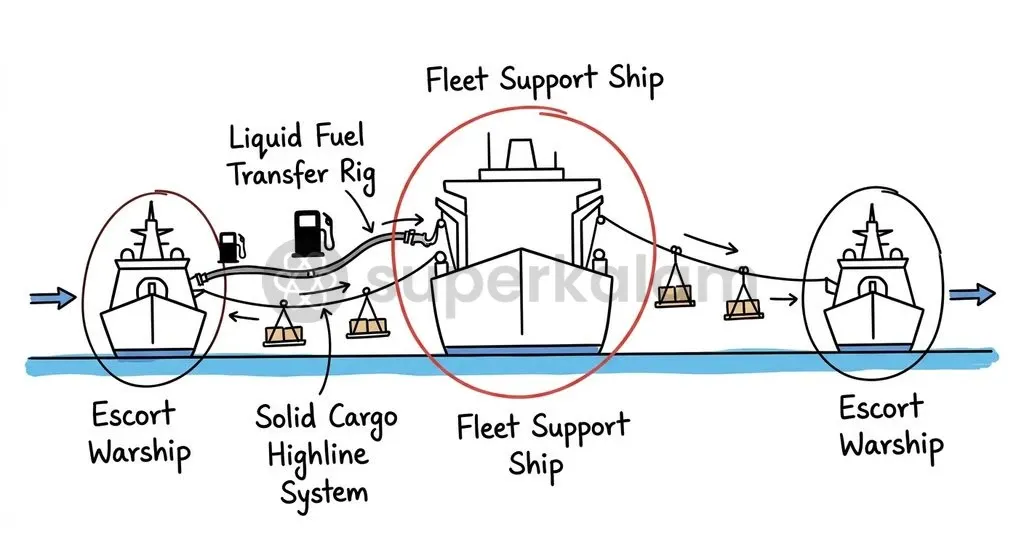
Fleet Support Ships are dedicated naval auxiliary vessels designed to provide underway replenishment to combatant warships while operating at sea. Underway replenishment (UNREP) transfers fuel, munitions, fresh water, and provisions directly to warships while underway. This eliminates the operational requirement to break patrol and return to port.
These auxiliary platforms serve as logistical force multipliers for naval task forces. By sustaining combat units directly in operational theatres, support ships allow frontline combatants to maintain continuous sea control and surveillance. Auxiliary vessels differ fundamentally from frontline combatants, prioritising volumetric cargo payload, mechanical pumping systems, and cargo transfer rigs over heavy offensive armaments.
| Dimension | Frontline Combatants (Destroyers / Frigates) | Auxiliary Fleet Support Ships (FSS) |
|---|---|---|
| Primary Mission | Anti-surface, anti-air, and anti-submarine warfare | Mid-sea logistics, replenishment, and technical repair |
| Cargo & Payload Capacity | Limited internal stores; prioritises weapon suites and sensors | Massive liquid and solid cargo capacity (fuel, water, munitions) |
| Operational Endurance | Highly constrained by onboard fuel and consumable storage | Extended endurance (up to 60 days) to sustain escort vessels |
| Armament Configuration | Heavy offensive and defensive missile systems, main guns, torpedoes | Point-defence weapons, decoy launchers, and light CIWS mounts |
| Aviation Role | Anti-submarine warfare and airborne early warning helicopters | Multi-role utility helicopters for vertical replenishment (VERTREP) |
Discuss with Superkalam
Recall the displacement, operational range, and indigenous content percentage of INS Surya mentioned in the article.
Ask NowKey Specifications and Operational Capabilities of INS Surya
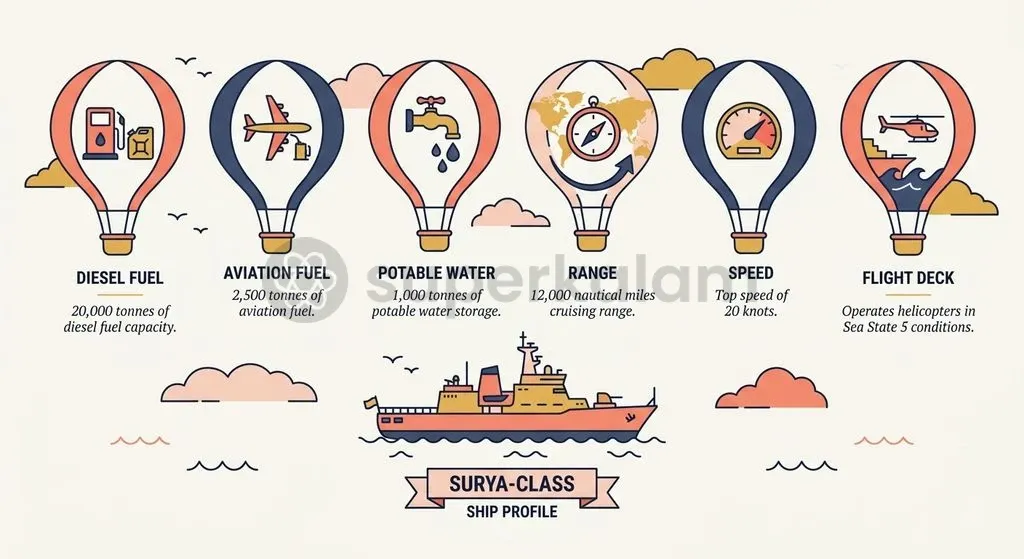
Surya-class vessels displace approximately 43,500 to 44,000 tonnes with an overall length of 223.6 metres and a beam of 31.5 metres. This makes them the heaviest auxiliary ships built by an Indian shipyard.
According to Hindustan Shipyard Limited and Ministry of Defence specifications, the platform features a maximum continuous cruising speed of 20 knots, a mission endurance of 60 days, and an unrefueled operational range of 12,000 nautical miles.
The vessel serves as a floating supply node with extensive cargo capacities:
- Liquid Fuel Cargo: Approximately 20,000 tonnes of low-sulphur high-speed diesel and 2,500 tonnes of aviation turbine fuel for carrier-borne fighters and shipborne helicopters.
- Water Reserves: Roughly 1,000 tonnes of fresh potable water and 250 tonnes of boiler feed water.
- Solid Stores & Munitions: Dedicated ammunition magazines, dry provisions, and victuals to support extended carrier strike group deployments.
- Technical Maintenance: Onboard engineering and electronics workshops designed to conduct mid-sea defect rectification and battle damage repairs on frontline combatants.
- Aviation Deck: A flight deck and hangar certified up to Sea State 5, supporting medium multi-role helicopters such as the MH-60R and Sea King 42B for vertical replenishment (VERTREP) and search-and-rescue tasks.
- Medical & Disaster Response: Dedicated surgical suites, casualty wards, and intensive care facilities to support humanitarian assistance and disaster relief (HADR) alongside non-combatant evacuation operations.
For organic self-defence in contested environments, reported technical analyses indicate the vessel is likely configured with close-in weapon systems (CIWS) such as AK-630 mounts, the Kavach chaff decoy launcher, the Mareech torpedo defence suite, and the Shakti electronic warfare suite.
Discuss with Superkalam
Explain how underway replenishment (UNREP) fundamentally changes a combatant warship's operational deployment cycle.
Ask NowIndigenisation and Aatmanirbhar Bharat in Modern Warship Construction
The ₹19,000-crore Fleet Support Ship programme embodies the Aatmanirbhar Bharat initiative by achieving an indigenous content level of approximately 82%. Contracted by the Ministry of Defence on 25 August 2023, the project integrates domestic raw materials, specialised marine equipment, and an extensive network of domestic micro, small, and medium enterprises (MSMEs).
The procurement strategy bridges public and private defence manufacturing through key arrangements:
- Dual-Yard Construction: To optimise delivery timelines and manage shipyard load, HSL subcontracted the construction of two vessels to Larsen & Toubro's Kattupalli Shipyard near Chennai.
- Employment Generation: Official projections by the Ministry of Defence estimate that the overall five-ship construction effort will generate 168.8 lakh man-days of industrial employment over an eight-year cycle.
Strategic Imperatives in the Indian Ocean Region: Countering Regional Challenges
China's People's Liberation Army Navy (PLAN) has expanded its auxiliary support architecture to project persistent expeditionary power into the Indian Ocean. According to the US Department of Defense Annual Report on Military and Security Developments Involving the PRC, Chinese naval logistics rely on two major capabilities:
- Replenishment Fleet: At least nine Type 903/903A replenishment oilers and two 45,000-tonne Type 901 fast combat support ships.
- Overseas Naval Bases: The military base at Doraleh in Djibouti, established in 2017 with deepwater piers capable of berthing large auxiliary ships and aircraft carriers.
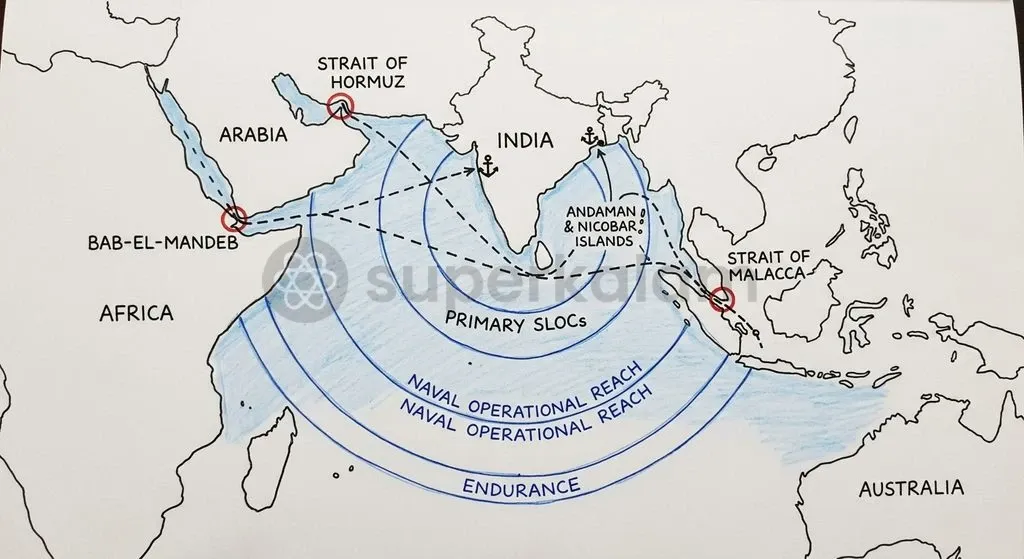
Beijing also maintains commercial port access across regional maritime nodes such as Gwadar in Pakistan, Hambantota in Sri Lanka, and Ream in Cambodia. To counter these dual-use maritime developments, the Indian Navy requires high-endurance auxiliary vessels to maintain persistent surveillance and sea denial along key Sea Lines of Communication.
Discuss with Superkalam
How can the aviation and medical facilities on INS Surya be applied during non-combat missions such as regional HADR operations?
Ask NowChallenges in Shipbuilding Timelines and Future Force Projections
Modern naval shipbuilding requires strict adherence to project timelines and supply chain coordination. The FSS programme faces two primary structural demands:
- Concurrent Hull Fabrication: Coordinating production across two distinct shipyards—HSL in Visakhapatnam and L&T Kattupalli—while integrating complex mid-sea liquid cargo handling systems and specialised marine propulsion units.
- Fleet Expansion Parity: Sustaining a target force structure of over 175 warships by 2035, demanding that auxiliary support vessels keep pace with the commissioning of destroyers, frigates, and conventional submarines.
Infrastructure upgrades mitigate these bottlenecks. The newly commissioned Slipway-4 and Goliath crane at HSL allow domestic yards to assemble large-displacement hulls entirely within India.
Discuss with Superkalam
Analyse the geopolitical implications of China's expanding auxiliary fleet and dual-use port infrastructure across the Indian Ocean Region.
Ask NowWay Forward: Expanding India's Maritime Logistics and Sea Denial Capabilities
Securing India's maritime interests across the Indo-Pacific requires deep integration between physical logistics platforms, forward operating bases, and international logistics sharing pacts:
- Forward Base Integration: The physical reach provided by INS Surya must be coupled with enhanced berthing and maintenance infrastructure at forward military hubs, particularly the Andaman and Nicobar Command.
- Logistics Sharing Pacts: India must leverage its bilateral logistics agreements—such as the Logistics Exchange Memorandum of Agreement (LEMOA) with the United States and similar pacts with France, Australia, and Japan—alongside organic replenishment assets.
Combining high-capacity fleet support ships with access to partner facilities establishes an operational safety net for naval task forces operating across the wider Indo-Pacific theatre.
Key Takeaways
- Launch Milestone: Defence Minister Rajnath Singh launched the 44,000-tonne Fleet Support Ship INS Surya (FSS-1) at Hindustan Shipyard Limited, Visakhapatnam, on 6 October 2026.
- Force Multiplication: Procured under a ₹19,000-crore contract signed in August 2023, the five Surya-class auxiliary vessels more than double the Indian Navy's mid-sea replenishment capacity.
- Operational Reach: With an unrefueled operational range of 12,000 nautical miles and 60 days of mission endurance, Surya can transfer approximately 20,000 tonnes of diesel and 2,500 tonnes of aviation fuel mid-sea.
- Indigenous Industrial Base: The programme achieves 82% indigenous content, dividing construction between HSL and L&T Kattupalli while generating an estimated 168.8 lakh man-days of employment.
- Strategic Balancing: Enhanced underway replenishment counters expanding Chinese naval deployments and dual-use maritime infrastructure across the Indian Ocean Region.
Mains Question
"Auxiliary vessels serve as vital logistical force multipliers essential for transforming a regional naval force into an expeditionary blue-water navy." In light of the launch of INS Surya, elucidate the strategic significance of Fleet Support Ships for India's maritime posture. (10 Marks)
Evaluate NowMains Question
"The ₹19,000-crore Fleet Support Ship programme embodies the dual imperatives of bolstering maritime operational reach and enhancing domestic defence manufacturing." Critically analyse the strategic, industrial, and execution dimensions of this project amidst evolving Indian Ocean security dynamics. (15 Marks)
Evaluate NowPractice MCQs
QUESTION 1
With reference to the Surya-class Fleet Support Ships (FSS), consider the following statements:
- They possess an operational unrefueled range of approximately 12,000 nautical miles with a continuous mission endurance of 60 days.
- The platform is designed to carry both low-sulphur high-speed diesel and aviation turbine fuel to support carrier strike group operations.
- The aviation deck and hangar facilities are certified to operate medium multi-role helicopters up to Sea State 5.
Which of the statements given above are correct?
QUESTION 2
Consider the following statements regarding the construction and procurement framework of India's Fleet Support Ship (FSS) programme:
- The ₹19,000-crore FSS programme achieves an indigenous content level of approximately 82%.
- Under a dual-yard construction arrangement, Hindustan Shipyard Limited subcontracted the construction of two vessels to Larsen & Toubro's Kattupalli Shipyard.
- The milestone achieved on 6 October 2026 marked the formal commissioning and operational deployment of INS Surya into the Indian Navy.
Which of the statements given above is/are correct?
QUESTION 3
Consider the following statements regarding maritime logistics and naval capabilities in the Indian Ocean Region:
- The induction of five Surya-class vessels will more than double the Indian Navy's existing underway replenishment capacity.
- China's People's Liberation Army Navy operates 45,000-tonne Type 901 fast combat support ships alongside an overseas military naval base at Doraleh in Djibouti.
Which of the statements given above is/are correct?
QUESTION 4
Which of the following best describes the primary operational purpose of 'Underway Replenishment' (UNREP) in blue-water naval doctrine?
QUESTION 5
Consider the following statements regarding the auxiliary support vessels of the Indian Navy:
- The historical replenishment fleet of the Indian Navy includes INS Jyoti, INS Aditya, INS Deepak, and INS Shakti.
- Unlike frontline combatants that prioritise offensive missile suites, auxiliary Fleet Support Ships prioritise volumetric cargo capacity, pumping systems, and cargo transfer rigs.
Which of the statements given above is/are correct?





