Sovereign AI and India's Digital Public Infrastructure - UPSC Mains Notes
Discover how India transitions from transactional digital rails to predictive, state-backed AI governance through the IndiaAI Mission.
Aug, 2026
•10 min read
Overview

Fig: India's Sovereign AI strategy integrates indigenous language models and public supercomputing with established DPI rails like Aadhaar and UPI to power predictive governance.
India's transition to Sovereign AI represents a structural shift from passive, transactional Digital Public Infrastructure (DPI) to state-backed, predictive governance. This evolution leverages localised foundational models alongside an open compute architecture. As of July 2026, the Union Cabinet’s ₹10,371.92 crore IndiaAI Mission underpins this strategy by funding public compute clusters, curated datasets, and indigenous language models.
By embedding intelligence into public rails like AgriStack, the Ayushman Bharat Digital Mission, and Bhashini, India aims to democratise automated public service delivery while safeguarding national data sovereignty. However, realizing this vision requires navigating a major trade-off. High capital barriers for GPU compute allocations and heavy regulatory compliance under the data protection framework threaten to concentrate power among well-funded entities, potentially recreating the very data monopolies that sovereign open-stack infrastructure is designed to prevent.
Why India's Open Stack Strategy Needs an AI Overhaul
India's original Digital Public Infrastructure (DPI) framework relied on non-proprietary rails like Aadhaar and Unified Payments Interface (UPI) to solve basic transactional identity and financial inclusion bottlenecks. These foundational layers allowed millions of citizens to authenticate identity digitally and conduct low-cost peer-to-peer financial transactions.
However, rule-based transactional rails cannot interpret unstructured local data, predict agricultural shocks, or deliver personalised healthcare advice across diverse languages. To move beyond simple transaction execution toward intelligent service delivery, public systems require an AI-driven structural overhaul. According to the Office of the Principal Scientific Adviser, India promotes an open stack AI approach that treats dataset platforms, language translation frameworks, and foundational model APIs as Digital Public Goods.
| Architecture Layer | Core Components & Functions |
Intelligent Governance Layer (AI-DPI) | Predictive agriculture, voice-based welfare, and adaptive EdTech. |
Data Empowerment Layer (DEPA Framework) | Consent managers, account aggregators, and privacy-by-design systems. |
Transactional Core Layer (Traditional DPI) | Aadhaar identity rails and UPI financial infrastructure. |
This evolution alters the role of the state from a digital pipe provider to an active enabler of predictive governance. AI integration allows government platforms to analyze complex datasets in real time and deliver automated, proactive interventions to citizens:
- Predictive Agriculture: The Department of Agriculture & Farmers Welfare launched the Krishi Decision Support System (Krishi-DSS) in August 2024, which integrates satellite remote sensing, weather forecasts, and soil data directly into AgriStack for yield estimation.
- Intelligent Healthcare: Data released by MeitY shows that the Ayushman Bharat Digital Mission (ABDM) has generated over 93 crore unique Ayushman Bharat Health Accounts (ABHA) and linked more than 104 crore digital health records. AI algorithms parse these records to detect regional disease outbreaks early.
- Adaptive Education: Under PM e-Vidya, the DIKSHA platform incorporates Personalised Adaptive Learning (PAL) tools and AI speech technologies to tailor educational content to individual student learning paces.
While early DPI was lightweight and low-compute, AI-driven public infrastructure requires massive computational capacity and large-scale data processing. This structural shift introduces a new risk: if compute access and data governance become concentrated, the open-stack ethos of Indian digital governance could be compromised.
What is Sovereign AI in the Context of Digital Public Infrastructure?
Sovereign AI refers to a nation's capacity to build, deploy, and govern artificial intelligence models using indigenous computing infrastructure, domestic datasets, and open-source foundation architectures. In the context of DPI, sovereignty ensures that critical public governance algorithms remain independent of foreign proprietary software stacks and external geopolitical pressures.
According to a press release by MeitY, as of July 2026, the IndiaAI Mission selected 20 indigenous sovereign AI model proposals for state support, comprising 12 Large Language Models (LLMs) and 8 Small Language Models (SLMs). A Large Language Model is a deep-learning algorithm trained on vast text datasets to parse and generate human language, whereas a Small Language Model uses a more compact parameter size optimised to run efficiently on lower-spec local hardware.
| Attribute | Traditional Transactional DPI | AI-Augmented Sovereign DPI |
Primary Function | Identity verification and payment settlement | Predictive analysis and natural language service delivery |
Core Architecture | Relational databases and standardized API gateways | Deep learning neural networks and foundational language models |
Data Interaction | Structured demographic and transactional records | Unstructured voice, satellite imagery, and clinical health data |
Compute Demand | Low-latency, basic server infrastructure | High-performance GPU clusters and supercomputing grids |
Governance Focus | System uptime and transaction security | Model bias, algorithmic accountability, and data sovereignty |
Building domestic AI models prevents cultural misinterpretation and algorithmic bias in public administration. Foreign models trained primarily on Western datasets frequently fail to process the linguistic nuance, socio-economic context, and localized administrative structures of Indian states.
Building Blocks: How AI Augments Existing DPI Pillars Like Aadhaar and UPI
Language frameworks under the BHASHINI mission integrate directly with existing digital identity and payment layers to convert text-heavy public service interfaces into voice-based regional interactions. Developed as the National Language Translation Mission under MeitY, Digital India BHASHINI provides open-source voice and text AI models across 22 Scheduled Indian languages.
- Citizen Input: Spoken regional voice prompt from the user.
- BHASHINI Processing: Speech-to-text translation across 22 Scheduled languages.
- AI Scheme Engine: Generative model processes query logic and identifies applicable welfare programs.
- Authentication & Payments: Direct routing through Aadhaar identity and UPI payment rails.
- Entitlement Delivery: Automated execution of Direct Benefit Transfer (DBT).
Integrating voice-based AI layers with transactional identity rails reduces literacy barriers, allowing non-literate citizens to access welfare state entitlements through simple voice prompts:
- Voice-Driven Welfare Access: The Ministry of Agriculture deployed Kisan e-Mitra, an AI chatbot for the PM-KISAN scheme that resolves farmer welfare queries in regional languages using natural language processing.
- Conversational Assistance over Messaging Applications: As reported in May 2023 by Microsoft News Center, the open-source Jugalbandi AI chatbot uses Bhashini translation models and generative AI over WhatsApp to explain over 170 central government schemes to rural citizens in local spoken dialects.
- Voice-Enabled Micro-Payments: AI models embedded into payment platforms translate spoken local language commands into encrypted payment instructions, routing them securely through the UPI rail.
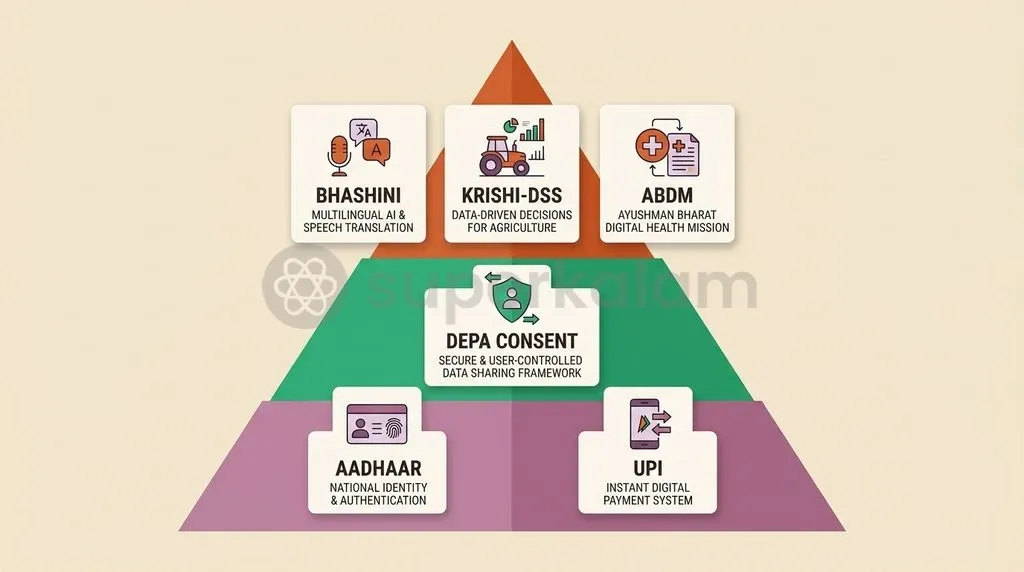
Fig: The transition from transactional DPI to AI-augmented DPI adds consent management and natural-language AI layers on top of traditional identity and payment rails.
Unlocking Data Empowerment: Integrating DEPA with National AI Models
NITI Aayog developed the Data Empowerment and Protection Architecture (DEPA) as a techno-legal framework to give citizens granular control over personal data sharing across digital infrastructure. DEPA replaces blanket data scraping with a consent-driven protocol managed by licensed, legally accountable Consent Managers.
Integrating DEPA with national AI models solves a core tension in public artificial intelligence: accessing high-quality training datasets without violating individual privacy rights. Consent Managers act as neutral intermediaries, executing machine-readable consent parameters specified by the citizen.
- Consent Request: National AI Model Trainer sends a granular data access request to the citizen.
- Consent Token: Citizen grants approval, generating a machine-readable consent token.
- Protocol Validation: Token passes to DEPA Consent Manager, which enforces scope, purpose, expiry, and anonymisation.
- Anonymised Data Stream: Verified data stream flows from the Data Fiduciary (e.g., ABDM health records or AgriStack soil data).
The framework enables anonymized data flows to train domain-specific models, such as diagnostic algorithms for Indian public healthcare, while maintaining security safeguards:
- Granular Consent Scoping: Citizens specify the exact purpose, duration, and data points accessible to an AI training pipeline.
- Privacy-Preserving Training: AI models run on aggregated, anonymized data streams derived via DEPA protocols rather than raw, identifiable personal records.
- Statutory Compliance Anchors: The statutory framework under the Digital Personal Data Protection (DPDP) Act, 2023 reinforces DEPA by establishing the Data Protection Board of India to enforce compliance and penalize unauthorized processing up to ₹250 crore.
Discuss with Superkalam
How does integrating BHASHINI with Aadhaar and UPI enable voice-driven welfare delivery?
Ask NowState-Led Infrastructure: Evaluating AIRAWAT and Public Supercomputing
The Centre for Development of Advanced Computing (C-DAC) in Pune hosts AIRAWAT, an AI supercomputer deployed under the National Program on AI that achieved 200 AI Petaflops mixed-precision compute. In June 2023, AIRAWAT achieved global recognition when it was ranked 75th on the prestigious TOP500 list of international supercomputers.
To expand public compute capacity, the Union Cabinet approved the comprehensive IndiaAI Mission in March 2024 with a budget outlay of ₹10,371.92 crore over five years. The mission is structured across seven core pillars:
- IndiaAI Compute Capacity: Establishing a public-private computing infrastructure deploying 10,000 or more GPUs using Viability Gap Funding (VGF).
- IndiaAI Foundation Models: Developing and fine-tuning indigenous multi-modal foundational models.
- IndiaAI Application Development Initiative: Promoting AI applications in high-priority socio-economic sectors.
- AIKosh: Serving as a national unified data platform for hosting non-personal, high-quality public datasets.
- IndiaAI Startup Financing: Providing early-stage capital and compute subsidies to domestic deep-tech AI startups.
- IndiaAI FutureSkills: Expanding specialized graduate and post-graduate AI education streams across universities.
- Safe & Trusted AI: Formulating governance guidelines, algorithmic auditing tools, and privacy-enhancing frameworks.
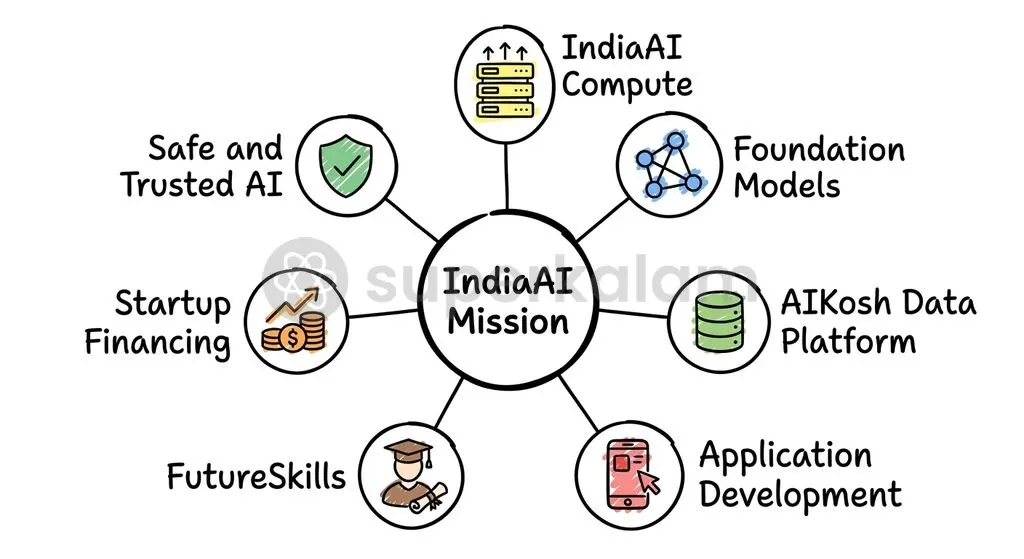
Fig: The IndiaAI Mission structures its ₹10,371.92 crore allocation across seven core pillars to support domestic compute capacity and indigenous foundational models.
Balancing Open-Source Innovation with Data Sovereignty and Security
The Digital Personal Data Protection Act, 2023 establishes legal obligations for data fiduciaries while safeguarding citizen privacy across public and private AI application deployments. Under Rule 13 of the Digital Personal Data Protection Rules 2025, designated Significant Data Fiduciaries must perform annual Data Protection Impact Assessments (DPIAs), undergo independent audits, execute algorithmic due diligence, and adhere to localized data storage requirements for specified data flows.
Here lies the central policy paradox of India’s Sovereign AI strategy. While the IndiaAI Mission uses Viability Gap Funding to subsidize access to its targeted 10,000+ GPU compute pool, high legal compliance costs under Rule 13 can disproportionately burden small AI startups.
| Policy Tension Factor | Operational & Systemic Impact |
Compute Concentration | High capital outlay forces small firms to rely on state or big-tech GPU infrastructure. |
Heavy Compliance Burden | Mandatory DPIAs, audits, and data localisation under DPDP raise entry barriers for early startups. |
Systemic Risk | Creation of public or private compute monopolies, defeating the open-stack ethos. |
An early-stage enterprise building a localized Small Language Model faces significant capital hurdles:
- Compute Access Costs: Advanced GPU resources remain capital-intensive, forcing startups to rely heavily on centralized state allocations or large corporate cloud providers.
- Compliance Costs: Carrying out mandatory annual DPIAs, independent algorithmic audits, and localized data management requires dedicated legal and technical compliance teams.
If public supercomputing allocations favor established players while regulatory costs price out small innovators, India risks creating public or private compute monopolies. This dynamic threatens to undermine the non-proprietary, open-stack philosophy that made India's original DPI ecosystem successful.
Global Benchmarks: Where India Stands in Global AI Governance Like GPAI
The Global Partnership on Artificial Intelligence (GPAI) adopted the GPAI New Delhi Declaration in December 2023 during its summit hosted in New Delhi. Member countries pledged to advance safe, secure, and trustworthy AI while ensuring equitable access to computing infrastructure and open datasets for global south nations.
| Governance Model | Core Paradigm & Structural Approach |
United States Model | Market-led approach driven by private tech markets and rapid commercial scale. |
European Union Model | Risk-based approach with strict compliance tiers enforced under the EU AI Act. |
Indian Sovereign Model | Open-stack approach treating public compute, Bhashini translation, and DEPA as Digital Public Goods. |
India’s open-stack approach offers a distinct alternative to global AI governance frameworks:
- The United States Model: Primarily market-driven and led by private tech monopolies, prioritizing rapid commercial scaling with minimal up-front federal regulation.
- The European Union Model: Heavily precautionary and risk-based, enforcing strict compliance tiers under the EU AI Act that can sometimes constrain foundational innovation.
- The Indian Model: Centered on public infrastructure. India treats compute grids, translation models like Bhashini, and consent architectures like DEPA as Digital Public Goods, enabling private entities to innovate on top of publicly funded infrastructure.
By championing open stacks at GPAI, India positions itself as a leader for Global South economies seeking digital autonomy without resorting to protectionist internet fragmentation.
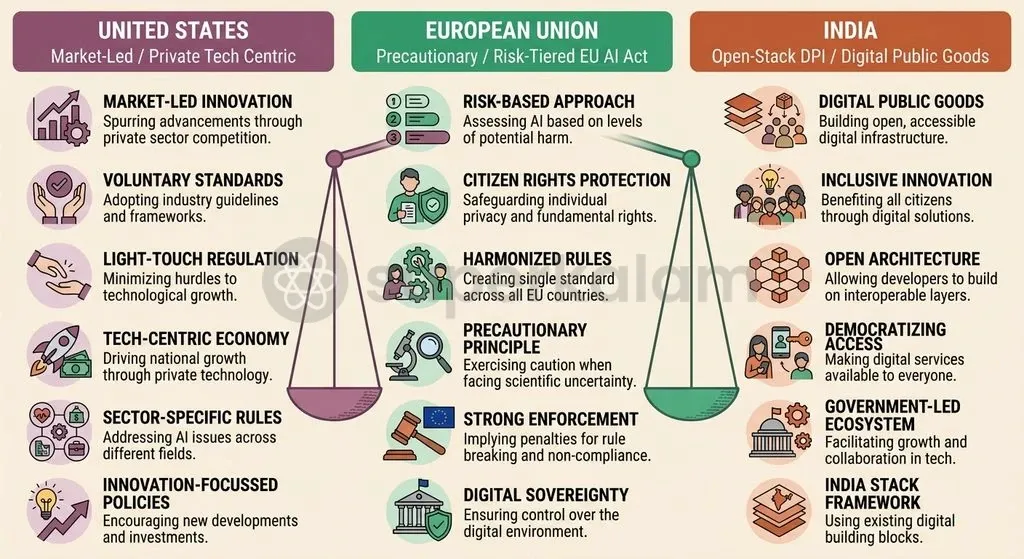
Fig: Unlike market-led US approaches or heavily restrictive EU regulations, India's Sovereign AI model promotes foundational compute and models as Digital Public Goods.
Discuss with Superkalam
Can AIRAWAT and the IndiaAI Mission prevent data monopolies in digital public infrastructure?
Ask NowThe Way Forward: Securing an Inclusive and Sovereign AI Future
Sustaining India's digital public infrastructure requires democratising supercomputing access for startups while streamlining regulatory compliance burdens for data fiduciaries under statutory frameworks. To ensure Sovereign AI remains inclusive, national policy must prioritize three key interventions:
- Decentralised Compute Subsidies: The MeitY allocation under the IndiaAI Mission's GPU rollout must implement tiered Viability Gap Funding (VGF) that prioritises early-stage deep-tech startups and academic research institutions over established cloud vendors.
- Proportional Regulatory Sandbox Frameworks: The Data Protection Board of India should establish statutory sandboxes under the DPDP framework. These sandboxes would allow small entities developing Small Language Models (SLMs) to perform algorithmic due diligence and DPIA testing without incurring immediate financial penalties.
- Standardised Consent Interfaces: NITI Aayog and technical standards bodies must standardize open-source DEPA consent APIs. Providing ready-to-use consent modules reduces integration costs for indigenous developers, ensuring personal data processing remains transparent and compliant.
By balancing state-led computing investments with balanced regulatory standards, India can build a resilient Sovereign AI ecosystem that advances public welfare without sacrificing market competition.
Key Takeaways
Key takeaways summarise the critical statutory, architectural, and financial developments shaping India's sovereign artificial intelligence framework and digital public infrastructure integration.
- Financial & Programmatic Blueprint: The Union Cabinet approved the ₹10,371.92 crore IndiaAI Mission in March 2024 across seven key pillars, aiming to establish a public computing capacity of 10,000+ GPUs through Viability Gap Funding.
- Public Supercomputing Capacity: C-DAC Pune operates AIRAWAT, an AI supercomputer achieving 200 AI Petaflops mixed-precision compute, which was ranked 75th globally on the TOP500 list in June 2023.
- Linguistic Democratisation Rail: The BHASHINI mission provides open-source voice and text translation models across 22 Scheduled languages, powering voice-based AI access to welfare schemes like Kisan e-Mitra and Jugalbandi.
- Statutory Compliance Mandates: The DPDP Act, 2023 sets penalty caps up to ₹250 crore, while Rule 13 of the DPDP Rules 2025 requires Significant Data Fiduciaries to execute annual DPIAs, independent audits, algorithmic due diligence, and localized processing.
- Global AI Diplomacy: Member states adopted the GPAI New Delhi Declaration in December 2023, endorsing India's strategy of treating foundational AI tools and consent frameworks as Digital Public Goods.
Mains Question
"While sovereign AI promises inclusive governance, high capital barriers for GPU compute allocations and heavy regulatory compliance threaten to concentrate power among well-funded entities." Critically analyse the operational and infrastructure trade-offs in building state-backed supercomputing capacity for public governance.
Evaluate NowMultiple Choice Questions
QUESTION 1
Q1. Under the Safe & Trusted AI Pillar of the IndiaAI Mission, how many indigenous sovereign AI model proposals were selected for state support as of July 2026?
QUESTION 2
Q2. Consider the following pairs of AI public service interventions and their associated platforms:
- Kisan e-Mitra : PM-KISAN AI chatbot for regional language farmer queries
- Jugalbandi : WhatsApp chatbot explaining central government schemes using Bhashini translation models
- Personalised Adaptive Learning (PAL) : DIKSHA platform under PM e-Vidya
Which of the pairs given above is/are correctly matched?
QUESTION 3
Q3. Consider the following statements regarding supercomputing infrastructure for Sovereign AI in India:
- The AIRAWAT supercomputer is hosted at the Centre for Development of Advanced Computing (C-DAC) in Pune.
- AIRAWAT achieved 200 AI Petaflops mixed-precision compute performance under the National Program on AI. 3. AIRAWAT was ranked 75th on the TOP500 list of international supercomputers in June 2023.
Which of the statements given above are correct?