SME Growth Fund: Rs10,000 Crore Equity Support Explained
The Cabinet approved a Rs10,000 crore commitment for the SME Growth Fund. Read why equity financing matters for small and medium enterprises.
Oct, 2026
•7 min read

Overview
The SME Growth Fund approved by the Union Cabinet represents a structural shift in India's industrial financing strategy by deploying patient equity capital through an Alternative Investment Fund structure, moving high-potential enterprises away from debt overhang toward loss-absorbing equity capital. According to the Economic Survey 2025-26, micro, small, and medium enterprises contribute 31.1% of India's GDP, 35.4% of manufacturing output, and 48.58% of total exports. As of October 2026, formal enterprise registrations on the Udyam and Udyam Assist platforms have expanded to 9.78 crore enterprises supporting 43.28 crore jobs, underscoring the urgency of transitioning viable units from credit dependence to scalable equity backing. By blending sovereign anchor capital with private venture funds, this framework aims to overcome structural dwarfism and build globally competitive manufacturing champions.
Why in the News: The Strategic Push for MSME Equity Capital
The Union Cabinet approved a commitment of ₹10,000 crore on October 6, 2026, to establish the SME Growth Fund. This dedicated corpus addresses a long-standing structural gap in small-enterprise financing by providing growth-stage units with non-debt risk capital.
Formal registrations under the Udyam and Udyam Assist Platform (UAP) reached approximately 9.78 crore enterprises reporting 43.28 crore employment opportunities as of October 6, 2026. While credit guarantees and interest subventions provided emergency liquidity in prior years, commercial scaling requires balance-sheet strength rather than accumulated debt liabilities.
The strategic push aligns with macroeconomic targets to expand domestic manufacturing value-addition and export share. Channelling equity to small enterprises helps promising units expand operational capacity without increasing immediate debt-servicing burdens.
The Missing Middle: Why Indian MSMEs Struggle with Debt-Led Growth
The Reserve Bank of India has highlighted that excessive reliance on debt financing leaves small enterprises vulnerable to macroeconomic downturns. Conventional bank loans require strict collateral covenants and continuous monthly interest servicing, which drains operational cash flows during unexpected demand contractions.
The RBI Expert Committee on MSMEs chaired by ⚠️ VERIFY estimated the formal MSME credit gap at ₹20 to ₹25 lakh crore. Traditional commercial banks hesitate to lend beyond collateral values, leaving fast-growing enterprises starved of the capital needed to upgrade technology or expand manufacturing footprint.
Emergency support mechanisms like the Emergency Credit Line Guarantee Scheme (ECLGS) provided 100% credit guarantee cover to financial institutions during liquidity shocks. However, guarantee mechanisms expanded total debt obligations without improving the underlying net worth of borrowing enterprises.
Discuss with Superkalam
How does the 1:4 leverage ratio in the Mother Fund-Daughter Fund model enable sovereign funds to mobilize larger pools of private venture capital?
Ask NowWhat is the SME Growth Fund Architecture?
The SME Growth Fund operates as an Alternative Investment Fund designed to channel venture-style risk capital into scaling industrial units. Structured under SEBI regulations, the platform operates primarily through Category-I and Category-II Alternative Investment Funds (AIFs) managed by institutional trustees such as SIDBI Venture Capital Limited.
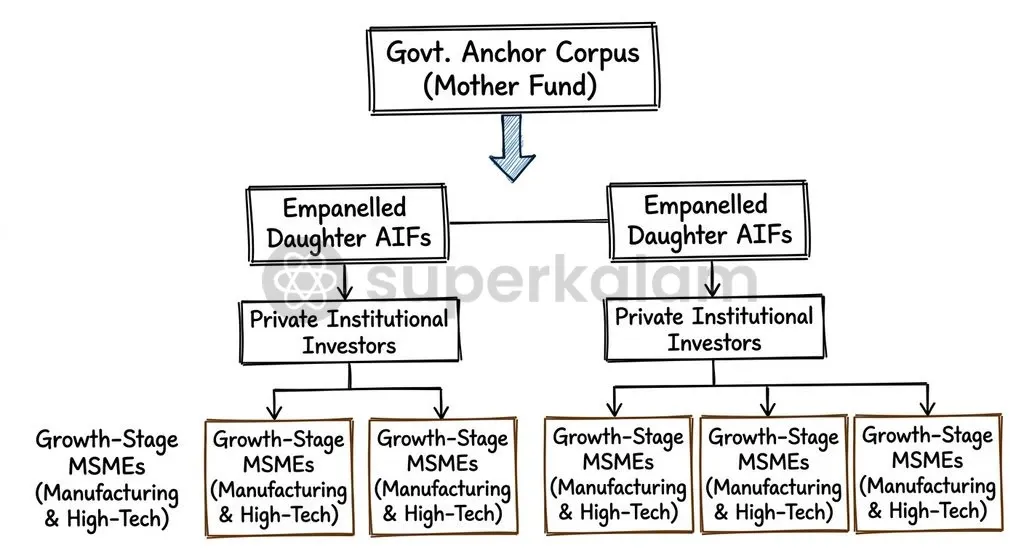
The initiative builds on the operational architecture of the Self-Reliant India (SRI) Fund, which pioneered the Mother Fund-Daughter Fund model. Under this structure:
- The Government of India acts as the anchor investor in the Mother Fund.
- The Mother Fund invests up to 20% of the corpus in specialized Daughter Funds (a 1:4 leverage ratio).
- Empanelled Daughter Funds raise the remaining 80% capital from private venture capital, institutional investors, and financial institutions.
- Daughter Funds execute direct equity and quasi-equity investments into eligible growth-stage enterprises.
As of March 2025, the precursor SRI Fund had channelled ₹10,979 crore of equity and quasi-equity investment across 577 MSME units through 60 empanelled Daughter Funds. The newly approved ₹10,000 crore SME Growth Fund expands this equity pipeline to ensure sustained patient capital for scaling enterprises.
Discuss with Superkalam
Analyse how regulatory thresholds and debt-servicing burdens historically incentivized Indian small businesses to stay small rather than scale into medium enterprises.
Ask NowDebt vs Equity Financing: Key Differences for Growing Enterprises
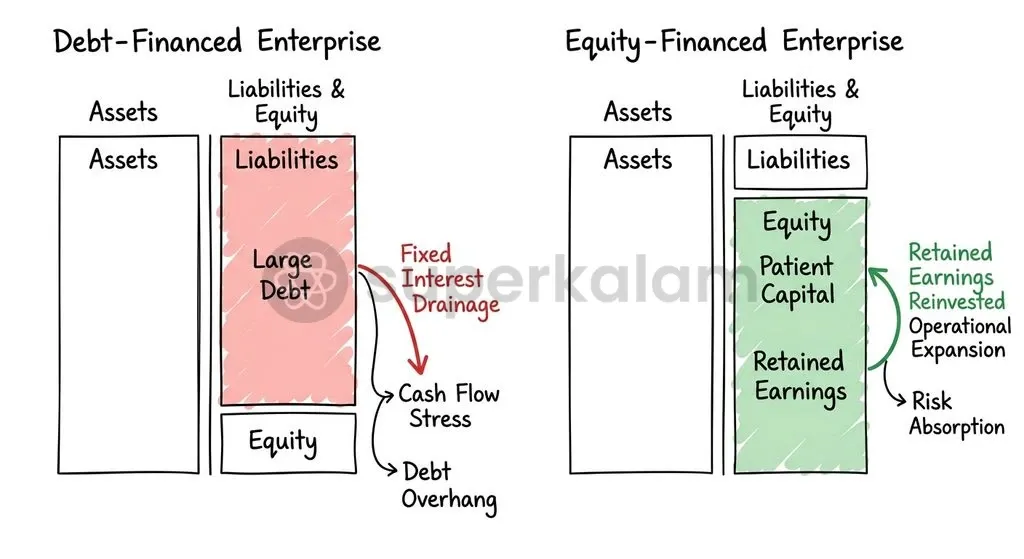
Financing instruments differ fundamentally in risk allocation, capital cost, and ownership structure for expanding micro, small, and medium enterprises. While debt imposes a contractual liability regardless of business performance, equity financing provides loss-absorbing patient capital that aligns the investor's returns directly with enterprise expansion.
| Parameter | Debt Financing (e.g., Bank Loans / CGTMSE) | Equity Financing (e.g., SME Growth Fund / AIFs) |
|---|---|---|
| Capital Obligation | Mandatory periodic interest and principal repayment | No fixed servicing liability; returns tied to profits and valuation |
| Collateral Requirement | Requires physical collateral or third-party guarantee cover | Zero physical collateral; investment backed by enterprise valuation |
| Cash-Flow Impact | Drains monthly operational liquidity during gestation periods | Preserves operational cash flow for research, scaling, and hiring |
| Risk Bearing | Enterprise carries all downside default risk | Investor shares commercial downside as loss-absorbing capital |
| Governance & Value Addition | Passive oversight limited to loan covenants and recovery | Active board participation, strategic mentoring, and governance upgrades |
| Exit Mechanism | Loan closure upon complete repayment | Secondary stake sales, private equity buyouts, or SME public listings |
Discuss with Superkalam
Evaluate whether expanding credit guarantee schemes like CGTMSE is more effective than deploying equity funds like the SME Growth Fund in supporting technology-intensive MSMEs.
Ask NowOvercoming Dwarfism: How Equity Unlocks Long-Term Expansion
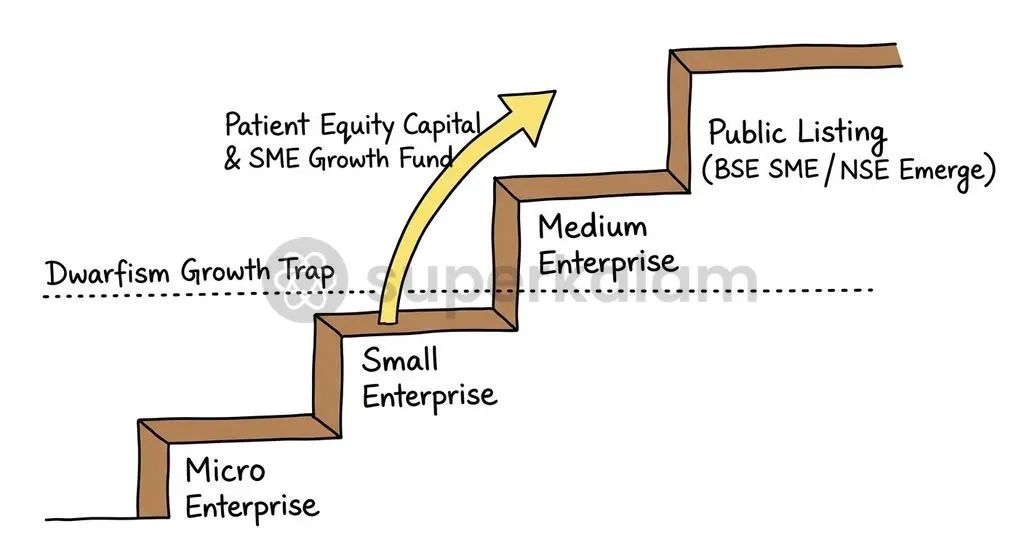
The Economic Survey documented enterprise dwarfism as a structural barrier where size-based regulatory thresholds disincentivise small firms from scaling. Small units intentionally suppress growth to retain priority-sector lending advantages, tax concessions, and compliance exemptions, resulting in an industrial landscape dominated by older, unproductive micro-enterprises rather than dynamic giants.
Under revised classification thresholds effective from April 1, 2025, the MSME framework defines:
- Small Enterprises: Investment in plant and machinery up to ₹25 crore and turnover up to ₹100 crore.
- Medium Enterprises: Investment up to ₹125 crore and turnover up to ₹500 crore.
Patient equity capital allows enterprises to cross these thresholds comfortably. By strengthening net worth and modernising corporate reporting, equity backing prepares small firms for initial public offerings on dedicated BSE and NSE SME platforms, establishing secondary market liquidity and institutional credibility.
Policy Lessons: Key Committee Insights on Small Business Capital
The U.K. Sinha Committee recommended establishing a ₹10,000 crore government-sponsored Fund of Funds to institutionalise venture equity for MSMEs. The panel noted that traditional banking channels are structurally ill-suited for underwriting technology adoption, product innovation, and intangible assets.
Government policy has simultaneously de-risked debt through the Credit Guarantee Fund Trust for Micro and Small Enterprises (CGTMSE), jointly established by the Ministry of MSME and SIDBI. The trust enhanced its credit guarantee ceiling up to ₹10 crore to enable collateral-free bank lending.
A balanced financial ecosystem combines credit guarantees for micro-level working capital with equity interventions for growth-stage enterprises. While CGTMSE cushions commercial banks against immediate credit defaults, the SME Growth Fund supplies the risk capital required for global export competitiveness.
Way Forward: Creating a Viable Growth Ecosystem for Small Businesses
Sustained industrial growth requires integrating credit guarantee platforms with deeper domestic venture capital and streamlined public listing mechanisms. Relying solely on debt interventions restricts enterprise scale and increases systemic banking vulnerabilities during global trade shocks.
Policymakers must prioritise several targeted measures:
- Expanding Daughter Fund Empanelment: Accelerating private capital onboarding into Category-I and Category-II AIFs to maximise the 1:4 leverage multiplier.
- Deepening SME Capital Markets: Simplifying compliance norms on SME exchange platforms of BSE and NSE to create reliable exit routes for early equity investors.
- Capacity Building for Equity Readiness: Establishing technical assistance cells via SIDBI to train first-generation promoters in equity dilution, valuation metrics, and formal accounting standards.
- Targeting High-Value Sectors: Prioritising equity deployment toward export-oriented manufacturing, green-technology supply chains, and import-substituting component industries.
Discuss with Superkalam
What institutional mechanisms or capacity-building measures should SIDBI implement to overcome first-generation entrepreneurs' hesitation toward equity dilution?
Ask NowKey Takeaways
- Strategic Anchor: The Union Cabinet approved a ₹10,000 crore commitment on October 6, 2026, to establish the SME Growth Fund as an Alternative Investment Fund.
- Macro Contribution: According to the Economic Survey 2025-26, MSMEs generate 31.1% of GDP, 35.4% of manufacturing output, and 48.58% of exports.
- Structural Leverage: Operating on the Mother Fund-Daughter Fund model established under the SRI Fund, public capital mobilises private venture funds at a 1:4 leverage ratio.
- Tackling Dwarfism: Equity injection provides loss-absorbing capital that allows firms to scale past revised MSME thresholds (Small: ₹25 cr investment / ₹100 cr turnover; Medium: ₹125 cr investment / ₹500 cr turnover) without debt overhang.
- Policy Synergy: While CGTMSE offers collateral guarantees up to ₹10 crore for bank lending, equity funds address the ₹20 to ₹25 lakh crore credit gap identified by the U.K. Sinha Committee.
Mains Question
'While credit guarantee schemes like ECLGS and CGTMSE have addressed short-term liquidity bottlenecks, debt-led financing alone is inadequate to cure structural enterprise dwarfism.' In light of the newly approved SME Growth Fund, critically examine the role of equity financing in scaling India's MSME sector. (15 Marks)
Evaluate NowMains Question
The Mother Fund-Daughter Fund architecture leverages sovereign anchor capital to crowd in private venture investments for small enterprises. Elucidate the operational structure of the SME Growth Fund and its significance for industrial competitiveness. (10 Marks)
Evaluate NowPractice MCQs
QUESTION 1
With reference to the SME Growth Fund architecture approved by the Union Cabinet, consider the following statements:
- The Fund is structured under SEBI regulations primarily through Category-I and Category-II Alternative Investment Funds (AIFs).
- Under the Mother Fund-Daughter Fund model, the Mother Fund invests up to 20% of the corpus into Daughter Funds, achieving a 1:4 leverage ratio.
- The Daughter Funds exclusively deploy collateral-backed debt instruments with fixed monthly servicing covenants. Which of the statements given above is/are correct?
QUESTION 2
Consider the following statements regarding MSME classification thresholds and financing dynamics in India:
- Under revised classification thresholds effective from April 1, 2025, Small Enterprises are defined by investment in plant and machinery up to ₹25 crore and turnover up to ₹100 crore.
- Medium Enterprises are defined by investment up to ₹125 crore and turnover up to ₹500 crore.
- The RBI Expert Committee chaired by U.K. Sinha estimated the formal MSME credit gap at ₹20 to ₹25 lakh crore. Which of the statements given above are correct?
QUESTION 3
With reference to MSME financing instruments in India, consider the following statements:
- Debt financing imposes mandatory periodic interest and principal repayment regardless of business performance.
- The Credit Guarantee Fund Trust for Micro and Small Enterprises (CGTMSE) provides an equity investment ceiling up to ₹10 crore.
- Equity financing acts as loss-absorbing patient capital with returns tied directly to enterprise valuation and profits. Which of the statements given above is/are correct?
QUESTION 4
Consider the following statements regarding the macro contribution of MSMEs and equity interventions in India:
- According to the Economic Survey 2025-26, MSMEs contribute 31.1% of India's GDP, 35.4% of manufacturing output, and 48.58% of total exports.
- As of March 2025, the precursor Self-Reliant India (SRI) Fund channelled over ₹10,000 crore of equity and quasi-equity across more than 500 MSME units. Which of the statements given above is/are correct?
QUESTION 5
Which of the following expert committees recommended the establishment of a ₹10,000 crore government-sponsored Fund of Funds to institutionalise venture equity for Indian MSMEs?





