Sal Heartwood Borer Attack in MP: Causes, Ecological Fallout, and IPM
As beetle epidemics force mass felling in central India, foresters and tribal communities confront an urgent trade-off between pest control and ecology.
Oct, 2026
•8 min read
Overview
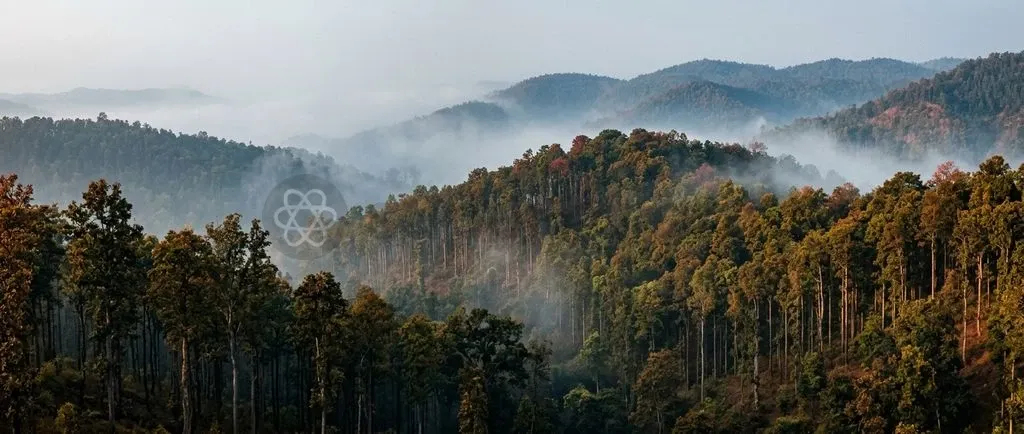
A massive outbreak of the Sal heartwood borer beetle across the Shorea robusta forests of eastern Madhya Pradesh has prompted authorities to seek large-scale sanitisation felling of infested trees to prevent an uncontrolled ecological crisis across the Maikal hills landscape. The wood-boring larvae tunnel through sapwood and heartwood, cutting off vital vascular transport and killing mature canopy trees within a single seasonal cycle.
As of late 2026, forest administrators view physical extraction as the only reliable containment barrier against runaway epidemic spread. However, indigenous tribal communities and conservation scientists express acute concern over immediate canopy loss, topsoil degradation, and the destruction of vital forest livelihoods.
Why in the News: The Sal Tree Crisis in Madhya Pradesh
The Madhya Pradesh Forest Department has mobilised emergency containment measures following an extensive infestation of the sal heartwood borer across the Satpura-Maikal landscape.
According to reports by The Indian Express, the outbreak has spread rapidly across several administrative divisions:
- Geographic extent: The borer infestation has affected over 30,000 hectares of primary sal forest across East Karanjia, West Karanjia, South Samnapur, and Bajag forest ranges in Dindori district.
- Approved felling volume: In response to escalating tree mortality, the Central Government approved the felling of approximately 1,46,784 infested sal trees in Dindori district and 9,535 trees in the Amarkantak region of Anuppur district, as reported by Down To Earth.
- Bug-bounty scheme: The state forest administration launched a community bug-bounty programme, paying villagers Rs 2 per collected adult beetle to suppress populations before the monsoon.
Discuss with Superkalam
What insect order and family does the Sal heartwood borer belong to, and what percentage of tree damage defines an epidemic?
Ask NowWhat Is the Sal Heartwood Borer and How Does It Kill Trees?
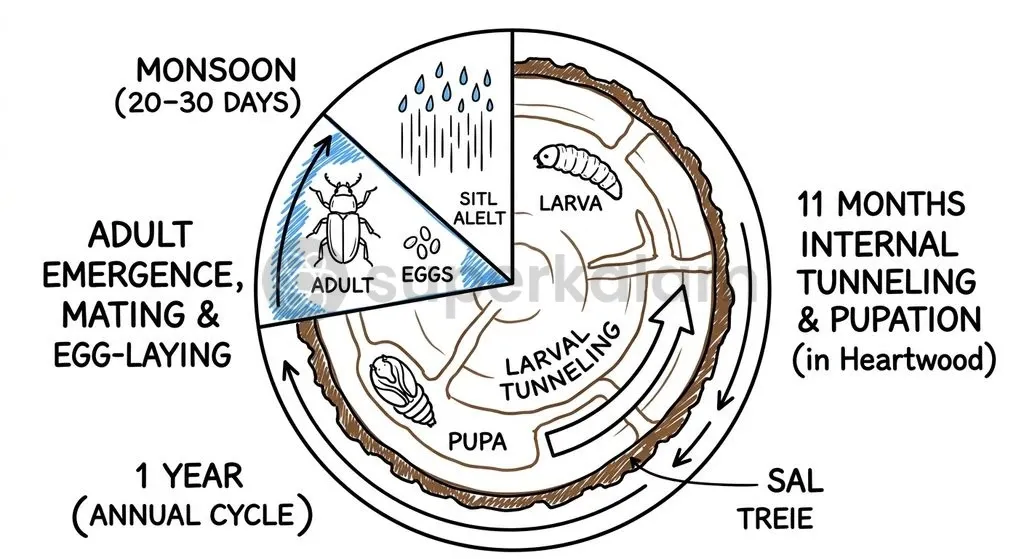
The sal heartwood borer (Hoplocerambyx spinicornis Newman) is a cerambycid beetle belonging to the insect order Coleoptera, notorious for destroying standing sal timber.
According to the Food and Agriculture Organization (FAO), the insect follows an annual life cycle where it spends nearly 11 months inside the tree trunk as an endophytic, wood-eating larva and pupa. Adult beetles emerge synchronously from pupal chambers for a brief window of 20 to 30 days during the onset of the monsoon. Research from the State Forest Research Institute (SFRI) Jabalpur indicates that elevated atmospheric humidity and heavy early monsoon showers trigger mass beetle emergence and rapid egg-laying under tree bark.
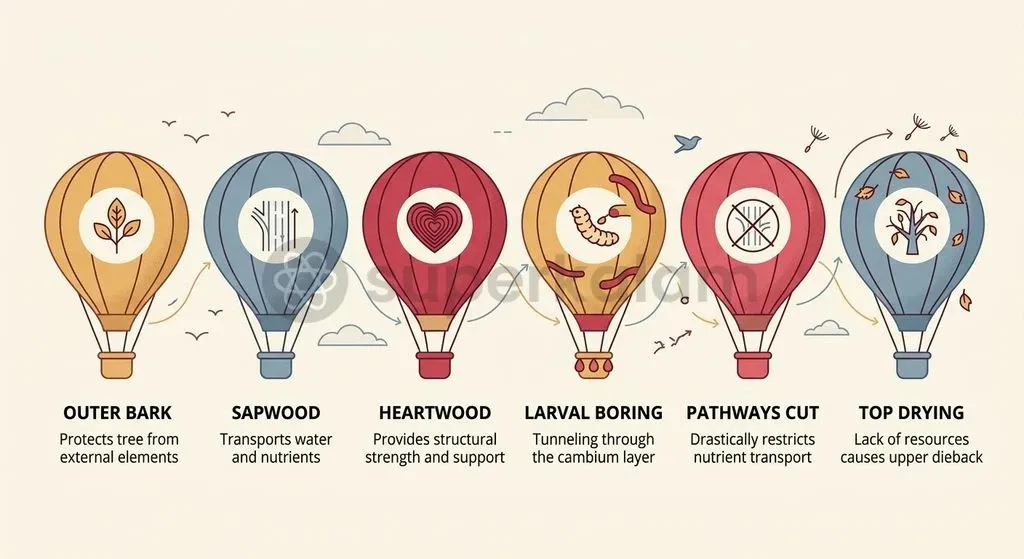
Once hatched, the larval grubs bore inward. They create extensive, winding galleries through the sapwood before penetrating deep into the structural heartwood. This extensive tunnelling destroys the vascular cambium, severing xylem sap flow and starving the upper canopy of water and minerals.
Silviculturally, entomologists classify an outbreak as a full-scale epidemic infestation whenever the proportion of visibly affected trees exceeds 1% of the total sal stand.
| Parameter | Endemic (Normal) Phase | Epidemic (Outbreak) Phase |
|---|---|---|
| Infestation Threshold | Under 1% of standing trees | Exceeds 1% of standing trees |
| Primary Tree Target | Over-mature, fallen, or dead wood | Vigorous, mature standing trees |
| Crown Appearance | Isolated yellowing of outer twigs | Complete canopy desiccation and browning |
| Larval Density | Low grub density per bole | Hundreds of grubs per tree trunk |
| Control Approach | Regular silvicultural maintenance | Sanitation felling and mass trapping |
Ecological and Economic Importance of Shorea robusta Forests
Shorea robusta, locally known as Sal, is a keystone ecological species across Central India's tropical moist and dry deciduous forest biomes.
These dipterocarp trees dominate the dense forest tracts of Madhya Pradesh, Chhattisgarh, Odisha, and Jharkhand. They underpin both environmental stability and indigenous community livelihoods:
- Watershed protection and microclimate: Sal woodlands ensure microclimate regulation, highland aquifer recharge, and topsoil stabilisation across fragile watershed highlands.
- Soil biodiversity support: Pure stands form a deep, nutrient-rich leaf-litter layer supporting varied ground flora, fungi, and invertebrate communities.
- Tribal subsistence and trade: Sal forests anchor the tribal economy, enabling sal seed collection for commercial fat extraction and the tapping of aromatic sal resin, locally called dammar or Jhuna.
Discuss with Superkalam
Explain why early monsoon rainfall and high humidity trigger the emergence and spread of the Sal heartwood borer.
Ask NowWhy Mass Felling Is Used as a Containment Strategy
Forest entomologists view sanitation felling as an unavoidable physical barrier to arrest self-sustaining beetle epidemics.
According to technical advisories from the Forest Research Institute (FRI) Dehradun and the Tamil Nadu Agricultural University (TNAU) Agritech Portal, chemical insecticides are ineffective once larvae have bored into the central heartwood. Because the immature grubs remain protected behind thick outer bark and dense timber, surface pesticide sprays cannot reach the feeding galleries.
Historical records illustrate the catastrophic trajectory of unchecked outbreaks:
- 1905 Balaghat outbreak: The earliest recorded epidemic in Central India occurred in Balaghat.
- 1923–1924 Mandla-Dindori crisis: A severe 1923–1924 outbreak across Mandla and Dindori damaged nearly 7 million trees.
- 1996–2001 regional epidemic: The infestation spread across 5,000 square kilometres, forcing the sanitation felling of 1.59 million trees in Dindori and Mandla alone.
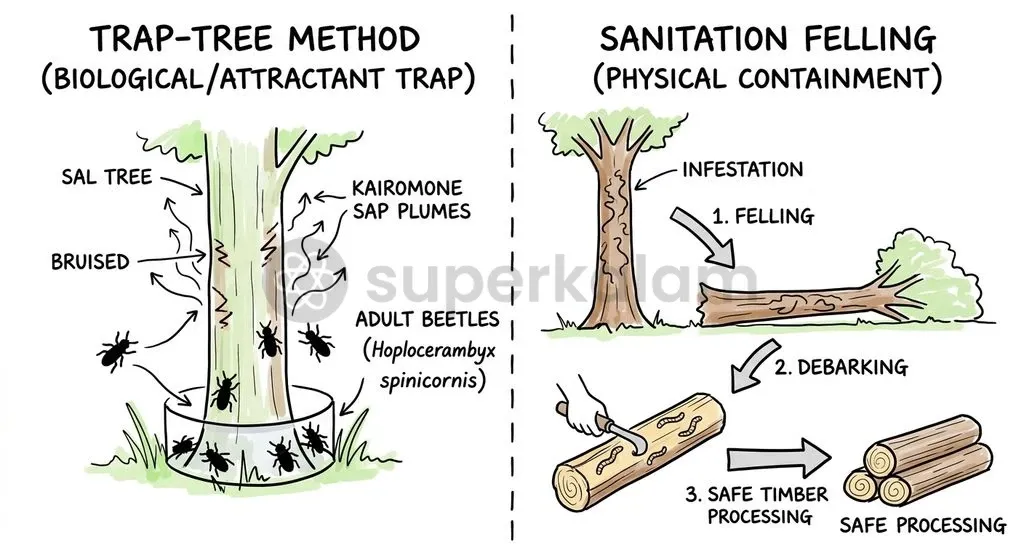
To break this destructive cycle, forest managers must fell, debark, and convert infested logs before the subsequent monsoon unleashes a fresh generation of flying adults.
Environmental and Tribal Livelihood Concerns Over Tree Cutting
The prospective felling of over 1.5 lakh mature trees in Dindori and Anuppur has raised serious ecological and socio-economic objections.
Technical bulletins from the Forest Survey of India (FSI) and tribal assessments highlight three key vulnerabilities:
- Soil loss and weed invasion: Large canopy openings accelerate topsoil erosion across the Maikal hills and facilitate rapid colonisation by invasive alien species like Lantana camara.
- Structural vulnerability of monocultures: Past silvicultural management favouring dense, single-species sal stands removed natural spatial buffers found in mixed deciduous systems.
- Erosion of forest rights: Canopy losses directly hit the Gond and Baiga communities, curtailing minor forest produce yields and undermining statutory livelihood security under the Forest Rights Act, 2006.
Discuss with Superkalam
Weigh the immediate necessity of mass sanitation felling against the statutory forest rights and livelihoods of Gond and Baiga tribes.
Ask NowScientific Alternatives: Biological Control and Trap-Tree Methods
Modern silviculture emphasises Integrated Pest Management (IPM) to curb borer populations without relying solely on clear-felling.
The primary non-destructive silvicultural tool is the classic trap-tree method, developed by forest entomologists to suppress adult beetles during their short flight period. Under this technique, foresters fell a small number of low-girth, non-commercial sal trees, cut them into billets, and beat the bark to release aromatic oleoresin sap. The evaporating sap acts as a potent attractant, drawing adult beetles from surrounding compartments so field teams can collect and destroy them manually.
Natural biological control also plays an active role in healthy ecosystems. Ornithological research published in Indian Birds confirms that woodpeckers of the family Picidae are the primary natural predators of Hoplocerambyx spinicornis, chiselling through bark to consume resting grubs and pupae. Protecting natural avian nesting sites helps preserve an enduring biological check against future population spikes.
Way Forward: Balancing Forest Health, Biodiversity, and Forest Rights
Sustainable management of central Indian sal ecosystems demands a decisive shift away from emergency tree felling toward proactive, landscape-level forest governance.
- Transition toward mixed-species forestry: Forest departments should systematically diversify forest composition by promoting native associates such as Terminalia tomentosa (Saj), Madhuca longifolia (Mahua), and Anogeissus latifolia (Dhaora) to break unbroken monoculture vulnerability.
- Early warning surveillance networks: Establish seasonal monitoring protocols tracking tree exudates, wood-dust ejection, and soil moisture variations to detect localised pest flare-ups before they cross the 1% epidemic threshold.
- Community-led surveillance and compensation: Institutionalise the involvement of local Gram Sabhas and Van Suraksha Samitis in beetle trapping operations, ensuring prompt fair compensation for monitoring work under statutory forest rights frameworks.
- Aggressive post-felling ecological restoration: Ensure every cleared compartment undergoes assisted natural regeneration and immediate native planting to prevent the expansion of invasive weeds like Lantana camara.
Discuss with Superkalam
Design an Integrated Pest Management (IPM) plan integrating community surveillance, mixed-species plantation, and biocontrol for sal forests.
Ask NowKey Takeaways
- Hoplocerambyx spinicornis is an aggressive wood-boring beetle that spends roughly 11 months within the tree trunk, killing mature Shorea robusta trees by destroying vascular sap pathways.
- An infestation is silviculturally classified as an epidemic outbreak whenever the proportion of damaged standing trees exceeds 1% of the forest stand.
- Chemical insecticides remain ineffective once larvae penetrate the heartwood, forcing forest authorities to rely on mechanical sanitation felling to break the reproductive cycle.
- Large-scale felling in Dindori risks accelerating topsoil erosion in the Maikal hills and threatens the livelihoods of Gond and Baiga tribal communities dependent on sal seeds and resin.
- Sustainable control requires combining early trap-tree operations, avian predator conservation, and a transition away from vulnerable monocultures toward resilient mixed-canopy forests.
Mains Question
"Sanitation felling of epidemic-hit Shorea robusta stands prevents runaway pest outbreaks but poses acute ecological and socio-economic challenges for indigenous forest-dwelling communities." Critically examine this statement in the context of the Forest Rights Act, 2006. (15 Marks)
Evaluate NowMains Question
Examine the effectiveness of Integrated Pest Management (IPM) techniques, particularly the trap-tree method and avian biocontrol, as sustainable alternatives to clear-felling in sal forest ecosystems. (10 Marks)
Evaluate NowPractice MCQs
QUESTION 1
With reference to the Sal heartwood borer (Hoplocerambyx spinicornis), consider the following statements:
- It is a cerambycid beetle whose larvae spend nearly 11 months tunneling inside the tree trunk.
- Chemical pesticide sprays are highly effective in curing trees during advanced stages of infestation as they reach the central heartwood.
- An infestation is silviculturally classified as an epidemic outbreak when visibly affected trees exceed 1% of the total sal stand.
Which of the statements given above are correct?
QUESTION 2
Consider the following statements regarding the trap-tree method used in managing Sal borer infestations:
- It involves felling a small number of low-girth, non-commercial sal trees and beating their bark to release aromatic oleoresin sap.
- The released sap acts as a chemical deterrent to repel flying adult beetles from the forest division.
- It offers a low-cost physical capture technique with zero toxic chemical residues.
Which of the statements given above is/are correct?
QUESTION 3
Consider the following statements regarding the ecology and economic significance of Shorea robusta (Sal) forests in Central India:
- Sal is a keystone species dominating tropical moist and dry deciduous biomes in states like Madhya Pradesh and Chhattisgarh.
- The tree yields an aromatic resin commercially known as dammar or Jhuna.
- Woodpeckers belonging to the family Picidae serve as natural biological predators of the sal heartwood borer.
Which of the statements given above are correct?
QUESTION 4
Which among the following native tree species are recommended to be promoted alongside Shorea robusta to transition away from vulnerable monocultures in Central Indian sal forests?
- Terminalia tomentosa (Saj)
- Madhuca longifolia (Mahua)
- Anogeissus latifolia (Dhaora)
Select the correct answer using the code given below:
QUESTION 5
In the context of forest entomology and pest control, why is sanitation felling considered the primary containment strategy against severe Hoplocerambyx spinicornis epidemics?





