RTI Section 4: Why Suo Motu Proactive Disclosure Fails
When public authorities evade proactive disclosure without penalty, citizens bear the burden of seeking routine data while appellate dockets choke.
Oct, 2026
•10 min read

Overview
Section 4 of the Right to Information Act, 2005 establishes a statutory mandate for suo motu public disclosure. It requires public authorities to publish operational, budgetary, and welfare data proactively, ensuring citizens have minimum resort to filing formal information requests.
Although conceived as the structural bedrock of administrative transparency, this voluntary disclosure framework remains crippled by obsolete record management, irregular compliance audits, and systemic administrative apathy. Public authorities routinely default on their statutory obligations.
This breakdown happens because enforcement under Section 20 penalises individual information officers for specific petition delays, rather than penalising public authorities for failing to publish basic records. Consequently, proactive governance has devolved into reactive processing, compelling citizens to file individual petitions for routine information while overburdening Information Commissions nationwide.
Why in the News?
The Central Information Commission faced severe structural strain with 29,034 second appeals and 3,577 complaints pending disposal as of February 2026, according to written disclosures in the Rajya Sabha by the Ministry of Personnel, Public Grievances and Pensions. Union Government authorities disposed of 13,80,509 RTI applications while transferring 2,80,353 requests and rejecting 58,501 during 2024-25.
This persistent backlog stems directly from the collapse of suo motu disclosure under Section 4 of the Right to Information Act, 2005, which was legislatively designed to pre-empt formal queries. In CBSE v. Aditya Bandopadhyay, the Supreme Court of India reaffirmed that public authorities have an inescapable duty to maintain and disseminate information proactively to prevent administrative paralysis.
The Broken Promise: Why RTI Was Designed to Be Proactive
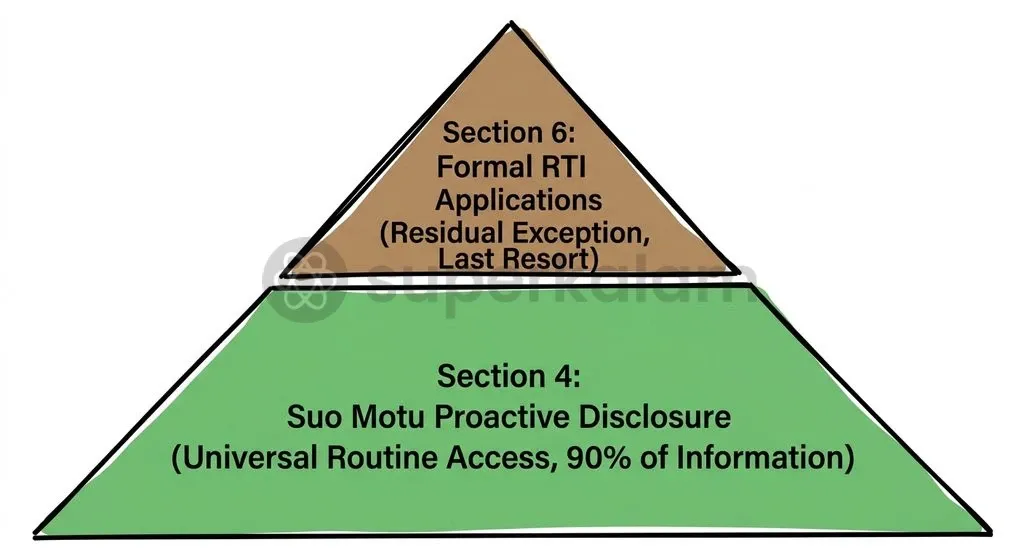
The Right to Information Act, 2005 envisioned a self-disclosing administrative regime where voluntary transparency was the primary vehicle for citizen information. Section 4(2) of the Act mandates that every public authority must make constant endeavours to provide information suo motu at regular intervals through various communication channels.
Discuss with Superkalam
How many operational categories are public authorities mandated to disclose proactively under Section 4(1)(b) of the RTI Act?
Ask NowParliament intended formal requests under Section 6 to be an exceptional fallback rather than the default route for routine inquiries. In Kishan Chand Jain v. Union of India, the Supreme Court clarified the core mechanics of this statutory promise:
- Co-relative obligations: The citizen's right to information under Section 3 is co-relative to the statutory duty cast on public authorities under Section 4.
- Continuous oversight: The bench directed Information Commissions to monitor Section 4 proactive disclosures continuously, observing that administrative silence forces citizens into unnecessary litigation.
Without reliable voluntary disclosures, the transparency architecture flips from an open-door public service into an adversarial bureaucratic contest.
Decoding Section 4: High-Impact Disclosures That Touch Citizen Lives
Section 4(1)(b) of the RTI Act mandates that every public authority proactively publish 17 operational categories within 120 days of enactment and update them annually. Far from being a technical checklist, these obligations directly intersect with public spending, welfare distribution, and administrative fairness.
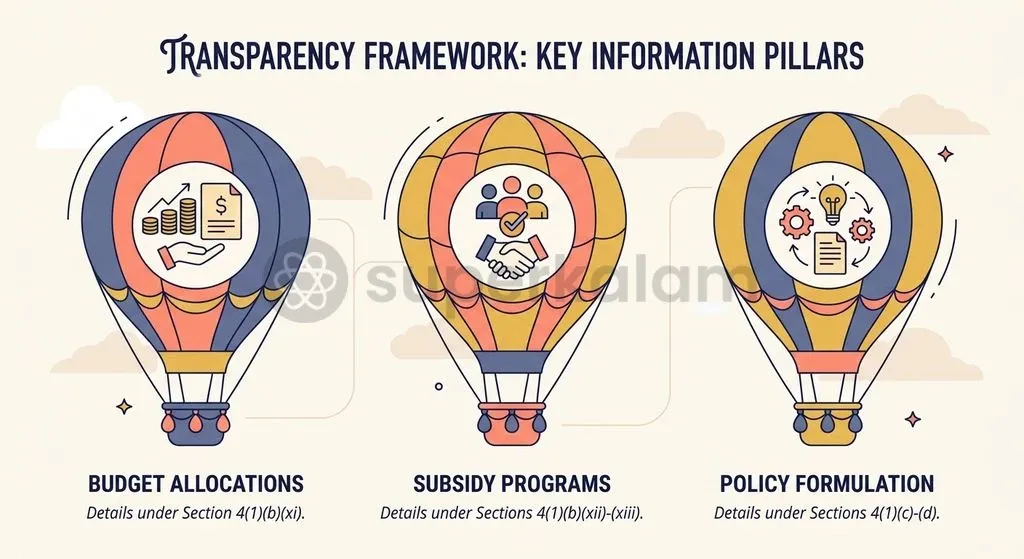
Civil-service analysts categorise these seventeen mandates into three functional governance pillars:
- Fiscal and Procurement Outlays: Public authorities are statutorily required under Section 4(1)(b)(xi) to disclose the budget allocated to each agency, including proposed expenditures and disbursement reports. Publishing itemised spending curbs off-budget allocations and fiscal misreporting.
- Welfare Programmes and Entitlements: Sections 4(1)(b)(xii) and 4(1)(b)(xiii) obligate public authorities to publish the execution of subsidy schemes, including allocated amounts and beneficiary details, alongside particulars of concessions, permits, or authorisations. This mandate provides grassroots auditability for food security, pensions, and local licences.
- Participatory and Reasoned Decision-Making: Section 4(1)(c) and Section 4(1)(d) require public authorities to publish all relevant facts while formulating important policies and provide reasons for administrative decisions to affected persons. This provision curbs arbitrary executive discretion before policies become irrevocable.
Discuss with Superkalam
Why did Parliament intend for Section 6 applications to serve only as an exceptional fallback rather than the primary route for accessing public information?
Ask NowProactive vs Reactive RTI: Why Filing Petitions Became the Default
The Right to Information Act, 2005 creates a stark operational divide between proactive transparency under Section 4 and reactive petitions under Section 6. Studies by the Rajiv Gandhi Institute for Contemporary Studies and the Commonwealth Human Rights Initiative reported that over 50% of individual applications filed under Section 6 seek routine administrative and service information that public authorities are statutorily required to publish suo motu under Section 4.
| Dimension | Proactive Disclosure (Section 4) | Reactive Application (Section 6) |
|---|---|---|
| Operational Driver | Statutory obligation of the public authority | Individual formal request filed by a citizen |
| Information Accessibility | Universal, searchable, zero additional fees | Restricted to the applicant, requiring statutory fees |
| Dissemination Mode | Digital portals, open data platforms, notice boards | Individual physical replies or bespoke portal responses |
| Substantive Scope | Systemic disclosure across 17 structured heads | Narrow queries targeting specific file notings or orders |
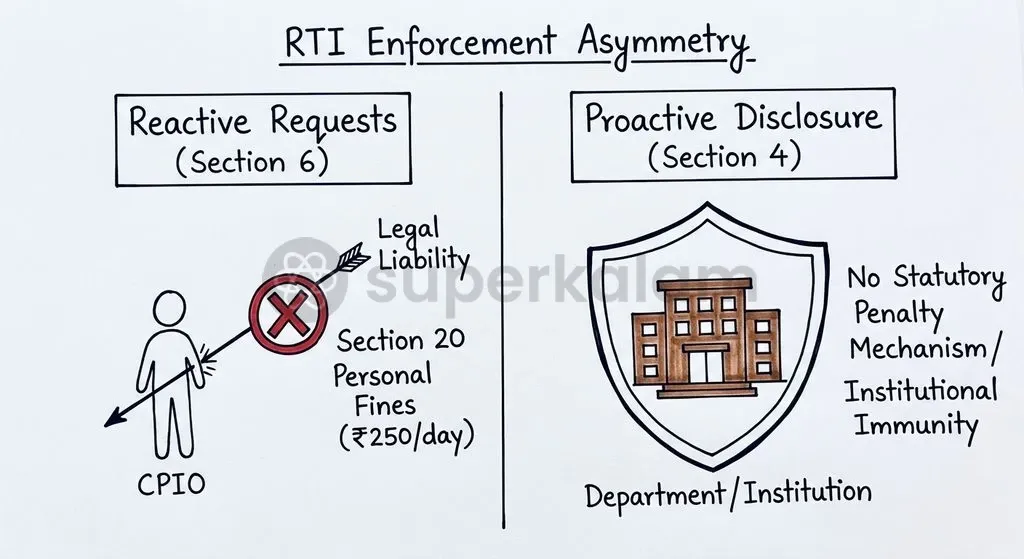
| Statutory Liability | No direct financial penalty on institutions | Fines up to ₹250 per day on defaulting CPIOs under Section 20 |
When public authorities withhold routine operational information, citizens must file formal Section 6 petitions. Central Public Information Officers spend hundreds of work hours fielding repetitive questions about welfare lists and office budgets. This administrative bottleneck clogs appellate bodies.
Discuss with Superkalam
If you were appointed as the administrative head of a department where 50% of RTI requests pertain to routine subsidy distribution, how would you operationalise Section 4(1)(b)(xii) to cut petition backlogs?
Ask NowThe Enforcement Gap: Judicial Rulings and the Penalty Loophole
Section 20 of the RTI Act exposes a critical statutory loophole by penalising individual information officers while exempting public authorities from institutional liability for Section 4 defaults. The penal framework under Section 20 applies exclusively to Central or State Public Information Officers who refuse, delay, or destroy information requested under specific Section 6 applications. The Act provides no direct statutory financial penalty for departments that entirely ignore proactive disclosure.
The Delhi High Court confirmed this personal-liability limit in Registrar of Companies v. Dharmendra Kumar Garg, holding that Section 20 penalties are not automatic: the Commission must assess the listed defaults and whether the officer had reasonable cause. Because the failure to maintain a comprehensive web portal is an institutional failure rather than a personal omission by a junior information officer, Information Commissions cannot levy fines on departmental heads.
| Default Type | Statutory Liability | Practical Result |
|---|---|---|
| Institutional Default (Section 4) | No statutory fine under Section 20 | Zero executive urgency |
| Individual Default (Section 6) | Fines up to ₹250 per day on CPIO | Disproportionate burden |
Regulatory efforts to plug this accountability gap have stalled across Union departments. The Department of Personnel and Training (DoPT) issued Office Memorandum No. 1/6/2011-IR mandating that every Ministry and Public Authority must get its proactive disclosure package audited annually by a third-party government training institute. The Supreme Court in Kishan Chand Jain v. Union of India highlighted that only 33% of public authorities had undergone third-party transparency audits in the four years leading up to 2023.
Compliance remains dismal: in 2024-25, out of 2,303 public authorities registered with the Central Information Commission, nearly 37% (857 authorities) skipped the mandatory annual third-party audit. A review of Union Government portals showed that only 33 out of 94 Union departments listed as public authorities on the Union RTI portal had published their latest third-party audit reports online.
Ethical and Democratic Costs: When Secrecy Replaces Open Governance
Administrative secrecy under the RTI regime undermines constitutional morality by eroding citizen dignity and insulating executive discretion from legitimate democratic scrutiny. In a constitutional democracy, access to public information is an entitlement flowing from freedom of speech under Article 19(1)(a), not a bureaucratic concession.
- Preserving Citizen Dignity: The Second Administrative Reforms Commission emphasised in its Fourth Report on Ethics in Governance that proactive disclosure protects citizen dignity. It eliminates the need for marginalised welfare recipients to plead with local officials or pay application fees to access basic entitlements. Forcing a pensioner or daily-wage worker to file paperwork for subsistence benefits turns rights into bureaucratic patronage.
- Containing Executive Discretion: The Central Information Commission affirmed in Rajnish Ratnakar v. Central Vigilance Commission that proactive transparency is an ethical antidote to arbitrary executive discretion by forcing decision-making criteria and subsidy beneficiary lists into full public view. When public agencies publish tender selections, discretionary funds, and licensing quotas, opportunities for illicit rent-seeking decline sharply.
Discuss with Superkalam
Examine how the personal liability model in Section 20 contributes to institutional non-compliance with proactive disclosure mandates.
Ask NowRoadmap for Reform: Turning Paper Mandates into Real-Time Transparency
Reforming the RTI proactive disclosure regime requires dynamic open-data architectures, actionable civil service accountability, and ring-fenced budgets for digital record management. India cannot resolve appellate backlogs without addressing the institutional root cause of administrative secrecy.
- Scaling Dynamic Transparency Portals: The Government of Rajasthan launched the 'Jan Soochna Portal' on September 13, 2019, operationalising Section 4(2) of the RTI Act to provide dynamic, real-time public access to scheme-level information at the panchayat and ward levels. As of 2024, the portal expanded from 13 departments to over 115 government departments and more than 350 schemes, allowing citizens to inspect ration allocations, pension payments, and job-card balances without filing a single RTI application. Union Ministries and state secretariats must adopt this dynamic push-model.
- Amending Civil Service Conduct Rules: The Second Administrative Reforms Commission recommended that failure to comply with Section 4 proactive disclosures should be made an actionable misconduct under civil service conduct rules, holding Heads of Departments personally accountable. Penalising institutional heads directly bypasses the Section 20 statutory loophole.
- Mandatory Budgetary Audits: Public authorities must submit proactive disclosure self-appraisals across six thematic parameters—including organisation and functions, budget, and e-governance—as mandated by Central Information Commission guidelines. State legislatures and Parliament should condition departmental budget approvals on verified transparency audit compliance.
- Dedicated Modernisation Allocations: Governments must implement the Second ARC recommendation to allocate at least 1% of departmental operational budgets for modernising, networking, and indexing public records under Section 4(1)(a).
Discuss with Superkalam
Given that over a third of public authorities skipped mandatory third-party audits in 2024-25, evaluate whether introducing institutional financial penalties is the most viable path to achieve Section 4 compliance.
Ask NowKey Takeaways
The Right to Information Act, 2005 was structured to make administrative transparency a routine statutory obligation rather than an adversarial citizen battle.
- Statutory Premise: Section 4(2) establishes that public authorities must proactively disseminate operational data to ensure the public has minimum resort to filing Section 6 applications.
- High-Impact Clusters: Section 4(1)(b) demands annual proactive publication of 17 operational categories, with critical democratic importance attached to budgets, subsidy beneficiary lists, and policy rationales.
- The Enforcement Loophole: Section 20 provides statutory financial penalties exclusively against individual Public Information Officers for Section 6 defaults, leaving departmental non-compliance with Section 4 without a direct departmental fine under Section 20; Section 19(8) still empowers compliance directions.
- Audit Deficits: In 2024-25, nearly 37% of public authorities registered with the Central Information Commission skipped their mandatory annual third-party transparency audit.
- Structural Solution: Scaling dynamic open-data platforms like Rajasthan's Jan Soochna Portal and classifying Section 4 non-compliance as actionable civil service misconduct can restore proactive transparency.
Mains Question
"The citizen's right to information under Section 3 is co-relative to the statutory duty cast on public authorities under Section 4." In light of this judicial observation, critically examine the structural and statutory impediments hindering proactive disclosure under the RTI Act, 2005. (15 Marks)
Evaluate NowMains Question
'The failure of proactive disclosure under Section 4 of the RTI Act transforms transparency into an adversarial bureaucratic contest.' Elucidate. (10 Marks)
Evaluate NowPractice MCQs
QUESTION 1
With reference to Section 4 of the Right to Information (RTI) Act, 2005, consider the following statements:
- Section 4(1)(b) obligates every public authority to proactively publish 17 operational categories within 120 days of enactment and update them annually.
- Section 4(1)(d) mandates public authorities to provide reasons for administrative decisions to affected persons.
- Section 20 provides for direct financial penalties on public authorities that fail to comply with suo motu disclosure under Section 4. Which of the statements given above are correct?
QUESTION 2
Under the Right to Information Act, 2005, which of the following functional governance pillars is statutorily mapped to Section 4(1)(b)(xi)?
QUESTION 3
Consider the following statements regarding compliance with proactive disclosure under the RTI Act:
- The Department of Personnel and Training (DoPT) mandates an annual third-party audit of proactive disclosure packages by a government training institute.
- Studies by the Rajiv Gandhi Institute for Contemporary Studies and CHRI show that over 50% of Section 6 applications seek information already required to be proactively disclosed under Section 4.
- In 2024-25, less than 10% of public authorities registered with the Central Information Commission skipped the mandatory annual third-party audit. Which of the statements given above is/are correct?
QUESTION 4
In 'CBSE v. Aditya Bandopadhyay', what core principle regarding public administration and the RTI Act was reaffirmed by the Supreme Court of India?