Rooftop Solar Grid Integration: Why India Needs Smarter Discom Networks
As rooftop solar surges past 50 lakh homes, fragile distribution networks must deploy smart edge software to prevent grid instability and financial strain.
Nov, 2026
•9 min read
Overview
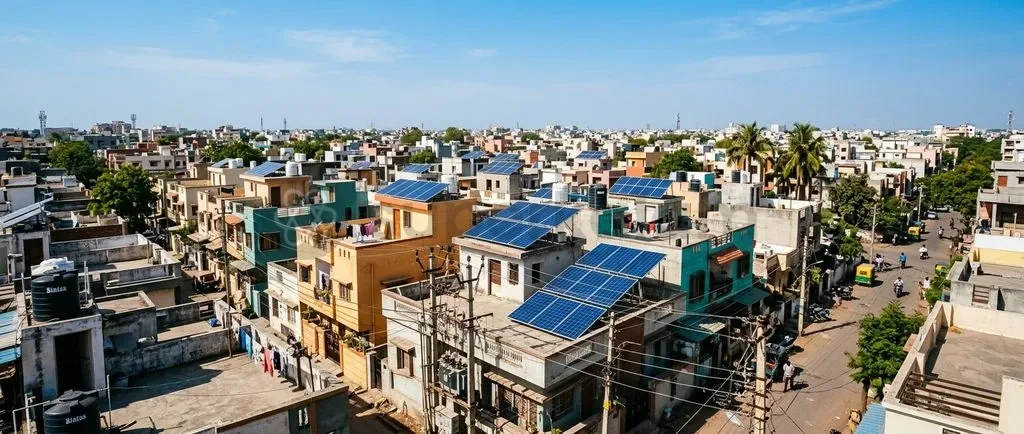
The rapid expansion of residential rooftop solar under PM Surya Ghar: Muft Bijli Yojana is fundamentally reshaping India's local distribution networks. Managing these uncoordinated consumer installations requires Distributed Energy Resource Management Systems (DERMS) to turn passive generation into grid-stabilising assets.
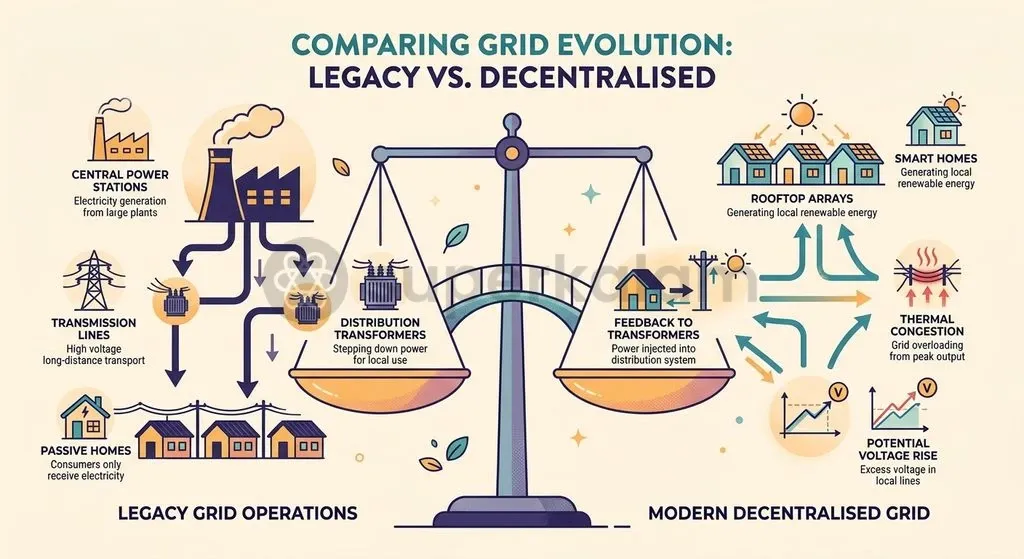
Traditional distribution grids were built for one-way electricity delivery from central thermal stations down to passive consumers. Today, bidirectional power flows from millions of domestic photovoltaic generators create steep voltage spikes and overload local feeders without digital visibility.
Edge-computing software paired with smart meters allows distribution companies to bundle rooftop inverters into virtual power plants. This digital orchestration preserves statutory voltage limits while protecting utility balance sheets.
Why in the News: The Push for Rooftop Solar Under PM Surya Ghar
PM Surya Ghar: Muft Bijli Yojana is rapidly decentralising India's power mix across millions of residential rooftops. On 29 February 2024, the Union Cabinet approved the scheme with an outlay of ₹75,021 crore to supply up to 300 units of free monthly electricity to one crore households by FY 2026-27.
Under operational guidelines from the Ministry of New and Renewable Energy (MNRE), the Central Financial Assistance covers:
- Sub-2 kW Systems: A 60% capital subsidy on benchmark costs.
- 2 kW to 3 kW Systems: A 40% capital subsidy on additional capacity.
According to the Ministry of New and Renewable Energy, rapid consumer uptake pushed total installations past 50.06 lakh nationwide as of August 2026, adding 14.8 GW of distributed generation capacity.
This growth marks a structural break from utility-scale solar parks. High-voltage transmission lines handle utility-scale generation under strict scheduling protocols, whereas residential rooftop systems feed directly into fragile low-tension distribution feeders.
Discuss with Superkalam
What are the specific subsidy slabs and total financial outlay approved under PM Surya Ghar: Muft Bijli Yojana?
Ask NowWhat Is a Distributed Energy Resource Management System (DERMS)?
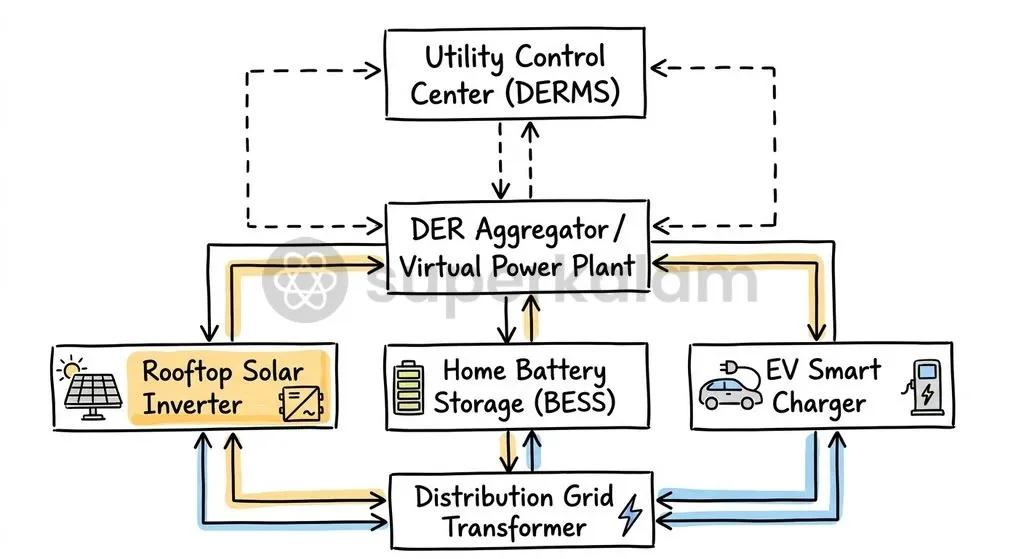
A Distributed Energy Resource Management System is an enterprise software platform that aggregates, monitors, and autonomously dispatches front-of-the-meter and behind-the-meter assets. Behind-the-meter assets sit on the consumer side, such as rooftop panels and home storage.
Front-of-the-meter assets include distribution substations and grid-scale gear. DERMS bridges utility-level control systems with millions of independent domestic inverters.
The core architecture rests on four operational pillars:
- Real-Time Fleet Visibility: Ingesting telemetry data from smart inverters, bidirectional smart meters, and distribution transformers to track decentralised generator status continuously.
- Dynamic Hosting Capacity Calculation: Evaluating how much solar capacity an 11 kV feeder or low-tension line can safely carry without breaching thermal or voltage limits.
- Virtual Power Plant Aggregation: Combining dispersed rooftop units into software-coordinated clusters to supply active and reactive power during localized peak stress.
- Standardised Interoperability: Linking grid-edge inverters through non-proprietary protocols such as IEEE 2030.5, OpenADR 2.0b, and IEC 61850-7-420.
How Unmanaged Rooftop Solar Strains Traditional Discom Networks
Distribution networks were engineered strictly for unidirectional electricity flow from 33 kV or 11 kV substations to households. Unmanaged solar back-feed destabilises this architecture across three main operational fronts:
- Reverse Power Flow and Voltage Spikes: Peak midday generation pushes electricity backwards into distribution lines, causing localised voltage rise. Under Central Electricity Authority (Grid Standards) Regulations, Discoms must hold point-of-coupling voltages within a statutory band of ±6% of nominal voltage. Back-feeding breaches this band, tripping home electronics and triggering inverter safety shut-offs.
- Transformer Degradation: Reverse power flows paired with non-linear inverter current harmonics induce severe core saturation and eddy currents, rapidly accelerating thermal insulation breakdown in distribution transformers.
- Phase Imbalance and Neutral Currents: Domestic users largely install single-phase arrays. Dispersing single-phase systems unevenly across three-phase distribution circuits triggers heavy neutral currents and phase-to-phase voltage unbalance.
Discuss with Superkalam
How does dynamic volt-VAR regulation across a 0.95 power factor band help stabilize local grid voltages?
Ask NowTraditional SCADA vs Modern DERMS: A Functional Comparison
Supervisory Control and Data Acquisition (SCADA) platforms have anchored transmission and substation automation for decades. Yet central SCADA setups poll a limited number of high-voltage points at fixed intervals of two to four seconds, leaving them blind to low-voltage lines. By contrast, modern DERMS operates on edge-computing topologies that autonomously direct millions of dispersed endpoints.
| Operational Dimension | Traditional Utility SCADA / DMS | Modern DERMS Platform |
|---|---|---|
| Network Visibility | Primary substations and 11 kV feeders; blind below distribution transformers | Complete visibility extending down to Low Tension circuits and behind-the-meter inverters |
| Asset Ownership | Exclusively monitors utility-owned infrastructure (transformers, circuit breakers) | Orchestrates utility, third-party, and privately owned consumer energy resources |
| Control Architecture | Centralised polling architecture with deterministic 2- to 4-second refresh cycles | Distributed, edge-computing architecture with real-time autonomous local response |
| Primary Grid Function | Network switching, fault isolation, and service restoration (FLISR) | Dynamic hosting capacity calculation, resource aggregation, and volt-VAR grid support |
| Communication Protocols | Legacy industrial telemetry protocols (IEC 60870-5-104, DNP3, Modbus) | Web-based and IoT application protocols (IEEE 2030.5, OpenADR 2.0b, IEC 61850-7-420) |
| Operational Scale | Designed to handle hundreds or thousands of high-capacity grid nodes | Scalable to coordinate millions of low-capacity, dispersed generation endpoints |
According to NITI Aayog, integrating Advanced Distribution Management Systems (ADMS) with DERMS separates physical switching from real-time generation dispatch. While ADMS manages physical fault isolation and network restoration, DERMS dynamically caps feeder hosting limits to prevent feeder overload.
Core Benefits: Turning Passive Consumers into Active Grid Stabilizers
Intelligent edge controls turn private solar arrays from network liabilities into grid-stabilising assets. Paired with smart inverters, DERMS automates reactive volt-VAR support without manual intervention from substation staff.
Under CEA Connectivity Regulations, distributed inverters must run across a dynamic power factor band of 0.95 lagging to 0.95 leading. By continuously dispatching reactive power, DERMS suppresses midday voltage surges and props up terminal voltage during evening peaks.
| Architecture Layer | Power and Data Route | System Capability |
|---|---|---|
| Legacy Model | Central Station → High-Voltage Grid → Substation → Consumer | Passive, one-way power flow with no real-time edge orchestration |
| Active DERMS Model | Consumer Generation ↔ IEEE 2030.5 / DERMS ↔ Grid Core | Two-way dynamic support with automated volt-VAR and hosting limit controls |
Aggregating rooftop panels into Virtual Power Plants generates immediate financial savings for utilities. Software-led peak shaving trims high-cost power purchases and defers expensive transformer upgrades, enabling Discoms to integrate renewables cleanly on existing physical assets.
Discuss with Superkalam
How would a Discom utilize a Virtual Power Plant (VPP) model during localized evening peak demand hours?
Ask NowKey Hurdles: Why Discoms Struggle to Modernize Grid Infrastructure
Indian distribution utilities face persistent structural and revenue bottlenecks that deter software investments. Discom finances are constrained by two primary challenges:
- Elevated Commercial Losses: Power Finance Corporation data recorded national AT&C losses at 16.12% in FY 2023-24, down from 21.91% in FY 2020-21. While this marks operational progress, lingering revenue leaks leave state utilities unable to fund advanced IT-OT integration.
- The Utility Death Spiral: Tariffs cross-subsidise agricultural and low-income users via steep charges on commercial, industrial, and high-use domestic consumers. When affluent households install rooftop solar under PM Surya Ghar, Discoms lose their most remunerative retail tariffs, eroding the revenue required to cover fixed network costs.
Discuss with Superkalam
Why is the centralized polling architecture of traditional SCADA insufficient for managing millions of distributed rooftop solar arrays?
Ask NowPolicy and Regulatory Levers Needed to Scale Smart Grid Solutions
Aligning rooftop solar growth with distribution modernization requires coordinated regulatory mechanisms across state and central bodies:
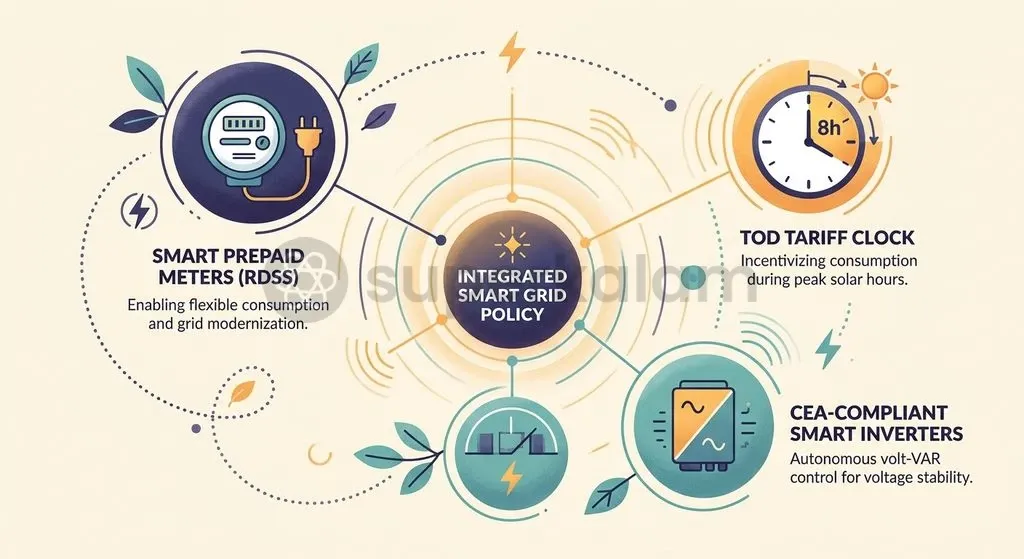
- Mandatory Time-of-Day (ToD) Tariffs: Under the Electricity (Rights of Consumers) Amendment Rules, 2023, the Ministry of Power amended Rule 8A to enforce Time-of-Day pricing. Tariffs during the eight-hour solar window must be at least 20% below base rates, shifting heavy demand into midday hours. These ToD tariffs took effect for Commercial and Industrial users exceeding 10 kW demand on 1 April 2024, and expanded to other non-agricultural consumers on 1 April 2025 alongside smart meter rollouts.
- Advanced Metering Infrastructure under RDSS: The Ministry of Power is implementing the Revamped Distribution Sector Scheme with an outlay of ₹3,03,758 crore, supported by ₹97,631 crore in Central Budgetary Support. The scheme aims to lower national AT&C losses to 12-15% and close the ACS-ARR gap by FY 2027-28. The Centre has sanctioned 20.33 crore prepaid smart meters on a TOTEX public-private partnership model to supply the interval data required for DERMS hosting capacity analytics.
- Smart Inverter Compliance Mandates: Regulation 11(6) of the CEA Connectivity Standards mandates automatic anti-islanding mechanisms that disconnect inverters within two seconds during blackouts to protect utility repair crews. Inverters must also restrict direct current injection to 0.5% of rated full-load current and observe IEEE 519-2014 harmonic distortion thresholds.
- Evolution of Net-Metering Regulations: The Electricity (Rights of Consumers) Amendment Rules, 2021 allow net-metering up to 500 kW or the sanctioned load, mandating gross-metering or net-billing above 500 kW. In the draft Electricity (Rights of Consumers) Amendment Rules, 2026, the Ministry of Power proposed empowering SERCs to levy grid-support charges on solar systems over 5 kW to offset wheeling costs (as proposed in draft rules, March 2026).
Discuss with Superkalam
How should regulatory commissions balance consumer adoption of clean rooftop solar against the risk of worsening Discom financial viability?
Ask NowWay Forward: Building a Resilient, Flexible Last-Mile Power Grid
Modernising low-voltage grids requires a sequence of structural, regulatory, and technical reforms:
- Transition Discoms to Distribution System Operators (DSOs): State regulators must push utilities to operate as active DSOs. Under this model, utilities oversee dynamic local energy balancing, partner with third-party Virtual Power Plants, and procure flexibility services.
- Operationalise the ₹500 Crore Innovation Corpus: Authorities should swiftly deploy the ₹500 crore pilot fund sanctioned under the 'Innovative Projects' component of PM Surya Ghar. These grants must test peer-to-peer solar trading, community battery storage, and standardised DERMS architectures.
- Mandate Standardised Inverter Interfaces: Regulators should make IEEE 2030.5 compliance an absolute prerequisite for PM Surya Ghar capital subsidies. Equipping inverters with interoperable gateways guarantees immediate plug-and-play capability with utility DERMS platforms, converting distributed solar from a grid risk into an enduring asset.
Key Takeaways
- Unprecedented Solar Proliferation: PM Surya Ghar: Muft Bijli Yojana holds a ₹75,021 crore outlay targeting one crore households, having crossed 50.06 lakh installations and 14.8 GW of distributed generation capacity as of August 2026.
- Distribution Network Challenges: Rapid uncoordinated solar growth induces reverse power flows, violates statutory ±6% distribution voltage limits under CEA standards, and accelerates thermal ageing of distribution transformers.
- Technological Architecture of DERMS: Distributed Energy Resource Management Systems bridge enterprise utility software with grid-edge smart inverters via open protocols (IEEE 2030.5, OpenADR), aggregating distributed assets into Virtual Power Plants.
- Regulatory Modernisation: Key operational enablers include mandatory Time-of-Day tariffs under the Electricity (Rights of Consumers) Amendment Rules, smart meter rollouts under the ₹3,03,758 crore RDSS scheme, and CEA-mandated volt-VAR inverter controls.
- Discom Structural Constraints: National AT&C losses stood at 16.12% in FY 2023-24, where cross-subsidy erosion from self-generating affluent consumers heightens utility resistance to decentralized solar integration.
Mains Question
"The structural shift from centralized utility-scale solar parks to decentralized rooftop generation under the PM Surya Ghar: Muft Bijli Yojana presents unprecedented technical challenges for low-tension distribution infrastructure." Examine. (10 Marks)
Evaluate NowMains Question
"Aggressive adoption of distributed solar risks exacerbating the 'utility death spiral' for Discoms burdened by commercial losses." In light of this statement, critically analyse the operational and financial hurdles faced by Discoms and evaluate the role of modern regulatory and digital mechanisms in overcoming them. (15 Marks)
Evaluate NowPractice MCQs
QUESTION 1
With reference to the PM Surya Ghar: Muft Bijli Yojana, consider the following statements:
- The scheme provides a 60% capital subsidy on benchmark costs for systems up to 2 kW capacity.
- For systems between 2 kW and 3 kW, a 40% capital subsidy is provided on the additional capacity.
- The scheme aims to supply up to 300 units of free monthly electricity to one crore households.
Which of the statements given above are correct?
QUESTION 2
Consider the following statements regarding the integration of distributed rooftop solar into low-tension distribution networks:
- Under Central Electricity Authority (Grid Standards) Regulations, Discoms must maintain point-of-coupling voltages within a statutory band of ±6% of nominal voltage.
- Dispersing single-phase residential solar arrays unevenly across three-phase distribution circuits triggers heavy neutral currents.
- Reverse power flow from unmanaged solar inverters eliminates core saturation and eddy currents in distribution transformers.
Which of the statements given above is/are correct?
QUESTION 3
In the context of power distribution automation, how does a Distributed Energy Resource Management System (DERMS) differ from a traditional SCADA system?
- Traditional SCADA exclusively monitors utility-owned infrastructure, whereas DERMS can orchestrate privately owned behind-the-meter consumer assets.
- Traditional SCADA provides complete operational visibility down to low-tension circuits, whereas DERMS is restricted to 11 kV feeders.
- DERMS utilizes web-based and IoT application protocols such as IEEE 2030.5 and OpenADR 2.0b rather than legacy industrial telemetry protocols alone.
Which of the statements given above is/are correct?
QUESTION 4
Under the Central Electricity Authority (Technical Standards for Connectivity of Distributed Generation Resources) Regulations cited in the article, distributed solar inverters are required to operate across which dynamic power factor band for reactive volt-VAR support?
QUESTION 5
With reference to the Electricity (Rights of Consumers) Amendment Rules, 2023 regarding Time-of-Day (ToD) tariffs, consider the following statements:
- Rule 8A mandates that tariffs during the specified solar duration must be at least 20% below base rates.
- The solar window under the ToD tariff framework is specified as an eight-hour duration.
Which of the statements given above is/are correct?