India Crude Oil Import Dependency: Limits of Hedging and Autonomy
With import reliance at 88.7%, short-term rupee pacts and fiscal buffers cannot shield the Indian economy from maritime supply chokes in West Asia.
Nov, 2026
•12 min read

Context
India's external economic vulnerability is anchored in its structural energy deficit. Recurring West Asian conflicts regularly expose the sharp limits of short-term fiscal and currency hedges.
With domestic crude oil import dependency reaching 88.7% of total consumption as of late 2026, tactical measures offer only fleeting accounting buffers against systemic supply shocks. These tactical buffers include windfall profit taxes, rupee-denominated bilateral trade pacts, and alternative spot purchases.
Lasting energy security requires accelerating domestic upstream production under modern licensing regimes. It also demands aggressive downstream demand substitution. Together, these reforms can transform India from an exposed price-taker into a resilient low-carbon economy.
Why West Asia Conflict Sends Shockwaves Through India's Economy
Geographic concentration along narrow maritime transit routes makes Indian energy security precarious. Instability in West Asia immediately jeopardises national supplies because of this reliance on volatile maritime corridors.
According to the International Energy Agency (IEA), the Strait of Hormuz handles approximately 20 million barrels per day. This accounts for roughly 20% of global petroleum consumption and between 45% to 50% of India's crude imports.
| Maritime Choke Point | Global Flow & Volume | Indian Vulnerability |
|---|---|---|
| Strait of Hormuz | 20 mbpd global petroleum transit | Handles 45%–50% of crude imports; >90% of imported LPG |
| Bab-el-Mandeb | Key gateway between Red Sea and Gulf of Aden | Rerouting around Cape of Good Hope adds 10–14 days and war-risk premiums |
Physical disruptions in these waterways trigger immediate shortages far beyond liquid fuels. Press Information Bureau briefings highlight that over 90% of India's imported Liquefied Petroleum Gas transits through the Strait of Hormuz. This leaves domestic cooking gas networks directly exposed to maritime blockades.
Maritime security risks in the Red Sea compound these import expenses. Shipping advisories from the Ministry of Ports, Shipping and Waterways note that disruptions along the Bab-el-Mandeb Strait force merchant vessels to bypass the Suez Canal and detour around the Cape of Good Hope. This diversion adds 10 to 14 days of transit time, sharply elevating shipping freight charges and maritime war-risk insurance premiums.
The scale of modern supply disruptions underlines this structural fragility. Analysis from the IEA World Energy Outlook 2026 indicates that cumulative global oil supply losses reached 2.8 billion barrels during the 2026 Middle East shipping crisis, ranking as the largest supply shock in modern energy history.
Discuss with Superkalam
Can you recall the three geographical locations of India's Phase I Strategic Petroleum Reserve caverns and their total combined storage capacity?
Ask NowThe Macro Transmission: Current Account Deficit, Inflation, and the Rupee
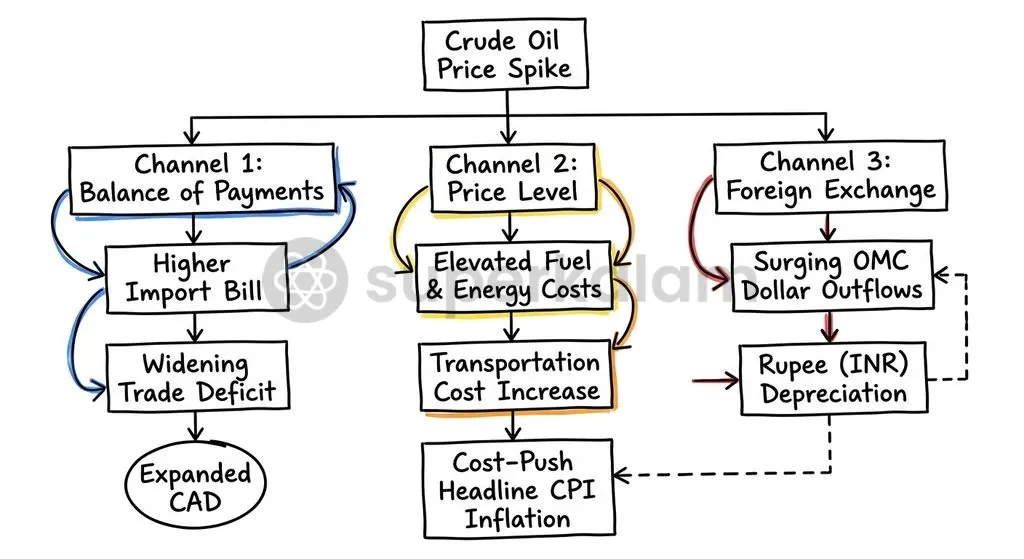
Crude spikes hit the Indian economy across three interlinked transmission channels: trade deficits, domestic inflation, and foreign exchange reserves. Surging global prices transmit quickly through external sector balances, wholesale input prices, and currency markets.
Empirical models in the Economic Survey demonstrate that every $10 per barrel increase in international crude oil prices expands India's Current Account Deficit by approximately 0.4% to 0.5% of GDP. That represents an annual foreign exchange drain of $13 billion to $15 billion.
Petroleum Planning & Analysis Cell trade data shows that India's net oil and gas import bill reached $97.7 billion during April–October 2026. This represented a year-on-year surge of nearly 40%, driven primarily by international price spikes rather than domestic volume growth.
| Channel | Quantitative Impact |
|---|---|
| Current Account Deficit | +$10/bbl crude expands CAD by 0.4%–0.5% of GDP |
| Consumer Inflation (CPI) | +10% sustained crude adds 20–30 bps to CPI |
| Foreign Exchange Market | OMC dollar demand depresses Rupee exchange rate |
| Import Bill (Apr–Oct '26) | Surged ~40% YoY to reach $97.7 billion |
Inflationary pressures manifest across both direct fuel indices and secondary transport costs. The Reserve Bank of India Monetary Policy Report estimates that a sustained 10% increase in international crude benchmarks transmits 20 to 30 basis points into headline Consumer Price Index inflation.
Currency depreciation compounds these imported inflationary dynamics. As documented in the RBI Financial Stability Report, state-run oil marketing companies enter spot foreign exchange markets to buy US dollars to settle high-value crude shipments. This concentrated dollar demand exerts sustained depreciation pressure on the Indian Rupee. Consequently, the central bank must conduct active foreign exchange interventions to curb disorderly exchange-rate volatility.
Fiscal Shock Absorbers: How Windfall Taxes and Excise Duties Cushion the Blow
Calibrated tax levers protect retail fuel consumers while skimming excessive upstream energy rents. On July 1, 2022, the Ministry of Finance invoked powers under the Central Excise Act to introduce the Special Additional Excise Duty as an extraordinary windfall profit tax.
The fiscal mechanism pursues three explicit economic objectives:
- Tapping Supernormal Margins: The levy skims abnormal operational profits earned by domestic crude exploration firms and private export-oriented refiners capitalising on high crack spreads.
- Calibrating Revenue Receipts: Union Budget data indicates that annual receipts from this windfall tax dropped from ₹25,000 crore in FY2023 to under ₹6,000 crore by FY2025 as international margins normalised. Revenue authorities later recalibrated the duties during subsequent geopolitical price escalations.
- Protecting Public Retail Margins: By absorbing crude increases through variable upstream taxes, the government moderates the need to slash general central excise duties on petrol and diesel, preserving budgetary allocations for capital expenditure.
Fiscal cushions face strict operational limits. When crude prices remain elevated across multiple quarters, suppressing retail pump prices requires state-owned oil marketing companies to absorb marketing under-recoveries. This strains their balance sheets and risks necessitating future taxpayer-funded capital infusions.
Discuss with Superkalam
How does an international crude price spike translate into domestic retail inflation and currency depreciation in India?
Ask NowCurrency Hedging in Practice: The Promise and Bottlenecks of Rupee-Dirham Trade
Local currency settlement reduces reliance on the US dollar, but structural trade deficits limit its expansion. In July 2023, the Reserve Bank of India and the Central Bank of the UAE executed a landmark Memorandum of Understanding establishing the Local Currency Settlement System to facilitate cross-border trade transactions settled in Indian Rupees and UAE Dirhams.
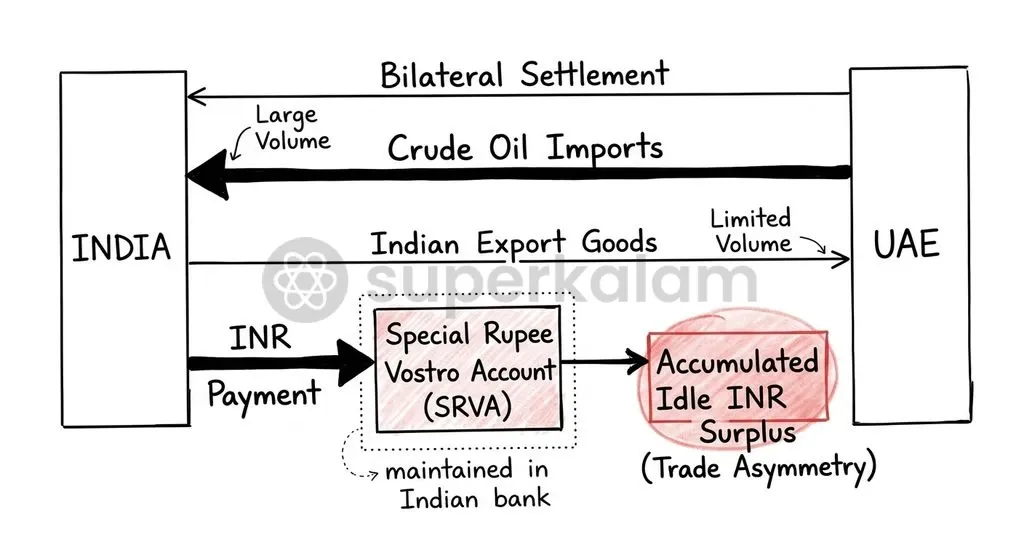
The framework achieved an initial commercial milestone in August 2023 when the Indian Oil Corporation completed a bilateral crude cargo acquisition. The public refiner purchased one million barrels of crude from the Abu Dhabi National Oil Company, invoicing and settling the entire transaction in Indian Rupees.
- Rupee Payment Invoicing: Indian refiners pay for imported Gulf crude directly in Indian Rupees rather than converting to US dollars.
- Vostro Account Balances: UAE commercial banks hold these payments in dedicated Special Rupee Vostro Accounts.
- Trade Asymmetry Lock: Because India imports far more energy from the Gulf than it exports in return, surplus rupee balances accumulate without ready conversion into local merchandise.
Despite this breakthrough, structural barriers prevent bilateral currency settlement from providing an expansive shield against global shocks:
- Persistent Trade Asymmetries: According to the RBI Report on Currency and Finance, local currency trade remains constrained by persistent bilateral trade deficits. Because India imports far more energy value from Gulf partners than it exports in merchandise, foreign energy exporters accumulate large, unconvertible balances in Special Rupee Vostro Accounts.
- Limited Re-investment Avenues: Non-resident energy suppliers find limited liquidity outside of Indian government securities to deploy accumulated Rupee assets.
- Pervasiveness of Benchmark Pricing: West Asian crudes remain priced against dollar-denominated global indices like Brent and Dubai Fateh. Consequently, local currency settlements merely hedge transaction conversion costs rather than shielding the economy from core dollar-denominated price escalations.
Strategic Petroleum Reserves: How Prepared Is India for a Physical Supply Choke?
India's underground oil stockpiles provide emergency physical insulation against naval blockades and maritime supply disruptions. India manages emergency underground hydrocarbon inventories through the Indian Strategic Petroleum Reserves Limited, an operational subsidiary of the Oil Industry Development Board. Strategic underground reserves provide sovereign storage insulated from surface attacks and marine blockades, providing a non-commercial buffer during severe global supply interruptions.
Parliamentary records from the Ministry of Petroleum and Natural Gas show that Phase I infrastructure establishes 5.33 Million Metric Tonnes of storage capacity across unlined underground rock caverns. This inventory is distributed across three locations:
- Visakhapatnam, Andhra Pradesh: 1.33 MMT cavern capacity
- Mangaluru, Karnataka: 1.5 MMT cavern capacity
- Padur, Karnataka: 2.5 MMT cavern capacity
Official disclosures indicate that this 5.33 MMT inventory provides roughly 9.5 days of net crude oil consumption cover. When integrated with commercial petroleum stocks maintained by commercial refiners (64.5 days), India's total physical buffer totals approximately 74 days of national consumption requirements.
| Reserve Category | Infrastructure Location | Dedicated Storage Capacity | Days of Net Consumption Cover | Operating Entity |
|---|---|---|---|---|
| Strategic (Phase I) | Visakhapatnam, Mangaluru, Padur | 5.33 MMT | ~9.5 days | ISPRL |
| Commercial Stocks | Coastal Refineries & Product Depots | Commercial tanks and pipelines | ~64.5 days | Public & Private OMCs |
| Total National Cover | Combined Operational Inventory | Physical crude & refined products | ~74.0 days | Integrated Sector |
| IEA Benchmark | Emergency Member Requirement | Strategic & Industry Stocks | 90 days | IEA Member Standard |
| Strategic (Phase II) | Chandikhol (4 MMT) & Padur (2.5 MMT) | 6.50 MMT (PPP Model) | Additional ~12 days | ISPRL / PPP Concessionaires |
This 74-day combined cushion leaves the country below the mandatory 90 days net import benchmark stipulated for members of the International Energy Agency.
To bridge this operational deficit, the Union Cabinet sanctioned SPR Phase II in July 2021. This expansion authorises 6.5 MMT of additional underground storage across Chandikhol in Odisha (4 MMT) and Padur in Karnataka (2.5 MMT) under a public-private partnership structure valued at ₹14,527 crore. However, until commercial execution finishes and caverns are fully filled, physical resilience against extended shipping blockades remains constrained.
Discuss with Superkalam
If a regional conflict forces complete avoidance of the Bab-el-Mandeb Strait, how would the alternative maritime route affect shipping timelines and operational costs for Indian importers?
Ask NowWhy Domestic Exploration Stalled: Evaluating HELP, OALP, and the Kelkar Blueprint
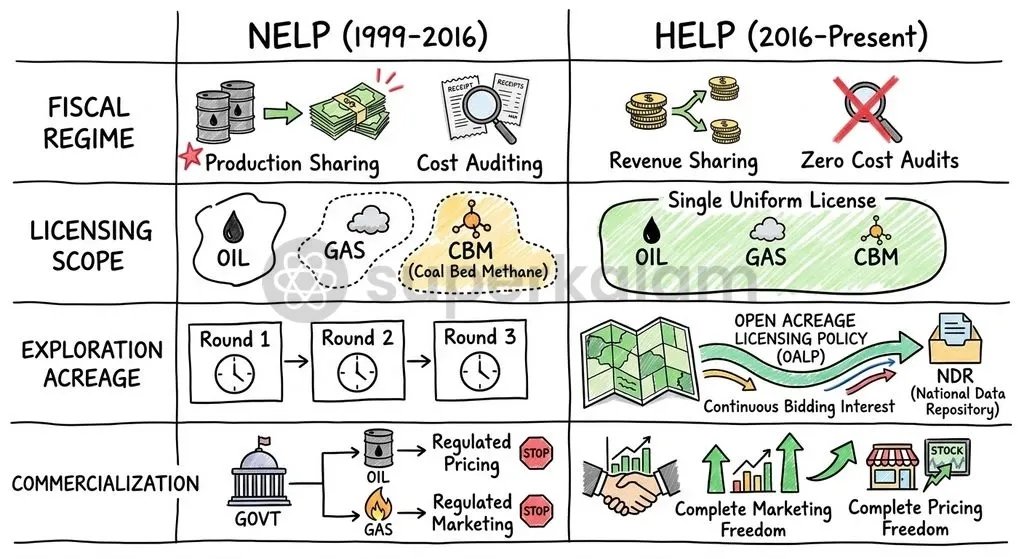
Shifting from cost-recovery production contracts to revenue sharing removed administrative deadlocks but failed to reverse declining domestic exploration. In 2016, the government overhauled its exploration architecture by replacing the 1999 New Exploration Licensing Policy with the Hydrocarbon Exploration and Licensing Policy.
| Dimension | NELP (1999) | HELP (2016) |
|---|---|---|
| Contract Model | Production Sharing Contracts (PSC) | Revenue Sharing Contracts |
| Auditing & Disputes | Complex cost-recovery audits | No cost audits; share linked to gross revenue |
| Licencing Scope | Separate licences per resource | Uniform Licensing System for all hydrocarbons |
| Block Allocation | Periodic government bidding rounds | Open Acreage Licensing Programme (OALP) |
The institutional transition under HELP introduced three structural departures monitored by the Directorate General of Hydrocarbons:
- Revenue Sharing Contracts: HELP abandoned the contentious cost-recovery Production Sharing Contracts of NELP. Under NELP, operators often inflated capital expenditure before sharing profits. In contrast, HELP instituted a transparent revenue-sharing model tied directly to gross output.
- Uniform Licensing System: Operators obtain a single composite licence permitting the extraction of conventional crude, natural gas, coal-bed methane, and shale reserves without requiring separate administrative clearances.
- Open Acreage Licensing Programme: Bidders demarcate exploration blocks continuously through the year via the National Data Repository, moving past slow government bidding rounds.
Despite these upstream reforms, domestic crude output failed to reverse the country's import trajectory. The landmark Vijay Kelkar Committee Report laid down a comprehensive blueprint titled the Roadmap for Reduction in Import Dependency in Hydrocarbon Sector by 2030.
The Kelkar panel recommended establishing a competitive tax regime, expediting domestic gas market pricing freedom, and setting targets to curtail import dependency by 10% by 2022 and by 50% by 2030.
Yet, actual crude import reliance rose from 77% during the committee's tenure to an unprecedented 88.7% by late 2026. Upstream exploration stalled under complex environmental clearances and deepwater geological challenges. Global exploration majors also delayed committing frontier risk capital.
The Strategic Way Forward: Beyond Tactical Hedging to Real Energy Autonomy
Securing long-term independence requires replacing temporary trade workarounds with structural fuel substitution. While discounted Russian crude imports expanded from less than 2% of India's import mix in 2021 to over 35% by 2024–2025, such opportunistic sourcing remains inherently vulnerable to evolving international sanctions, tanker fleet availability, and shifting geopolitical alignments.
Real energy autonomy demands aggressive implementation across four strategic pillars:
- Downstream Demand Substitution: The Ministry of Petroleum and Natural Gas achieved a milestone by reaching an average 20% ethanol blending rate in petrol by late 2026, advancing its original Ethanol Blended Petrol target ahead of the 2030 schedule. Maintaining this trajectory through cellulosic biofuels and commercial green hydrogen directly cuts baseline crude requirements.
- Accelerated Fleet Electrification: Structural projections in the IEA World Energy Outlook 2026 show that under aggressive policy responses, electric mobility can displace over 11 million barrels per day of global oil demand by 2035. Expanding domestic electric public transport infrastructure curtails imported oil demand within urban logistics.
- Accelerating Strategic Storage Execution: Completing SPR Phase II infrastructure across Chandikhol and Padur is a national security priority to meet the 90 days emergency buffer.
- Fiscal and Upstream Realignment: Fulfilling the Kelkar Committee recommendations requires institutionalising predictable domestic fiscal terms and granting market-linked pricing for difficult offshore fields. This would incentivise technological partnerships for enhanced oil recovery across ageing wells.
Discuss with Superkalam
Why does bilateral local currency trade fail to eliminate the macroeconomic risks of imported energy inflation despite avoiding the US dollar?
Ask NowKey Takeaways
- Elevated Import Dependence: India's net crude oil import dependency reached 88.7% by late 2026, driving the net oil and gas import bill to $97.7 billion during April–October 2026 alone.
- Macroeconomic Vulnerability: Every $10 per barrel increase in global crude prices expands India's Current Account Deficit by 0.4% to 0.5% of GDP and passes 20 to 30 basis points into Consumer Price Index inflation.
- Fiscal and Currency Hedging Limits: The Special Additional Excise Duty captures temporary domestic windfall profits, while the Local Currency Settlement System enables bilateral rupee trade; however, persistent trade deficits limit rupee convertibility in foreign Vostro accounts.
- Strategic Storage Deficit: India's underground Strategic Petroleum Reserves Phase I establishes 5.33 MMT of capacity across Visakhapatnam, Mangaluru, and Padur. While this provides roughly 9.5 days of net cover and refiners add commercial stocks to total 74 days, the national cushion remains below the International Energy Agency's 90 days benchmark.
- Structural Upstream Challenges: The transition from NELP to the Hydrocarbon Exploration and Licensing Policy established revenue-sharing and open acreage, but failed to hit the Kelkar Committee's target of cutting import dependency 10% by 2022.
Mains Question
"Tactical instruments such as windfall profit taxes and bilateral local currency settlement mechanisms offer only fleeting buffers against systemic global energy shocks." Critically analyse. (15 Marks)
Evaluate NowMains Question
Examine the role and adequacy of the Indian Strategic Petroleum Reserves (ISPRL) framework in mitigating physical supply shocks arising from maritime choke point disruptions. (10 Marks)
Evaluate NowPractice MCQs
QUESTION 1
Consider the following statements regarding the macro-economic impact of crude oil price shocks on India:
- Every $10 per barrel increase in international crude oil prices expands India's Current Account Deficit by approximately 0.4% to 0.5% of GDP.
- A sustained 10% increase in international crude benchmarks transmits roughly 20 to 30 basis points into headline Consumer Price Index (CPI) inflation.
- Increased dollar demand by oil marketing companies to settle crude imports tends to exert appreciation pressure on the Indian Rupee. Which of the statements given above are correct?
QUESTION 2
With reference to India's Strategic Petroleum Reserves (SPR) Phase I infrastructure, consider the following statements:
- The emergency underground hydrocarbon reserves are managed by Indian Strategic Petroleum Reserves Limited (ISPRL), a subsidiary of the Oil Industry Development Board.
- Phase I infrastructure establishes underground rock cavern storage across Visakhapatnam, Mangaluru, and Padur.
- The Phase I physical storage capacity alone provides approximately 74 days of net national crude oil consumption cover. Which of the statements given above is/are correct?
QUESTION 3
Consider the following statements regarding the Local Currency Settlement System (LCSS) framework between India and the UAE:
- It enables cross-border trade transactions to be invoiced and settled in Indian Rupees and UAE Dirhams.
- UAE commercial banks hold rupee balances in dedicated Special Rupee Vostro Accounts.
- Because crude oil is invoiced in local currency, the arrangement completely shields India from dollar-denominated global price escalations. Which of the statements given above is/are correct?
QUESTION 4
Regarding the Special Additional Excise Duty introduced in July 2022, consider the following statements:
- It was invoked by the Ministry of Finance under the provisions of the Central Excise Act.
- It acts as a windfall profit tax targeting supernormal gains of domestic exploration firms and export-oriented refiners.
- Annual receipts under this levy rose continuously from FY2023 through FY2025. Which of the statements given above is/are correct?
QUESTION 5
According to the International Energy Agency (IEA) and official data cited in the article, which of the following maritime choke points handles between 45% to 50% of India's crude imports and over 90% of its imported Liquefied Petroleum Gas (LPG)?
Discuss with Superkalam
Between fiscal buffers (like windfall taxes) and physical storage (like underground petroleum caverns), which serves as a more reliable hedge against extended maritime blockades?
Ask Now