Rabies Elimination by 2030: NAPRE, Surveillance Gaps, and One Health
Overcoming acute surveillance gaps and fractured One Health coordination is critical for India to achieve zero dog-mediated human rabies deaths by 2030.
Oct, 2026
•9 min read

Overview
India's National Action Plan for Dog Mediated Rabies Elimination by 2030 steers public policy toward a cross-sector One Health framework. The strategy targets zero dog-transmitted human rabies deaths through mass canine vaccination, rapid post-exposure prophylaxis, and inter-ministerial coordination.
Rabies is 100% preventable through timely prophylaxis, yet it carries an almost 100% case-fatality rate once clinical neurological symptoms appear.
India's elimination timeline faces critical surveillance blind spots. In many rural districts, unrecorded home deaths completely bypass official tracking systems. Bridging this reporting gap remains the central administrative hurdle before the 2030 milestone.
Why in the News?
The Ministry of Health and Family Welfare and state health departments are accelerating interventions under the National Action Plan for Dog Mediated Rabies Elimination to meet the 2030 deadline.
As of April 2025, central advisories have led at least 23 States and Union Territories to declare human rabies a notifiable disease, making case reporting mandatory across both public and private health facilities. This policy shift highlights the need to link municipal administration and healthcare delivery under a unified One Health approach.
What is the National Action Plan for Rabies Elimination (NAPRE)?
The National Action Plan for Dog Mediated Rabies Elimination provides an operational roadmap to end dog-mediated human rabies in India by 2030. The Ministry of Health and Family Welfare alongside the Ministry of Fisheries, Animal Husbandry and Dairying jointly launched the initiative on World Rabies Day on 28 September 2021.
This framework aligns India with the international 'Zero by 30' goal, established jointly by the World Health Organization (WHO), the World Organisation for Animal Health (WOAH), the Food and Agriculture Organization (FAO), and the Global Alliance for Rabies Control (GARC).
NAPRE operates across three strategic pillars:
- Human Health Component: Guaranteeing universal access to modern cell-culture vaccines, expanding intradermal administration routes, and decentralising rabies immunoglobulins across primary care facilities.
- Animal Health Component: Scaling mass dog vaccination campaigns to build herd immunity and managing stray canine populations through regulated veterinary procedures.
- Surveillance and Community Outreach: Merging human and animal health data into integrated digital platforms and running targeted awareness campaigns across schools and local wards.
Discuss with Superkalam
What is the target year set under the National Action Plan for Dog Mediated Rabies Elimination (NAPRE), and what canine vaccination coverage percentage is required to break disease transmission?
Ask NowUnderstanding the Disease: Transmission, Symptoms, and Post-Exposure Prophylaxis
Rabies is an acute, fatal viral encephalomyelitis caused by the neurotropic Lyssavirus. It spreads primarily through the saliva of infected animals via transdermal bites or scratches.
The single-stranded RNA virus belongs to the Rhabdoviridae family, moving along peripheral nerves to the central nervous system to induce acute encephalopathy. In India, roughly 96% of human rabies cases and fatalities stem from domestic and free-roaming dog bites.
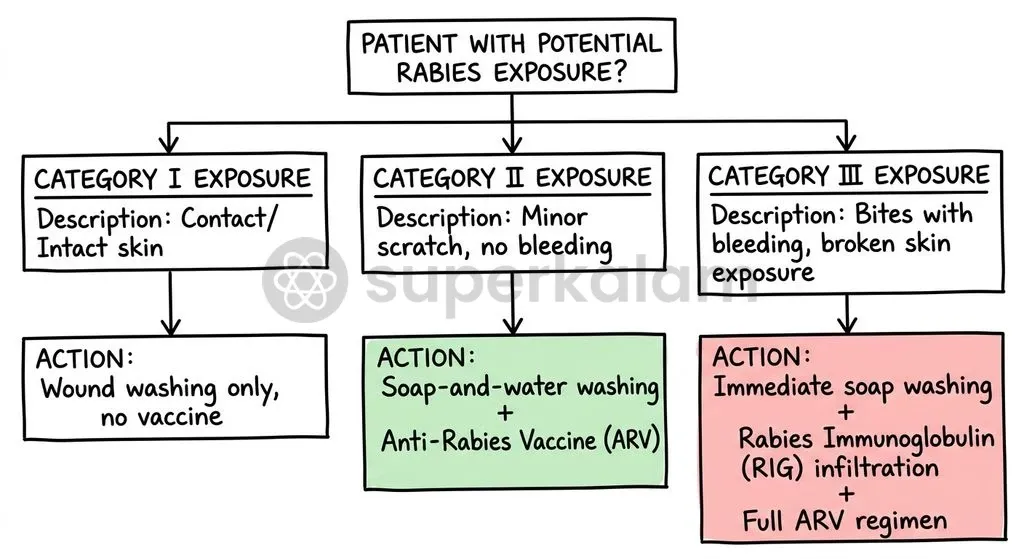
The World Health Organization classifies animal exposures into three clinical categories to direct post-bite management:
| Exposure Category | Nature of Contact / Injury | Prescribed Post-Exposure Prophylaxis (PEP) Protocol |
|---|---|---|
| Category I | Touching or feeding animals; licks on intact, unbroken skin | No medical prophylaxis required; thorough washing of exposed skin |
| Category II | Minor scratches or abrasions without bleeding; nibbling of uncovered skin | Immediate wound washing with soap and running water; complete anti-rabies vaccination regimen |
| Category III | Single or multiple transdermal bites, scratches; licks on broken skin or mucous membranes | Immediate wound washing, complete anti-rabies vaccination, and direct Rabies Immunoglobulin (RIG) infiltration |
Prompt local wound management is essential. Washing the bite area under running tap water with soap for at least 15 minutes physically removes and inactivates virus particles at the wound site.
For Category III exposures, clinical management follows a strict three-step protocol:
- Wound Cleansing: Immediate, vigorous washing with soap and running water for at least 15 minutes.
- Passive Immunisation: Direct anatomical infiltration of Rabies Immunoglobulin (RIG) into and around all wound margins.
- Active Immunisation: Completion of a full anti-rabies vaccination schedule via intradermal or intramuscular administration.
To improve accessibility, the Drugs Controller General of India (DCGI) approved the economical Intradermal (ID) route for cell-culture rabies vaccines in 2006. By depositing small doses directly into the dermis, intradermal delivery reduces vaccine volume and cost by 60% to 80% compared to intramuscular regimens. This technique allows multiple bite victims to share a single vial safely.
The Data Mismatch: Official Surveillance vs Epidemiological Estimates
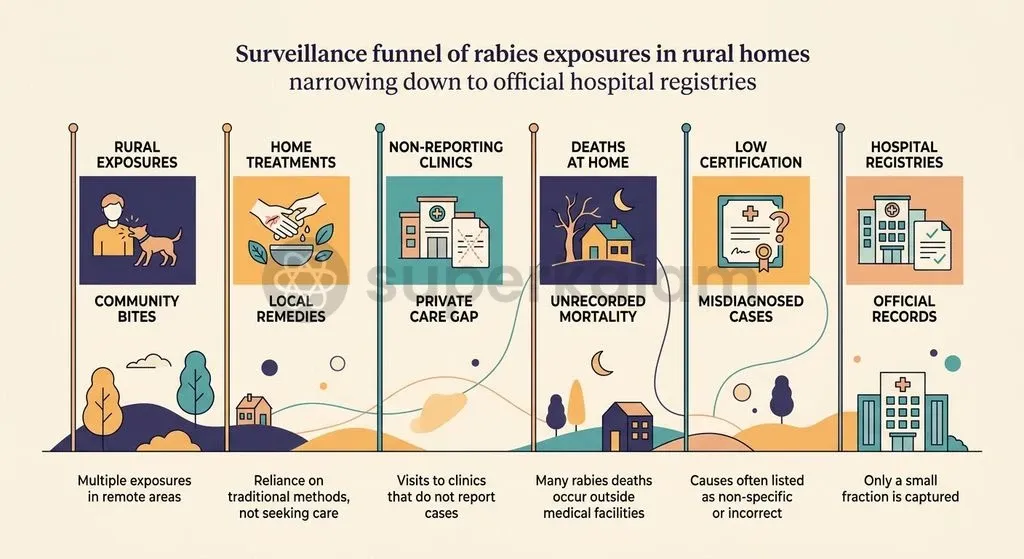
India records a sharp discrepancy between routine government surveillance and independent epidemiological estimates of rabies mortality. Institutional reporting captured through the Integrated Disease Surveillance Programme and the Integrated Health Information Platform (IDSP-IHIP) logs only a fraction of suspected human rabies deaths.
Three systemic factors drive this institutional undercount:
- Hospital-Centric Reporting: IDSP-IHIP historically relied on sentinel public tertiary hospitals, missing patients who leave against medical advice or die at home.
- Exclusion of the Private Sector: Private nursing homes and clinics rarely submit clinical records to municipal health officers without strict statutory compulsion.
- Low Medical Death Certification: The Medical Certification of Cause of Death (MCCD) system covers under 25% of registered deaths, leaving a wide information void in rural districts.
By contrast, epidemiological models and the landmark national survey by the Association for Prevention and Control of Rabies in India (APCRI) estimated India's toll at roughly 18,000 to 20,000 deaths annually, accounting for nearly 36% of global rabies mortality (as reported, September 2023). Until all states enforce mandatory notification, this data gap distorts local health budgets and vaccine procurement.
Key Bottlenecks in India's Anti-Rabies Strategy
India's rabies containment efforts face persistent obstacles across clinical supply chains, canine herd immunity, and inter-agency coordination.
The most acute implementation hurdles include:
- Immunoglobulin Supply Shortages: While rabies vaccines are widely stocked, rural Primary Health Centres (PHCs) and Community Health Centres (CHCs) regularly run out of Rabies Immunoglobulin (RIG). This gap forces patients to travel to distant tertiary hospitals.
- Sub-Threshold Canine Vaccination: WHO guidelines show that mass dog vaccination drives must reach at least 70% canine vaccination coverage to break transmission cycles. Most urban bodies lack accurate dog census data to sustain these targets.
- Open Solid Waste Accumulation: Unregulated food and organic waste in urban commons artificially expands the biological carrying capacity of cities, sustaining high stray dog population densities.
- Inter-Departmental Silos: Human health authorities, veterinary departments, and municipal corporations often operate without shared data systems, limiting contact tracing when rabid animals are identified.
Discuss with Superkalam
How does unregulated municipal solid waste expand the biological carrying capacity of cities for stray canine populations?
Ask NowSuccess Stories: How Goa Achieved Rabies-Controlled Status
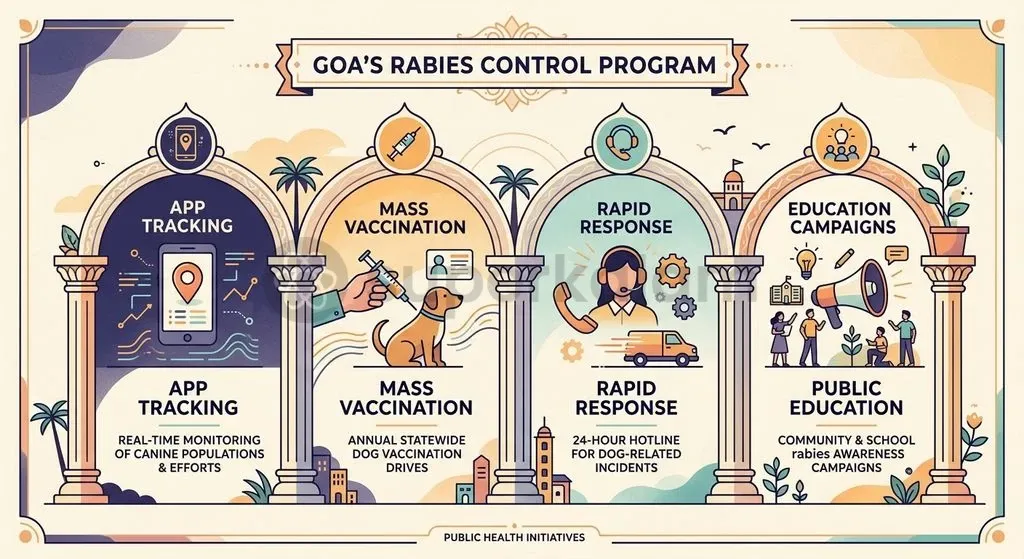
Goa became India's first rabies-controlled state in June 2021 by executing a targeted One Health model under the Mission Rabies initiative. The state earned this benchmark after documenting zero indigenous human rabies deaths for over three consecutive years.
The Goa Model relied on four integrated operational mechanisms:
- Digital Field Tracking: Vaccination teams used a specialised mobile tool (WVS App) with geographic mapping to track fieldwork in real time, administering over 95,000 canine vaccinations annually to surpass the 70% threshold.
- 24-Hour Surveillance Hotline: A public emergency telephone line let citizens report suspected rabid animals, deploying veterinary teams immediately for quarantine and diagnostic testing.
- School and Community Outreach: Targeted campaigns educated students and local leaders on dog body language, bite avoidance, and mandatory wound-washing steps.
- Cross-Departmental Synergy: The state unified operations across the Directorate of Health Services, the Department of Animal Husbandry and Veterinary Services, and village panchayats.
Ethical and Policy Dimensions of Stray Animal Management
Managing urban stray dog populations requires balancing the fundamental right to life under Article 21 with animal welfare provisions under the Constitution of India. Under Article 243W read with the Twelfth Schedule, urban local bodies hold the statutory duty for sanitation, public health, and municipal waste administration.
The legal framework operates through specific statutory rules and judicial rulings:
- Animal Birth Control Rules, 2023: Issued under Section 38 of the Prevention of Cruelty to Animals Act, 1960, these rules require local authorities to manage stray populations via sterilisation and immunisation rather than culling.
- Non-Relocation Mandate: Under the ABC Rules, 2023 and Supreme Court directions in Animal Welfare Board of India vs P.E.S.T. & Ors (SLP No. 691 of 2009), municipal bodies cannot relocate captured dogs. Animals must be released back into their original localities after treatment.
- Constitutional Harmony: Judicial doctrine balances Article 21 (Right to Life and Personal Liberty), Article 48A (Protection of the Environment), and Article 51A(g) (Fundamental Duty of Compassion) to protect human safety while upholding humane animal welfare standards.
Discuss with Superkalam
As a district health officer managing a Category III dog bite cluster, how would you operationalize the clinical three-step protocol and community response?
Ask NowWay Forward: Fixing Surveillance and Operationalizing One Health
Reaching the 2030 target demands universal disease notification, robust vaccine logistics, and institutional One Health execution across local governments.
Key policy priorities include:
- Universalise Disease Notification: All remaining States and Union Territories must make human and animal rabies a notifiable disease, enforcing strict reporting compliance for private clinics and diagnostic laboratories.
- Strengthen Primary Care Logistics: State medical procurement agencies must ensure uninterrupted supplies of intradermal vaccines and equine or human rabies immunoglobulins across all Community Health Centres.
- Scale Mass Canine Immunisation: Municipal bodies should fund GPS-tracked dog vaccination campaigns, adopting Goa's framework to maintain the 70% canine herd immunity benchmark.
- Enforce Scientific Waste Processing: Strict enforcement of the Solid Waste Management Rules will clear open food sources, reducing stray animal carrying capacities across residential neighbourhoods.
Discuss with Superkalam
Analyze the systemic factors that cause routine institutional surveillance systems like IDSP-IHIP and MCCD to undercount rabies mortality in rural India.
Ask NowKey Takeaways
- NAPRE targets the elimination of dog-mediated human rabies in India by 2030, supporting the global 'Zero by 30' framework led by WHO, WOAH, FAO, and GARC.
- Rabies is an acute viral encephalomyelitis caused by the Lyssavirus genus, presenting an almost 100% case-fatality rate upon symptom onset, yet remaining 100% preventable via timely post-exposure prophylaxis.
- Category III bite exposures necessitate immediate 15-minute wound washing, anti-rabies vaccination, and local infiltration of Rabies Immunoglobulin (RIG).
- Official data under IDSP-IHIP undercounts rabies mortality due to hospital-centric capture and low medical certification of deaths, whereas historical surveys (APCRI) estimated roughly 18,000 to 20,000 annual deaths (as reported, September 2023).
- The Goa Model demonstrated proof-of-concept by achieving rabies-controlled status through digital vaccination tracking, community hotlines, and cross-departmental One Health execution.
- Animal management governance under the Animal Birth Control Rules, 2023 (notified under Section 38 of the Prevention of Cruelty to Animals Act, 1960) requires combined sterilisation, vaccination, and territorial non-relocation.
Mains Question
"Despite rabies being 100% preventable through timely post-exposure prophylaxis, India continues to experience critical surveillance blind spots and implementation bottlenecks." In the context of the National Action Plan for Rabies Elimination (NAPRE), critically examine the institutional hurdles hindering India's 'Zero by 30' goal. (15 Marks)
Evaluate NowMains Question
Goa's achievement of rabies-controlled status demonstrates the operational viability of a cross-sector One Health approach. Evaluate the key components of the Goa Model and discuss how it can inform urban stray animal management in India. (10 Marks)
Evaluate NowPractice MCQs
QUESTION 1
With reference to the National Action Plan for Dog Mediated Rabies Elimination (NAPRE) in India, consider the following statements:
- It was jointly launched by the Ministry of Health and Family Welfare and the Ministry of Fisheries, Animal Husbandry and Dairying.
- It aligns India with the global 'Zero by 30' goal established by WHO, WOAH, FAO, and GARC.
- It mandates that human rabies be treated exclusively through intramuscular administration routes to ensure efficacy.
Which of the statements given above are correct?
QUESTION 2
According to the World Health Organization (WHO) exposure classification and post-exposure prophylaxis protocols, consider the following pairs:
- Category I Exposure: Touching or feeding animals — No medical prophylaxis required except washing exposed skin
- Category II Exposure: Minor scratches or abrasions without bleeding — Wound washing and complete anti-rabies vaccination regimen
- Category III Exposure: Single or multiple transdermal bites or scratches — Wound washing, vaccination, and direct Rabies Immunoglobulin (RIG) infiltration
How many of the pairs given above are correctly matched?
QUESTION 3
Consider the following statements regarding rabies surveillance and mortality estimates in India:
- The Integrated Disease Surveillance Programme (IDSP-IHIP) captures nearly all rabies fatalities due to high home-death reporting.
- The Medical Certification of Cause of Death (MCCD) system covers less than 25% of registered deaths across India.
- Epidemiological models estimate India's annual rabies mortality at 18,000 to 20,000 deaths, accounting for over a third of global rabies deaths.
Which of the statements given above is/are correct?
QUESTION 4
Regarding the biological characteristics and clinical prevention of rabies, which of the following statements is NOT correct?
QUESTION 5
Consider the following statements regarding the Goa One Health model for rabies control:
- Goa was declared India's first rabies-controlled state after documenting zero indigenous human rabies deaths for three consecutive years.
- The intervention utilized a specialized digital tool (WVS App) to track field vaccinations in real time.
- The model achieved its benchmark solely through canine culling without administering vaccines.
Which of the statements given above is/are correct?





