Pulses Procurement in India: Why Assured Offtake Alone Cannot Ensure Self-Sufficiency
Guaranteed MSP offtake cannot ensure self-reliance while cereal subsidies, duty-free import surges, and rainfed yield deficits suppress pulse farmgate returns.
Oct, 2026
•8 min read
Overview
India’s drive for pulses self-sufficiency cannot succeed through guaranteed procurement alone. Open-ended cereal subsidies, duty-free import surges, and chronic rainfed yield gaps continually depress farmgate returns.
While the Union Government's Mission for Aatmanirbharta in Pulses commits ₹11,440 crore for assured procurement, structural price distortions persist. Water-intensive cereals continue to outcompete pulses across major agricultural belts.
Achieving genuine agricultural autonomy requires three structural shifts: aligning trade policy with domestic support prices, closing yield deficits in rainfed tracts, and rewarding farmers for the positive ecological externalities of leguminous crops.
Why in the News?
The Union Government approved the Centrally Sponsored Scheme Mission for Aatmanirbharta in Pulses with an outlay of ₹11,440 crore to eliminate import dependency.
As of October 2026, national pulse production reached 274.09 lakh tonnes, rising from 256.83 lakh tonnes in 2024–25. Despite this rise, persistent deficits in pigeon pea (tur), black gram (urad), and lentils (masoor) continue to trigger substantial foreign purchases, according to the Ministry of Agriculture and Farmers Welfare Progress Review.
Central nodal agencies now guarantee 100 percent procurement of tur, urad, and masoor at Minimum Support Prices (MSP) via digital portals, as confirmed by the Press Information Bureau release on tur procurement. The measure seeks to insulate domestic growers from market shocks and incentivise crop diversification away from water-depleting cereals.
What the Pulses Self-Sufficiency Mission Promises: Assured Procurement and Targets
The Mission for Aatmanirbharta in Pulses establishes ambitious production, acreage, and yield milestones spanning the financial years 2025–26 to 2030–31. According to the Press Information Bureau backgrounder on the Mission for Aatmanirbharta in Pulses, the initiative targets 310 lakh hectares of cultivation area, 350 lakh tonnes of domestic output, and an average productivity of 1,130 kg per hectare by 2030–31.
Central agencies execute this mandate through a targeted institutional mechanism:
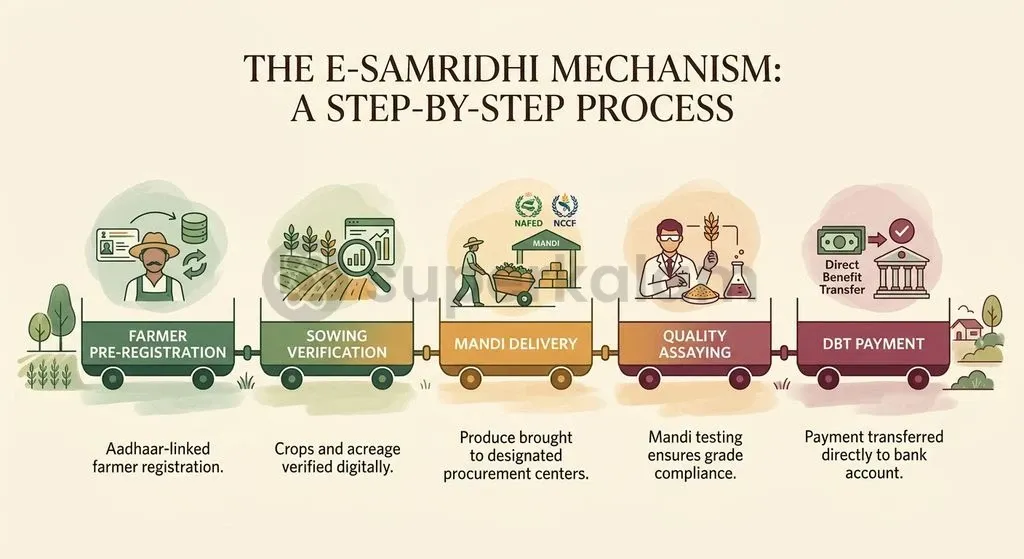
- Four-Year Complete Offtake Guarantee: The central government guarantees 100 percent procurement of tur, urad, and masoor at notified MSPs for four years up to 2028–29 through the National Agricultural Cooperative Marketing Federation of India (NAFED) and the National Cooperative Consumers' Federation of India (NCCF).
- Digital Pre-Registration: Procurement operates via the e-Samridhi portal managed by NAFED and the e-Samyukti portal managed by NCCF, which require pulse growers to register before harvest.
- Direct Benefit Settlement: Verified registration links Aadhaar details to land records, enabling direct benefit transfer payments straight into bank accounts and curtailing intermediary exploitation.
- Targeted Input Support: The Ministry of Agriculture planned the free distribution of 87.5 to 88 lakh seed minikits alongside 126 lakh quintals of certified seeds over six years to upgrade genetic stock.
Discuss with Superkalam
What are the specific targets for production, area, and yield set under the Mission for Aatmanirbharta in Pulses for 2030–31?
Ask NowThe Cereal Bias: Why Farmers Choose Paddy and Wheat Over Pulses
Indian agricultural policy maintains a systemic cereal bias that renders paddy and wheat far more financially secure than leguminous crops. Open-ended procurement by the Food Corporation of India absorbs roughly 30% to 40% of national wheat and paddy output, according to the Department of Food and Public Distribution. In contrast, historical procurement under the Price Support Scheme (PSS) absorbed less than 5% of pulse harvests.
Input subsidies widen this economic divergence. Subsidised electricity, canal networks, and underpriced urea heavily favour cereal monocultures, depressing the relative private profitability of pulses.
| Dimension | Cereal Monoculture (Paddy & Wheat) | Leguminous Crops (Pulses) |
|---|---|---|
| Assured Public Offtake | 30% to 40% of total national output absorbed by state agencies | Historically less than 5% absorbed under price support operations |
| Irrigation Coverage | Over 90% of wheat land and nearly 65% of paddy land under irrigation | Under 20% of pulse area enjoys irrigation access |
| Input Subsidies | Disproportionately captures power, canal water, and fertiliser outlays | Minimal capture of major input and power subsidies |
| Price Volatility | Insulated by dependable open-ended procurement infrastructure | High seasonal volatility; frequent farmgate crashes below MSP |
| Agro-Ecological Impact | Groundwater depletion, soil salinisation, and heavy carbon footprint | Atmospheric nitrogen fixation and superior water conservation |
Production remains geographically concentrated, leaving output exposed to regional rainfall shocks. Madhya Pradesh, Maharashtra, and Rajasthan together generate over 55% of India's pulses, according to the NITI Aayog Report on Strategies and Pathways for Accelerating Growth in Pulses. Without widespread procurement centres in these rainfed heartlands, local farmers struggle to access state-backed safety nets.
Discuss with Superkalam
How does open-ended cereal procurement and input subsidisation create a systemic disincentive against pulse cultivation?
Ask NowThe Policy Contradiction: Pro-Farmer MSPs Clashing with Cheap Food Imports
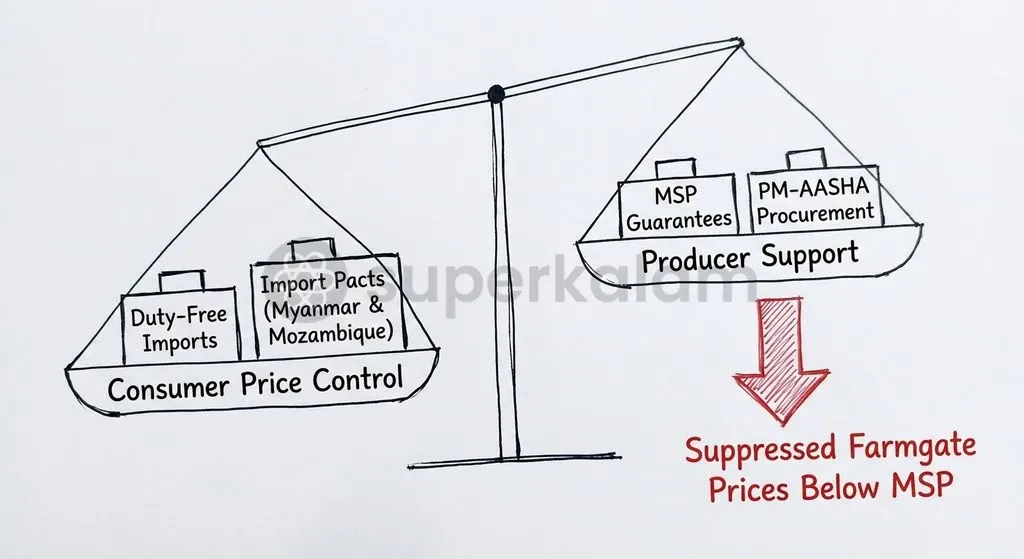
Consumer inflation concerns frequently override domestic farm support objectives. The Directorate General of Foreign Trade extended duty-free, unrestricted imports of pigeon peas and black gram until March 31, 2027 to curb retail food inflation.
When global shipments enter Indian ports without tariffs during domestic harvest arrivals, local mandi prices crash. This dynamic undercuts the remunerative price signals intended by higher MSP announcements.
Government-to-government import pacts compound harvest-time market gluts. India maintains bilateral import agreements securing annual quotas of 200,000 tonnes of tur from Mozambique, alongside 250,000 tonnes of urad and 100,000 tonnes of tur from Myanmar.
Zero-duty imports and dedicated bilateral shipments around domestic harvesting seasons routinely push farmgate prices below MSP, as documented by NITI Aayog. Smallholders facing depressed prices cut pulse acreage in following seasons, perpetuating a recurring cycle of shortfalls, import dependence, and price volatility.
The Arvind Subramanian Committee Blueprint: What Real Pricing Reform Requires
The Arvind Subramanian Committee submitted a foundational blueprint in 2016 titled Incentivising Pulses Production through Minimum Support Price (MSP) and Related Policies to dismantle structural disincentives in pulse farming. Administrative price setting must compensate pulses for their environmental contributions rather than relying solely on conventional cost-of-cultivation metrics.
Key recommendations of the Arvind Subramanian Committee highlight three systemic interventions:
- Ecological Valuation in MSP: The Commission for Agricultural Costs and Prices (CACP) should explicitly factor positive ecological externalities—specifically atmospheric nitrogen fixation and water conservation—into pulse MSP formulas to offset the subsidised advantages enjoyed by cereals.
- Strategic Buffer Stocking: The central government should construct a 20 lakh tonne strategic buffer stock, deploying central agencies for aggressive and opportunistic procurement whenever harvest prices fall below benchmark rates.
- Unrestricted Agricultural Markets: State governments should delist pulses from Agricultural Produce Market Committee (APMC) regulations, remove internal movement barriers, and eliminate recurring stock limits under the Essential Commodities Act to build a unified national market.
Discuss with Superkalam
Assess the economic trade-off between consumer inflation management via zero-duty pulse imports and farmer income security via MSP.
Ask NowBeyond Procurement: Yield Gaps, Rainfed Farming, and Seed Technology
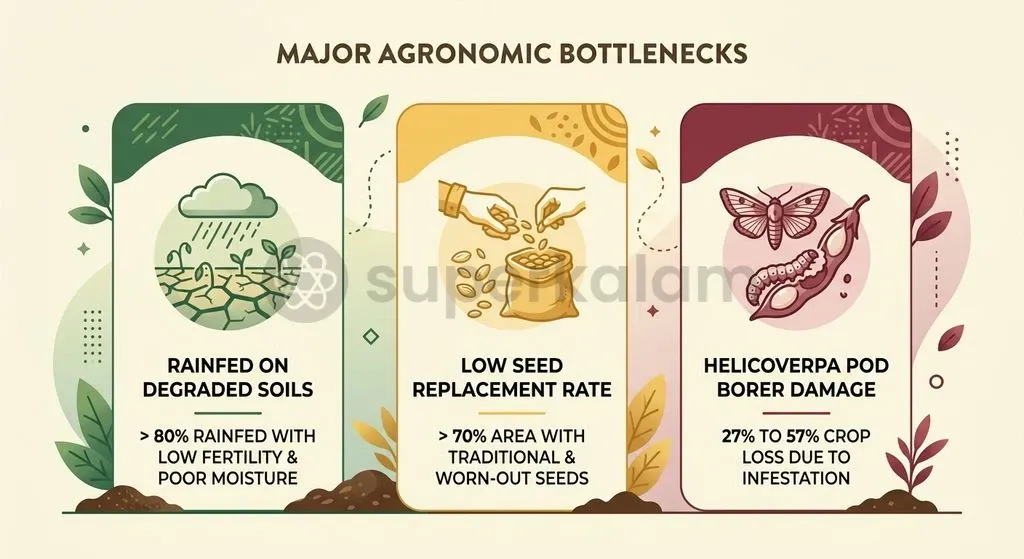
Agronomic constraints outside the procurement system severely suppress domestic pulse productivity. According to NITI Aayog, approximately 80% of pulses in India grow under rainfed conditions on marginal, degraded soils, supporting over 5 crore farming households. Severe moisture stress during pod development regularly reduces yields across rainfed tracts.
India's national average pulse yield hovers around 850 to 900 kg per hectare (0.851 tonnes/ha), less than half the yield achieved by major international exporters.
| Country | Average Pulse Productivity (kg/ha) |
|---|---|
| India | 850–900 kg/ha |
| Canada | 1,900 kg/ha |
Two major non-price barriers perpetuate this productivity deficit:
- Low Seed Replacement Rate (SRR): Pulses suffer from a chronically low seed replacement rate, with over 70% of cultivated area in multiple states relying on degenerated, farm-saved seeds rather than certified high-yielding varieties.
- Vulnerability to Pest Infestation: The gram pod borer (Helicoverpa armigera) inflicts severe damage, causing avoidable crop yield losses ranging from 27% to over 57% in pigeon pea and chickpea under unprotected field conditions, according to the ICAR-Indian Institute of Pulses Research.
Way Forward: Aligning Trade Policy, Farm Incentives, and Nutritional Security
A durable transition to pulse self-sufficiency requires synchronising domestic price support with dynamic foreign trade policy.
Key interventions must focus on three operational fronts:
- Dynamic Tariff Architecture: Calibrated import tariffs should replace blanket zero-duty windows, automatically adjusting upward during domestic harvest arrivals to protect farmgate prices while preserving supply during domestic shortfalls.
- Decentralised Procurement Networks: Public procurement under PM-AASHA must expand beyond nodal hubs into interior rainfed districts. Networks managed by Farmer Producer Organisations (FPOs) and Primary Agricultural Credit Societies can improve physical access to e-Samridhi registration, ensuring smallholders receive assured MSPs without excessive transit costs.
- Targeted Agronomic Packages: Expanding the distribution of certified, pest-tolerant seed varieties and providing supplementary protective irrigation through watershed programmes will bridge yield gaps. When complemented by pricing models that compensate farmers for environmental conservation, these interventions will build a resilient pulse sector that guarantees farmer livelihoods and national nutritional security.
Discuss with Superkalam
How would you design a dynamic tariff and buffer stocking framework to insulate domestic pulse growers without triggering retail price shocks?
Ask NowKey Takeaways
- The Mission for Aatmanirbharta in Pulses (FY 2025–26 to 2030–31) commits ₹11,440 crore to reach 350 lakh tonnes of production and 310 lakh hectares of cultivation by 2030–31.
- Central agencies NAFED and NCCF guarantee 100 percent procurement of tur, urad, and masoor up to 2028–29 through pre-registration on the e-Samridhi and e-Samyukti portals.
- Pervasive cereal bias persists because open-ended FCI procurement absorbs 30% to 40% of wheat and paddy output, supported by extensive power, canal irrigation, and fertiliser subsidies.
- Duty-free import extensions through March 2027 alongside bilateral import pacts with Mozambique and Myanmar depress domestic harvest prices, creating a structural policy contradiction with MSP goals.
- The Arvind Subramanian Committee (2016) recommended incorporating positive ecological externalities into CACP pricing formulas, establishing a 20 lakh tonne strategic buffer, and delisting pulses from APMC restrictions.
- Agronomic productivity faces severe constraints: 80% of pulses remain rainfed, over 70% of acreage in key states uses farm-saved seeds, and gram pod borer infestations cause yield losses of up to 57%.
Mains Question
"Open-ended cereal subsidies and uncalibrated trade policies have created structural disincentives for pulse cultivation in India." Critically analyse the efficacy of the Mission for Aatmanirbharta in Pulses in addressing these systemic bottlenecks. (15 Marks)
Evaluate NowMains Question
Highlighting the blueprint submitted by the Arvind Subramanian Committee (2016), elucidate how pricing and market reforms can incentivize pulse production in rainfed tracts. (10 Marks)
Evaluate NowPractice MCQs
QUESTION 1
With reference to the 'Mission for Aatmanirbharta in Pulses', consider the following statements:
- It guarantees 100 percent procurement of tur, urad, and masoor at Minimum Support Prices up to 2028–29.
- Procurement operations are executed digitally through platforms such as the e-Samridhi and e-Samyukti portals.
- It aims to achieve an average pulse productivity of 1,900 kg per hectare by 2030–31. Which of the statements given above are correct?
QUESTION 2
Consider the following statements regarding the structural differences between cereal and pulse cultivation in India:
- Open-ended procurement by state agencies absorbs over 30% of national wheat and paddy output, whereas historically less than 5% of pulse harvests were absorbed under price support operations.
- Over 90% of wheat land and nearly 65% of paddy land are irrigated, whereas under 20% of pulse acreage has irrigation access.
- More than 55% of India's pulses are concentrated in Madhya Pradesh, Maharashtra, and Rajasthan. Which of the statements given above is/are correct?
QUESTION 3
The Arvind Subramanian Committee report (2016), titled 'Incentivising Pulses Production through Minimum Support Price (MSP) and Related Policies', recommended which of the following measures?
- Factoring positive ecological externalities like atmospheric nitrogen fixation and water conservation into pulse MSP determination.
- Setting up a 20 lakh tonne strategic buffer stock with aggressive procurement when prices fall below benchmark rates.
- Imposing strict, recurring stock limits under the Essential Commodities Act to prevent price surges. Select the correct answer using the code given below:
QUESTION 4
Which of the following agricultural pests is specifically cited as causing avoidable yield losses between 27% and 57% in pigeon pea and chickpea under unprotected field conditions?
QUESTION 5
Consider the following statements regarding India's pulse trade policy and agreements:
- The Directorate General of Foreign Trade extended duty-free, unrestricted imports of pigeon peas and black gram until March 31, 2027.
- India maintains bilateral government-to-government import agreements with Mozambique and Myanmar for pulses. Which of the statements given above is/are correct?