Press Council of India: Composition, Powers and Limitations
The Press Council of India has a chairman and 28 members. Read its composition, functions, powers, limitations and role in protecting press freedom.
Oct, 2026
•9 min read
Context
The Press Council of India is a statutory, quasi-judicial autonomous body established under the Press Council Act, 1978. It works to preserve press freedom and maintain journalistic standards across the country's print media landscape.
Originating from the recommendations of the First Press Commission in 1954, the Council acts as an industry-led self-regulatory watchdog without direct executive interference. Its statutory design prioritises moral censure over coercive punishment to protect constitutional free speech.
However, the expansion of television broadcasting and algorithmic online platforms has created an uneven regulatory environment. This growth exposes structural gaps in the Council's print-only jurisdiction and spurs debate on regulatory modernisation.
Why in the News?
As of March 2026, media governance in India remains under close scrutiny as statutory bodies confront an increasingly converged digital and broadcast landscape.
Key statutory developments highlighting this tension include:
- Constitutional Free Speech: The Press Council of India operates under a statutory mandate grounded in the freedom of speech and expression under Article 19(1)(a) of the Constitution, subject to reasonable restrictions under Article 19(2).
- Expanded Statutory Role: Recent legislative steps, such as the Press and Registration of Periodicals Act, 2023, reaffirm the role of the Council by appointing its Chairperson to head the newly established Press and Registration Appellate Board.
- Jurisdictional Debate: The central debate asks whether a self-regulatory body designed for print can stay effective without expanding its jurisdiction over television and online news.
Origin and Statutory Basis of the Press Council
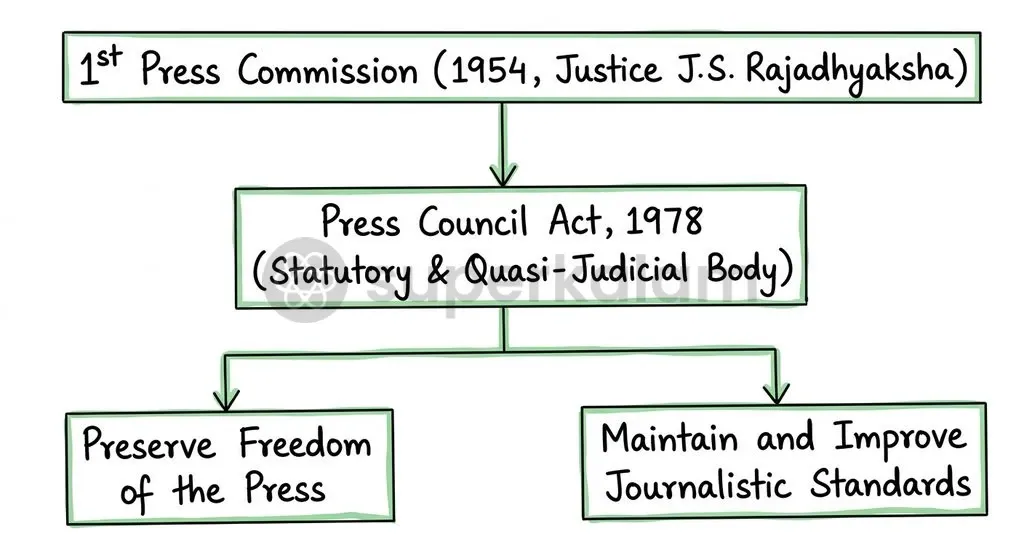
The First Press Commission, constituted under the chairmanship of Justice J. S. Rajadhyaksha in 1952, originally recommended creating a statutory body to safeguard journalistic autonomy in India. Justice Rajadhyaksha's commission submitted its report in 1954, outlining an institutional mechanism to uphold editorial standards and insulate newspapers from political or commercial pressure.
Parliament enacted the Press Council Act, 1978 (Act No. 37 of 1978) to replace earlier legislative arrangements and establish the Press Council of India as a permanent statutory, quasi-judicial autonomous body.
Under Section 13(1) of the 1978 Act, the core statutory objectives of the Council are two-fold:
- To preserve the freedom of the press from external pressures and executive encroachments.
- To maintain and improve the standards of newspapers and news agencies across India.
Discuss with Superkalam
Which commission originally recommended the establishment of a statutory Press Council in India, and in what year was its report submitted?
Ask NowWho Sits on the Council? Composition and Appointment Mechanism
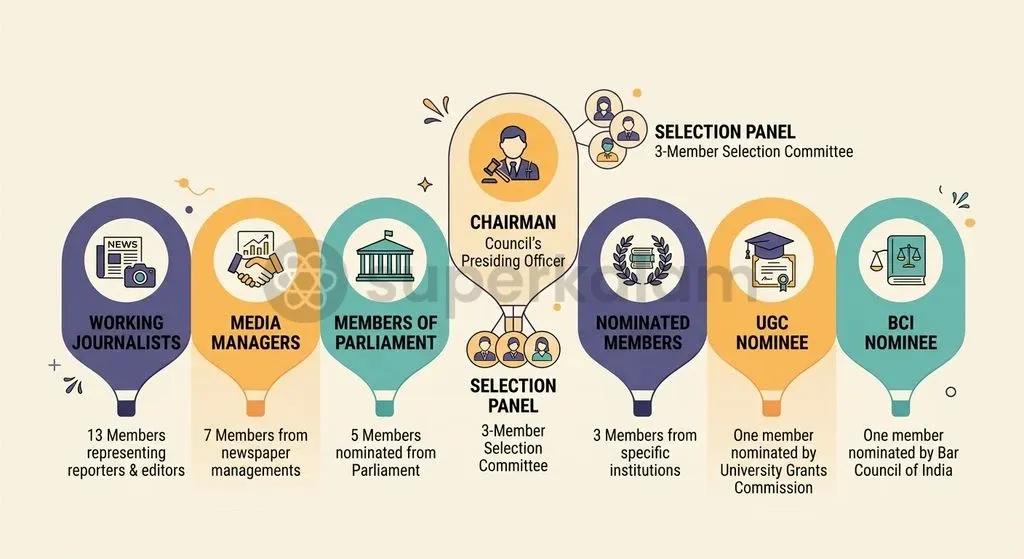
The Press Council Act, 1978 mandates a multi-stakeholder body comprising a Chairman and 28 members to ensure institutional autonomy. Under Section 5(1) of the Act, the Council brings together working journalists, media proprietors, parliamentarians, and representatives from cultural and educational bodies. By established convention, the Chairman of the Press Council of India is a retired judge of the Supreme Court of India.
The appointment of the Chairman is insulated from direct executive selection through a statutory three-member nomination panel under Section 5(2) of the Act. This selection committee consists of:
- The Chairman of the Rajya Sabha (Vice-President of India)
- The Speaker of the Lok Sabha
- A member chosen by the 28 Council members from among themselves
The remaining 28 members represent diverse segments of the media and public life under Sections 5(3) and 5(4) of the Act:
- Working Journalists (13 members): Six editors of newspapers and seven working journalists other than editors.
- Media Management (7 members): Six owners or managers of newspapers (two each representing big, medium, and small newspapers) and one individual managing news agencies.
- Public Institutions (3 members): One nominee each from the University Grants Commission (education), the Bar Council of India (law), and the Sahitya Akademi (literature).
- Members of Parliament (5 members): Three members of the Lok Sabha nominated by the Speaker and two members of the Rajya Sabha nominated by the Chairman of the Rajya Sabha.
Council members serve a term of three years pursuant to Section 6(1) of the Act. This balanced structure prevents any single commercial or political group from dominating proceedings.
What Can the PCI Do? Key Powers and Quasi-Judicial Functions
The Press Council of India exercises distinct quasi-judicial powers under the Press Council Act, 1978 while conducting formal inquiries into journalistic misconduct. Under Section 15(1) of the Act, the Council holds the same powers as a civil court under the Code of Civil Procedure, 1908 in specific procedural areas.
These procedural powers include:
- Summoning and enforcing the attendance of witnesses and examining them under oath.
- Requiring the discovery and inspection of relevant documents.
- Receiving evidence through sworn affidavits.
- Requisitioning public records or copies thereof from any public office or court.
Journalistic privilege receives explicit statutory protection under Section 15(2) of the Act. The Council cannot compel any newspaper, editor, news agency, or journalist to disclose the confidential source of information published or received.
When an inquiry under Section 14(1) concludes that a publication or journalist has breached journalistic ethics or public taste, the Council may warn, admonish, censure, or disapprove their conduct after providing a reasonable opportunity of being heard. Under Section 13(2)(b), the Council also formulates the Norms of Journalistic Conduct, establishing ethical guidelines on accuracy, fairness, privacy, and commercial probity.
Discuss with Superkalam
Explain how the composition of the 28 Council members under Section 5 of the Press Council Act, 1978 prevents commercial proprietors or political parties from capturing the regulatory body.
Ask NowComparing Regulators: Print Media vs TV and Digital Media
The Indian media ecosystem features fragmented oversight, dividing print, television, and digital publications across disparate statutory and self-regulatory regimes. While print media falls under the statutory oversight of the Press Council Act, 1978, television broadcasting operates primarily under self-regulatory industry bodies, and digital news portals fall under executive rules.
| Regulatory Dimension | Print Media (Press Council of India) | Television News (NBDSA / Industry Bodies) | Digital News Portals |
|---|---|---|---|
| Legal Basis | Statutory body under the Press Council Act, 1978 | Voluntary private self-regulatory association (News Broadcasting & Digital Standards Authority) | Digital rules administered by central executive ministries |
| Media Jurisdiction | Newspapers, periodicals, and news agencies only | Private satellite news and current affairs channels | Web portals, online news aggregators, and OTT content |
| Enforcement Powers | Can only warn, admonish, or censure; no financial penalties | Can issue warnings, demand apologies, or levy voluntary membership fines | Executive directions for content takedown or blocking |
| Source Protection | Explicit statutory protection under Section 15(2) | Governed by general criminal and procedural laws | Governed by general information technology and criminal laws |
This jurisdictional fragmentation means identical news content faces entirely different regulatory standards and enforcement mechanisms depending solely on its medium of delivery.
Why is the Press Council Called 'Toothless'? Major Institutional Bottlenecks
The Press Council of India operates under statutory constraints that limit its ability to deter deliberate malpractice. The Council lacks legislative authority to impose financial penalties, suspend daily publishing licences, cancel registrations, or order imprisonment against defaulting entities. Consequently, an admonition or censure carries only moral weight, leaving repeat offenders unpenalised commercially.
Statutory exclusions further restrict the Council's reach across parallel proceedings and modern media formats:
- Sub-Judice Restriction: Under Section 14(3) of the Act, the Council cannot inquire into any matter pending before a court of law. Offending parties can stall proceedings by filing civil or criminal suits.
- Medium Exclusion: The Council's mandate applies strictly to print media, excluding television channels, radio broadcasts, social media networks, and digital websites.
- Enforcement Deficit: Directions issued by the Council to publish retractions depend entirely on voluntary compliance, as the body cannot mandate remedial action through binding penal orders.
Discuss with Superkalam
If an investigative print journalist is summoned by the Press Council of India to reveal their sources, how does Section 15(2) of the 1978 Act govern the inquiry?
Ask Now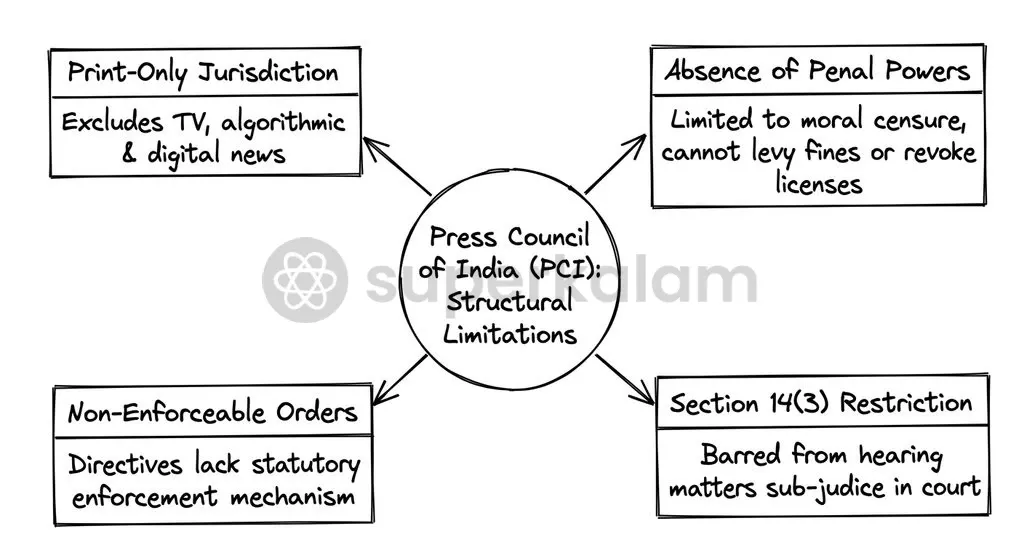
Media Ethics and Free Speech: The Constitutional and Ethical Dilemma
The Press Council of India operates at the sensitive intersection between free expression and democratic accountability. In landmark rulings such as Romesh Thappar v. State of Madras (1950) and Indian Express Newspapers v. Union of India (1985), the Supreme Court affirmed that press freedom flows implicitly from the fundamental right to free expression under Article 19(1)(a), subject only to reasonable restrictions under Article 19(2). This constitutional protection requires regulatory watchdogs to avoid excessive state control that could chill legitimate investigative reporting.
The practice of paid news illustrates a severe failure in journalistic integrity. In 2010, a dedicated Press Council of India Sub-Committee defined paid news as any news or analysis published in print or electronic media for monetary or in-kind consideration.
From an ethical perspective, paid news distorts public discourse and undermines governance through distinct institutional channels:
- Institutional Culpability: Editorial discretion becomes subordinated to revenue targets, converting impartial reporting into disguised commercial or political propaganda.
- Conflict of Interest: Media organisations breach their duty to citizens by concealing commercial sponsorships behind objective journalism.
- Erosion of Public Trust: When readers cannot distinguish genuine editorial analysis from paid advertisements, the credibility of the entire press degrades.
Because self-regulation relies on institutional conscience, commercial pressures often overpower voluntary ethical codes. Moral suasion alone proves inadequate when financial incentives reward biased reporting.
Discuss with Superkalam
Analyse how the sub-judice restriction under Section 14(3) can be leveraged by defaulting entities to stall inquiries before the Press Council.
Ask NowWay Forward: Reforming the Watchdog for the Digital Era
The Parliamentary Standing Committee on Communications and Information Technology has urged structural reforms to modernise media governance in India. In its 27th Report on 'Ethical Standards in Media Coverage' during the 17th Lok Sabha, the Committee recommended establishing a unified, statutory regulatory authority with punitive powers spanning print, electronic, and digital media.
Key reform proposals include:
- Unified Media Council of India: The Press Council of India has itself formally proposed amending the Press Council Act, 1978 to reconstitute the body as the 'Media Council of India', bringing television, print, and digital dissemination under an integrated regulatory umbrella.
- Graduated Punitive Powers: Empowering the statutory council to impose monetary fines, mandate prominent on-page apologies, and recommend the suspension of government advertisements for habitual offenders.
- Strengthened Co-Regulation: Creating a structured co-regulatory model where independent industry bodies handle initial complaints, backed by an autonomous statutory appellate tier headed by judicial experts.
- Protection of Journalistic Standards: Ensuring statutory updates continue to safeguard source confidentiality and shield working journalists from arbitrary harassment while maintaining strict accountability for unethical practices.
Key Takeaways
- The Press Council of India is a statutory, quasi-judicial body created under the Press Council Act, 1978, originating from the First Press Commission (1954) recommendations.
- The Council comprises a Chairman (conventionally a retired Supreme Court judge) and 28 members representing journalists, media owners, Parliament, and cultural institutions.
- While vested with civil court powers under the Code of Civil Procedure, 1908 to summon witnesses and requisition records, the Council can only warn, admonish, or censure offenders.
- The Council's regulatory jurisdiction is strictly limited to print media and cannot extend to television news, digital platforms, or matters pending in a court of law.
- The 27th Report of the Parliamentary Standing Committee and the PCI have both advocated establishing a unified statutory 'Media Council of India' to govern print, electronic, and digital media.
Mains Question
"Operating primarily on moral censure and restricted strictly to print journalism, the Press Council of India is frequently characterised as a toothless watchdog." In the light of the Press Council Act, 1978, critically analyse the institutional and jurisdictional bottlenecks hindering the Council's efficacy in contemporary media governance. (15 Marks)
Evaluate NowMains Question
The institutional design of the Press Council of India seeks to balance self-regulation with democratic accountability. Evaluate the statutory composition and appointment mechanism under the Press Council Act, 1978 in ensuring autonomy from executive dominance. (10 Marks)
Evaluate NowPractice MCQs
QUESTION 1
Consider the following statements regarding the Press Council of India (PCI):
- The Chairman of the Council is appointed based on the recommendation of a three-member statutory panel comprising the Chairman of the Rajya Sabha, the Speaker of the Lok Sabha, and a member chosen by the Council members from among themselves.
- The Council's regulatory oversight extends to print media, private satellite television broadcasting, and digital news aggregators.
- The Press Council Act, 1978 explicitly protects journalists and news agencies from being compelled to disclose confidential sources of information. Which of the statements given above are correct?
QUESTION 2
With reference to the composition and tenure of the Press Council of India under the Press Council Act, 1978, consider the following statements:
- Working journalists, comprising editors and non-editor journalists, form the single largest category of members with 13 seats.
- Five Members of Parliament are nominated to the Council, with three from the Lok Sabha and two from the Rajya Sabha.
- Council members serve a fixed statutory term of five years from the date of nomination. Which of the statements given above is/are correct?
QUESTION 3
Consider the following statements regarding the institutional powers and limitations of the Press Council of India:
- The Council possesses the powers of a civil court under the Code of Civil Procedure, 1908 in matters of summoning witnesses and requisitioning public records.
- The Council is statutorily barred from inquiring into any matter that is pending before a court of law.
- The Council is empowered under Section 14 of the Press Council Act, 1978 to levy monetary fines and cancel registrations of repeat offenders. Which of the statements given above is/are correct?
QUESTION 4
Under the Press and Registration of Periodicals Act, 2023, the Chairperson of the Press Council of India has been appointed to head which of the following bodies?
QUESTION 5
Consider the following statements:
- The Press Council of India was first recommended by the First Press Commission under the chairmanship of Justice J. S. Rajadhyaksha.
- By established convention, the Chairman of the Press Council of India is a retired judge of the Supreme Court of India. Which of the statements given above is/are correct?





