PRAHAAR Counter-Terrorism Policy: 7 Pillars and Grassroots Strategy
India's first codified counter-terror doctrine connects central intelligence grids to grassroots police beats to establish institutionalised deterrence.
Sep, 2026
•8 min read
Overview
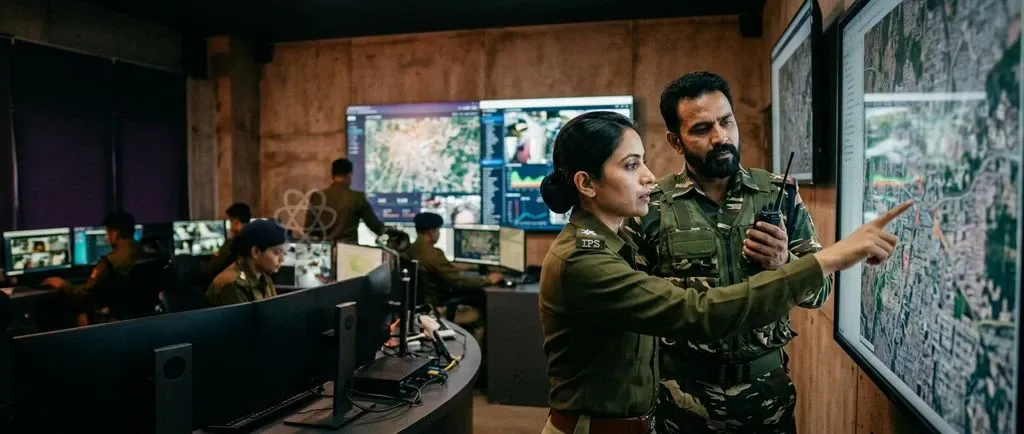
The Ministry of Home Affairs unveiled PRAHAAR on 23 February 2026 as India's first comprehensive, codified National Counter-Terrorism Policy and Strategy. It formalises a seven-pillar doctrine to integrate national intelligence grids directly with ground-level police station responses across all states.
This framework marks a structural pivot from reactive containment to proactive institutional deterrence. Grounded in zero tolerance against extremist violence, the doctrine explicitly avoids linking terror to any specific religion, ethnicity, nationality, or civilisation.
Connecting central statutory authorities with local beat policing operationalises cross-agency synergy. It also mandates strict compliance with constitutional safeguards and procedural fairness across the internal security apparatus.
Why is the PRAHAAR Counter-Terrorism Strategy in the News?
Union Home Minister Amit Shah reviewed the PRAHAAR framework at the National Counter-Terrorism Policy and Strategy Conference in New Delhi on 28 September 2026.
The high-level review outlined strategic directives and highlighted recent cross-border interdictions:
- 10-Year Institutional Roadmap: The Ministry directed security establishments to build an automated response mechanism supported by a 10-year institutional roadmap. The review stressed that operational readiness must reach local police stations for early threat detection.
- Unified Extradition Portal: Launched on 28 September 2026, the portal coordinates the Ministry of External Affairs, Central Bureau of Investigation, and State Police directorates. Ministry data confirms that between 2019 and September 2026, Indian agencies extradited 288 fugitive criminals across 36 foreign jurisdictions.
- Syndicate Interdiction: Recent multi-agency coordination dismantled the cross-border Shahzad Bhatti smuggling and terror network. This operation yielded 350 arrests across 15 states and prompted the network's statutory designation under the Unlawful Activities (Prevention) Act, 1967.
The Evolution of India's Multi-Tier Counter-Terror Architecture
India's counter-terrorism architecture evolved through successive institutional reforms following major national security crises over the past two decades.
The systemic gaps exposed by the 2008 Mumbai attacks accelerated the creation of specialised statutory and intelligence coordination bodies. Key post-26/11 milestones restructured the central security landscape:
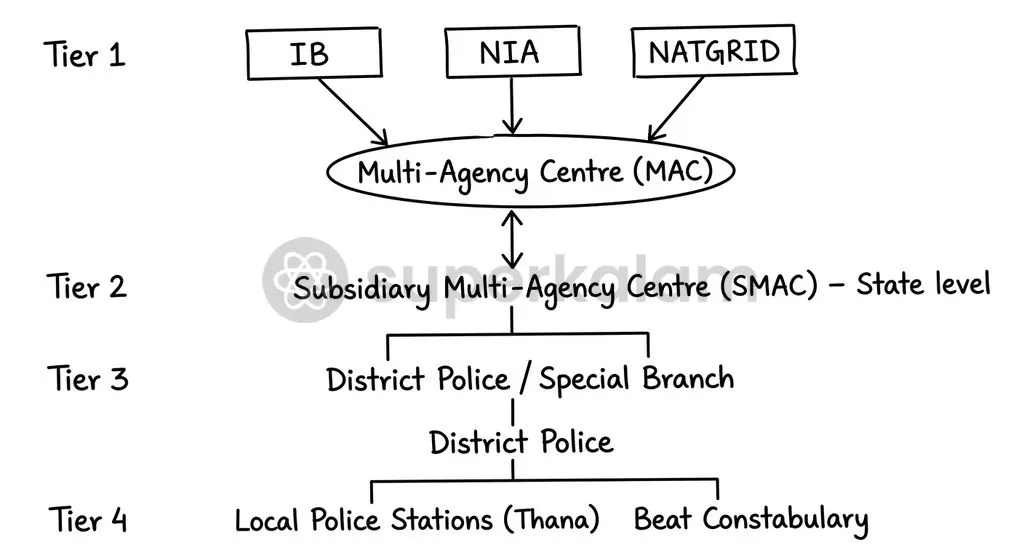
- National Investigation Agency (NIA): Formed as a central statutory body to investigate scheduled terror offences across state borders without requiring prior state government concurrence.
- Multi-Agency Centre (MAC): Operationalised under the Intelligence Bureau to aggregate round-the-clock tactical intelligence from military, intelligence, and enforcement agencies.
- Subsidiary Multi-Agency Centres (SMACs): Established across all state capitals to connect central intelligence feeds directly with state special branches.
- National Intelligence Grid (NATGRID): Developed as a secure data pipeline linking 11 core user agencies with immigration, banking, telecom, vehicle, and taxation databases.
Despite these centralised assets, operational execution frequently encountered friction at state and district levels. The PRAHAAR doctrine resolves this fragmentation by establishing an end-to-end framework linking federal intelligence nodes with local police stations.
Discuss with Superkalam
Can you list the seven strategic pillars established under India's PRAHAAR counter-terrorism doctrine?
Ask NowDecoding PRAHAAR: The 7 Core Pillars Explained
The PRAHAAR framework establishes seven strategic pillars covering prevention, operational response, institutional capacity, legal integrity, de-radicalisation, international diplomacy, and societal resilience.
Each pillar outlines clear mandates for central agencies and state security forces, creating a structured matrix for national counter-terror operations.
| Pillar Number | Strategic Focus | Key Mandates and Operational Mechanisms |
|---|---|---|
| Pillar 1 | Prevention of terror attacks | Pre-emptive intelligence collection, disrupting terror financing and illicit arms supply lines, and neutralising sleeper modules. |
| Pillar 2 | Swift and proportionate responses | Establishing clear local-to-central escalation chains and tactical action protocols during kinetic terror incidents. |
| Pillar 3 | Aggregating internal capacities | Building whole-of-government synergy across central intelligence agencies, CAPFs, and State Police forces. |
| Pillar 4 | Human rights and Rule of Law | Mandating that all threat mitigation, detention, and investigative procedures strictly follow constitutional due process. |
| Pillar 5 | Attenuating conducive conditions | Executing targeted de-radicalisation programmes, countering online extremist propaganda, and mitigating socio-economic vulnerabilities. |
| Pillar 6 | Shaping international efforts | Aligning domestic protocols with Financial Action Task Force (FATF) standards, INTERPOL notices, and multilateral counter-terror treaties. |
| Pillar 7 | Recovery and societal resilience | Delivering structured victim assistance frameworks, post-incident rehabilitation, and critical infrastructure reconstruction. |

Discuss with Superkalam
How does the integration of NATGRID, MAC, and SMAC operationalise the intelligence-sharing pipeline down to state police forces?
Ask NowLegal and Statutory Foundations Supporting the Framework
The PRAHAAR doctrine functions within India's constitutional distribution of powers and draws operational strength from codified criminal statutes.
Under the Seventh Schedule of the Constitution, counter-terror policing occupies a dual constitutional space. While 'Public order' (Entry 1) and 'Police' (Entry 2) fall under the State List, the 'Defence of India' (Entry 1) and foreign intelligence remain within the Union List. Operationalising PRAHAAR requires continuous inter-governmental cooperation between central ministries and state home departments.
Statutory Hierarchy and Flow
- Constitutional Basis (Seventh Schedule): Establishes legislative competence between Union and State domains.
- Substantive Counter-Terror Law (UAPA, 1967): Defines terrorist acts under Section 15 and authorises proscription.
- Federal Investigation (NIA Act, 2008): Grants nationwide and extraterritorial jurisdiction over scheduled offences.
- General Criminal Law (BNS, 2023): Integrates standalone counter-terror penal sanctions under Section 113.
The statutory architecture rests on three foundational legislative pillars:
- Unlawful Activities (Prevention) Act, 1967: Serves as the primary anti-terror statute, with Section 15 defining terrorist acts. The 2019 amendment empowered the Union Government to designate individuals as terrorists alongside organisations.
- National Investigation Agency Act, 2008: Empowers the federal agency to investigate offences listed in its Schedule, with its 2019 amendment extending extraterritorial jurisdiction over terror offences committed against Indian citizens or interests overseas.
- Bharatiya Nyaya Sanhita, 2023: Codified a standalone definition and penal sanctions for terrorist acts under Section 113, embedding counter-terror provisions directly into general substantive criminal law.
Discuss with Superkalam
How might a local police station apply standardised first-response protocols during the golden hour of a terror incident before central tactical teams arrive?
Ask NowFrom Headquarters to Thana: Operational Changes at Ground Level
The PRAHAAR implementation plan mandates extending counter-terror preparedness directly to the grassroots police station level.
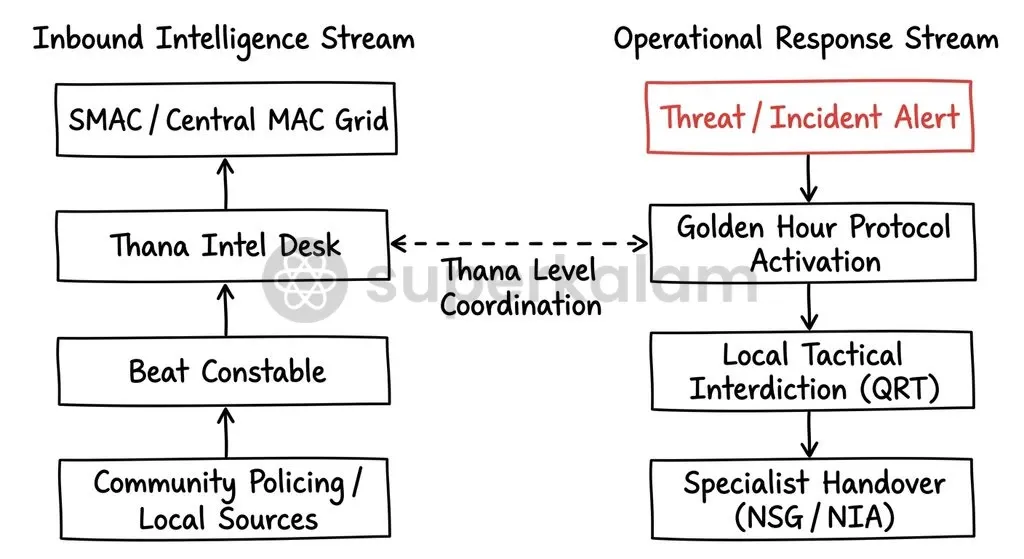
Historical security reviews revealed that first responders at local police stations often lacked standardised tactical guidelines during the initial stages of an attack. Under the renewed guidelines, police stations must operationalise standardised first-response protocols to manage the critical golden hour before elite tactical teams arrive on site.
Local police stations must also strengthen beat-level human intelligence to spot sleeper cells, radicalisation clusters, and illicit logistics networks. Beat constables serve as the primary radar for community counter-radicalisation cells. They provide bottom-up intelligence inputs that feed directly into State Anti-Terror Squads (ATS) and the Subsidiary Multi-Agency Centre (SMAC) network.
Structural and Federal Hurdles in Grassroots Implementation
Inter-state operational disparities and federal coordination challenges present substantive hurdles to implementing the PRAHAAR framework uniformly.
State police departments exhibit severe variations in technological capabilities, specialised training, and budgetary resources. While some states maintain well-equipped Anti-Terror Squads and cyber-forensic units, others lack basic drone interdiction equipment and automated data-sharing tools, creating vulnerabilities in the national security cordon.
Information Flow Between Central and State Nodes
- Central Nodes (IB / MAC / NATGRID): Aggregate national intelligence feeds, strategic databases, and international alerts.
- Two-Way Secure Linkage: Coordinates round-the-clock analytical feeds and tactical advisories.
- State and Local Nodes (SMAC / State ATS / Thana): Supply ground intelligence, verify suspect records, and execute local kinetic interdictions.
Reconciling firm counter-terror enforcement with Pillar 4's human rights mandate poses continuous constitutional considerations. Legal analysts argue that investigative actions, preventive detentions, and surveillance measures must adhere strictly to the principles of proportionality and due process under Articles 21 and 22 per SPRF (as reported, May 2026). Safeguarding civil liberties while maintaining investigative efficacy remains essential for long-term legal legitimacy.
Discuss with Superkalam
What structural frictions arise between Union legislative competence over national defence and State jurisdiction over police and public order under the Seventh Schedule?
Ask NowWay Forward: Building an Integrated and Resilient Security Grid
Building an integrated counter-terror framework requires modernising state police infrastructure and institutionalising bottom-up intelligence sharing.
- Standardised Modernisation Grants: Earmark central modernisation funds specifically for upgrading district cyber labs, drone detection systems, and tactical weaponry across all state forces.
- Institutionalised SMAC Integration: Mandate regular two-way data exchanges between district police stations and state SMACs to prevent intelligence bottlenecks.
- Capacity Building and Human Rights Training: Institute recurring joint training programmes between the National Investigation Agency, Central Armed Police Forces, and state police officers focusing on forensic investigation and constitutional safeguards.
- Community Resilience Networks: Expand civil society partnerships to build grassroots counter-radicalisation platforms and victim support mechanisms per Pillar 7.
Key Takeaways
- The Ministry of Home Affairs released PRAHAAR on 23 February 2026 as India's first codified national counter-terrorism policy, operating on seven foundational pillars.
- The policy adopts a strict zero-tolerance approach to extremist violence while explicitly rejecting any linkage between terrorism and specific religions, ethnicities, or nationalities.
- Legal enforcement is anchored in Section 15 of UAPA (1967), the NIA Act (2008) with extraterritorial jurisdiction, and Section 113 of the Bharatiya Nyaya Sanhita (2023).
- Operational priority shifts counter-terror capabilities down to the police station (thana) level through first-response protocols and beat-level intelligence integration.
- As of September 2026, the newly launched Extradition Portal coordinates MHA, MEA, CBI, and State Police forces, building on the return of 288 fugitive criminals since 2019.
Mains Question
"The PRAHAAR doctrine seeks to institutionalise a structural pivot from reactive containment to proactive institutional deterrence by linking federal intelligence nodes with local police stations." Elucidate the institutional mechanisms underpinning this strategy and examine the federal challenges in its grassroots operationalisation. (15 Marks)
Evaluate NowMains Question
Critically analyse how the PRAHAAR framework attempts to reconcile swift counter-terror enforcement with constitutional safeguards and rule of law mandates. (10 Marks)
Evaluate NowPractice MCQs
QUESTION 1
With reference to India's statutory counter-terrorism architecture, consider the following statements:
- The Unlawful Activities (Prevention) Act, 1967 defines terrorist acts under Section 15 and allows the designation of individuals as terrorists.
- The National Investigation Agency requires prior concurrence of the concerned state government to investigate scheduled offences across state borders.
- Section 113 of the Bharatiya Nyaya Sanhita, 2023 codifies standalone penal sanctions for terrorist acts in general substantive criminal law.
Which of the statements given above are correct?
QUESTION 2
Consider the following statements regarding the intelligence and security infrastructure mentioned in the PRAHAAR framework:
- The Multi-Agency Centre (MAC) operates under the Central Bureau of Investigation to aggregate round-the-clock intelligence.
- The National Intelligence Grid (NATGRID) functions as a data pipeline linking 11 core user agencies with multiple databases.
- Subsidiary Multi-Agency Centres (SMACs) are established across all state capitals to connect central feeds with state special branches.
Which of the statements given above is/are correct?
QUESTION 3
Consider the following pairs of strategic pillars under the PRAHAAR Counter-Terrorism Policy and their focus areas:
- Pillar 1: Pre-emptive intelligence collection and disrupting terror financing
- Pillar 4: Adherence to constitutional due process and human rights
- Pillar 6: Structuring victim assistance frameworks and infrastructure reconstruction
Which of the pairs given above is/are correctly matched?
QUESTION 4
With reference to the constitutional division of legislative powers relevant to internal security, consider the following statements:
- 'Public order' and 'Police' are listed under Entry 1 and Entry 2 of the State List in the Seventh Schedule.
- 'Defence of India' is enumerated under Entry 1 of the Union List in the Seventh Schedule.
Which of the statements given above is/are correct?
QUESTION 5
The 'Unified Extradition Portal', launched in September 2026 under India's counter-terror and law-enforcement strategy, primarily coordinates between which of the following entities?





