Post-Quantum Cryptography: Why Banks Must Prepare for Q-Day
With quantum computing poised to break classical encryption, India's financial sector faces an urgent race to overhaul legacy core banking architectures.
Oct, 2026
•12 min read

Overview
Post-quantum cryptography has become an immediate architectural priority for financial institutions worldwide. Quantum computers running Shor's algorithm will dismantle classical asymmetric encryption, leaving long-dated banking records, sovereign transactions, and real-time settlement rails vulnerable to retrospective decryption.
As of August 2026, international standard-setting bodies and central banks recognise that adversaries are actively capturing encrypted financial traffic to exploit once quantum hardware matures. Transitioning core banking architectures, payment gateways, and public key infrastructures to quantum-resilient standards requires years of technical overhaul. Financial regulators emphasise that failure to act today risks catastrophic systemic compromise across global capital markets and domestic retail payment systems.
Why Banks Are Preparing for Q-Day Today
Commercial banks face systemic exposure from Q-Day because cryptanalytically relevant quantum computers will break the classical asymmetric algorithms protecting global financial messaging. The term "Q-Day" designates the threshold moment when quantum processors attain sufficient fault-tolerant physical qubits to run algorithms capable of cracking standard cryptographic primitives.
According to the National Institute of Standards and Technology (NIST), asymmetric cryptosystems like RSA and Elliptic Curve Cryptography secure virtually every electronic financial exchange. These classical algorithms protect critical financial touchpoints:
- User authentication across online interfaces and consumer banking portals
- Automated teller machine transactions and point-of-sale retail terminals
- Wholesale interbank settlements coordinating sovereign liquidity
- Secure sockets layer sessions encrypting inter-entity communications
The core analytical reality is straightforward. Post-quantum migration is not an optional technological upgrade awaiting future quantum machines, but an immediate operational necessity. Financial contracts, cross-border corporate trade secrets, sovereign debt covenants, and customer identity records possess confidentiality lifespans extending across decades.
If cryptographic migration is delayed until functional quantum computing engines become commercially viable, financial data harvested in the interim will be rendered completely transparent to hostile entities.
Discuss with Superkalam
Recall the cryptographic algorithm that breaks classical asymmetric encryption in polynomial time on a quantum processor.
Ask NowHarvest Now, Decrypt Later: Why the Threat Exists Today
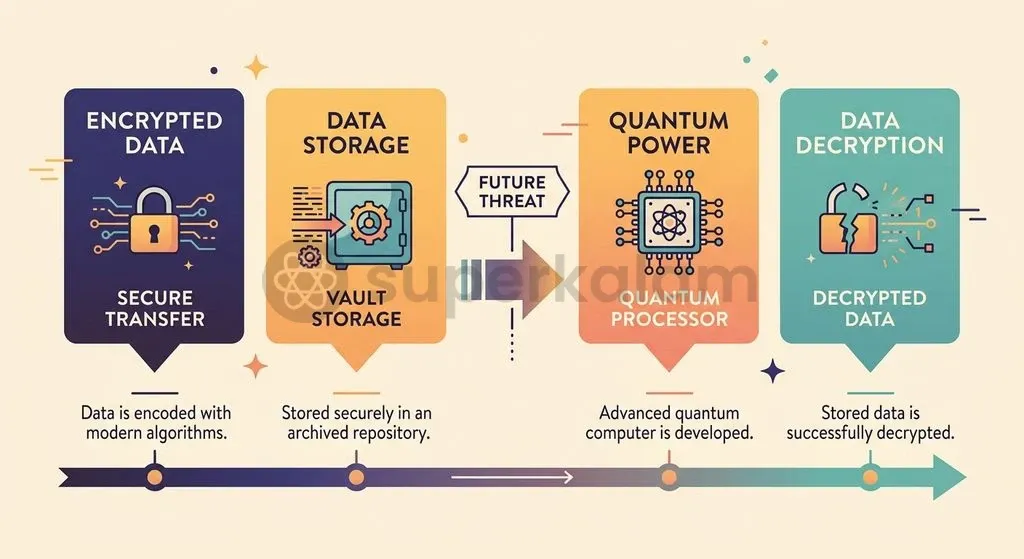
Adversaries targeting financial institutions currently execute Harvest Now, Decrypt Later operations by intercepting and storing encrypted banking traffic to decipher it retrospectively. As detailed by the Bank for International Settlements (BIS) Project Leap Report, this intelligence-gathering doctrine invalidates the assumption that quantum threats belong solely to a remote technological future.
Under this attack model, state-sponsored actors and cybercrime syndicates vacuum up high-value cryptographic streams across optical fibre lines, interbank messaging gateways, and cloud storage repositories. The captured ciphertexts are catalogued and warehoused in sovereign data vaults. Once a cryptanalytically relevant quantum computer becomes operational, adversaries can apply quantum decryption algorithms to extract plaintext records without needing real-time network penetration.
This offensive model creates three direct risks for the modern banking ecosystem:
- Exposure of Long-Dated Financial Records: Syndicated loans, 30-year sovereign bonds, structured credit contracts, and cross-border trade transactions retain legal and financial significance across multiple decades.
- Compromise of Customer Identity Repositories: Know Your Customer records, biometric hashes, and personal tax identification dossiers stored in digital registries can be decoded, creating generational identity vulnerabilities.
- Compromise of Sovereign and Strategic Disclosures: Interbank wire messaging containing sovereign capital transfers and geopolitical fund movements can be systematically reconstructed.
What Happens When Classical Encryption Fails in Banking Systems
Quantum computing architectures threaten banking systems by attacking asymmetric and symmetric encryption through fundamentally distinct mathematical mechanisms. Modern digital banking relies on two distinct classes of cryptographic algorithms: public key algorithms used for key exchange and digital signatures, and symmetric ciphers used for bulk data encryption.
Shor's algorithm solves prime factorisation and discrete logarithms in polynomial time on quantum processors, establishing the complete mathematical collapse of asymmetric cryptosystems, including RSA, Elliptic Curve Cryptography, and Diffie-Hellman. Because public key infrastructure anchors certificate issuance, mutual authentication, and digital signatures in Core Banking Solutions, the execution of Shor's algorithm strips away the foundational layer of digital trust.
In contrast, Grover's algorithm provides a quadratic speedup against symmetric ciphers and cryptographic hash functions. This speedup effectively reduces a 128-bit symmetric key to a marginal 64 bits of security, but this theoretical speedup does not establish a practical break of AES-128. However, 256-bit symmetric encryption, such as AES-256, maintains an effective 128-bit security margin under quantum analysis, remaining quantum-resilient without requiring a total mathematical redesign.
| Cryptographic Primitive | Primary Banking Function | Primary Mathematical Assumption | Quantum Threat Vector | Post-Quantum Security Status |
|---|---|---|---|---|
| RSA-2048 / RSA-4096 | Public key encryption, digital signatures, SSL certificates | Computational hardness of prime factorisation | Broken via Shor's algorithm in polynomial time | Zero resilience; requires total replacement |
| ECC (ECDSA / ECDH) | Mobile banking signatures, tokenised payments, TLS keys | Discrete logarithm problem over elliptic curves | Broken via Shor's algorithm in polynomial time | Zero resilience; requires total replacement |
| AES-128 | Database encryption at rest, secure interbank communications | Substitution-permutation networks | Key strength halved to 64-bit security margin via Grover's algorithm | NIST permits continued use; practical quantum attacks are not established |
| AES-256 | Bulk transaction payload encryption, ATM pin blocks | Substitution-permutation networks | Key strength halved to 128-bit security margin via Grover's algorithm | Quantum-resilient; retainable with key management |
| Lattice Cryptography (ML-KEM / ML-DSA) | Quantum-safe key encapsulation, digital transaction signing | Hardness of high-dimensional Learning With Errors problems | Resilient against both Shor's and Grover's attacks | Adopted global standard under NIST FIPS 203/204 |
Discuss with Superkalam
Explain why AES-256 remains considered quantum-resilient despite the quadratic speedup offered by Grover's algorithm.
Ask NowThe Performance Penalty: How Larger PQC Keys Impact Real-Time Payment Latency
Payment networks like Unified Payments Interface operate under stringent latency thresholds that post-quantum cryptographic primitives threaten through increased data packet sizes. The transition from classical public key schemes to post-quantum algorithms introduces unavoidable physical trade-offs in computation time, network payload sizes, and bandwidth consumption.
On August 13, 2024, the U.S. National Institute of Standards and Technology released its primary post-quantum standards: FIPS 203 for Module-Lattice-Based Key-Encapsulation Mechanisms (ML-KEM), FIPS 204 for Module-Lattice-Based Digital Signatures (ML-DSA), and FIPS 205 for Stateless Hash-Based Digital Signatures (SLH-DSA). Lattice-based cryptography derives its strength from the hardness of high-dimensional geometric problems, specifically the Learning With Errors framework.
While lattice-based schemes successfully resist quantum cryptanalysis, their structural footprint is significantly larger than classical schemes:
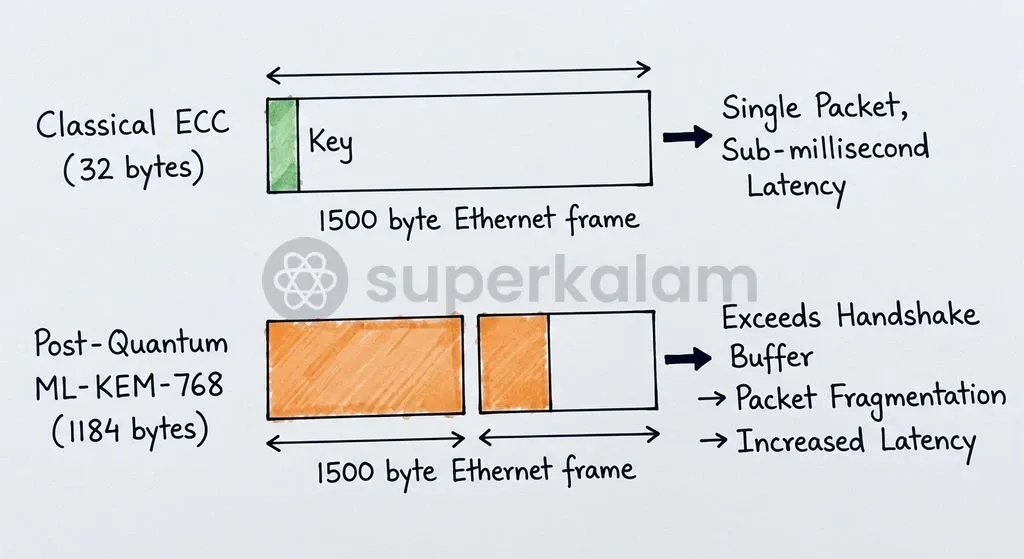
- Exploding Key Sizes: Under FIPS 203 (ML-KEM-768), public keys expand to 1,184 bytes and ciphertexts to 1,088 bytes. In comparison, standard elliptic curve public keys require only 32 to 64 bytes.
- Network MTU Bottlenecks: Standard Ethernet connections enforce a Maximum Transmission Unit of 1,500 bytes per data frame. Post-quantum handshake payloads that exceed this threshold force packet fragmentation, requiring multiple TCP segments and additional network round-trips during Transport Layer Security negotiation.
- Payment Rail Latency Spikes: In high-frequency, millisecond-sensitive retail networks like the Unified Payments Interface and wholesale gross systems like Real Time Gross Settlement, handshake fragmentation threatens strict service-level agreements and increases transaction abandonment rates.
Discuss with Superkalam
If a domestic retail payment system with sub-second SLA requirements adopts ML-KEM-768, how might the 1,500-byte MTU threshold affect transaction success rates?
Ask NowGlobal Benchmarks: What BIS Project Leap and NIST Standards Reveal
Central banks and international standard-setting bodies have accelerated post-quantum transition frameworks to protect cross-border wholesale payment infrastructures. Financial authorities recognise that isolated institutional migration cannot protect interconnected global correspondent banking channels.
In December 2025, the Bank for International Settlements Innovation Hub Eurosystem Centre concluded Project Leap Phase 2 in collaboration with the Bank of France, Deutsche Bundesbank, Bank of Italy, and Swift. The trial demonstrated the end-to-end transmission of post-quantum digital signatures on TARGET2 liquidity transfers. Technical findings revealed that deploying ML-DSA signatures produced a roughly tenfold size increase compared to legacy RSA-2048 signatures, triggering verification latency penalties and packet header parsing errors in legacy settlement connectors.
International regulators are setting firm transition timetables to enforce compliance:
- United States CNSA 2.0: The National Security Agency's Commercial National Security Algorithm Suite 2.0 establishes that software and firmware code signing must transition to post-quantum standards by 2030, with full system-wide migration mandatory by 2035.
- Hong Kong Monetary Authority Framework: In July 2026, the Hong Kong Monetary Authority published its Quantum Preparedness Index, revealing that surveyed banks averaged a readiness score of only 2.3 out of 10, while establishing a mandatory benchmark of 10 out of 10 across all licensed institutions by 2030.
- NIST Cryptographic Fallbacks: NIST specified FIPS 205 (SLH-DSA), an alternative standard grounded in stateless hash-based digital signatures rather than lattice assumptions, offering a conservative fallback algorithm if mathematical vulnerabilities are uncovered in lattice schemes.
Discuss with Superkalam
Analyse the structural differences between asymmetric public key encryption and symmetric bulk encryption in terms of their quantum threat exposure.
Ask NowIndia's Regulatory Action: RBI Cyber Security Norms, IDRBT, and the National Quantum Mission
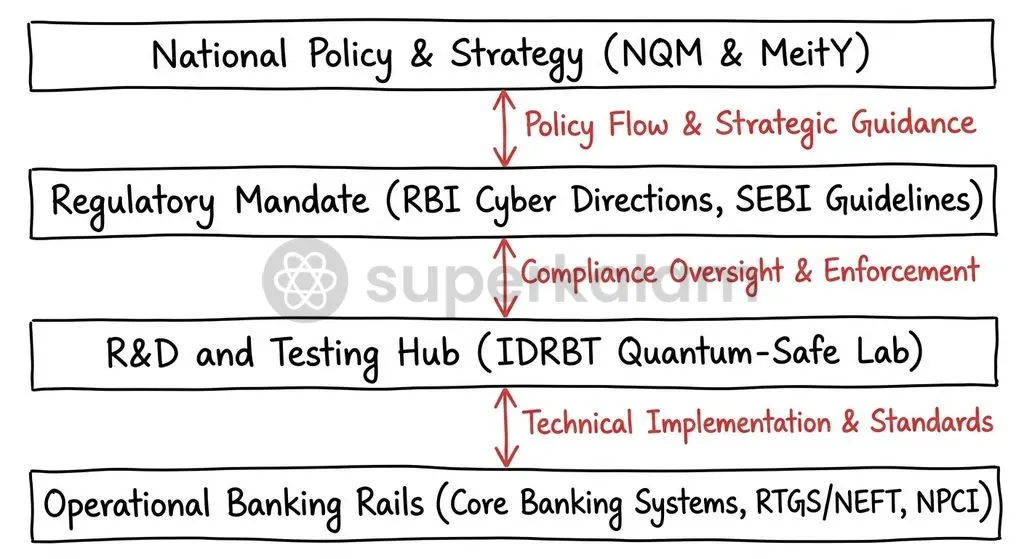
The Reserve Bank of India has established stringent cybersecurity mandates to compel regulated financial entities to fortify their technological infrastructure. The Indian financial sector operates one of the most transaction-dense digital ecosystems in the world, making proactive quantum resilience an economic imperative.
On July 31, 2026, the central bank issued the Reserve Bank of India (Commercial Banks – Cybersecurity, Technology: Risk, Resilience and Assurance Framework) Directions, 2026 (Circular RBI/DoS/2026-27/410), which took effect immediately. Under these regulations, commercial banks must report all cyber incidents to the Reserve Bank through its DAKSH supervisory platform within six hours of detection.
This operational directive builds upon the Master Direction on Information Technology Governance, Risk, Controls and Assurance Practices issued in November 2023, which became effective on April 1, 2024, and explicitly mandates cryptographic control audits and board-approved IT strategy committees across regulated banks.
Parallel regulatory and technical interventions across India's financial and scientific governance structures reinforce this mandate:
- SEBI Market Infrastructure Mandates: On August 24, 2026, the Securities and Exchange Board of India issued Circular HO/47/18/11(1)2026-MRD-TPD1/I/19509/2026, introducing a mandatory 100-point IT Resilience Index for Market Infrastructure Institutions, weighting Availability and Security highest at 20 points each while ordering Early Warning Systems to be operational by February 28, 2027.
- IDRBT Quantum Lab Initiatives: The Institute for Development and Research in Banking Technology established a dedicated Quantum Safe Cryptography Lab to design indigenous post-quantum algorithms and build lattice-based public key infrastructure for Indian banking networks.
- National Quantum Mission Integration: Approved by the Union Cabinet on April 19, 2023, with an outlay of ₹6,003.65 crore across eight years (FY 2023-24 to FY 2030-31), the mission targets inter-city quantum key distribution across 2,000 kilometres over optical fibre. During FY 2024–25, four Thematic Hubs covering Quantum Computing, Quantum Communication, Quantum Sensing, and Quantum Materials were incorporated as Section-8 companies across premier research institutions.
The Operational Hurdles: Legacy Core Banking, Testing, and Cryptographic Agility
Commercial banks encounter severe architectural roadblocks when attempting to integrate post-quantum algorithms into legacy Core Banking Solutions. The primary operational bottleneck lies within outdated core databases, monolithic transaction engines, and tamper-resistant cryptographic hardware.
Hardware Security Modules deployed inside commercial banks house the cryptographic keys that authorise interbank transactions and generate customer personal identification numbers. As highlighted by the Payment Card Industry Security Standards Council, legacy hardware modules lack the volatile memory and hardware acceleration necessary to handle large post-quantum keys. Replacing these physical appliances requires heavy capital expenditure and extended procurement cycles. It also forces scheduled service interruptions across core transaction branches.
To overcome these structural constraints without causing system outages, financial institutions must cultivate cryptographic agility:
- Deploying Cryptographic Agility: Cryptographic agility refers to an architectural design enabling an IT system to switch cryptographic algorithms, key lengths, and digital certificates without rewriting application code or breaking Core Banking Solutions.
- Compiling a Cryptographic Bill of Materials: The initial phase of achieving cryptographic agility requires constructing a machine-readable inventory cataloguing all encryption keys, digital certificates, signature algorithms, and hardware dependencies across banking infrastructure.
- Implementing Hybrid Schemes: To prevent systemic failure during the migration window, banks deploy hybrid models combining classical algorithms like ECDH with post-quantum algorithms like ML-KEM, requiring an attacker to compromise both algorithms simultaneously to breach encrypted traffic.
Discuss with Superkalam
Evaluate whether transitioning legacy core banking systems to hybrid classical/PQC standards is preferable to an immediate complete replacement of cryptographic primitives.
Ask NowWay Forward: A Secure Migration Strategy for Indian Financial Infrastructure
Indian financial regulators must coordinate a phased migration strategy to secure national payments against emergent quantum computing vulnerabilities. Addressing the post-quantum transition requires synchronised policy, hardware renewal, and algorithmic adaptation across all market participants.
Regulated entities should immediately implement a structured migration framework:
- Mandate Enterprise Cryptographic Inventories: The Reserve Bank of India should require all commercial banks, payment aggregators, and credit bureaus to construct an audited Cryptographic Bill of Materials, pinpointing asymmetric dependencies and legacy cryptographic algorithms across operational systems.
- Deploy Dual-Layer Hybrid Cryptography: Financial institutions must adopt dual-layer hybrid cryptographic schemes across outward-facing public interfaces, pairing classical elliptic curve key exchanges with FIPS 203 ML-KEM implementations to satisfy immediate compliance rules while mitigating quantum exposure.
- Upgrade Hardware Security Module Fleets: Scheduled commercial banks must initiate phased capital expenditure programmes to replace end-of-life Hardware Security Modules with quantum-ready cryptographic coprocessors supporting expanded lattice key storage and verification.
- Re-engineer Network Protocols for Payment Rails: The National Payments Corporation of India must test and re-engineer packet processing on high-frequency payment gateways, updating Maximum Transmission Unit configurations and session handshakes to eliminate latency degradation on the Unified Payments Interface.
- Align with National Quantum Mission Testbeds: The Indian banking sector must actively participate in field trials coordinated by the National Quantum Mission's Quantum Communication Thematic Hub and the IDRBT, integrating 2,000-kilometre quantum key distribution testbeds into core interbank wire settlement corridors.
Key Takeaways
- The Quantum Vulnerability: Shor's algorithm provides polynomial-time solutions to prime factorisation and discrete logarithms, threatening the complete mathematical collapse of asymmetric encryption systems including RSA and Elliptic Curve Cryptography.
- Harvest Now, Decrypt Later (HNDL): Adversaries intercept and warehouse encrypted sovereign and banking traffic today to decrypt transactions retrospectively once cryptanalytically relevant quantum computers arrive.
- Payment Latency Penalties: NIST post-quantum standards like FIPS 203 (ML-KEM-768) require public keys of 1,184 bytes, which by themselves do not exceed the standard 1,500-byte Ethernet Maximum Transmission Unit and introducing packet fragmentation risks to real-time networks like UPI.
- Global Precedents: The Bank for International Settlements concluded Project Leap Phase 2 in December 2025 across TARGET2 corridors, while NIST finalised post-quantum standards FIPS 203, 204, and 205 on August 13, 2024.
- Domestic Regulatory Mandates: The RBI issued updated Cybersecurity Directions on July 31, 2026, mandating six-hour incident reporting via DAKSH, complementing the Union Cabinet's ₹6,003.65 crore National Quantum Mission approved on April 19, 2023.
- Crypto-Agility Requirement: Banks must audit cryptographic assets through a machine-readable Cryptographic Bill of Materials (CBOM) and deploy hybrid transition schemes to preserve operational continuity in legacy Core Banking Solutions.
Mains Question
"The transition to Post-Quantum Cryptography in financial infrastructure is not a distant technological upgrade, but an immediate architectural imperative driven by 'Harvest Now, Decrypt Later' vulnerabilities." Elucidate. (10 Marks)
Evaluate NowMains Question
Discuss the technical and operational challenges highlighted by global trials like BIS Project Leap in migrating real-time payment networks to NIST post-quantum standards. (15 Marks)
Evaluate NowPractice MCQs
QUESTION 1
With reference to quantum threats to modern cryptographic systems, consider the following statements:
- Shor's algorithm provides a quadratic speedup capable of halving the effective key length of symmetric ciphers.
- Grover's algorithm solves prime factorisation and discrete logarithms in polynomial time, dismantling asymmetric cryptosystems.
- Under quantum cryptanalysis, AES-256 maintains an effective 128-bit security margin. Which of the statements given above is/are correct?
QUESTION 2
Consider the following statements regarding the 'Harvest Now, Decrypt Later' intelligence model:
- It involves intercepting and cataloguing encrypted communications today to decipher them retrospectively once cryptanalytically relevant quantum computers are operational.
- The model poses negligible risks to long-dated financial assets like 30-year sovereign bonds or syndicated credit contracts.
- Under this model, adversaries require real-time network penetration at the exact moment of quantum decryption. Which of the statements given above is/are correct?
QUESTION 3
Consider the following statements regarding Post-Quantum Cryptography standards:
- FIPS 203 specifies Module-Lattice-Based Key-Encapsulation Mechanisms (ML-KEM).
- Lattice-based cryptographic algorithms derive their mathematical security from the Learning With Errors framework.
- The public key size under ML-KEM-768 is smaller than that of standard elliptic curve cryptography. Which of the statements given above is/are correct?
QUESTION 4
In the context of network transmission and payment rails, what is the primary consequence of adopting post-quantum cryptographic schemes like ML-KEM-768 whose handshake payloads exceed standard 1,500-byte Maximum Transmission Units (MTU)?
QUESTION 5
With reference to the Bank for International Settlements (BIS) Project Leap Phase 2 trial, which of the following was a key technical finding?