PMAY-G 2.0: 3D Concrete Printing and Rural Housing Policy Reforms
As India commits ₹3,06,137 crore to build two crore rural homes, automated 3D printing and revised inclusion criteria redefine last-mile welfare delivery.
Oct, 2026
•8 min read
Overview
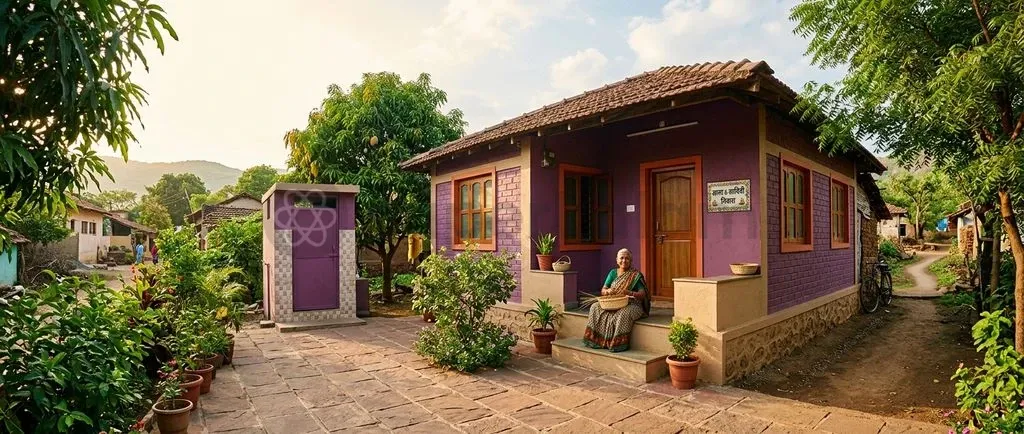
The Union Cabinet's approval of Pradhan Mantri Awaas Yojana-Gramin (PMAY-G) 2.0 commits ₹3,06,137 crore to construct two crore additional rural homes between FY 2024-25 and 2028-29. The scheme integrates revised socio-economic inclusion parameters with automated construction methods to accelerate delivery across Indian states.
By replacing the Socio-Economic and Caste Census (SECC) 2011 baseline with the digital Awaas+ 2024 survey, the policy broadens rural safety nets. It also pilots frontier technologies like 3D concrete printing to compress construction turnaround times.
Why Rural Housing is in the News: The Launch of PMAY-G 2.0
The Union Cabinet approved the continuation of PMAY-G on August 9, 2024, sanctioning an outlay of ₹3,06,137 crore to build two crore additional rural houses through FY 2028-29. The scheme ensures that rural families living in kutcha or dilapidated structures transition into disaster-resilient dwellings.
Key targets and budgetary commitments include:
- Cumulative Target: As of late 2024, the national rural housing target across Phase-1 and Phase-2 rises to 4.95 crore houses, building on the initial target of 2.95 crore units.
- Central Outlay: The Central government provides ₹2,05,856 crore towards project financing.
- State Contribution: The State matching share contributes ₹1,00,281 crore to meet execution targets.
Discuss with Superkalam
Recall the revised monthly household income ceiling for eligibility under PMAY-G 2.0.
Ask NowFrom 1.0 to 2.0: What Changed in the Rural Housing Scheme?
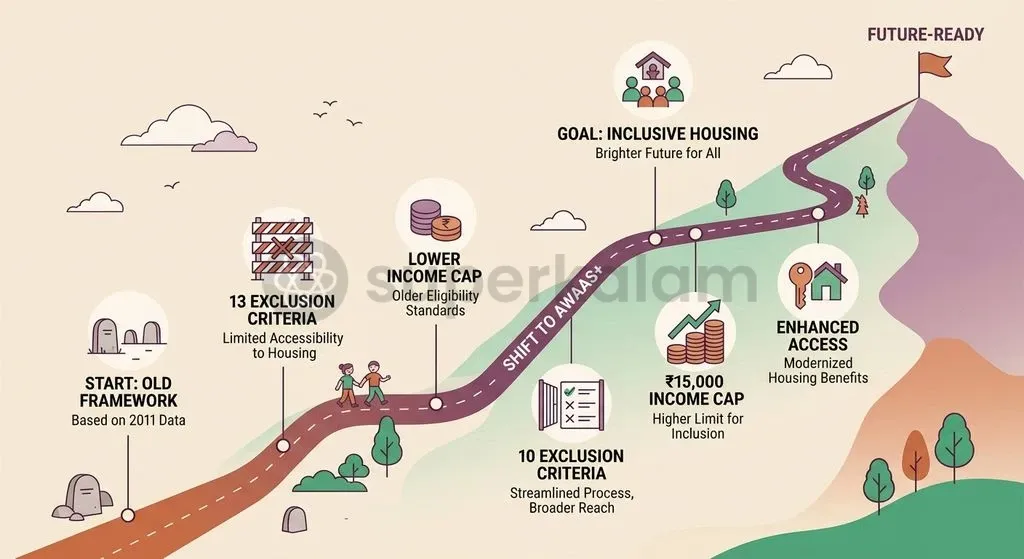
PMAY-G 2.0 modernises the rural housing framework by raising beneficiary income thresholds, relaxing exclusion criteria, and integrating advanced digital verification tools. This overhaul addresses coverage gaps that emerged from relying strictly on older survey databases.
Under the updated Awaas+ 2024 framework, exclusion parameters dropped from 13 to 10 criteria, eliminating automatic disqualifications for households owning motorised two-wheelers, fishing boats, refrigerators, or landline phones. Concurrently, the monthly household income ceiling rose from ₹10,000 to ₹15,000 per month to reflect rural economic shifts.
To ensure transparent beneficiary identification, the government launched the Awaas+ 2024 mobile application on September 17, 2024. The platform facilitates assisted surveys, self-surveys, Aadhaar-based face-authentication eKYC, and artificial intelligence-driven image recognition to prevent duplicate entries and fraudulent registrations.
| Feature Dimension | PMAY-G 1.0 (2016–2024) | PMAY-G 2.0 (2024–2029) |
|---|---|---|
| Identification Baseline | SECC 2011 & Awaas+ 2018 list | Awaas+ 2024 dynamic digital survey |
| Exclusion Criteria | 13 rigid disqualification parameters | 10 relaxed criteria (two-wheelers permitted) |
| Monthly Income Ceiling | ₹10,000 per household | ₹15,000 per household |
| Verification Technology | Basic geo-tagged mobile photos | Face eKYC and AI/ML image recognition |
| Unit Financial Assistance | ₹1.20 lakh (plains) / ₹1.30 lakh (hills) | ₹1.20 lakh (plains) / ₹1.30 lakh (hills) |
| Scheme Convergence | SBM-G (₹12,000) & MGNREGS (90–95 days) | SBM-G (₹12,000) & MGNREGS (90–95 days) |
| Minimum Unit Area | 25 sq m with hygienic cooking area | 25 sq m with hygienic cooking area |
The baseline financial assistance remains ₹1.20 lakh per unit in plain areas and ₹1.30 lakh per unit in North Eastern states, Hill states (Himachal Pradesh and Uttarakhand), and the Union Territories of Jammu & Kashmir and Ladakh. Beneficiaries also receive statutory convergence benefits, including 90 to 95 person-days of unskilled wage labour under the Mahatma Gandhi National Rural Employment Guarantee Scheme (MGNREGS) and ₹12,000 for toilet construction under Swachh Bharat Mission-Gramin (SBM-G).
How 3D Concrete Printing Works in Affordable Housing
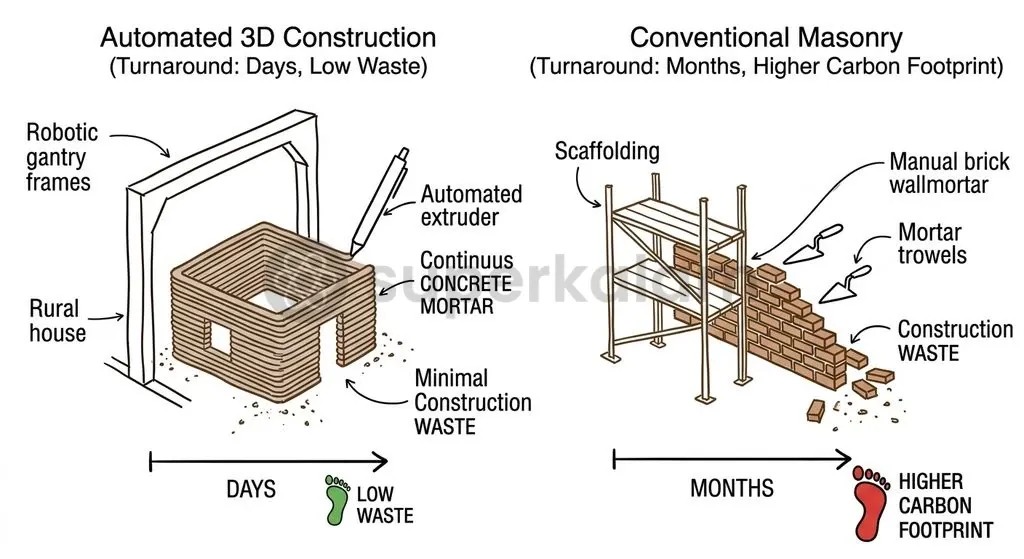
The Building Materials and Technology Promotion Council certifies 3D concrete printing systems to replace conventional brickwork with automated gantry extruders that deposit premixed structural mortars. This additive manufacturing approach deposits specialised, rapid-setting concrete layer by layer directly on-site, guided by computer-aided design blueprints.
According to a technical brief by the Building Materials and Technology Promotion Council, 3D concrete printing reduces wall-superstructure construction timelines to under 5 days per unit, compared to 30 to 45 days required for traditional brick-and-mortar masonry. The process completely eliminates conventional shuttering and formwork, curbing timber and steel wastage on the construction site.
Innovations evaluated under the council's Performance Appraisal Certification Scheme (PACS) demonstrate substantial environmental and operational advantages:
- Emissions Abatement: Life Cycle Assessment data indicates that 3D concrete printing with supplementary cementitious materials emits approximately 58 kg CO₂-eq/m², compared to 147 kg CO₂-eq/m² generated by traditional clay brick masonry.
- Structural Turnaround: Mechanised layering creates a continuous monolithic structure with minimal thermal bridging, cutting structural assembly time from weeks to hours.
- Material Efficiency: Precise digital mortar deposition significantly curbs raw material loss compared to standard on-site mixing.
Discuss with Superkalam
Explain how the elimination of shuttering and formwork in 3D concrete printing impacts material wastage and turnaround time.
Ask NowState-Level Delivery: How Andhra Pradesh and Others Implement the Shift
Andhra Pradesh launched India's first 3D concrete-printed rural housing project on October 4, 2026, alongside receiving ₹3,600 crore for three lakh houses under PMAY-G 2.0. The pilot initiative spans 177 units across Burripalem and Obulanayudupalem in Guntur district with an estimated project outlay of ₹14 crore, scheduled for completion within six months.
The execution of PMAY-G relies on structured federal fiscal arrangements:
- Cost Sharing Ratios: The funding ratio between the Centre and States is fixed at 60:40 for general states, 90:10 for North Eastern and Himalayan states, and 100% Central funding for Union Territories without legislatures.
- Administrative Support: Programme guidelines earmark 2% of total funds for administrative expenditure, distributing 1.70% to States and Union Territories for ground-level monitoring and retaining 0.30% at the Central level.
- Integrated Layouts: State governments provide land parcels and basic civic infrastructure, integrating housing clusters with piped drinking water and electricity grids.
Persistent Bottlenecks in Cost, Beneficiary Selection, and Land
High upfront capital expenditure for robotic machinery and specialised supply chains presents significant delivery challenges for automated construction in remote panchayats. While technology offers speed, decentralised rural geographies introduce distinct economic and logistical hurdles.
- Capital Cost Mismatch: According to an economic feasibility analysis on 3D printing in Andhra Pradesh (as reported on 6 June 2025), high initial capital expenditure for robotic gantry printers and mobile additive arms, often exceeding ₹1 to 2 crore per machine, creates a severe cost mismatch against the baseline ₹1.20 lakh unit grant in decentralised rural setups. Without state-level cluster aggregation, private contractors cannot amortise equipment costs across isolated, individual rural plots.
- Supply Chain and Quality Control: Additive manufacturing requires rigorous quality control over fine aggregates, viscosity-modifying admixtures, and rapid-curing formulations. Remote rural districts lack automated batching plants and testing facilities, making consistent mix delivery difficult.
- Last-Mile Disbursement Friction: Fund disbursements operate through the Public Financial Management System (PFMS), Single Nodal Accounts (SNA), and Aadhaar-linked Direct Benefit Transfers (DBT) triggered by multi-stage geo-tagged photographic verification. While this workflow prevents leakage, internet outages and biometric authentication failures occasionally delay milestone payments to genuine beneficiaries.
Discuss with Superkalam
How can district administrations apply cluster-based aggregation models to make 3D printing economically viable within the ₹1.20 lakh unit grant limit?
Ask NowConstitutional and Ethical Dimensions of Rural Shelter
The Supreme Court of India established the Right to Shelter as an integral component of Article 21 in Chameli Singh v. State of U.P. (1996). The bench held that the constitutional right to life does not merely encompass animal existence, but extends to the right to live with human dignity, requiring a decent home, safe surroundings, and civil amenities.
This jurisprudence builds upon the earlier ruling in Shantistar Builders v. Narayan Khimalal Totame (1990), where the Supreme Court affirmed that reasonable accommodation is a fundamental prerequisite for human development.
State-sponsored housing programmes operationalise non-justiciable Directive Principles of State Policy:
- Article 38: Directs the State to promote public welfare by minimising inequalities in income, status, facilities, and opportunities.
- Article 39(b): Mandates that ownership and control of material resources be distributed to serve the common good.
Beyond constitutional protections, PMAY-G drives gender empowerment. As of late 2024, approximately 74% of completed houses are owned solely or jointly by women, transferring durable land and property assets to rural female heads of households.
The Way Forward: Scaling Green Tech and Strengthening Federal Funding
Sustaining PMAY-G 2.0 requires expanding workforce capacity, streamlining fund transfers, and localising advanced construction technology to suit India's varied rural terrain. Scaling frontier tech alongside conventional rural methods ensures balanced regional development.
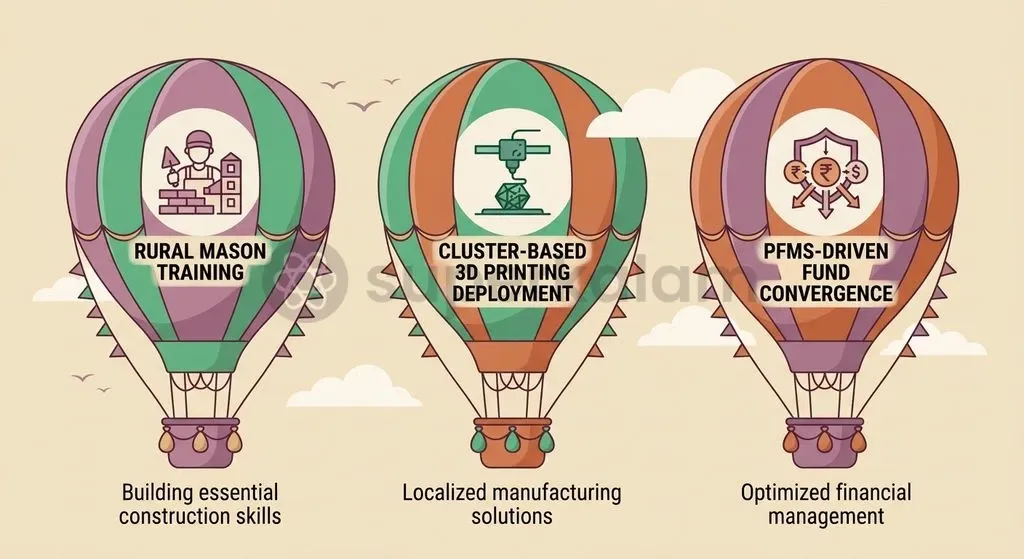
Capacity building remains a foundational pillar for decentralised delivery. Under the Rural Mason Training (RMT) programme, over 3 lakh rural masons have received formal certification in disaster-resilient masonry and quality building techniques. Integrating basic digital literacy and additive mix preparation into this curriculum can prepare the local workforce for emerging automated methods.
To overcome equipment cost barriers, state housing boards must adopt a cluster-based delivery model:
- Cluster Deployment: Aggregating housing sanctions across contiguous village clusters enables the cost-effective deployment of mobile 3D printers, while isolated individual sites continue using conventional, green masonry.
- Fiscal Continuity: Maintaining smooth liquidity through the Public Financial Management System and ensuring prompt release of State matching shares will safeguard project continuity and uphold the constitutional promise of rural shelter.
Discuss with Superkalam
Analyse the trade-offs between rapid robotic 3D concrete printing and the generation of local unskilled wage labour under MGNREGS convergence.
Ask NowKey Takeaways
- Policy Mandate: PMAY-G 2.0 targets the construction of two crore additional rural houses between FY 2024-25 and 2028-29 with an approved outlay of ₹3,06,137 crore (Central share: ₹2,05,856 crore; State share: ₹1,00,281 crore).
- Revised Eligibility: The Awaas+ 2024 survey reduces exclusion criteria from 13 to 10 parameters and raises the monthly household income ceiling from ₹10,000 to ₹15,000.
- Frontier Technology: Certified by BMTPC, 3D concrete printing cuts wall construction to under 5 days and reduces structural emissions to 58 kg CO₂-eq/m² compared to 147 kg CO₂-eq/m² in conventional masonry.
- Constitutional Anchor: Rural housing implements the Right to Shelter under Article 21 (Chameli Singh, 1996) and advances social justice under Directive Principles Articles 38 and 39(b).
- Cost Caveat: Initial equipment capital costs exceeding ₹1 to 2 crore per robotic printer require cluster-based aggregation to match the standard ₹1.20 lakh unit grant.
Mains Question
The transition from SECC 2011 to the digital Awaas+ 2024 framework under PMAY-G 2.0 reflects an attempt to address coverage gaps in rural housing. Examine the institutional and technological reforms introduced in beneficiary identification and fund disbursement. (10 Marks)
Evaluate NowMains Question
"Adopting frontier construction technologies such as 3D concrete printing in rural housing offers significant environmental and speed benefits, but faces structural economic mismatches in decentralised rural setups." Critically analyse this statement in light of India's rural shelter initiatives. (15 Marks)
Evaluate NowPractice MCQs
QUESTION 1
With reference to the Pradhan Mantri Awaas Yojana-Gramin (PMAY-G) 2.0 framework, consider the following statements:
- The baseline exclusion criteria for identifying eligible households have been reduced from 13 to 10 parameters under Awaas+ 2024.
- Households possessing a motorised two-wheeler or a refrigerator are categorically disqualified from receiving housing benefits.
- The monthly household income threshold for eligibility has been revised upwards from ₹10,000 to ₹15,000. Which of the statements given above are correct?
QUESTION 2
Consider the following statements regarding the financial architecture and convergence provisions of PMAY-G 2.0:
- Unit financial assistance is fixed at ₹1.20 lakh for plain areas and ₹1.30 lakh for North Eastern and Himalayan states.
- The cost-sharing ratio between the Centre and States is fixed at 90:10 for all general category states.
- Beneficiaries are entitled to 90 to 95 person-days of unskilled wage labour under MGNREGS in addition to ₹12,000 under Swachh Bharat Mission-Gramin. Which of the statements given above is/are correct?
QUESTION 3
With reference to the adoption of 3D concrete printing technology in affordable housing construction, consider the following statements:
- It utilizes additive manufacturing with automated gantry extruders that deposit rapid-setting concrete layer by layer.
- It requires specialized timber formwork and extensive steel shuttering to erect wall superstructures.
- Life Cycle Assessment data indicates that 3D concrete printing produces lower greenhouse gas emissions per square metre compared to traditional clay brick masonry. Which of the statements given above is/are correct?
QUESTION 4
In the context of the constitutional jurisprudence on the Right to Shelter in India, which Supreme Court judgment affirmed that the Right to Life under Article 21 encompasses the right to live with human dignity, including a decent home and civic amenities?
QUESTION 5
Consider the following statements regarding the technological and administrative monitoring mechanisms of PMAY-G 2.0:
- The dynamic Awaas+ 2024 application integrates Aadhaar-based face eKYC and artificial intelligence-driven image recognition.
- Fund disbursements are routed through the Public Financial Management System (PFMS) and Single Nodal Accounts triggered by multi-stage geo-tagged photographs.
- Exactly 10% of the total scheme allocation is reserved exclusively for administrative expenses at the Central level. Which of the statements given above is/are correct?





