PM-SETU Scheme: Can Modernising 1,000 ITIs Solve India's Skill Crisis?
PM-SETU brings industry-led governance and new-age courses to India's ITIs. What the scheme does, how it is structured and what changed in its first year.
Oct, 2026
•8 min read
Overview
The PM-SETU scheme, launched by the Government of India on October 4, 2025, commits ₹60,000 crore to modernise 1,000 Government Industrial Training Institutes and five National Skill Training Institutes, shifting India's vocational ecosystem from equipment-heavy grants to an industry-led hub-and-spoke co-governance model. According to World Bank project appraisal data, young people account for approximately 72% of India's unemployed population, while historical job placement rates for graduates from Industrial Training Institutes (ITIs) have remained below 50%. Furthermore, a report by NITI Aayog highlighted that only 2.3% to 5% of the Indian workforce has received formal vocational training, compared to 75% in Germany and 80% in Japan. PM-SETU tackles this structural deficit by pairing capital infusion with majority-equity industry partnerships. This article examines whether this institutional redesign can resolve systemic faculty shortages, regulatory fragmentation, and curriculum obsolescence to transform India's technical training landscape.
Why in the News: The Launch of the PM-SETU Scheme
The Ministry of Skill Development and Entrepreneurship launched the PM-SETU scheme on October 4, 2025, to modernise 1,000 Government Industrial Training Institutes and augment five National Skill Training Institutes.
The initiative operates with a total financial outlay of ₹60,000 crore over five years. Financing is structured across three pillars: ₹30,000 crore from the Central Government, ₹20,000 crore from State Governments, and ₹10,000 crore from private industry partners. To reinforce this capital base, the World Bank approved an $830 million concessional loan in February 2026 alongside Asian Development Bank co-financing, designed to mobilise $680 million in private investment.
As of October 2026, the central government has identified 850 ITIs, comprising 172 Hub ITIs and 678 Spoke ITIs, and approved Strategic Investment Plans for 14 clusters valued at ₹3,446 crore. The Visakhapatnam ITI Cluster in Andhra Pradesh became the first approved plan, anchored through a joint partnership with ArcelorMittal Nippon Steel India.
The Legacy Burden: Why Earlier Upgrades Under VTIP and STRIVE Fell Short
Previous centrally assisted vocational modernisation programmes failed to achieve sustainable job placements because capital spending was decoupled from institutional accountability.
The World Bank-assisted Vocational Training Improvement Project, implemented between 2007 and 2018, modernised 400 Government ITIs across India. While the project upgraded physical workshops, the World Bank's post-completion evaluation revealed that machinery procurement alone failed to raise training quality without sustained, operational industry linkages. Workshops frequently housed advanced equipment that remained unutilised due to untrained instructors and rigid curricula.
Discuss with Superkalam
What are the financial contributions committed by the Centre, States, and Industry under the ₹60,000 crore PM-SETU scheme?
Ask NowTo correct these design flaws, the Ministry of Skill Development and Entrepreneurship launched the Skills Strengthening for Industrial Value Enhancement project between 2017 and 2023. The initiative introduced Performance-Based Grant Agreements and incentivised Industry Cluster networks to decentralise institutional governance. While this framework improved administrative autonomy, it struggled with uneven state-level execution and could not prevent the widening gap between classroom instruction and market demand.
The Sharda Prasad Blueprint: Diagnosing Structural Faults in ITIs
The Sharda Prasad Committee (2016) revealed that rapid, unregulated expansion compromised the operational integrity of India's vocational training architecture.
Total training institutes grew rapidly across the country, rising from 9,776 institutions in 2014 to 13,888 by 2026, while nationwide enrolment expanded from 9.51 lakh to 14.70 lakh trainees. The committee observed that uncurbed expansion of private ITIs led to rampant commercialisation, substandard physical infrastructure, and superficial compliance, largely enabled by weak supervisory oversight from the National Council for Vocational Training and State Councils for Vocational Training.
To resolve these systemic distortions, the committee outlined two mandatory structural interventions:
- Trainees must spend at least one-third of training duration directly on factory shop floors through integrated industry apprenticeships.
- Fragmented testing bodies must be replaced by an independent National Board of Assessment and Certification to enforce standardized qualification benchmarks across all technical trades.
These recommendations catalyzed the establishment of the National Council for Vocational Education and Training as an overarching regulatory body in 2020.
Inside PM-SETU: Hub-and-Spoke Model, Capital Infusion, and Industry 4.0
The PM-SETU architecture addresses systemic training failures through a dual-component model that links physical infrastructure consolidation with corporate co-management.
Under Component I of the scheme, 1,000 upgraded Government ITIs are organised into a structured Hub-and-Spoke network. In this arrangement, 200 Hub ITIs are equipped with advanced laboratories, digital classrooms, and technology incubation hubs. These hubs extend technical resources, specialised machinery access, and master trainers to 800 surrounding Spoke ITIs.
Corporate governance is institutionalised through a dedicated co-management framework. Each ITI cluster is managed via a Special Purpose Vehicle where:
- Anchor Industry Partners maintain a 51% majority equity stake, directing curriculum design, equipment choices, and shop-floor apprenticeships.
- Respective State Governments hold a 49% minority equity stake, ensuring administrative support, statutory continuity, and public accessibility.
Under Component II, the scheme establishes National Centres of Excellence across five National Skill Training Institutes situated in Bhubaneswar, Chennai, Hyderabad, Kanpur, and Ludhiana. These centres oversee high-end master trainer qualification and manage global institutional partnerships.
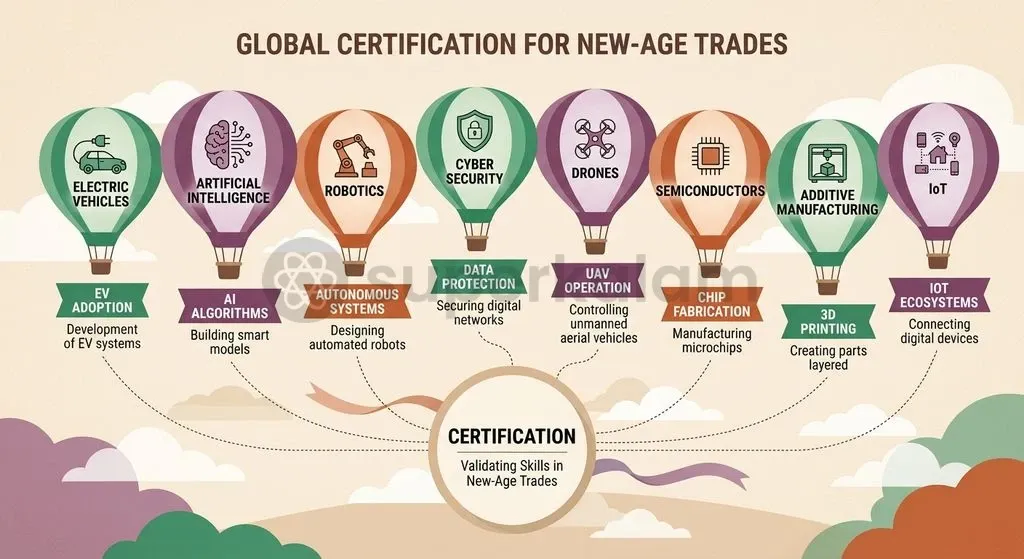
The overhauled curriculum integrates 32 advanced Industry 4.0 courses, training students in electric vehicles, artificial intelligence, robotics, cyber security, drones, semiconductors, additive manufacturing, and industrial internet of things.
Discuss with Superkalam
How does the Hub-and-Spoke model under PM-SETU optimize machinery and instructor resources across 1,000 ITIs?
Ask NowHow PM-SETU Compares with Past Vocational Training Schemes
Evaluating PM-SETU against historic interventions highlights a transition from input-driven equipment financing to legally binding corporate co-governance.
| Dimension | Vocational Training Improvement Project (VTIP) | Skills Strengthening for Industrial Value Enhancement (STRIVE) | PM-SETU Scheme |
|---|---|---|---|
| Operational Period | 2007–2018 | 2017–2023 | 2025–2030 |
| Primary Funding Mechanism | Centrally assisted grants and direct multilateral lending | Performance-Based Grant Agreements (PBGA) | Tripartite capital pool: Centre (50%), States (33%), Industry (17%) |
| Institutional Governance | State Directorate control with advisory Institute Management Committees | Cluster-level industry networks with decentralized grant autonomy | Legally incorporated Special Purpose Vehicles with 51% industry majority equity |
| Curriculum Focus | Conventional mechanical and electrical CTS trades | Standardised National Skills Qualification Framework (NSQF) alignment | 32 Industry 4.0 trades including robotics, AI, and green mobility |
| Infrastructure Model | Standalone institutional upgrades | Decentralized competitive institutional grants | Hub-and-Spoke structure (200 Hubs supporting 800 Spokes) |
Discuss with Superkalam
If you were managing an ITI cluster SPV, how would you design industry apprenticeships to ensure at least one-third shop-floor training?
Ask NowKey Execution Bottlenecks: Faculty Deficits, State Financing, and Industry Reluctance
Despite robust structural design, PM-SETU faces operational friction rooted in state-level fiscal disparities and severe shortages of qualified instructors.
Reports by NITI Aayog show that instructor vacancies regularly exceed 30% across several state-run training systems, forcing institutions to rely on poorly remunerated ad-hoc contract trainers. Because contract instructors rarely receive pedagogical retraining or exposure to advanced factory automation, newly installed Industry 4.0 tools risk remaining underutilised.
Fiscal synchronisation presents another hurdle under India's federal structure. The scheme requires State Governments to collectively commit ₹20,000 crore in counterpart funding. As of October 2026, 36 States and Union Territories have incorporated dedicated budget line items, and 35 have notified State Steering Committees. However, differences in state fiscal capacity create risks of uneven implementation between industrialized and fiscally stressed regions.
Private sector engagement also varies widely. While major industrial conglomerates readily anchor Tier-1 clusters, smaller enterprises and regional manufacturing units often hesitate to commit capital or open shop floors to long-term apprentice stipends.
Discuss with Superkalam
Why did previous equipment-focused initiatives like VTIP fail to achieve high post-training employment rates despite substantial capital infusion?
Ask NowLessons from Abroad: What Germany's Dual Vocational Model Can Teach India
International models demonstrate that vocational education succeeds when industry functions as a co-funder and co-educator rather than a passive consumer of talent.
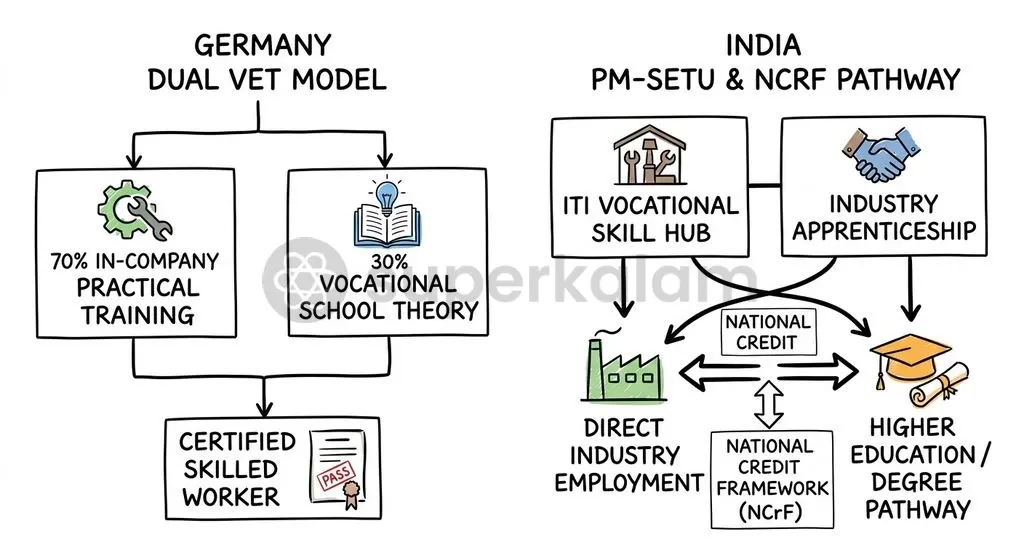
Under the German Dual Vocational Education and Training system (Duales Ausbildungssystem), trainees spend approximately 70% of their learning hours on enterprise shop floors and 30% in classroom instruction. German host companies directly fund apprentice allowances through a regulated wage-sharing structure, while regional Chambers of Commerce verify examinations and enforce quality standards.
This structural integration explains why 75% of Germany's workforce possesses formal technical credentials, compared to just 2.3% to 5% in India. For PM-SETU to mirror this success, Indian industry associations must assume binding legal responsibilities for workplace training rather than relying entirely on state-funded classrooms.
Way Forward: Reforming Governance, Accreditation, and Youth Aspirations
Modernising physical workshops will only yield sustainable economic returns if paired with broader regulatory clarity, academic mobility, and social parity.
First, regulatory streamlining through the National Council for Vocational Education and Training must enforce uncompromising standards for private and public institutes alike. Accrediting bodies that fail infrastructure, safety, or faculty audits must face rapid de-affiliation to eliminate sub-par training operations.
Discuss with Superkalam
Weigh the benefits and risks of giving private industry partners a 51% majority equity stake in the management of public ITIs.
Ask NowSecond, the National Credit Framework must be fully operationalised across state school boards and universities. By establishing horizontal and vertical mobility between technical training and mainstream degrees under the National Skills Qualification Framework, technical qualifications can shed their historical stigma as dead-end educational tracks.
Finally, state directorates must address instructor vacancies by creating permanent, well-compensated technical cadres. Linking PM-SETU's Industry 4.0 labs with industry-backed trainer certification will ensure that India's demographic dividend translates into productive, future-ready employment.
Key Takeaways
- PM-SETU is a ₹60,000 crore initiative designed to modernise 1,000 Government ITIs and five NSTIs, supported by an $830 million World Bank loan.
- The institutional framework is organised around 200 Hub ITIs and 800 Spoke ITIs, with management handled via Special Purpose Vehicles where anchor industry partners hold a 51% majority equity stake.
- The initiative addresses core faults highlighted by the Sharda Prasad Committee (2016), which recommended mandatory one-third shop-floor training and unified assessment oversight.
- Only 2.3% to 5% of India's workforce is formally skilled, while ITI placement rates have historically remained below 50%.
- Sustained success requires overcoming instructor vacancies exceeding 30%, timely state-level budget disbursements, and seamless academic credit transfers through the National Credit Framework.
Mains Question
"Past vocational interventions like VTIP and STRIVE demonstrated that equipment-heavy capital grants without structural industry co-governance fail to bridge the employability divide." In light of the Sharda Prasad Committee's findings, evaluate how the PM-SETU scheme attempts to reform India's technical training architecture. (15 Marks)
Evaluate NowMains Question
Examine the role of the tripartite financing and hub-and-spoke co-governance model under the PM-SETU scheme in overcoming structural bottlenecks in India's Industrial Training Institutes (ITIs). (10 Marks)
Evaluate NowPractice MCQs
QUESTION 1
With reference to the PM-SETU scheme, consider the following statements:
- It envisions the modernization of 1,000 Government Industrial Training Institutes (ITIs) and five National Skill Training Institutes (NSTIs).
- The institutional governance model mandates a Special Purpose Vehicle where private industry partners hold a 51% majority equity stake.
- The scheme's total financial outlay of ₹60,000 crore is funded entirely by the Central Government through multilateral loans.
Which of the statements given above are correct?
QUESTION 2
Consider the following statements regarding vocational education reforms and committee recommendations in India:
- The Sharda Prasad Committee (2016) recommended that trainees spend at least one-third of their training duration on factory shop floors.
- The Sharda Prasad Committee proposed replacing fragmented testing bodies with a National Board of Assessment and Certification.
- Under the PM-SETU scheme, Component II establishes National Centres of Excellence across selected National Skill Training Institutes.
Which of the statements given above is/are correct?
QUESTION 3
Consider the following statements comparing historical vocational schemes in India:
- The Vocational Training Improvement Project (VTIP) relied on centrally assisted grants and multilateral lending for physical workshop upgrades.
- The STRIVE project introduced Performance-Based Grant Agreements to incentivize decentralized institutional governance.
- Unlike its predecessors, PM-SETU adopts a Hub-and-Spoke model comprising 200 Hub ITIs and 800 Spoke ITIs.
Which of the statements given above are correct?
QUESTION 4
With reference to the institutional architecture of PM-SETU, which of the following cities hosts one of the five National Skill Training Institutes (NSTIs) designated as a National Centre of Excellence?
QUESTION 5
Consider the following statements regarding the status of vocational training in India as highlighted in official reports:
- According to NITI Aayog, formal vocational training in the Indian workforce is significantly lower than in Germany and Japan.
- World Bank project appraisal data indicates that young people constitute nearly 72% of India's unemployed population.
- Historical placement rates for ITI graduates have consistently remained above 75%.
Which of the statements given above is/are correct?





