PM-MKSSY Aquaculture Insurance: Bridging India's 1% Fish Cover Gap
As India targets a resilient Blue Economy, PM-MKSSY replaces open-ended subsidies with parametric digital tools to secure smallholder aqua-farmers.
Sep, 2026
•9 min read
Overview
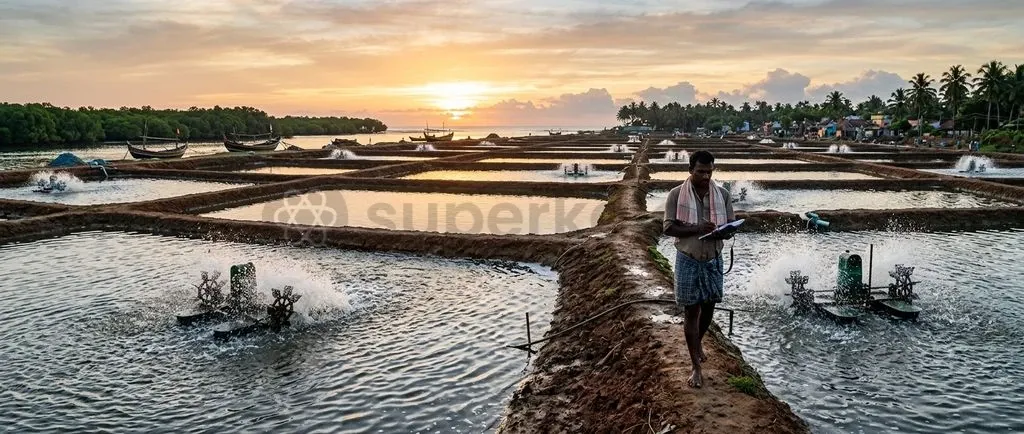
India's aquaculture sector is expanding rapidly, yet risk protection has lagged behind. The Union Cabinet approved the Pradhan Mantri Matsya Kisan Samridhi Sah-Yojana as a Central Sector sub-scheme under the Pradhan Mantri Matsya Sampada Yojana. The policy targets digital formalisation and direct premium subsidies to fix this gap.
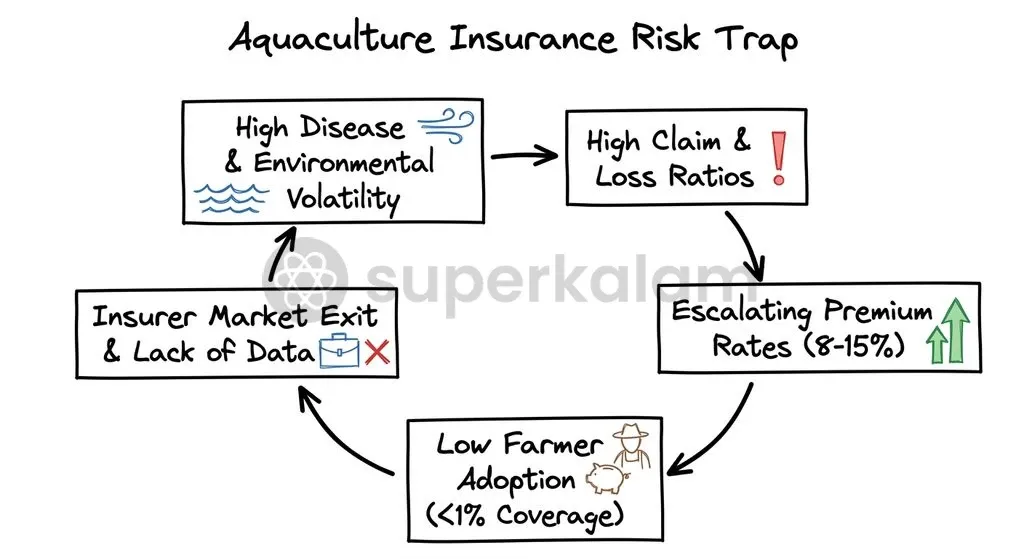
Insurance penetration has stalled below 1% across water spread areas. Severe disease volatility and steep premiums have kept private underwriters away.
Rather than adopting open-ended crop subsidies, PM-MKSSY introduces a one-time premium incentive tied to the National Fisheries Digital Platform. Farm-level verification and landholding caps protect vulnerable smallholders while laying down baseline actuarial data.
Why in the News: Launch of the Aquaculture Insurance Framework Under PM-MKSSY
The Union Cabinet approved the Pradhan Mantri Matsya Kisan Samridhi Sah-Yojana (PM-MKSSY) on 8 February 2024 as a dedicated Central Sector sub-scheme under the broader Pradhan Mantri Matsya Sampada Yojana (PMMSY) framework.
The four-year programme runs from FY 2023-24 to FY 2026-27 with a total outlay of ₹6,000 crore. Key operational pillars include:
- Blended Financing Model: Public funding makes up 50% (₹3,000 crore), financed partly through multilateral borrowings from the World Bank and the Agence Française de Développement (AFD).
- Private Co-Investment: The remaining 50% (₹3,000 crore) is structured from anticipated private beneficiary contributions and commercial equity.
- Formalisation Mandate: The scheme establishes an institutional shift toward formalisation, securing credit and risk transfer for a sector sustaining over 30 million livelihoods.
Discuss with Superkalam
What are the specific premium incentive percentages provided under PM-MKSSY for general category versus SC/ST and women fish farmers?
Ask NowThe Risk Trap: Why India's Aquaculture Insurance Penetration Stalled Below 1%
Aquaculture insurance penetration in India has historically stalled below 1% of total cultivated water spread area, leaving millions of primary producers exposed to sudden economic collapse.
Production, however, continues to climb. India achieved a record fish production of 19.8 million tonnes in 2024-25, with the inland and aquaculture sector contributing over 74% (14.74 million tonnes). Average aquaculture productivity reached 4.77 tonnes per hectare, approaching the national benchmark of 5 tonnes per hectare.
| Sector Metric | Performance Figure |
|---|---|
| Total Fish Production (2024-25) | 19.8 million tonnes |
| Inland & Aquaculture Share | >74% (14.74 million tonnes) |
| Average Pond Productivity | 4.77 tonnes/ha (Target: 5.0 tonnes/ha) |
| Dependent Population | Over 30 million livelihoods |
| Historical Insurance Penetration | Below 1% of water area |
Despite these gains, commercial insurers have stayed away due to unsustainable loss ratios. Private underwriters quoted prohibitive premium rates between 8% and 15% of the total sum insured, pricing out small-scale fishers.
Biological pathogens drive these loss ratios. Research by ICAR-CIBA indicates that epidemics like White Spot Syndrome Virus (WSSV), Enterocytozoon hepatopenaei (EHP), and infectious myonecrosis can wipe out shrimp crops within 48 hours. Compounded by coastal cyclones, these biosecurity threats drove insurers out of the market.
Discuss with Superkalam
Why are standard optical satellite sensors and NDVI unable to assess biomass loss in aquaculture ponds?
Ask NowClaims and Assessment: How Aquatic Loss Evaluation Differs from Land Crops
Aquatic loss assessment faces distinct physical and biological verification barriers absent in terrestrial crop insurance.
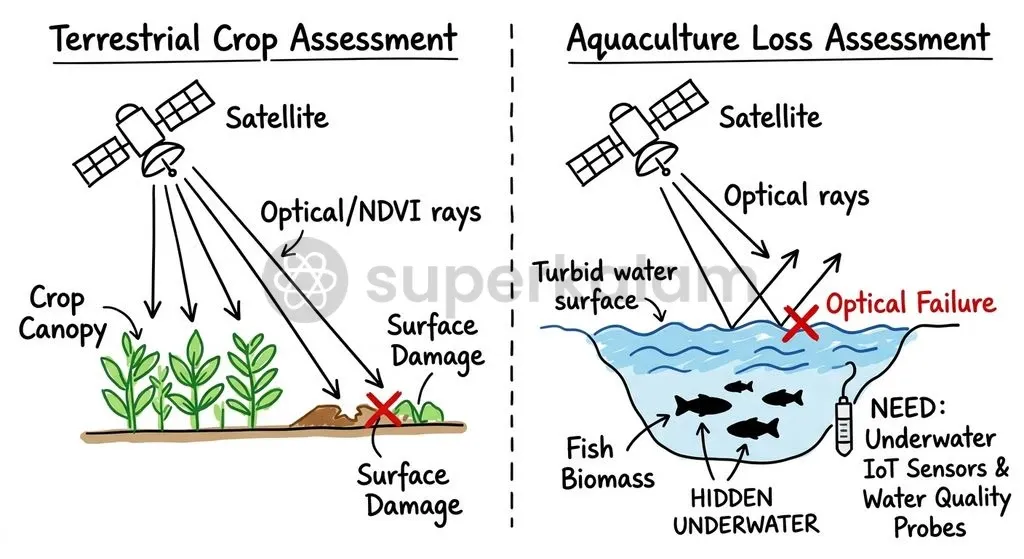
Terrestrial crop surveyors rely on the Normalized Difference Vegetation Index (NDVI) to measure canopy health and photosynthetic activity from orbit. Aquaculture biomass stays submerged in turbid pond water. Consequently, optical satellites cannot measure stock density or disease damage directly.
| Assessment Dimension | Terrestrial Crops (PMFBY) | Aquaculture Systems (PM-MKSSY) |
|---|---|---|
| Visibility of Stock | Surface canopy visible to satellite optical sensors | Biomass submerged in turbid pond water |
| Primary Remote Sensing Tool | Satellite-derived vegetation index (NDVI) | Optical satellite sensors rendered ineffective |
| Disaster Decay Rate | Crop stands degrade over days to weeks | Stock decomposes or sinks within hours |
| Assessment Solution | Crop cutting experiments and spectral imagery | Parametric proxy triggers and digital pond sensors |
Rapid biological decay complicates loss adjustment. When viral outbreaks strike, mortality occurs underwater within hours. Dead stock decomposes or sinks before an external surveyor can conduct physical sampling. These constraints historically generated acute information asymmetry and moral hazard, causing underwriters to reject claims or exit the sector.
Discuss with Superkalam
How does the 4-hectare ceiling in PM-MKSSY prevent the fiscal capture of insurance subsidies by commercial shrimp enterprises?
Ask NowLearning from PMFBY: Can PM-MKSSY Avoid the Pitfalls of Crop Insurance?
The structural framework of PM-MKSSY departs from the Pradhan Mantri Fasal Bima Yojana (PMFBY) to avoid chronic fiscal burdens and insurer exits.
PMFBY relies on an open-ended premium subsidy model. Farmers pay a statutory flat premium (1.5% for Rabi, 2% for Kharif, and 5% for commercial horticultural crops), with the Centre and States sharing the remaining actuarial cost 50:50. In contrast, PM-MKSSY uses a one-time Direct Benefit Transfer (DBT) incentive model to seed the market without creating indefinite state liabilities.
| Structural Feature | Pradhan Mantri Fasal Bima Yojana (PMFBY) | PM-MKSSY Aquaculture Insurance |
|---|---|---|
| Administrative Scope | Agricultural crops and commercial horticulture | Inland, brackishwater, and marine aquaculture |
| Subsidy Mechanism | Continuous, open-ended premium cost sharing between Centre and States | One-time catalytic DBT monetary incentive paid directly to farmers |
| Farmer Contribution | Uniformly capped at 1.5% to 5.0% of Sum Insured | Market-determined premium minus 40% to 50% one-time subsidy |
| Loss Verification Method | Crop Cutting Experiments (CCEs) and satellite NDVI indices | Parametric physical triggers and NFDP-verified pond diagnostics |
| Farm Size Eligibility | Universal coverage across all holding sizes | Strict 4-hectare ceiling to curb large corporate subsidy capture |
| Institutional Anchor | State Agriculture Departments and designated insurance clusters | Department of Fisheries via National Fisheries Digital Platform |
By avoiding state-level subsidy settlement delays that hampered PMFBY, PM-MKSSY preserves operational liquidity through direct central DBT transfers. Its explicit 4-hectare ceiling prevents public funds from subsidising capital-intensive commercial shrimp farms, preserving support for marginal growers.
Structural Bottlenecks: Moral Hazard, High Actuarial Risk, and Data Deficits
Underwriting aquaculture risk requires overcoming severe systemic bottlenecks created by disease contagion and historical data deficits.
Primary operational and structural challenges include:
- Spatial Contagion Across Pond Clusters: Adjacent coastal ponds often share tidal creek intake and drainage canals. Unsterilised discharge from one farm causes instantaneous cross-infection across clusters, wiping out multiple holdings at once.
- Actuarial Data Deficits: India lacks long-term, georeferenced disease registries and historical loss records, forcing insurers to build high safety buffers into elevated commercial premium quotes.
- Smallholder Exclusion and Information Gaps: Small-scale fishers often lack formal water lease deeds or registration papers, barring them from institutional products and locking them into informal debt traps.
- Lack of Specialised Loss Adjusters: The insurance sector lacks trained fisheries biologists and pathologists to verify causes of death, triggering prolonged claim settlement disputes.
Discuss with Superkalam
Weigh the advantages and trade-offs of using a one-time DBT premium incentive under PM-MKSSY versus an ongoing, open-ended subsidy model like PMFBY.
Ask NowWay Forward: Parametric Triggers and Digital Platforms for the Blue Economy
Closing India's aquaculture protection gap requires expanding parametric index-based insurance products linked to digital identity infrastructure.
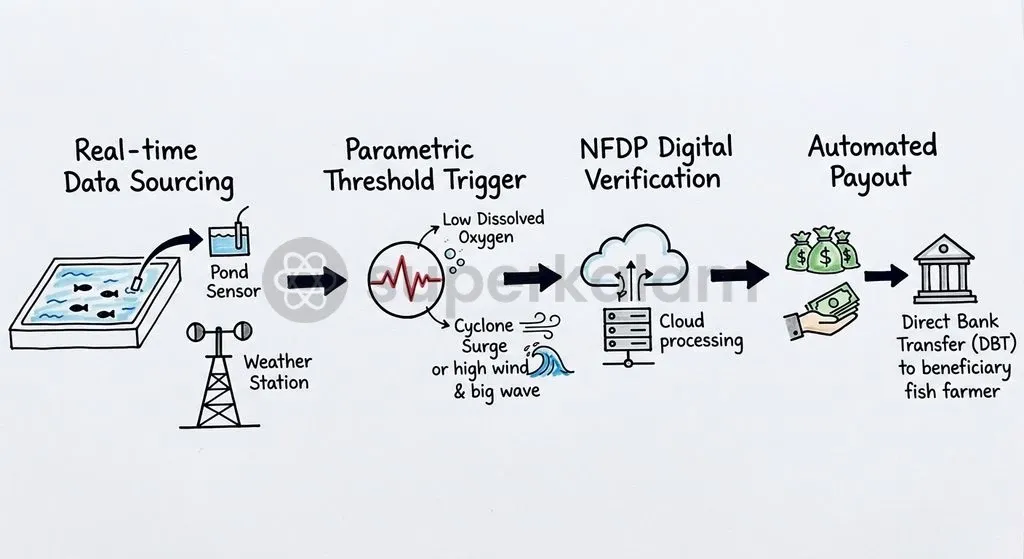
Parametric models settle claims automatically against pre-agreed objective environmental thresholds instead of post-disaster field sampling. World Bank technical reviews show that tracking proxy metrics—such as dissolved oxygen drops, tidal surges, and sustained wind speeds—enables instant, dispute-free claim settlements.
- Real-Time Data Collection: Continuous monitoring via on-farm IoT water probes and coastal weather stations tracking dissolved oxygen, salinity, temperature, and wind speeds.
- Automated Threshold Breach: Payouts trigger automatically when parameters cross pre-set limits, such as dissolved oxygen falling below 3.0 mg/L or wind speeds exceeding 80 km/h.
- Direct Payout Disbursal: Funds transfer directly to enrolled bank accounts through the NFDP DBT gateway, bypassing post-loss physical surveys and avoiding moral hazard.
The Department of Fisheries launched the National Fisheries Digital Platform (NFDP) on 11 September 2024 to establish a central registry for all fisheries interventions. As of September 2026, the NFDP dashboard recorded over 37 lakh registrations covering fishers, fish farmers, and coastal microenterprises.
Integrating the NFDP Credit Facilitation module lets farmers submit verified digital production profiles directly to commercial and Regional Rural Banks, expediting credit under the Kisan Credit Card (KCC) scheme.
To curb disease spread, PM-MKSSY encourages clustering under Fish Farmers Producer Organisations (FFPOs) following uniform Better Management Practices (BMPs) and biosecurity standards. Combining parametric triggers, digital verification via NFDP, and clustered biosecurity creates a viable underwriting foundation for India's Blue Economy.
Key Takeaways
- Policy Architecture: The Union Cabinet approved PM-MKSSY on 8 February 2024 with a ₹6,000 crore outlay (50% public funding via World Bank/AFD, 50% private equity) as a Central Sector sub-scheme under PMMSY.
- Targeted Premium Subsidies: Component 1-B delivers a 40% premium incentive capped at ₹25,000 per hectare for general farmers (maximum ₹1,00,000 per farmer up to 4 hectares), expanding to 50% for SC, ST, and women aqua-culturists.
- Penetration Deficit: Commercial aquaculture insurance penetration historically stalled below 1% due to high premium rates (8% to 15%) driven by extreme pathogen risks like White Spot Syndrome Virus (WSSV).
- Assessment Differences: Submerged biomass precludes optical satellite indices (NDVI) used in PMFBY, demanding a shift toward objective parametric triggers (dissolved oxygen levels, cyclone metrics) to eliminate moral hazard.
- Digital Backbone: As of September 2026, the National Fisheries Digital Platform (NFDP) has registered over 37 lakh fisheries stakeholders, connecting dynamic digital identities to insurance DBT and Kisan Credit Card facilities.
Mains Question
"Aquatic loss evaluation presents distinct physical, biological, and informational challenges that render traditional terrestrial crop insurance models ineffective." In light of this statement, examine the structural bottlenecks in India's aquaculture insurance sector and how PM-MKSSY seeks to overcome them. (15 Marks)
Evaluate NowMains Question
Compare the design of the Pradhan Mantri Matsya Kisan Samridhi Sah-Yojana (PM-MKSSY) with the Pradhan Mantri Fasal Bima Yojana (PMFBY), evaluating its potential to prevent fiscal burdens and insurer exits. (10 Marks)
Evaluate NowPractice MCQs
QUESTION 1
With reference to the Pradhan Mantri Matsya Kisan Samridhi Sah-Yojana (PM-MKSSY), consider the following statements:
- It is a Central Sector sub-scheme under the Pradhan Mantri Matsya Sampada Yojana (PMMSY).
- Under Component 1-B, general category fish farmers receive a 40% premium incentive capped at ₹25,000 per hectare for holdings up to 4 hectares.
- The scheme provides an open-ended, continuous premium sharing model identical to the Pradhan Mantri Fasal Bima Yojana (PMFBY).
Which of the statements given above is/are correct?
QUESTION 2
Consider the following statements regarding the financial architecture and institutional support under PM-MKSSY:
- The scheme is financed through a blended model where 50% comes from public funding and 50% from private beneficiary contributions and commercial equity.
- The public funding portion is financed partly through multilateral borrowings from the World Bank and the Agence Française de Développement (AFD).
- Scheduled Caste (SC), Scheduled Tribe (ST), and women beneficiaries receive a 50% total premium subsidy under Component 1-B.
Which of the statements given above are correct?
QUESTION 3
Which of the following biological pathogens are cited as rapid biosecurity threats capable of causing severe mortality in shrimp crops within 48 hours?
QUESTION 4
With reference to loss assessment in aquaculture insurance compared to terrestrial crop insurance, consider the following statements:
- Optical satellite-derived Normalized Difference Vegetation Index (NDVI) is directly used to measure submerged biomass density in turbid aquaculture ponds.
- Rapid biological decay of dead aquatic biomass in water creates acute information asymmetry and physical verification challenges for surveyors.
- The scheme targets structured insurance coverage for at least 1,00,000 hectares of aquaculture farms.
Which of the statements given above is/are correct?
QUESTION 5
Consider the following statements regarding the coverage and eligibility caps under PM-MKSSY:
- Intensive systems like Recirculatory Aquaculture Systems (RAS) and Biofloc qualify for a 40% premium incentive capped at ₹1,00,000 for units up to 1,800 cubic metres.
- Under Component 3, microenterprises owned by SC, ST, and women can receive performance grants up to 35% of investment capped at ₹45 lakh.
- Pond aquaculture holdings above 4 hectares are granted unlimited open-ended subsidies.
Which of the statements given above is/are correct?





