PM-AJAY Scheme: Architecture, Progress, and SC Welfare Implementation
PM-AJAY merges three legacy schemes into one framework, testing whether administrative convergence can finally turn financial outlays into grassroots equity.
Sep, 2026
•11 min read

Context
The Pradhan Mantri Anusuchit Jaati Abhyuday Yojana (PM-AJAY) consolidates three erstwhile welfare programmes into a single Centrally Sponsored Scheme. It aims to eliminate administrative fragmentation, enhance socio-economic infrastructure, and accelerate holistic saturation in Scheduled Caste majority habitations across India.
Launched in FY 2021-22 by the Ministry of Social Justice and Empowerment, the scheme targets persistent deficits in livelihood creation, educational access, and village civic amenities. Merging these legacy interventions into three coordinated pillars shifts targeted affirmative policy from isolated financial outlays toward measurable community-level outcomes.
Why PM-AJAY is in the News: Recent Performance Data and Review
The Ministry of Social Justice and Empowerment released updated nationwide performance metrics for PM-AJAY in mid-2026. Official monitoring data evaluates physical and financial execution across all operational States:
- Adarsh Gram Coverage: As of August 2026, 47,328 villages have been selected across 28 States and Union Territories, with 17,067 villages successfully declared as model habitations.
- Accelerated Outlays: In FY 2025-26 alone, central authorities issued mother sanctions amounting to ₹892.59 crore across all three scheme components to expedite local completions and clear pending state-level backlogs.
Parliamentary reviews evaluated how unified digital District Action Plans help overcome legacy administrative bottlenecks. These reviews highlighted substantial groundwork alongside recurring implementation friction in decentralised planning, making PM-AJAY a focal point for public policy analysis.
Discuss with Superkalam
Which three erstwhile Centrally Sponsored Schemes were merged to form the unified PM-AJAY architecture?
Ask NowConstitutional Foundations: Affirmative Action and the Article 46 Mandate
Constitutional safeguards for Scheduled Castes establish an explicit obligation for state-led developmental intervention and social protection. According to the Constitution of India, Article 46 directs the State to promote with special care the educational and economic interests of the weaker sections, particularly Scheduled Castes and Scheduled Tribes, while protecting them from social injustice and all forms of exploitation.
As a Directive Principle of State Policy in Part IV, Article 46 remains fundamental in governance. It guides executive policy design even though Directive Principles are non-justiciable in a court of law.
Constitutional Enabling Provisions
- Part III (Fundamental Rights — Justiciable):
- Article 15(4): Special provisions for the advancement of socially and educationally backward classes and SCs/STs.
- Article 16(4): Enables reservations in public appointments where representation remains inadequate.
- Part IV (Directive Principles — Fundamental in Governance):
- Article 46: Directs the State to promote the educational and economic interests of SCs/STs.
- Institutional Safeguard (Part XVI):
- Article 338: Establishes the National Commission for Scheduled Castes (NCSC) with authority to examine safeguards, review developmental processes, and participate in planning socio-economic programmes for Scheduled Castes.
The Pre-Merger Problem: How Fragmented Schemes Diluted SC Welfare
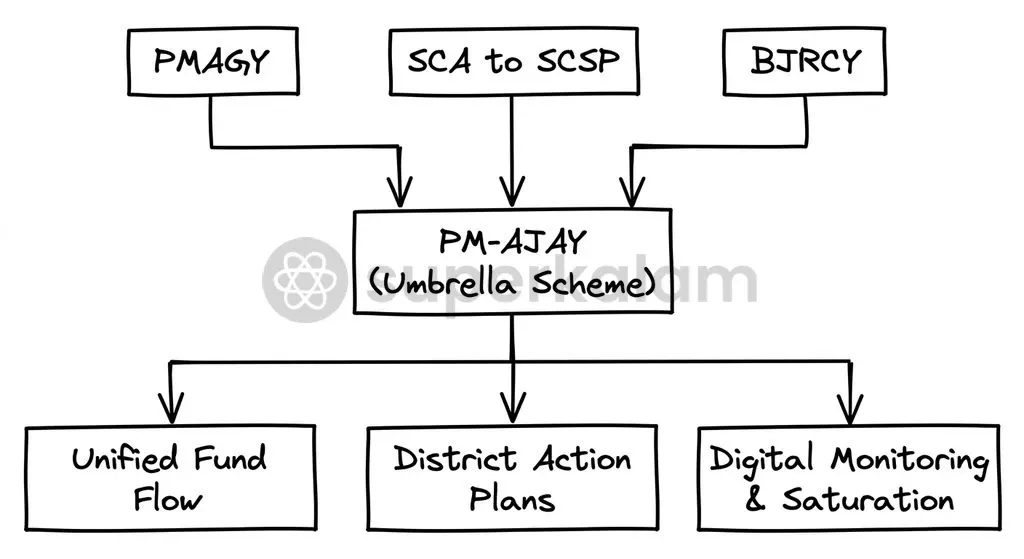
Historical welfare architecture for Scheduled Castes suffered from deep administrative silos across three standalone Centrally Sponsored Schemes. The Ministry of Social Justice and Empowerment previously administered the Pradhan Mantri Adarsh Gram Yojana (PMAGY), the Special Central Assistance to Scheduled Castes Sub Plan (SCA to SCSP), and the Babu Jagjivan Ram Chhatrawas Yojana (BJRCY) as distinct funding pipelines.
According to an evaluation by NITI Aayog, legacy Special Central Assistance suffered from persistent fund parking at state treasuries, delayed submissions of Utilisation Certificates, and fragmented project approvals that lacked spatial convergence.
Village-level interventions under PMAGY operated in isolation from livelihood subsidies granted under SCA to SCSP. Meanwhile, student accommodation under BJRCY faced prolonged construction delays and poor institutional maintenance.
Administrative fragmentation produced several structural deficiencies:
- Uncoordinated Infrastructure: Line departments planned village infrastructure independently without assessing cross-sectoral deficits in SC-dense habitations.
- Duplicative Paperwork: State welfare agencies managed separate compliance paperwork for each scheme, multiplying bureaucratic delays.
- Disconnected Outcomes: Livelihood initiatives remained separated from educational infrastructure, undermining long-term economic mobility.
- Idle Balances: Unspent balances accumulated across multiple bank accounts without centralised digital tracking.
Discuss with Superkalam
How does shifting from standalone scheme proposals to unified District Action Plans reduce administrative fragmentation?
Ask NowArchitecture of PM-AJAY: Breaking Down the Three Merged Pillars
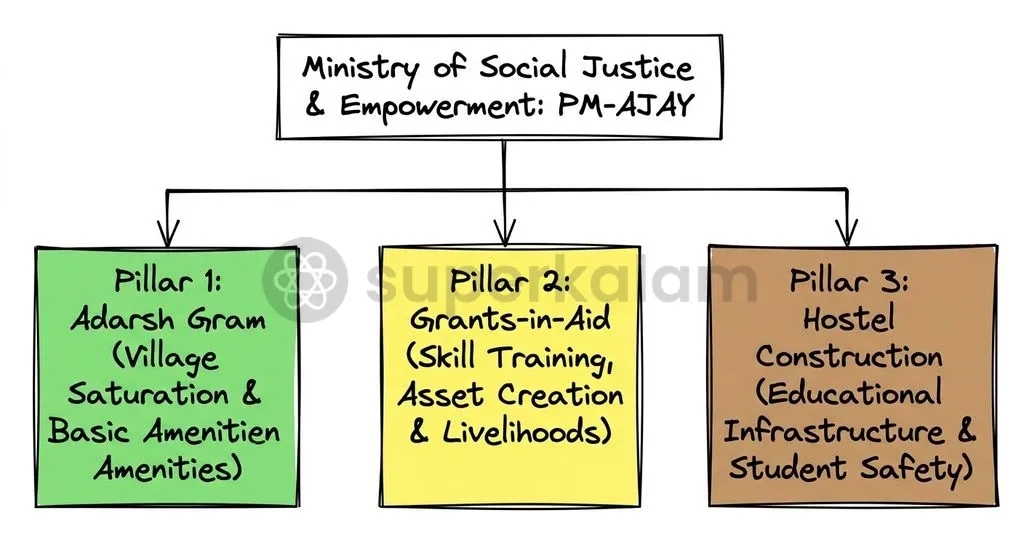
The unified PM-AJAY framework operates through three interconnected pillars designed to cover spatial infrastructure, household livelihoods, and educational support. The Ministry of Social Justice and Empowerment structured PM-AJAY as a 100% Centrally Sponsored Scheme launched in FY 2021-22 to streamline fund flows and eliminate overlapping institutional channels.
The scheme covers 28 States and Union Territories, excluding regions with negligible or zero SC populations such as Arunachal Pradesh, Nagaland, Meghalaya, Mizoram, Ladakh, and Lakshadweep. Up to 5% of total scheme funds are earmarked specifically for administrative expenses, digital monitoring platforms, capacity building, and independent third-party evaluations.
| Pillar | Focus Area | Key Eligibility & Quantitative Norms |
|---|---|---|
| 1. Adarsh Gram Component | Village Saturation & Civic Infrastructure | Population ≥ 500, SC population > 40%, 50 monitorable goals across 10 sectors |
| 2. Grants-in-Aid Component | Socio-Economic Projects & Livelihoods | ≥ 10% skills training, up to 15% for women's enterprises, up to 30% civic assets |
| 3. Hostel Component | Educational Infrastructure | New residential builds, repair of existing units, barrier-free Divyangjan access, 24/7 security |
The three components divide operational responsibilities into targeted developmental categories:
Adarsh Gram (Model Village) Component: Focuses on the integrated development of SC-majority villages. According to scheme guidelines, eligible villages must have a total population of 500 or more, with the SC population threshold revised to over 40% in FY 2022-23 (down from the earlier 50% benchmark) to expand geographical coverage. The model assesses village saturation against 50 monitorable socio-economic indicators distributed across 10 developmental sectors, including drinking water, sanitation, education, health, and rural connectivity.
Grants-in-Aid for District and State Projects: Provides flexible financial assistance for socio-economic development, asset generation, and skill-building projects. PM-AJAY guidelines mandate specific ring-fenced allocations: at least 10% for skill development, up to 15% exclusively for viable income-generating enterprises for SC women, and up to 30% for complementary infrastructure.
Hostel Component: Finances the construction of new residential hostels and the repair of existing facilities for SC students pursuing secondary and higher education. The guidelines enforce barrier-free accessibility for Divyangjan students (persons with disabilities) alongside dedicated safety protocols, including round-the-clock female wardens and security personnel in girls' hostels.
Discuss with Superkalam
If you were a District Collector tasked with selecting villages under the Adarsh Gram component, what demographic criteria must you verify?
Ask NowComparing Approaches: Pre-Merger Silos vs PM-AJAY Umbrella Convergence
The consolidation of legacy programmes into PM-AJAY fundamentally shifts administrative planning from disjointed scheme-level outputs to a unified district framework. By replacing isolated project submissions with integrated District Action Plans submitted via a unified portal, PM-AJAY aligns infrastructure creation directly with local demographic needs.
| Dimension | Pre-Merger Architecture (PMAGY, SCA to SCSP, BJRCY) | PM-AJAY Umbrella Model |
|---|---|---|
| Governance Structure | Administered as three independent schemes with disconnected guidelines. | Unified 100% Centrally Sponsored Scheme under three coordinated pillars. |
| Planning Unit | Fragmented departmental proposals submitted without spatial alignment. | Integrated District Action Plans submitted via an online portal and mobile application. |
| Village Eligibility | Strict >50% SC population requirement under erstwhile PMAGY. | Broadened coverage with population ≥ 500 and SC population threshold set at >40%. |
| Livelihood Ring-Fencing | Discretionary livelihood grants prone to administrative diversion. | Mandatory ring-fencing: ≥10% skills, up to 15% for SC women, up to 30% infrastructure. |
| Fund Tracking | Manual reconciliation and fragmented banking channels across states. | Real-time monitoring via the Public Financial Management System (PFMS). |
| Accountability Mechanism | Infrequent internal assessments without standardized saturation metrics. | 50 monitorable indicators across 10 sectors with mandatory social audits. |
Ground-Level Progress: What Government Data Shows on Saturation and Hostels
Empirical data published by the Ministry of Social Justice and Empowerment demonstrates steady scale across village saturation, livelihood funding, and student housing:
- Village Works Saturation: As of late July 2026, authorities have identified 3,28,131 village development works across selected Adarsh Grams nationwide, with 46,642 works completed and over 47.59 lakh beneficiaries saturated under critical infrastructure goals.
- Livelihood Capital: Under the Grants-in-Aid pillar, the central government has released more than ₹1,730 crore directly to States between FY 2021-22 and FY 2025-26, delivering skill and livelihood support to over 2.5 lakh beneficiaries.
- Educational Accommodations: Concurrently, the hostel infrastructure component has seen 90 new residential hostels sanctioned during the same five-year window, backed by ₹198.50 crore released to accommodate 10,649 SC students.
Discuss with Superkalam
Compare the pre-merger approach with the PM-AJAY model in terms of fund tracking and livelihood ring-fencing.
Ask NowStructural Bottlenecks: Fund Delays, Capacity Deficits, and Missing Audits
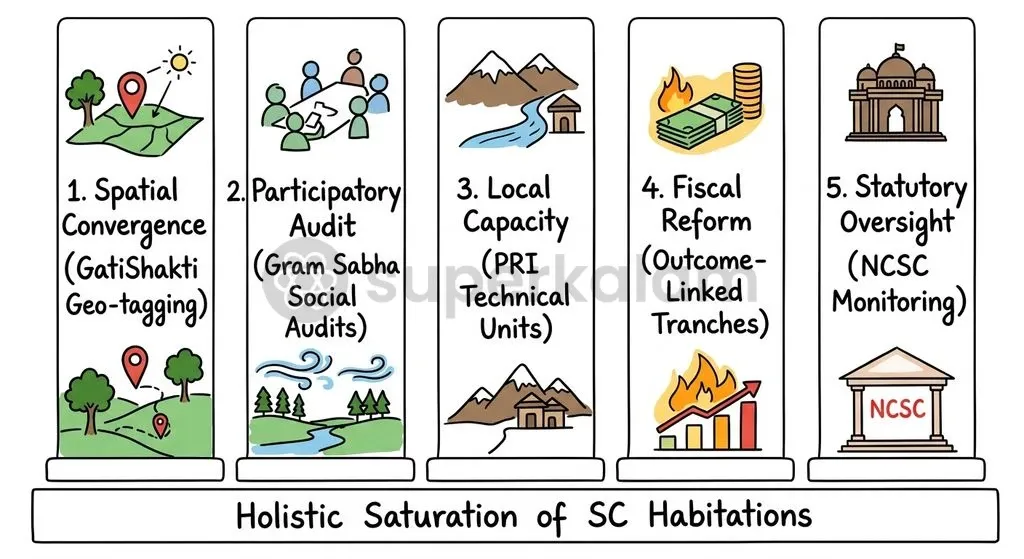
Inter-departmental coordination gaps at the district level continue to slow down the pace of village development works under PM-AJAY. The Parliamentary Standing Committee on Social Justice and Empowerment observed that horizontal convergence barriers persist between line departments responsible for piped water supply under the Jal Jeevan Mission, electricity under the Revamped Distribution Sector Scheme (RDSS), and housing under Pradhan Mantri Awaas Yojana-Gramin (PMAY-G) inside SC habitations.
Implementation challenges cluster around four systemic operational hurdles:
- Inter-Departmental Silos: Delayed ground convergence with Jal Jeevan Mission, RDSS, and PMAY-G schemes.
- Financial Compliance Delays: State-level fund hold-ups stemming from PFMS Single Nodal Agency drawdown and advance liquidation rules.
- Local PRI Capacity Deficits: Shortage of dedicated GIS tools and technical staff for drafting Village Development Plans.
- Irregular Social Audits: Infrequent institutional validation and Gram Sabha oversight prior to model village declarations.
Fund drawdowns encounter administrative friction under updated public finance management protocols. State welfare departments face compliance delays linked to Single Nodal Agency (SNA) mandates under the Public Financial Management System (PFMS), which require just-in-time central releases and the complete liquidation of prior advances before fresh funds can be drawn.
At the local tier, Panchayati Raj Institutions (PRIs) frequently operate without dedicated technical personnel or modern GIS tools. As reported by a NITI Aayog policy brief on decentralised planning, these technical deficits make it difficult for village panchayats to draft comprehensive Village Development Plans (VDPs) and execute baseline Need Assessment Surveys without external consultancy delays. Furthermore, while the Ministry has mandated social auditing prior to declaring an Adarsh Gram, institutionalised public auditing mechanisms remain unevenly adopted across participating States.
Discuss with Superkalam
Propose two administrative mechanisms to overcome delayed fund utilization and capacity deficits in district-level execution.
Ask NowKey Takeaways
- Merged Architecture: PM-AJAY was launched in FY 2021-22 by the Ministry of Social Justice and Empowerment by merging three legacy Centrally Sponsored Schemes: PMAGY, SCA to SCSP, and BJRCY.
- Constitutional Anchor: The scheme operationalises Directive Principle Article 46 to advance the educational and economic interests of Scheduled Castes, with oversight by the National Commission for Scheduled Castes under Article 338.
- Three Strategic Pillars: Interventions encompass (1) Adarsh Gram saturation in villages with population ≥ 500 and >40% SC population, (2) Grants-in-Aid for district livelihood projects with ring-fenced quotas for skills and women, and (3) student hostel construction.
- Empirical Progress: As of mid-2026, 47,328 villages have been selected with 17,067 declared as Adarsh Grams, alongside ₹1,730+ crore released for grants-in-aid and 90 hostels sanctioned.
- Critical Execution Challenges: Ground implementation faces inter-departmental convergence friction with line ministries, PFMS Single Nodal Agency compliance delays, PRI technical deficits, and irregular social audits.
Mains Question
"The transition from fragmented welfare pipelines to the unified architecture of PM-AJAY marks a paradigm shift from outlays to spatial saturation." Critically examine. (15 Marks)
Evaluate NowMains Question
Examine how the constitutional mandate under Article 46 is operationalised through targeted interventions in the PM-AJAY scheme. (10 Marks)
Evaluate NowPractice MCQs
QUESTION 1
With reference to the Pradhan Mantri Anusuchit Jaati Abhyuday Yojana (PM-AJAY), consider the following statements:
- It was formed by merging the erstwhile schemes of PMAGY, SCA to SCSP, and Babu Jagjivan Ram Chhatrawas Yojana.
- Under its Adarsh Gram component, eligible villages must have a total population of at least 500 with an SC population exceeding 40%.
- The scheme is implemented across all States and Union Territories in India without exception. Which of the statements given above is/are correct?
QUESTION 2
Regarding the Grants-in-Aid component of the PM-AJAY scheme, consider the following statements:
- At least 10% of the allocated funds are earmarked for skill development.
- Up to 15% of the funds are reserved exclusively for viable income-generating enterprises for SC women.
- Up to 30% of the allocation can be utilized for complementary infrastructure. Which of the statements given above are correct?
QUESTION 3
Consider the following statements regarding the constitutional and institutional framework for Scheduled Caste welfare in India:
- Article 46 of the Constitution obligates the State to promote the educational and economic interests of SCs and STs.
- Provisions under Article 46 are justiciable and enforceable through High Courts under Article 226.
- The National Commission for Scheduled Castes is established under Article 338 with powers to participate in planning socio-economic programmes. Which of the statements given above is/are correct?
QUESTION 4
Which of the following erstwhile schemes was NOT merged to create the Pradhan Mantri Anusuchit Jaati Abhyuday Yojana (PM-AJAY)?
QUESTION 5
Under the Adarsh Gram component of PM-AJAY, model village saturation is assessed against how many monitorable indicators across how many developmental sectors?





