US Orbital Weapons: Why Space Treaties Fall Short
New US orbital weapons plans expose gaps in the Outer Space Treaty, which bans weapons of mass destruction in orbit but not conventional arms.
Sep, 2026
•10 min read
Overview
The 1967 Outer Space Treaty fails to prevent modern orbital weaponisation. Its primary disarmament clause under Article IV exclusively bans weapons of mass destruction and nuclear arms. This leaves conventional kinetic interceptors, directed-energy weapons, and co-orbital systems entirely unregulated.
Negotiated during the Cold War, the treaty permits dual-use military support functions under the legal doctrine of non-aggressive peaceful use. Major space powers continue to develop ground-launched anti-satellite missiles and proximity-manoeuvring spacecraft. Without binding verification mechanisms or clear weapon definitions, outer space faces severe arms racing risks and catastrophic orbital debris generation.
Why in the News? The Growing Push for Orbital Counter-Space Capabilities
The United Nations General Assembly adopted Resolution 77/41 on 7 December 2022. It called on all member states to commit against conducting destructive direct-ascent anti-satellite missile tests. The resolution passed with 155 countries voting in favour, 9 voting against, and 9 abstaining, reflecting mounting alarm over the security of orbital infrastructure.
As of March 2025, major space powers continue expanding counter-space capabilities, exposing structural limitations in international space law. The growing deployment of dual-use satellites and ground-based interceptors shows that the existing multilateral framework cannot deter space-based aggression.
Discuss with Superkalam
Which specific categories of weapons are explicitly prohibited from Earth orbit under Article IV of the 1967 Outer Space Treaty?
Ask NowMilitarisation vs Weaponisation: Understanding the Crucial Difference
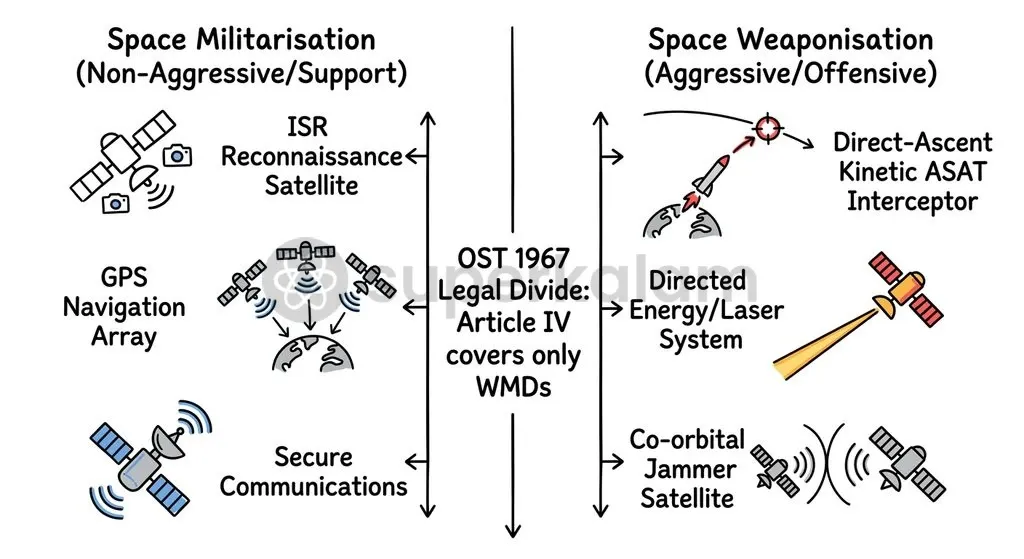
The United Nations Institute for Disarmament Research draws a sharp conceptual distinction between the militarisation of outer space and the weaponisation of outer space.
Space militarisation involves deploying satellites in orbit to support terrestrial armed forces through reconnaissance, navigation, communications, and missile early-warning systems. In contrast, space weaponisation entails placing offensive destructive systems directly into Earth orbit or deploying systems explicitly engineered to attack space-based targets.
| Dimension | Space Militarisation | Space Weaponisation |
|---|---|---|
| Core Definition | Using orbital platforms for terrestrial military logistics, intelligence, and communications | Stationing weapons in orbit or using destructive arms to disable space assets |
| System Types | Positioning constellations, optical surveillance satellites, secure military communications | Kinetic anti-satellite missiles, orbital laser systems, co-orbital interceptors |
| Legal Treatment under OST | Permitted under state practice as non-aggressive peaceful activity | Nuclear and WMD systems banned; conventional weapons unregulated |
| Impact on Orbit | Generates standard mission debris during operational lifespans | Risks massive debris generation and orbital degradation |
Space militarisation began alongside the early space race, providing essential reconnaissance for superpower militaries.
By contrast, space weaponisation converts outer space from an operational support medium into an active theatre of combat. Because civilian communications and military command networks share identical orbital bands, distinguishing defensive support assets from counter-space targeting systems remains technically challenging.
What Is the Outer Space Treaty (1967)? Key Provisions and Mandates
The Outer Space Treaty of 1967 is the foundational charter of international space law. Negotiated through the United Nations Committee on the Peaceful Uses of Outer Space during the Cold War, the pact sought to prevent the stationing of atomic weapons across extraterrestrial domains.
The treaty contains several foundational principles that govern state conduct across celestial bodies:
- Article I: Outer space is declared the "province of all mankind," ensuring exploration remains free for all states without discrimination.
- Article II: Outer space and celestial bodies are not subject to national appropriation by claim of sovereignty, occupation, or use.
- Article III: States must conduct exploration activities in accordance with international law and the Charter of the United Nations.
- Article IV, Paragraph 1: States Parties agree not to place in orbit around the Earth any objects carrying nuclear weapons or any other kinds of weapons of mass destruction, install such weapons on celestial bodies, or station them in outer space.
- Article IV, Paragraph 2: The Moon and other celestial bodies shall be used by all States Parties exclusively for peaceful purposes, expressly prohibiting military bases, weapons testing, and military manoeuvres on celestial surfaces.
Discuss with Superkalam
Explain how the interpretation of 'peaceful purposes' as 'non-aggressive' rather than 'non-military' creates a regulatory opening for military support satellites.
Ask NowThe Legal Gaps: Why the Outer Space Treaty Cannot Prevent Space Weapons
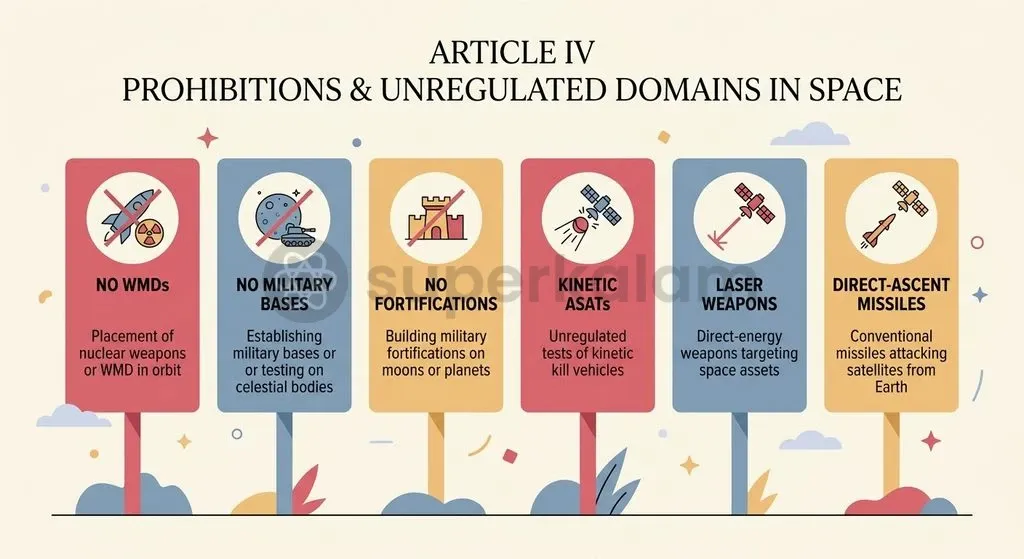
Article IV leaves critical counter-space technologies entirely unregulated. The treaty text outlaws only nuclear warheads and chemical or biological weapons of mass destruction from Earth orbit. Consequently, conventional kinetic-kill systems, high-energy lasers, particle beams, and electronic jamming devices stationed in orbit violate no explicit prohibition under the 1967 framework.
Key limitations in the regulatory scope of the Outer Space Treaty include:
- Article IV Bans: Prohibits only nuclear arms and weapons of mass destruction (WMDs) in orbit.
- Permitted Terrestrial Arms: Allows Earth-based and sea-based direct-ascent ASAT missile testing.
- Unregulated Technologies: Ignores co-orbital kinetic interceptors, electronic jamming, and directed-energy lasers.
- Flexible State Practice: Interprets "peaceful purposes" as non-aggressive rather than non-military.
The definition of "peaceful purposes" creates an additional legal opening under international law. Oxford Public International Law records that state practice across major powers interprets the term as meaning non-aggressive rather than non-military. This interpretation allows states to deploy dedicated military surveillance and command hardware in orbit while maintaining compliance with the treaty.
Earth-based counter-space systems bypass the treaty's reach altogether. The Arms Control Association notes that the Outer Space Treaty does not prohibit the testing or deployment of terrestrial or air-launched direct-ascent kinetic anti-satellite missiles. Because these interceptors travel along suborbital trajectories and do not enter permanent Earth orbit, their testing and use remain technically outside the core prohibition of Article IV.
Beyond the Outer Space Treaty: Other International Frameworks and Their Limitations
The Conference on Disarmament in Geneva has remained deadlocked on space arms control since 1985. The proposed treaty on the Prevention of an Arms Race in Outer Space aims to prohibit all space weapons. However, divergent national security doctrines have blocked negotiations for four decades. The Conference operates on a strict consensus rule, allowing individual states to veto draft negotiating mandates.
Alternative proposals have similarly failed to bridge diplomatic divisions across multilateral forums:
- Draft PPWT (2008/2014): Russia and China jointly submitted the Draft Treaty on the Prevention of the Placement of Weapons in Outer Space to the Conference on Disarmament. The draft prohibits placing weapons in orbit and using force against space objects, but critics argue it lacks effective verification mechanisms and excludes terrestrial direct-ascent anti-satellite missiles.
- UN Group of Governmental Experts (2013): The Group recommended voluntary transparency and confidence-building measures, including pre-launch notifications, information exchanges, and consultative mechanisms to reduce the risk of orbital miscalculations.
- Open-Ended Working Group (2021): Established under United Nations General Assembly Resolution 76/231, the working group pivoted space diplomacy toward defining responsible and irresponsible behaviours rather than pursuing elusive hardware bans.
Discuss with Superkalam
If a nation deploys a satellite equipped with robotic arms for orbital refuelling, how might an adversary interpret and respond to its dual-use potential during a geopolitical crisis?
Ask NowStrategic Impact: The Emerging Arms Race Between Major Space Powers
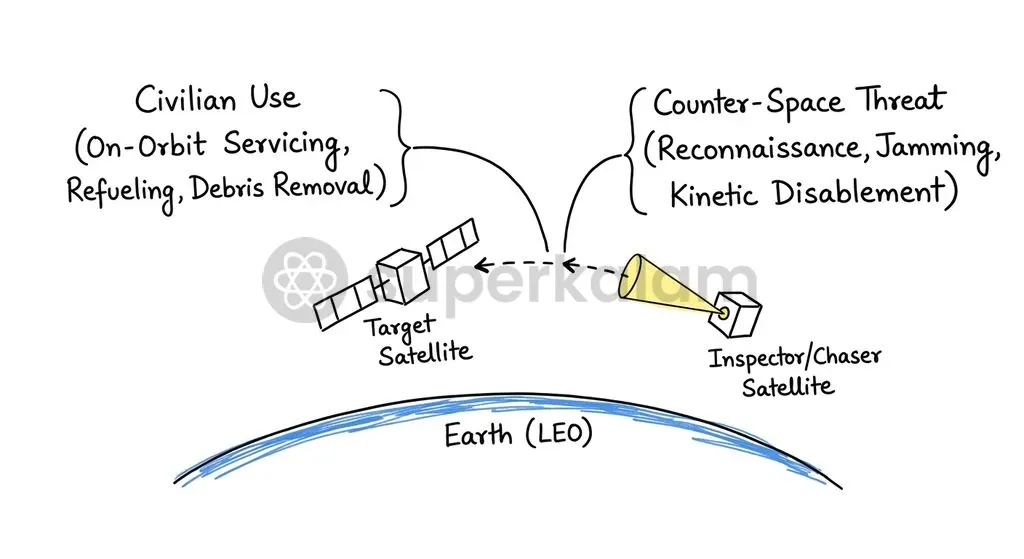
Major powers increasingly deploy rendezvous and proximity operations across Low Earth and Geostationary orbits. These spacecraft manoeuvre close to foreign satellites for inspection, refuelling, or maintenance tasks.
However, these platforms possess inherent dual-use capabilities. A robotic arm or thruster system designed for servicing can disable or capture an adversary satellite during hostilities.
Key counter-space vectors being prioritised by major militaries include:
- Dedicated Space Commands: Establishing independent services, such as the United States Space Force, to treat orbit as an active warfighting domain.
- Directed-Energy and Electronic Warfare: Investing in ground-based lasers to dazzle optical sensors, alongside radio-frequency jamming systems.
- Cyber Interdiction: Developing offensive capabilities to sever satellite telemetry links and corrupt ground station networks.
Orbital assets now underpin national economies, supporting financial transactions, maritime navigation, and disaster response. Consequently, orbital infrastructure has become a high-priority target in modern military planning.
Where India Stands: Space Security, Mission Shakti, and Defence Posture
The Ministry of External Affairs confirmed India's entry into the group of counter-space capable nations on 27 March 2019 through Mission Shakti. During the test, the Defence Research and Development Organisation used a modified Ballistic Missile Defence interceptor to destroy a live satellite, Microsat-R, in Low Earth Orbit at an altitude of approximately 283–300 km.
India's space security posture rests on several foundational pillars:
- Kinetic Deterrence: Demonstrated via Mission Shakti (2019) at an altitude of approximately 283–300 km.
- Tri-Services Integration: Operationalised through the Defence Space Agency (DSA).
- Multilateral Diplomacy: Continued support for legally binding PAROS negotiations.
- Legal Compliance: Strict adherence to Outer Space Treaty (1967) provisions.
The Ministry of External Affairs affirmed that the interception was conducted in Low Earth Orbit to ensure remaining debris decayed and burned up in the atmosphere within weeks. India maintained that Mission Shakti complied fully with the 1967 Outer Space Treaty and reaffirmed the country's longstanding diplomatic support for the Prevention of an Arms Race in Outer Space treaty.
The Government of India institutionalised its space security architecture by creating the Defence Space Agency under the Integrated Defence Staff. The tri-services agency unifies operational space assets, satellite surveillance, and electronic defence across the Indian Army, Navy, and Air Force. This structure balances credible deterrence against regional counter-space developments while preserving India's civil space programme under the Indian Space Research Organisation.
Discuss with Superkalam
Compare the effectiveness of hardware-focused weapon bans (like the draft PPWT) with behavioural regulation regimes (like the UN Open-Ended Working Group).
Ask NowEthical and Global Security Implications
Astrophysicist Donald Kessler formulated the Kessler Syndrome in 1978, describing a hazardous threshold in orbital mechanics. The model illustrates how high debris densities in Low Earth Orbit can trigger a self-sustaining cascade of fragmentations.
Beyond a critical density, each collision creates thousands of high-velocity shards that strike additional satellites, rendering vital orbital shells unusable for generations.
The ethical and strategic fallout spans several core dimensions:
- Destruction of the Global Commons: Outer space constitutes a shared domain essential for weather forecasting, climate tracking, agricultural planning, and telecommunications.
- Indiscriminate Debris Hazards: Kinetic weapon testing scatters hypervelocity debris across operational orbits without respecting national borders.
- Disproportionate Risk to Developing States: Emerging space nations lack dedicated space situational awareness networks, leaving their civil satellites vulnerable to untracked orbital debris.
Discuss with Superkalam
Given the consensus deadlock at the Conference on Disarmament, formulate a viable multilateral strategy to prevent kinetic anti-satellite testing.
Ask NowWay Forward: Building a Modern, Enforceable Space Governance Regime
The United Nations Committee on the Peaceful Uses of Outer Space must work alongside the Conference on Disarmament to update international space governance. Relying on an arms-control treaty written in 1967 cannot protect modern low-orbit constellations and commercial space corridors from weaponisation.
Constructive multilateral reforms require concrete legal and operational measures:
- Binding Definitions of Space Weapons: Member states must adopt clear definitions classifying directed-energy weapons, kinetic interceptors, and destructive co-orbital interference systems as prohibited space weapons.
- Multilateral Ban on Destructive ASAT Testing: Building on United Nations General Assembly Resolution 77/41, nations should codify a permanent, legally binding treaty prohibiting all debris-generating kinetic anti-satellite tests.
- Verification and Inspection Protocols: Space agreements must establish multilateral technical verification, including pre-launch inspections and orbital telemetry sharing, overcoming traditional impasses at the Conference on Disarmament.
- Behavioural Norms for Proximity Operations: International bodies should establish strict safety zones and mandatory notification rules for rendezvous and proximity operations to prevent misperceptions during satellite inspections.
- Universal Space Situational Awareness Sharing: Establishing an open, multilateral tracking network will democratise orbital tracking, allowing smaller states to detect counter-space manoeuvres and verify compliance independently.
Key Takeaways
- The 1967 Outer Space Treaty strictly prohibits nuclear arms and weapons of mass destruction in orbit under Article IV, but leaves conventional kinetic weapons, directed-energy arms, and ground-based anti-satellite missiles unregulated.
- State practice interprets the treaty requirement of "peaceful purposes" as non-aggressive rather than non-military, legally permitting orbital military communications and surveillance constellations.
- Negotiations on the Prevention of an Arms Race in Outer Space have remained deadlocked at the Conference on Disarmament in Geneva since 1985 due to fundamental verification and scope disagreements.
- Major space powers are deploying dual-use rendezvous and proximity operation satellites that can service peaceful spacecraft or execute counter-space interdiction.
- India demonstrated a kinetic counter-space capability through Mission Shakti in March 2019 at 283–300 km altitude, supported by the tri-services Defence Space Agency, while maintaining diplomatic support for peaceful space use.
- Kinetic weapon testing exacerbates the Kessler Syndrome, threatening the global orbital commons through cascading debris fragmentation.
Mains Question
"Article IV of the 1967 Outer Space Treaty has become inadequate to address modern counter-space threats and the reality of space weaponisation." Critically analyse. (15 Marks)
Evaluate NowMains Question
Distinguish between the militarisation and weaponisation of outer space. In light of the four-decade deadlock at the Conference on Disarmament regarding PAROS, evaluate the shift towards defining 'responsible behaviours' in space governance. (10 Marks)
Evaluate NowPractice MCQs
QUESTION 1
With reference to the Outer Space Treaty (1967), consider the following statements:
- Article IV of the Treaty explicitly prohibits the placement of conventional kinetic-kill systems in Earth orbit.
- The Treaty permits the testing of terrestrial direct-ascent anti-satellite missiles because they operate along suborbital trajectories.
- The Moon and other celestial bodies are reserved exclusively for peaceful purposes under Article IV, Paragraph 2. Which of the statements given above is/are correct?
QUESTION 2
Regarding the conceptual distinction between the 'militarisation' and 'weaponisation' of outer space, consider the following statements:
- Space militarisation involves utilizing orbital platforms for terrestrial logistics, navigation, and communications support.
- Space weaponisation refers to placing offensive destructive systems in orbit or attacking space assets.
- Both space militarisation and the deployment of conventional co-orbital weapons are expressly forbidden under the Outer Space Treaty. Which of the statements given above is/are correct?
QUESTION 3
Consider the following international frameworks and proposals regarding outer space governance:
- Draft PPWT (2008/2014): Proposed by Russia and China to ban orbital weapon placement but criticized for omitting terrestrial direct-ascent ASATs.
- UN Group of Governmental Experts (2013): Recommended voluntary transparency and confidence-building measures (TCBMs).
- UNGA Resolution 76/231 (2021): Established an Open-Ended Working Group focusing on responsible and irresponsible orbital behaviours. Which of the pairs given above are correctly matched?
QUESTION 4
The United Nations General Assembly Resolution 77/41, adopted in December 2022, primarily calls upon member states to:
QUESTION 5
With reference to rendezvous and proximity operations (RPOs) in outer space, consider the following statements:
- They involve spacecraft manoeuvring in close proximity to other satellites for inspection, refuelling, or repair.
- They possess inherent dual-use potential, as servicing mechanisms can be repurposed to disable target spacecraft.
- They are prohibited under Article II of the Outer Space Treaty as acts of national appropriation. Which of the statements given above is/are correct?