Rule 101 and Orphan Drugs in India: Can Fast-Track Waivers Solve Access?
Regulatory fast-tracking under Rule 101 removes clinical trial delays for rare diseases, yet persistent pricing barriers test India's constitutional mandates.
Sep, 2026
•10 min read

Overview
Rule 101 of the New Drugs and Clinical Trials Rules, 2019 permits the Central Drugs Standard Control Organisation to waive local clinical trials for designated orphan drugs. This provision accelerates market entry for rare disease therapies. However, it exposes structural gaps in drug affordability, domestic manufacturing, and population-specific safety data.
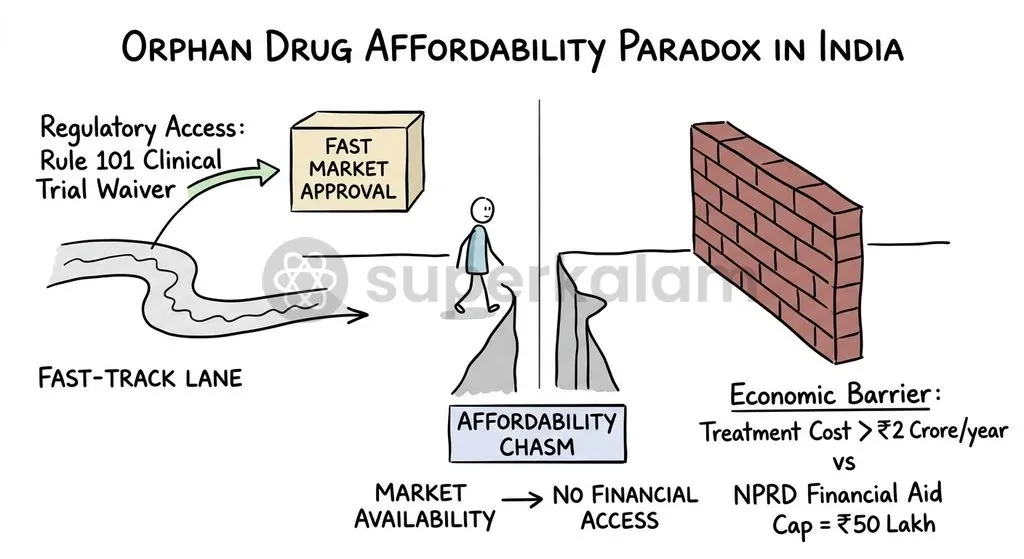
According to the Ministry of Health and Family Welfare, financial assistance under the National Policy for Rare Diseases, 2021 remains capped at ₹50 lakh per patient. This ceiling falls short of lifelong treatment costs that can exceed ₹2 crore annually. Bridging this divide requires pairing regulatory waivers with statutory price negotiations, compulsory licensing flexibilities, and systematic post-marketing pharmacovigilance.
Why in the News?
The Central Drugs Standard Control Organisation (CDSCO) issued an order under Rule 101 designating six international regulatory jurisdictions to accelerate approvals for rare disease therapies in India. As of August 2024, the Central Licencing Authority notified regulators from the United States, the United Kingdom, Japan, Australia, Canada, and the European Union for clinical trial waivers.
This fast-track pathway applies to five designated categories:
- Orphan drugs for rare diseases
- Gene and cellular therapies
- Pandemic drugs for public health emergencies
- Special defence drugs
- Significant therapeutic advances over current care standards
This regulatory shift balances rapid therapeutic access against statutory safety evaluation protocols.
What Are Rare Diseases and Orphan Drugs?
The New Drugs and Clinical Trials Rules, 2019 legally define an orphan drug under Rule 2(x) as a therapeutic agent intended to treat a condition affecting not more than 5 lakh individuals in India. Because patient populations are small, commercial pharmaceutical developers historically neglected these conditions, creating a persistent market failure.
According to the Ministry of Health and Family Welfare, the Central Technical Committee for Rare Diseases (CTCRD) has expanded the list of conditions recognised under the National Policy for Rare Diseases (NPRD) framework to 63 conditions.
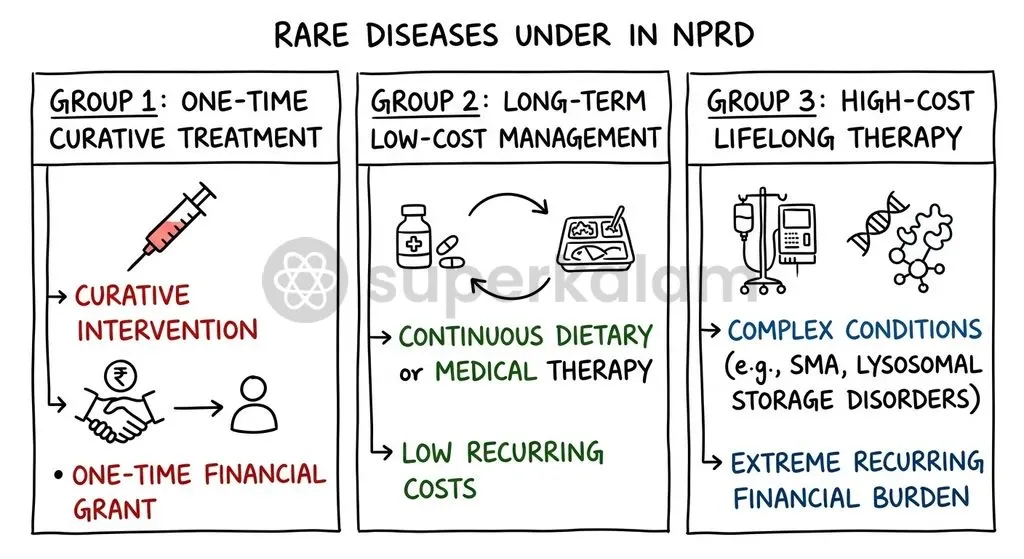
Rare diseases span three administrative groups under the policy:
- Group 1 Disorders: Conditions amenable to a one-time curative treatment, including disorders treated through hematopoietic stem cell transplantation.
- Group 2 Disorders: Diseases requiring lifelong or long-term management with relatively lower annual therapy costs.
- Group 3 Disorders: Chronic diseases requiring lifelong supportive therapies with high annual financial costs, such as Spinal Muscular Atrophy and Lysosomal Storage Disorders.
Discuss with Superkalam
Recall the population prevalence threshold defined under Rule 2(x) of the New Drugs and Clinical Trials Rules, 2019 to qualify a condition as a rare disease in India.
Ask NowHow Rule 101 Works: Fast-Track Mechanisms and Clinical Trial Waivers
Rule 101 of the New Drugs and Clinical Trials Rules, 2019 empowers the Drugs Controller General of India (DCGI) to waive local clinical trials for critical therapies already approved abroad. This provision allows the regulatory authority to rely on clinical trial data generated in mature regulatory ecosystems, bypassing redundant Phase I to Phase III clinical trials in India.
To secure a clinical trial waiver under Rule 101, an applicant must satisfy specific statutory criteria:
- Jurisdictional Approval: The drug must hold marketing approval from designated regulatory bodies in the USA, UK, Japan, Australia, Canada, or the European Union.
- Population Compatibility: The applicant must furnish verifiable scientific evidence demonstrating no known enzyme or genetic differences affecting pharmacokinetics, pharmacodynamics, safety, or efficacy in the Indian population.
- Phase IV Trial Commitment: The applicant must submit a formal written commitment to conduct Phase IV post-marketing trials to establish longitudinal safety within India.
The Core Tension: Accelerated Approval vs Local Safety and Efficacy Risks
Clinical trial waivers under Rule 101 trade pre-market empirical validation in local cohorts for rapid bedside availability. This regulatory shortcut introduces two interconnected clinical vulnerabilities:
- Pharmacokinetic and Pharmacodynamic Gaps: Pharmacokinetics tracks how the body absorbs, distributes, metabolises, and excretes a drug. Pharmacodynamics measures its biochemical and physiological impact. Genetic polymorphisms and metabolic variations in the Indian population can alter drug metabolism, rendering foreign safety benchmarks incomplete.
- Absence of Local Baseline Data: Waiving local pre-market trials eliminates the empirical baseline needed to detect population-specific adverse drug reactions before widespread deployment.
To manage these residual risks, the Indian Pharmacopoeia Commission (IPC) runs the Pharmacovigilance Programme of India (PvPI). This programme operates alongside mandatory Phase IV studies to capture post-marketing adverse events. Post-marketing surveillance serves as the primary regulatory safety net across diverse regional populations.
Discuss with Superkalam
Explain why relying solely on foreign clinical trial data under Rule 101 might leave safety gaps regarding genetic polymorphisms in the Indian population.
Ask NowThe Affordability Paradox: Why Market Clearance Fails to Deliver Access
Market clearance under Rule 101 does not ensure patient access because imported orphan drugs carry exorbitant prices. Fast-tracking speeds administrative clearance, but it leaves underlying patent monopolies intact.
Under the National Policy for Rare Diseases 2021, the Ministry of Health and Family Welfare provides financial assistance of up to ₹50 lakh per patient for treatment at notified Centres of Excellence (CoEs). While this grant covers Group 1 one-time curative procedures, parliamentary disclosures indicate it is insufficient for Group 3 chronic conditions, where lifelong enzyme replacement or gene therapies cost between ₹20 lakh to over ₹2 crore annually.
| Regulatory & Fiscal Pillar | Operational Mechanism | Access Bottleneck |
|---|---|---|
| Rule 101 Fast-Track | Waives local trial delays; grants market clearance | Accelerates entry without regulating launch prices |
| Patents Act, 1970 | Grants 20-year product patent monopolies | Prevents domestic generic and biosimilar competition |
| NPRD 2021 Fiscal Grant | Provides a capped ₹50 lakh one-time subsidy | Depleted within 1–2 years for lifelong conditions |
The Ministry of Finance took a targeted step by exempting imported orphan drugs and Special Medical Purpose Foods (FSMP) for personal use from Basic Customs Duty and Goods and Services Tax (GST) when routed through notified Centres of Excellence. Fiscal exemptions lower landed import costs, yet proprietary pricing maintains out-of-pocket barriers for most families.
Discuss with Superkalam
If a newly discovered rare disease requires an annual therapy cost of ₹80 lakh, how would the provisions of NPRD 2021 and customs duty exemptions apply to an indigent patient?
Ask NowEthical and Constitutional Dimensions: Article 21 and the Right to Health
The Delhi High Court held in Mohd. Ahmed v. Union of India (2014) that financial constraints cannot justify denying life-saving medical treatment under Article 21 of the Constitution. The Court affirmed that the Right to Health is an integral facet of the Right to Life, directing public authorities to construct sustainable funding mechanisms for indigent patients requiring orphan therapies.
In Master Arnesh Shaw & Ors. v. Union of India (2024), the Delhi High Court constituted a National Rare Diseases Committee (NRDC) to operationalise standard operating protocols for timely procurement and continuous orphan drug administration. These judicial directives reinforce the state's constitutional obligation to preserve life.
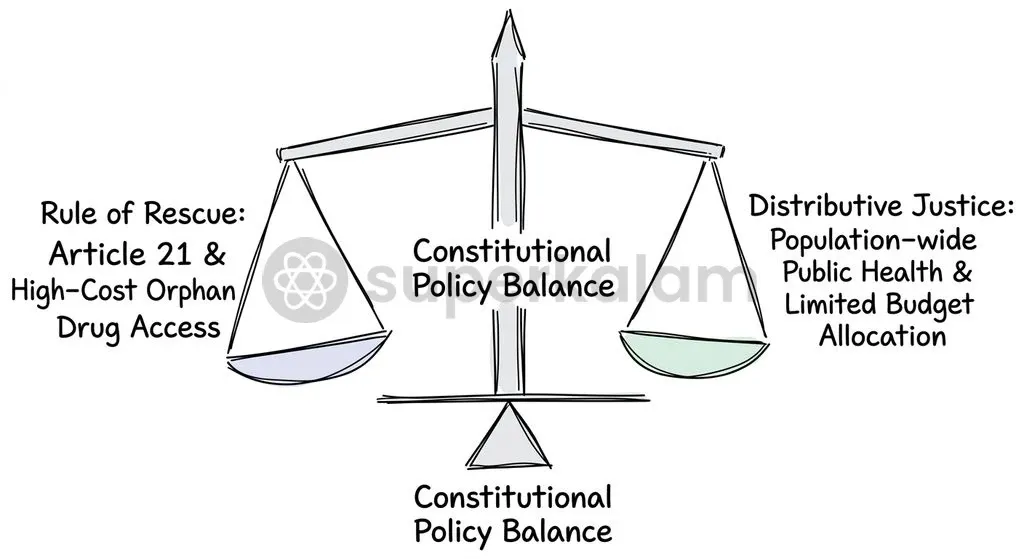
This constitutional mandate creates an acute bioethical dilemma between the Rule of Rescue—the moral imperative to rescue identifiable individuals facing imminent death—and utilitarian distributive justice. Policymakers must weigh subsidising ultra-expensive proprietary therapies for small cohorts against deploying limited public health budgets for broader community health interventions.
| Dimension | Rule of Rescue Perspective | Distributive Justice Perspective |
|---|---|---|
| Guiding Principle | Unconditional state duty to preserve human life | Maximisation of health outcomes per rupee spent |
| Constitutional Basis | Justiciable Right to Life under Article 21 | State directives for public health under Article 47 |
| Resource Allocation | High-cost subsidies allocated to individual rare cases | Prioritisation of primary healthcare and common diseases |
| Systemic Risk | Depletion of tertiary public health budgets | Exclusion of vulnerable patients with rare pathologies |
Comparing Approaches: India's Regulatory Fast-Track vs Global Frameworks
Global orphan drug frameworks combine market exclusivity extensions, tax subsidies, and Advance Market Commitments with streamlined regulatory pathways to de-risk private research. In contrast, the Indian ecosystem relies primarily on procedural waivers without substantial commercial manufacturing incentives.
The table below contrasts India's regulatory and economic mechanisms for orphan therapies against standard frameworks in the United States and the European Union:
| Parameter | India (NDCTR 2019 / NPRD 2021) | United States (Orphan Drug Act) | European Union (EU Regulation 141/2000) |
|---|---|---|---|
| Legal Definition | Prevalence $\le$ 5 lakh persons | Affecting $<$ 200,000 persons in the US | Prevalence $\le$ 5 per 10,000 community residents |
| Regulatory Waiver | Rule 101 local trial waiver based on 6 jurisdictions | Fast-track, accelerated approval, priority review vouchers | Accelerated assessment, priority access (PRIME scheme) |
| Market Exclusivity | Standard 20-year patent term under Patents Act, 1970 | 7-year orphan drug market exclusivity | 10-year market exclusivity (extended for pediatrics) |
| Fiscal Subsidies | One-time ₹50 lakh grant at CoEs; GST/Duty exemptions | R&D tax credits up to 25%, clinical research grants | Fee reductions for scientific advice, EU research grants |
| Indigenous Manufacturing | NCRDTRD consortium under ICMR | Commercial push-pull subsidies; venture capital de-risking | Joint procurement mechanisms across member states |
Way Forward: Integrating Waivers with Price Caps, Compulsory Licensing, and Local R&D
Sustainable rare disease management demands integrating Rule 101 trial waivers with statutory price flexibilities, public-private partnerships, and generic manufacturing. Fast-track regulatory entry must be coupled with structural market reforms to convert paper availability into actual bedside delivery.
| Policy Pillar | Primary Statutory & Institutional Mechanism | Strategic Target |
|---|---|---|
| 1. Statutory IP Flexibilities | Sections 84 & 92 of The Patents Act, 1970 | Compulsory and voluntary licensing for affordable domestic generic production |
| 2. Domestic R&D Incentives | NCRDTRD platform under ICMR & Advance Market Commitments | De-risking private capital and scaling local biosimilar manufacturing |
| 3. Post-Market Safety Net | Pharmacovigilance Programme of India (PvPI) & CoE registries | Real-time adverse event tracking and mandatory Phase IV safety data integration |
The government can deploy intellectual property flexibilities under The Patents Act, 1970 to encourage affordable generic alternatives:
- Compulsory Licensing via Section 84: Granting non-exclusive manufacturing licences when foreign patentees fail to make orphan therapies available at reasonable public prices.
- Government Notifications via Section 92: Invoking special provisions for compulsory licensing in circumstances of public health urgency to allow local production.
- Voluntary Licensing Agreements: Facilitating structured technology transfers between multinational innovators and Indian pharmaceutical manufacturers.
To mitigate market failure in domestic research, the Department of Health Research established the National Consortium for Research and Development on Therapeutics for Rare Diseases (NCRDTRD) under ICMR. The state can expand this initiative through Advance Market Commitments (AMCs) and Production-Linked Incentive (PLI) schemes. These guarantees ensure minimum procurement volumes to de-risk private capital investment in biosimilars. Finally, reinforcing the Pharmacovigilance Programme of India guarantees that rapid market entry does not compromise patient safety.
Discuss with Superkalam
Analyse the ethical conflict between the 'Rule of Rescue' under Article 21 and the principle of distributive justice under Article 47 in public health budgeting.
Ask NowKey Takeaways
- Rule 101 Mechanism: Under Rule 101 of the New Drugs and Clinical Trials Rules, 2019, the CDSCO designated six international jurisdictions (USA, UK, Japan, Australia, Canada, EU) to allow local clinical trial waivers for orphan drugs.
- Legal Thresholds: Rule 2(x) of the NDCTR 2019 legally defines an orphan drug as a treatment for a condition affecting not more than 5 lakh persons in India.
- Financial Limitations: The National Policy for Rare Diseases 2021 offers a one-time grant of up to ₹50 lakh per patient at Centres of Excellence, which does not cover Group 3 lifelong therapies costing ₹20 lakh to over ₹2 crore annually.
- Judicial Mandates: In Mohd. Ahmed v. Union of India (2014) and Master Arnesh Shaw v. Union of India (2024), the Delhi High Court anchored rare disease treatment within the Right to Health under Article 21, mandating institutional procurement frameworks.
- Statutory Flexibilities: Bridging the affordability gap requires combining Rule 101 approvals with compulsory licensing flexibilities under Sections 84 and 92 of The Patents Act, 1970 and indigenous R&D via ICMR's NCRDTRD.
Mains Question
While Rule 101 of the New Drugs and Clinical Trials Rules, 2019 accelerates market entry for orphan drugs, regulatory clearance alone fails to address the structural crisis of affordability. Critically analyse. (10 Marks)
Evaluate NowMains Question
'The bioethical dilemma between the Rule of Rescue under Article 21 and utilitarian distributive justice under Article 47 poses a major challenge in public health resource allocation.' In the context of the National Policy for Rare Diseases, 2021, evaluate this statement. (15 Marks)
Evaluate NowPractice MCQs
QUESTION 1
With reference to the regulatory and policy framework for rare diseases in India, consider the following statements:
- Under the New Drugs and Clinical Trials Rules, 2019, an orphan drug is defined as a therapeutic agent intended to treat a condition affecting not more than five lakh individuals in India.
- The National Policy for Rare Diseases categorises disorders into three groups, where Group 1 includes chronic conditions requiring lifelong high-cost supportive therapies.
- The Central Technical Committee for Rare Diseases has expanded the list of conditions recognised under the national policy framework to 63 conditions.
Which of the statements given above are correct?
QUESTION 2
Regarding the fast-track mechanism under Rule 101 of the New Drugs and Clinical Trials Rules, 2019, consider the following statements:
- The Drugs Controller General of India can waive local clinical trials for orphan drugs already approved in designated mature regulatory jurisdictions.
- The waiver exempts applicants from submitting post-marketing Phase IV trial commitments in India.
- Applicants must provide scientific evidence demonstrating no known enzyme or genetic differences affecting drug safety and efficacy in the Indian population.
Which of the statements given above is/are correct?
QUESTION 3
Consider the following statements regarding the fiscal and financial support mechanisms for rare disease treatments in India:
- Financial assistance under the National Policy for Rare Diseases, 2021 is capped at ₹50 lakh per patient for treatment at notified Centres of Excellence.
- Imported orphan drugs and Special Medical Purpose Foods (FSMP) for personal use routed through notified Centres of Excellence are exempt from Basic Customs Duty and GST.
- The financial grant under the National Policy for Rare Diseases is sufficient to cover lifelong annual enzyme replacement therapy for Group 3 disorders.
Which of the statements given above is/are correct?
QUESTION 4
In the context of the judicial interpretation of the Right to Health under Article 21 of the Indian Constitution, the Delhi High Court in Mohd. Ahmed v. Union of India (2014) held that:
QUESTION 5
Under Rule 101 of the New Drugs and Clinical Trials Rules, 2019, fast-track clinical trial waivers can be considered for which of the following categories?
- Gene and cellular therapies
- Pandemic drugs for public health emergencies
- Special defence drugs
- Significant therapeutic advances over current care standards
Select the correct answer using the code given below:





