Nobel Prize in Physics 2026: Francis Halzen and IceCube
Francis Halzen won the 2026 Nobel Prize in Physics for IceCube and cosmic neutrinos. Read how the detector works and why neutrino astronomy matters for UPSC.
Oct, 2026
•10 min read
Context
Neutrino astronomy marks a transformative shift in observational astrophysics. It bypasses optical and electromagnetic boundaries to capture nearly massless, uncharged subatomic particles that travel unimpeded from deep space.
Deep-underground and polar facilities like the IceCube Neutrino Observatory at the South Pole have unlocked multi-messenger astronomy. These instruments pinpoint cosmic accelerators such as flaring blazars billions of light-years away.
Global facilities in Antarctica, Japan, and the Mediterranean continue to advance particle physics. In contrast, India's flagship India-based Neutrino Observatory (INO) remains stalled by environmental litigation and local public misconceptions. This delay persists despite the country's historic 1965 pioneering discovery of atmospheric neutrinos at Kolar Gold Fields.
Why in the News?
Francis Halzen was awarded the 2026 Nobel Prize in Physics as a sole laureate by the Royal Swedish Academy of Sciences. The award recognised his decisive contributions to the IceCube Neutrino Observatory and the discovery of high-energy neutrinos of astrophysical origin, as reported on 6 October 2026.
This international recognition cements neutrino astronomy as a foundational pillar of modern mega-science and deep-space observation. The milestone also refocuses attention on India's domestic ambitions, where the proposed observatory in Theni, Tamil Nadu, faces institutional delays.
Discuss with Superkalam
Recall the location and detector material used by the Super-Kamiokande observatory to study neutrino oscillations.
Ask NowWhat Are Neutrinos and Why Are They So Difficult to Catch?
Neutrinos are fundamental leptons with half-integer spin, zero electric charge, and an exceptionally tiny mass below 0.1 eV/c². Because they lack charge and carry minimal mass, neutrinos interact with ordinary matter almost entirely through the weak subatomic force and gravity.
Trillions of cosmic and solar neutrinos pass through human bodies and the entire Earth every second without striking a single atomic nucleus. Interstellar dust clouds cannot absorb astrophysical neutrinos. Galactic magnetic fields cannot deflect them.
A neutrino emitted inside an extreme cosmic environment travels in a direct, straight path across billions of light-years. Capturing them requires enormous target masses of transparent media—such as natural ice, ultra-pure water, or deep ocean water—to observe rare collisions.
The phenomenon of neutrino oscillation demonstrates that neutrinos possess non-zero mass eigenstates. These states continuously mix as they propagate across vast distances through space and matter. Neutrinos exist in three distinct flavour states: electron ($\nu_e$), muon ($\nu_\mu$), and tau ($\nu_\tau$).
| Physical Property | Neutrino Characteristic | Observational Consequence |
|---|---|---|
| Electric Charge | Zero (neutral fundamental lepton) | Unaffected by intergalactic and galactic magnetic fields |
| Mass | Near-zero ($< 0.1\text{ eV}/c^2$) | Travels near the speed of light; exhibits flavour oscillation |
| Fundamental Interactions | Weak subatomic force and gravity only | Extremely small interaction cross-section with ordinary matter |
| Trajectory | Direct linear propagation from source | Points directly back to cosmic accelerators without scattering |
How IceCube Turned Antarctic Ice into a Cosmic Telescope
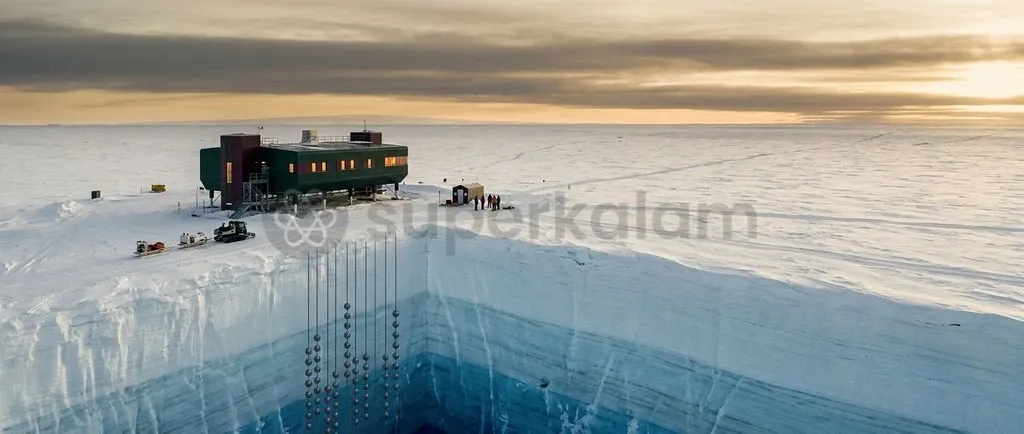
The IceCube Neutrino Observatory instruments one cubic kilometre of clear glacial ice between depths of 1,450 metres and 2,450 metres beneath the Amundsen-Scott South Pole Station in Antarctica. Conceived by physicist Francis Halzen, the facility transforms ancient, bubble-free polar ice into an enormous cosmic detection medium.
Construction was formally completed on 18 December 2010 upon the deployment of its final optical sensor. IceCube operates through an array of 5,160 Digital Optical Modules (DOMs) distributed across 86 vertical borehole strings arranged in a 125-metre hexagonal grid.
The observatory initiated its first fully instrumented physics run as a completed cubic-kilometre detector on 13 May 2011.
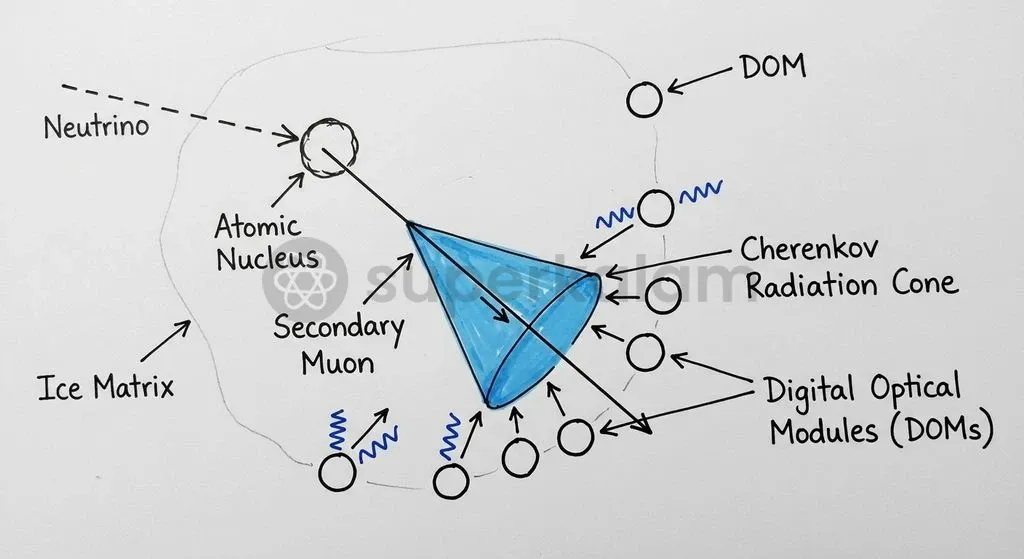
Detection within the glacial ice follows a five-stage sequence:
- Neutrino Arrival: A cosmic neutrino enters Antarctic glacial ice unhindered.
- Nuclear Interaction: The neutrino undergoes a rare collision with an ice nucleus.
- Secondary Lepton Generation: The collision produces an ultra-relativistic charged secondary lepton.
- Optical Emission: The particle emits a faint cone of blue Cherenkov radiation as it travels faster than the phase velocity of light in ice.
- Data Acquisition: Digital Optical Modules capture the timing and intensity of the optical signal to reconstruct energy, trajectory, and flavour.
The Digital Optical Modules record the optical pulse with sub-nanosecond precision. In 2013, the IceCube Collaboration presented the first conclusive detection of a diffuse flux of extraterrestrial neutrinos, recording landmark events with energies exceeding 1 PeV.
Discuss with Superkalam
Explain why astrophysical neutrinos travel across the universe without being deflected or absorbed, unlike photons or charged cosmic rays.
Ask NowThe Multi-Messenger Revolution: Unlocking Deep-Space Cosmic Accelerators
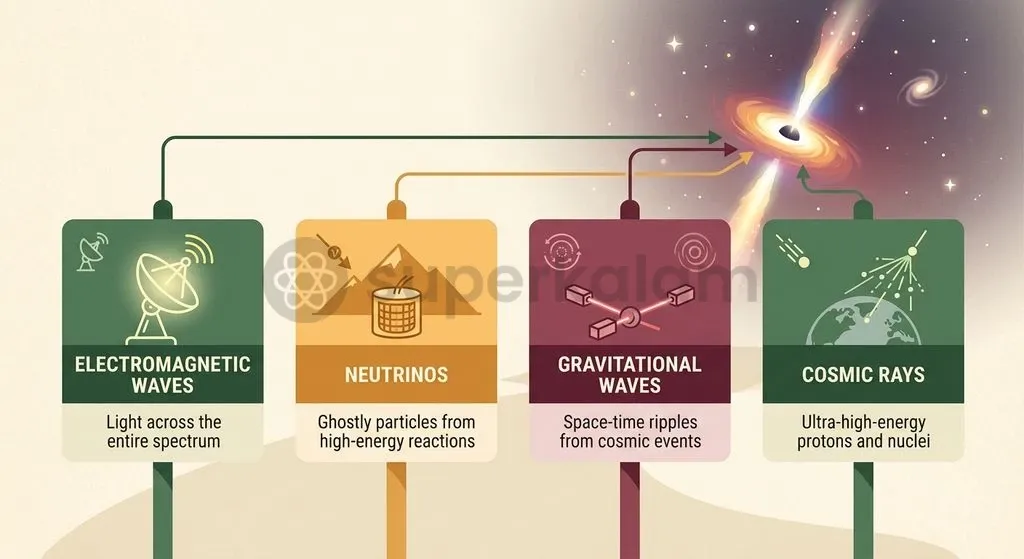
Multi-messenger astronomy combines four distinct observational cosmic messengers:
- Photons: Electromagnetic radiation across all wavelengths, which can be absorbed by dense gas clouds.
- Gravitational Waves: Spacetime ripples produced by colliding compact celestial bodies.
- Cosmic Rays: Charged relativistic ions that deflect across interstellar magnetic fields.
- Astrophysical Neutrinos: Neutral leptons that escape dense environments to provide an unscattered direct view of energetic phenomena.
On 22 September 2017, IceCube detected a high-energy neutrino of approximately 290 TeV (event IceCube-170922A). Within minutes, automated alerts triggered follow-up observations by space-based instruments like the Fermi Gamma-ray Space Telescope and ground-based observatories including MAGIC.
The joint observations traced the neutrino directly to TXS 0506+056, an active galactic nucleus known as a flaring blazar located 4 billion light-years from Earth. This simultaneous detection proved empirically that blazar relativistic jets are powerful cosmic accelerators, capable of generating both extreme gamma-ray flares and high-energy cosmic rays.
Global Neutrino Landscape: Comparing IceCube, KM3NeT, and Super-Kamiokande
International particle physics relies on diverse detector media and geographical sites to capture neutrinos across different energy thresholds.
| Observatory | Location & Depth | Detection Medium | Primary Scientific Objective |
|---|---|---|---|
| IceCube | South Pole, Antarctica (1,450–2,450 m deep) | $1\text{ km}^3$ Antarctic glacial clear ice | High-energy astrophysical neutrinos ($>\text{TeV}$ to $\text{PeV}$), multi-messenger astronomy |
| Super-Kamiokande | Mount Ikeno, Mozumi Mine, Japan (1,000 m underground) | 50,000 metric tons of ultra-pure liquid water | Solar, atmospheric neutrinos, proton decay, oscillation parameters |
| KM3NeT (ARCA & ORCA) | Mediterranean Sea (Deep sea off Sicily and Toulon) | Deep seawater instrumented optical arrays | High-energy cosmic neutrinos (ARCA) and atmospheric mass hierarchy (ORCA) |
| Baikal-GVD | Lake Baikal, Russia (750–1,300 m deep) | Freshwater deep lake instrumented strings | Multi-TeV to PeV astrophysical neutrino flux |
In Japan, Super-Kamiokande operates 1,000 metres underground in the Mozumi mine inside Mount Ikeno. The detector uses 50,000 metric tons of ultra-pure liquid water monitored by approximately 11,129 photomultiplier tubes.
In Europe, the KM3NeT project distributes optical units across deep Mediterranean waters. It runs KM3NeT-ARCA off Sicily for high-energy cosmic neutrinos and KM3NeT-ORCA off Toulon to determine atmospheric neutrino mass ordering. In Russia, the Baikal-GVD telescope instruments deep freshwater in Lake Baikal between depths of 750 metres and 1,300 metres to capture multi-TeV and PeV neutrino events.
Discuss with Superkalam
Analyse the primary factors that led to public resistance against the India-based Neutrino Observatory in Theni district.
Ask NowThe Stalled India-based Neutrino Observatory: Science, Protests, and Delays
India has a distinguished scientific heritage in particle physics. In 1965, a team led by B.V. Sreekantan and the Tata Institute of Fundamental Research (TIFR) achieved the world's first atmospheric neutrino detection inside a 2.3-kilometre-deep underground laboratory at the Kolar Gold Fields (KGF) in Karnataka.
Building on this legacy, the Union Cabinet formally approved the India-based Neutrino Observatory (INO) in January 2015 as a mega-science project with an initial financial allocation of ₹1,583 crore, funded jointly by the Department of Atomic Energy (DAE) and the Department of Science and Technology (DST).
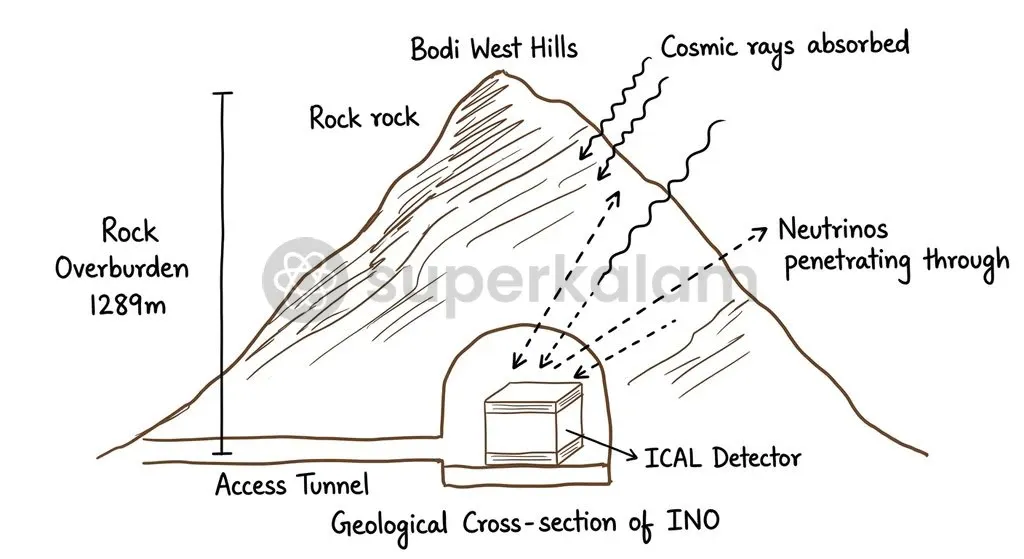
The INO design features a 50-kiloton magnetised Iron Calorimeter (ICAL) detector. It comprises 151 horizontal layers of 5.6-centimetre-thick magnetised soft iron plates interleaved with approximately 30,000 Resistive Plate Chambers (RPCs).
Sited under the Bodi West Hills at Pottipuram village in Theni district, Tamil Nadu, the cavern provides a vertical overburden of ~1,289 metres of uniform charnockite rock to shield against cosmic-ray muon backgrounds.
The primary physics objective of the ICAL detector is to resolve the neutrino mass hierarchy. It evaluates whether the $\nu_3$ mass eigenstate is heavier than $\nu_1$ and $\nu_2$ (normal ordering) or lighter (inverted ordering) by measuring Earth matter effects on atmospheric neutrinos.
Despite its scientific backing, the project experienced procedural and legal roadblocks:
- National Green Tribunal (NGT) Ruling (2018): The Principal Bench of the NGT ruled that execution of the project must remain contingent upon obtaining mandatory wildlife clearance from the National Board for Wildlife (NBWL).
- State Opposition in the Supreme Court: The Tamil Nadu State Board for Wildlife and the State Government formally opposed INO before the Supreme Court, contending that the proposed site falls within the Periyar–Agasthyamalai tiger corridor and sits within 5 km of the Mathikettan Shola National Park.
- Local Public Resistance: Ground-level public resistance in Theni district arose largely from local misconceptions conflating basic neutrino research with radioactive nuclear fission reactors and hazardous radioactive waste disposal.
Mega-Science Project Management: Key Policy Lessons for India
International mega-science guidelines stress that building deep-underground research facilities requires early institutional community engagement, bilingual science communication, and transparent environmental baseline monitoring to secure social licence. Siting sophisticated research infrastructure demands sustained public engagement alongside technological design.
Institutional alignment requires a balanced, multi-tier governance model:
- Union Level: Capital financing and project sanction through the Department of Atomic Energy (DAE) and Department of Science and Technology (DST).
- Federal Interface: Proactive coordination and statutory alignment with State Wildlife Boards and Forest Departments.
- Grassroots Integration: Structured public outreach and socio-economic integration with local district communities.
India's draft 5th National Science, Technology, and Innovation Policy (STIP) advocates for multi-stakeholder governance and proactive institutional alignment between Union funding bodies and State regulatory authorities for long-gestation infrastructure. When public engagement is deferred until after site selection, public concerns can intensify into prolonged judicial deadlocks.
Discuss with Superkalam
Evaluate the institutional alignment between Union funding agencies and State regulatory boards in the clearance process of the INO project.
Ask NowWay Forward: Building Public Trust and Indigenous Particle Physics Capacity
Constructive progress on national mega-science requires structured interventions that align scientific exploration with environmental governance and local community development:
- Demystifying Particle Physics via Regional Communication: Scientific bodies must deploy sustained, vernacular communication campaigns across local districts to clarify that neutrino detectors are entirely passive, emit no radiation, and produce no hazardous nuclear waste.
- Institutional Alignment via Cooperative Federalism: Establishing joint coordination committees involving the Department of Atomic Energy, the Department of Science and Technology, State Forest Departments, and State Wildlife Boards can resolve ecological clearance disputes before formal litigation arises.
- Ecological Conservation Protocols: Implementing comprehensive environmental monitoring protocols—such as non-invasive tunnel excavation methods and strict wildlife corridor protection—ensures mega-science projects uphold statutory conservation standards without halting fundamental research.
- Human Capital and Academic Integration: Expanding funding for experimental high-energy physics across central universities builds domestic technical capacity in detector instrumentation, Resistive Plate Chamber fabrication, and complex multi-messenger data analysis.
Key Takeaways
- Francis Halzen was awarded the 2026 Nobel Prize in Physics as a sole laureate by the Royal Swedish Academy of Sciences for his decisive contributions to the IceCube Neutrino Observatory and the discovery of high-energy neutrinos of astrophysical origin, as reported on 6 October 2026.
- Neutrinos are neutral leptons with near-zero mass ($< 0.1\text{ eV}/c^2$) that interact exclusively via the weak subatomic force and gravity, allowing them to traverse cosmic distances without deflection.
- IceCube organises one cubic kilometre of Antarctic clear ice instrumented with 5,160 Digital Optical Modules (DOMs) to detect faint Cherenkov radiation generated by neutrino interactions.
- In 2017, the multi-messenger identification of neutrino event IceCube-170922A traced its origin to the flaring blazar TXS 0506+056 located 4 billion light-years away.
- India's proposed 50-kiloton Iron Calorimeter (ICAL) at the India-based Neutrino Observatory in Theni, Tamil Nadu, designed to study atmospheric neutrino mass hierarchy, remains stalled by environmental clearances and public misgivings.
Mains Question
India's draft 5th National Science, Technology, and Innovation Policy (STIP) emphasizes multi-stakeholder governance and institutional alignment for long-gestation mega-science infrastructure. In the context of the procedural, environmental, and social roadblocks faced by the India-based Neutrino Observatory (INO), critically examine the challenges in establishing large-scale scientific research facilities in India. (15 Marks)
Evaluate NowMains Question
'Despite pioneering the detection of atmospheric neutrinos in 1965, India's flagship India-based Neutrino Observatory (INO) remains stalled due to ecological contestations and public misapprehensions.' Elucidate the essential policy, institutional, and communication strategies needed to build public trust and develop indigenous particle physics capacity. (10 Marks)
Evaluate NowPractice MCQs
QUESTION 1
With reference to the physical properties of neutrinos, consider the following statements:
- Neutrinos are fundamental leptons with half-integer spin, zero electric charge, and a mass below 0.1 eV/c².
- Interstellar dust clouds readily absorb astrophysical neutrinos, while galactic magnetic fields deflect their trajectories.
- Neutrinos exist in three distinct flavour states: electron, muon, and tau. Which of the statements given above is/are correct?
QUESTION 2
Consider the following global neutrino observatories and their operational characteristics:
- Super-Kamiokande operates 1,000 metres underground in Mount Ikeno using 50,000 metric tons of ultra-pure liquid water.
- KM3NeT deploys deep-sea arrays in the Mediterranean Sea, including KM3NeT-ARCA off Sicily and KM3NeT-ORCA off Toulon.
- Baikal-GVD instruments deep freshwater in Lake Baikal to capture multi-TeV and PeV neutrino fluxes. Which of the statements given above are correct?
QUESTION 3
Regarding the proposed India-based Neutrino Observatory (INO) at Pottipuram, consider the following statements:
- The observatory design features a 50-kiloton magnetised Iron Calorimeter (ICAL) detector interleaved with Resistive Plate Chambers.
- The project is funded jointly by the Department of Atomic Energy (DAE) and the Department of Science and Technology (DST).
- The primary physics objective of the ICAL detector is to resolve the neutrino mass hierarchy by measuring Earth matter effects. Which of the statements given above is/are correct?
QUESTION 4
With reference to India's historical particle physics research and the regulatory challenges of the INO, consider the following statements:
- The world's first atmospheric neutrino detection was achieved in 1965 at the Kolar Gold Fields in Karnataka.
- The National Green Tribunal (NGT) mandated that execution of the INO project is contingent upon obtaining clearance from the National Board for Wildlife (NBWL). Which of the statements given above is/are correct?
QUESTION 5
Which international scientist was awarded the 2026 Nobel Prize in Physics for decisive contributions to the IceCube Neutrino Observatory and the discovery of high-energy neutrinos of astrophysical origin?





