Nobel Prize in Economic Sciences 2026: Why Hall and Woodford Won
Robert E. Hall and Michael Woodford won the 2026 Nobel Prize in Economic Sciences for the microeconomic foundations of macroeconomic stabilisation. What they proved, and why it matters for UPSC.
Oct, 2026
•14 min read

Context
Stanford economist Robert E. Hall and Columbia economist Michael Woodford remain leading speculative contenders for the Sveriges Riksbank Prize in Economic Sciences in Memory of Alfred Nobel for demonstrating how forward-looking household micro-foundations dictate macroeconomic monetary policy transmission. Hall established in 1978 that rational consumers adjust spending exclusively to unexpected permanent income shocks, causing aggregate consumption to follow a random walk.
Michael Woodford synthesised this household behaviour in 2003 into the New Keynesian monetary architecture. He showed that independent central banks stabilise prices by guiding private-sector expectations rather than controlling physical money aggregates. This micro-to-macro synthesis reshaped modern central banking across the globe, providing the theoretical blueprint for rule-based regimes like the statutory Flexible Inflation Targeting framework adopted by the Reserve Bank of India.
Why in the News: Hall and Woodford Win the 2026 Nobel Prize in Economic Sciences
Stanford economist Robert E. Hall and Columbia economist Michael Woodford have won the Sveriges Riksbank Prize in Economic Sciences in Memory of Alfred Nobel 2026, announced on 12 October 2026. The Royal Swedish Academy of Sciences awarded them the prize "for microeconomic foundations of macroeconomic stabilisation", with the two laureates sharing the 12 million Swedish kronor prize amount equally.
Macroeconomic policy works only when monetary tools anchor forward-looking household expectations rather than manipulating administrative money supply aggregates. Historically, macroeconomic models treated the aggregate economy as a machine of mechanical relationships, assuming that injecting liquidity or altering income taxes produced predictable shifts in demand.
Their analytical breakthroughs redirected modern policy along two distinct dimensions:
- Household intertemporal choices: Robert Hall overturned older baselines by proving that aggregate demand reflects the intertemporal optimisation of households planning across their lifespans.
- Management of expectations: Michael Woodford integrated those micro-foundations into policy design, establishing that monetary policy is primarily the management of expectations rather than cash rationing.
- UPSC GS-3 relevance: The operational mechanics of the Reserve Bank of India, its statutory inflation target, and its reliance on the repo rate as the primary operating instrument trace their lineage to the theoretical architecture Hall and Woodford developed.
Discuss with Superkalam
Can you state the primary difference between how Classical Monetarism and Woodford's New Keynesian framework view the main operational target of a central bank?
Ask NowRobert Hall and Household Spending: The Random Walk of Consumption
Robert E. Hall revolutionised consumption analysis in 1978 by proving that household spending follows a statistical random walk under rational expectations. In his seminal paper published in the Journal of Political Economy, Hall merged Milton Friedman's permanent income hypothesis with the rational expectations hypothesis formulated by Robert Lucas. Hall demonstrated that optimising individuals do not base current consumption on current disposable income, but on the expected discounted present value of their lifetime earnings.
Consumption following a random walk means that past income patterns, historical wages, and predictable bonuses cannot forecast future changes in household spending. Forward-looking households evaluate all available information about their financial future continuously. Spending alters only when they encounter genuinely new, unforeseen economic developments.
Testing postwar United States time-series data, Hall verified empirically that only unpredictable permanent income shocks cause shifts in consumption patterns. Predictable changes in disposable income produce no significant consumption adjustment when they actually occur. This holds true for an anticipated salary increment, a scheduled annual tax rebate, or a pre-announced government transfer because households incorporate those expected shifts well in advance.
The policy implications of Hall's findings disrupted traditional fiscal stimulus orthodoxy:
- Transitory tax cuts: Predictable, temporary tax reductions fail to trigger major surges in aggregate demand because rational households spread temporary income windfalls across their remaining lifespan.
- Structural tax changes: Permanent structural policy shocks, such as an enduring tax rate revision or lasting productivity shifts, alter consumption immediately because they revise long-term permanent income.
- Forward-looking demand: Household spending reacts to news about the future rather than historical income streams, making aggregate demand inherently forward-looking.
Michael Woodford and Modern Central Banking: Guiding Expectations Over Money Supply
Michael Woodford restructured monetary economics in 2003 by publishing Interest and Prices: Foundations of a Theory of Monetary Policy, establishing the foundations of the New Keynesian synthesis. Woodford demonstrated that modern central banks can achieve macroeconomic stabilisation in a cashless credit economy without tracking or targeting monetary aggregates like M1 or M3. Woodford dismantled the classical assumption that central banking requires direct administrative control over the physical volume of bank reserves.
Woodford demonstrated that central banking operates fundamentally as the management of expectations. Aggregate spending and output do not react primarily to the current overnight policy rate. Instead, they react to market forecasts regarding the future trajectory of nominal interest rates and inflation.
Central banks stabilise macroeconomic fluctuations by transparently committing to an interest-rate rule governed by the Taylor principle. This principle mandates that the policy interest rate must rise by more than one-for-one in response to an increase in inflation.
To model aggregate supply, Woodford integrated Calvo-style staggered price contracts into dynamic stochastic general equilibrium models to construct the New Keynesian Phillips Curve. In this pricing equation, current inflation is driven by real marginal costs and forward-looking inflation expectations:
- Staggered pricing: Monopolistically competitive firms adjust prices at staggered, discrete intervals rather than continuously.
- Forward-looking price setters: Price-setting corporate managers look forward, setting prices today based on their forecasts of future sector-wide demand and future headline inflation.
- Policy credibility: Disinflation relies heavily on institutional reputation, because credible central bank guidance directly anchors inflation expectations without requiring prolonged economic contractions.
Discuss with Superkalam
Why does Robert Hall argue that an anticipated annual salary bonus will not lead to an increase in consumption at the time it is credited?
Ask NowBridging the Gap: How Micro-Foundations Built Modern Macroeconomics
Modern macroeconomic policymaking synthesises Robert Hall's microeconomic consumption dynamics with Michael Woodford's general equilibrium monetary transmission mechanisms. Early macroeconomic frameworks lacked micro-foundations, relying on static behavioural equations that broke down whenever economic policies changed. Robert Lucas identified this structural vulnerability in his critique, warning that econometric forecasting models cannot evaluate policy shifts if their parameters depend on the historical policy regime.
Woodford resolved the Lucas critique by anchoring his macroeconomic framework directly to Robert Hall's forward-looking consumption Euler equation. The policy transmission mechanism in Woodford's dynamic stochastic general equilibrium model relies on an expectational IS curve, which expresses aggregate output demand as a function of expected future output and the ex-ante real interest rate:
- Euler optimisation: Forward-looking households, adhering to Hall's optimising principles, evaluate their consumption across multiple time periods.
- Short-term rate transmission: The central bank adjusts its nominal policy interest rate, shifting the short-term real interest rate faced by commercial lenders.
- Intertemporal arbitrage: Households compare the return on saving against the marginal utility of present consumption, adjusting their spending based on expected future policy stances.
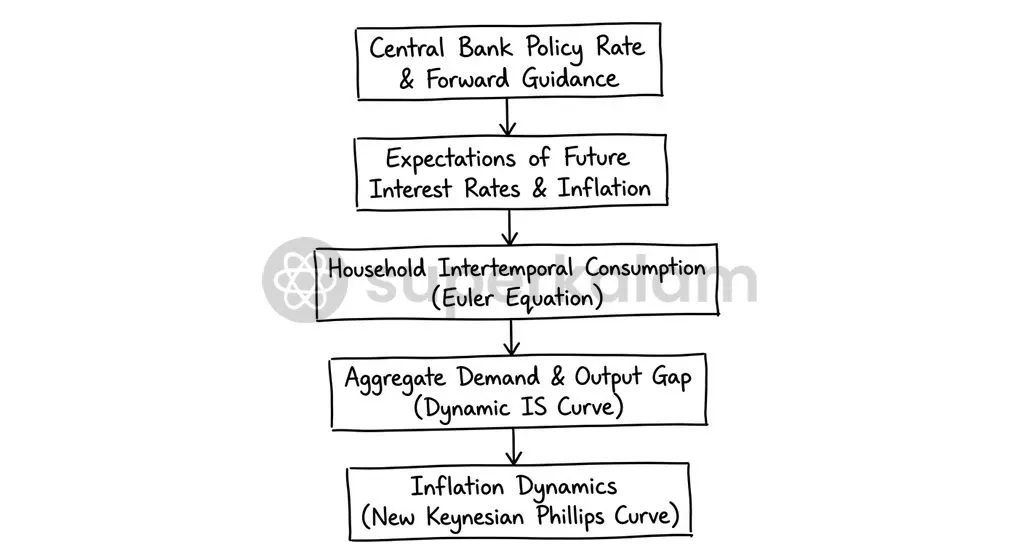
The expectations-led transmission mechanism operates in a clear four-stage sequence:
- Policy signalling: The central bank announces a credible forward path for nominal policy interest rates.
- Real rate adjustments: Financial markets adjust forward real interest rates across multiple maturities.
- Euler equation rebalancing: Rational households update their intertemporal consumption plans based on updated real yields.
- Aggregate demand response: Multi-year household spending shifts, moving aggregate output toward potential.
Monetary policy actions transmit through expectations rather than immediate cash rationing. When a central bank communicates a credible forward interest-rate path, forward-looking households and price-setting firms adjust their multi-year plans immediately. Hall provided the microeconomic theory of the optimising household, while Woodford supplied the general equilibrium architecture showing how central banks leverage those microeconomic behaviours to secure macroeconomic price stability.
Comparing Approaches: Classical Monetarism vs Woodford's New Keynesian Framework
The transition from Classical Monetarism to Woodford's New Keynesian synthesis marked a fundamental paradigm shift in the operating philosophy of global central banks. Classical Monetarism, pioneered by Milton Friedman, asserted that inflation is always an administrative money-growth phenomenon requiring strict quantitative limits on monetary aggregates. Woodford's framework abandoned money aggregates entirely, replacing quantitative targets with transparent interest-rate rules and strategic communications.
The operational and conceptual distinctions between the two macroeconomic frameworks reveal why central banks abandoned money targeting:
| Dimension | Classical Monetarism (Friedman) | New Keynesian Synthesis (Woodford) |
|---|---|---|
| Primary Policy Target | Quantitative growth rate of monetary aggregates (such as M1 or M3) | Forward inflation target anchored by policy interest rate paths |
| Operating Instrument | Commercial bank reserve requirements and primary money supply base | Short-term nominal policy rate (such as the overnight repo rate) |
| Price Adjustment Assumption | Prices adjust smoothly across long horizons; money is neutral in long run | Staggered, sticky prices via Calvo-style contracts creating real output gaps |
| Transmission Channel | Direct bank liquidity balances and real-balance portfolio effects | Expectations channel working through the household intertemporal Euler equation |
| Role of Money Supply | Central causal driver of aggregate demand and nominal price levels | Endogenous accounting residual with no independent operational role |
| Role of Central Bank Communication | Minimal; policy follows mechanical quantitative expansion targets | Essential; forward guidance and transparency anchor market forecasts |
Discuss with Superkalam
If a government announces a one-time, temporary tax rebate to combat a slowdown, how would a household operating under Hall's permanent income framework respond?
Ask NowFrom Theory to RBI Policy: The Urjit Patel Committee and Inflation Targeting
India's modern monetary architecture represents a direct institutional adoption of the New Keynesian policy framework articulated by Michael Woodford. Prior to 2014, the Reserve Bank of India operated under a discretionary multi-indicator approach, attempting to balance output growth, exchange rate stability, and credit flows simultaneously. This operational design generated persistent inflation volatility and undermined domestic policy credibility.
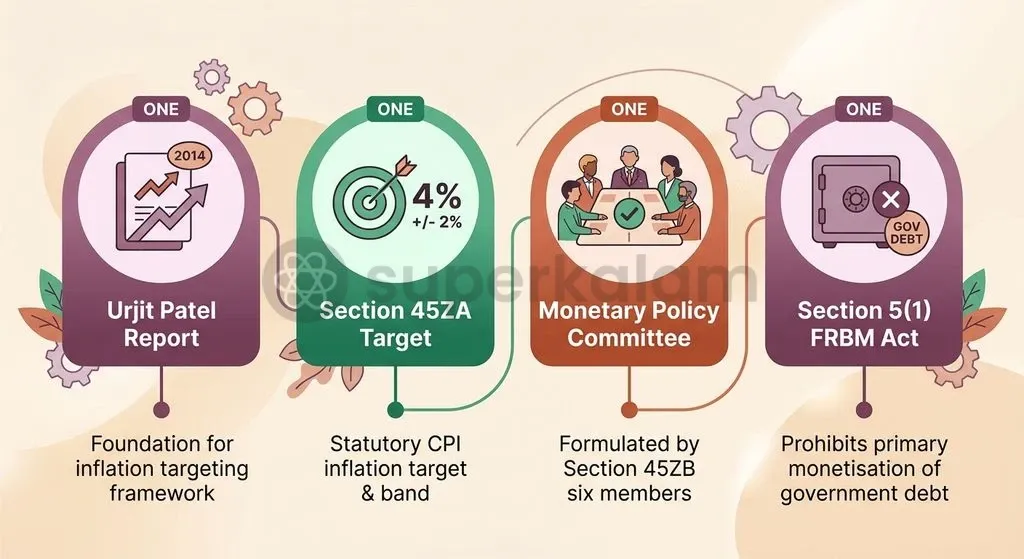
The RBI's Expert Committee to Revise and Strengthen the Monetary Policy Framework, chaired by Dr. Urjit R. Patel, recommended abandoning the multi-indicator approach in favour of a rule-based Flexible Inflation Targeting framework in January 2014. The Urjit Patel Committee grounded its recommendations in New Keynesian principles, concluding that price stability is the necessary precondition for sustainable economic expansion.
Parliament enacted this reform by passing the Finance Act, 2016, which amended the Reserve Bank of India Act, 1934 to insert Chapter IIIF. This legislative amendment introduced vital statutory anchors:
- Section 45ZA of the RBI Act, 1934: Mandates that the Central Government shall, in consultation with the Reserve Bank of India, determine the inflation target in terms of the Consumer Price Index once every five years.
- Section 45ZB of the RBI Act, 1934: Establishes a statutory six-member Monetary Policy Committee responsible for determining the policy repo rate necessary to achieve the inflation target.
The statutory decision-making process functions through an institutional sequence:
- Target determination (Section 45ZA): The Central Government, in consultation with the RBI, sets the target at CPI 4 per cent with a tolerance band of ±2 per cent.
- Monetary Policy Committee review (Section 45ZB): The six-member MPC evaluates output gaps and forward inflation projections.
- Repo rate calibration: The MPC votes on the policy repo rate to anchor market expectations to the statutory target.
Woodford's New Keynesian framework fundamentally contrasts with Modern Monetary Theory, which advocates that central banks should passively accommodate government fiscal expenditures through unlimited currency creation. Woodford's model requires strict central bank independence, systematic interest-rate rules, and hard fiscal-monetary separation to prevent runaway price levels.
India's legal framework explicitly repudiates debt monetisation through Section 5(1) of the Fiscal Responsibility and Budget Management Act, 2003, which prohibits the RBI from subscribing to primary issuances of Central Government securities. Monetary policy in India focuses on managing interest rate expectations to guide private sector choices rather than underwriting sovereign deficits.
Where the Models Fall Short: Supply Shocks, Inequality, and Fiscal Dominance
The New Keynesian DSGE models constructed around Hall's consumption theory and Woodford's monetary rules face acute structural limitations in emerging market economies like India. These theoretical frameworks assume frictionless financial markets, uniform optimising agents, and price dynamics dominated by domestic aggregate demand. When real-world conditions diverge from these foundational assumptions, standard interest rate interventions struggle to secure domestic macroeconomic stability.
First, India's consumption basket exposes headline inflation heavily to volatile supply-side disturbances. In India's Consumer Price Index (Combined, 2012 base), the Food and Beverages category holds a weight of 45.86 per cent, while Fuel and Light carries a weight of 6.84 per cent. New Keynesian interest-rate tightening cannot replenish monsoon-damaged agricultural harvests or repair disrupted international crude pipelines. Raising the policy repo rate curbs aggregate demand, but it cannot repair supply-side structural bottlenecks.
Second, Robert Hall's random walk hypothesis breaks down among households facing acute liquidity and credit constraints. In developing economies, millions of informal workers operate as hand-to-mouth households, possessing a marginal propensity to consume near unity. These households cannot smooth consumption across time because they lack access to formal credit markets:
- Immediate expenditure: Liquidity-constrained families spend current disposable income immediately on basic necessities rather than optimising across their lifespans.
- Direct income sensitivity: Heterogeneous Agent New Keynesian models show that monetary policy affects constrained individuals primarily through direct employment and income changes rather than through intertemporal interest-rate arbitrage.
- Inequality dampening: Severe consumption inequality dampens the traditional expectations channel while magnifying the real distributional impacts of monetary contraction.
Third, Michael Woodford's baseline 2003 framework abstracted from credit market frictions, commercial banking distress, and balance sheet fragility. During systemic financial disruptions, commercial banks restrict private credit to protect their capital adequacy ratios, blocking the transmission of RBI repo rate cuts to retail lending rates.
Discuss with Superkalam
How does the integration of Calvo-style staggered pricing in the New Keynesian Phillips Curve link a central bank's institutional credibility directly to the cost of disinflation?
Ask NowWay Forward: Updating Macroeconomic Playbooks for an Uncertain Global Economy
Central banks operating in emerging economies must modernise their analytical frameworks to balance forward-looking interest rate guidance with targeted structural interventions. Relying exclusively on interest rate adjustments to curb supply-driven domestic price shocks risks slowing industrial growth without resolving underlying cost pressures. The Reserve Bank of India and global monetary authorities must combine New Keynesian expectations management with macroprudential policy tools and supply-side fiscal coordination.
To fortify monetary governance, economic policymakers should pursue four structural reforms:
- Calibrating Policy to Core Inflation Trends: Monetary authorities should anchor expectations to core inflation measures that exclude volatile food and fuel components, preventing aggressive interest-rate overreactions to temporary agricultural supply disruptions.
- Integrating Macroprudential Regulations: Central banks must actively use countercyclical capital buffers, loan-to-value caps, and targeted risk-weight adjustments to contain asset-price bubbles without relying solely on blunt policy rate hikes.
- Strengthening Credit Flow to Constrained Sectors: Expanding formal microfinance architectures and financial inclusion platforms like the Unified Payments Interface enables low-income households to smooth consumption, strengthening the transmission of policy rates.
- Coordinating Fiscal and Monetary Action: The Central Government must deploy proactive supply-side measures, including strategic grain buffer stock releases, trade tariff adjustments, and cold-storage infrastructure investments, to combat food price surges while the Monetary Policy Committee safeguards general financial stability.
By integrating heterogeneous household realities and supply-side constraints into Woodford's interest-rate framework, macroeconomic policy can protect vulnerable populations while anchoring long-term price stability.
Discuss with Superkalam
To what extent can central banks rely purely on expectations management and interest-rate rules when an economy is hit by severe supply shocks or fiscal dominance?
Ask NowKey Takeaways
- Stanford's Robert E. Hall and Columbia's Michael Woodford won the Sveriges Riksbank Prize in Economic Sciences in Memory of Alfred Nobel 2026, announced on 12 October 2026, for building the microeconomic foundations of modern macroeconomic stabilisation policy.
- Hall established in 1978 that household consumption follows a random walk under rational expectations, proving that spending shifts occur only in response to unexpected permanent income shocks rather than predictable disposable income changes.
- Woodford demonstrated in his 2003 treatise Interest and Prices that central banks achieve price stability by steering public expectations through interest-rate rules rather than controlling quantitative money supply aggregates.
- The Reserve Bank of India institutionalised Woodford's New Keynesian framework following the 2014 Urjit Patel Committee report, establishing a statutory Flexible Inflation Targeting framework under Section 45ZA and a six-member Monetary Policy Committee under Section 45ZB of the RBI Act, 1934.
- India rejects debt monetisation under Section 5(1) of the FRBM Act, 2003, distinguishing its institutional framework from Modern Monetary Theory prescriptions.
- New Keynesian policy models face severe operational constraints in India because the Consumer Price Index assigns 45.86 per cent weight to Food and Beverages, exposing headline inflation to supply shocks that aggregate demand-side interest rate policies cannot directly correct.
Mains Question
"Monetary policy is primarily the management of expectations rather than cash rationing." In the light of Michael Woodford's New Keynesian framework, elucidate how modern central banking anchors price stability. (10 Marks)
Evaluate NowMains Question
Robert Hall's finding that consumption follows a 'random walk' fundamentally challenged traditional fiscal and monetary transmission assumptions. Critically examine the implications of household intertemporal optimization for macroeconomic policy design. (15 Marks)
Evaluate NowPractice MCQs
QUESTION 1
With reference to Robert Hall's hypothesis on household consumption behavior, consider the following statements:
- It demonstrates that aggregate household spending is primarily determined by current disposable income.
- Aggregate consumption follows a statistical random walk because forward-looking households only adjust spending to unpredictable permanent income shocks.
- Pre-announced, temporary tax cuts fail to trigger major surges in aggregate demand as households spread the windfall over their remaining lifespan. Which of the statements given above are correct?
QUESTION 2
Consider the following statements regarding Michael Woodford's New Keynesian framework of monetary policy:
- It asserts that modern central banks must primarily target and control physical monetary aggregates like M1 and M3 to stabilize prices.
- It incorporates the Taylor principle, which mandates that the nominal policy interest rate must rise by more than one-for-one in response to an increase in inflation.
- It models aggregate supply through the New Keynesian Phillips Curve, where current inflation depends on real marginal costs and forward-looking inflation expectations. Which of the statements given above are correct?
QUESTION 3
Regarding the transmission mechanism of monetary policy in Woodford's dynamic stochastic general equilibrium model, consider the following statements:
- Policy adjustments transmit directly via administrative rationing of commercial bank cash reserves.
- The expectational IS curve links aggregate demand to expected future output and the ex-ante real interest rate.
- The mechanism relies on forward-looking households optimizing intertemporal consumption across time periods via an Euler equation. Which of the statements given above is/are correct?
QUESTION 4
In macroeconomic theory, the 'Lucas critique' primarily warned against which of the following practices?
QUESTION 5
Which of the following describes the sequence of the expectations-led monetary transmission mechanism synthesized in modern central banking models?
- Multi-year household spending shifts, moving aggregate output toward potential.
- Central bank announces a credible forward path for nominal policy rates.
- Rational households rebalance intertemporal consumption based on updated real yields.
- Financial markets adjust forward real interest rates across multiple maturities. Select the correct sequence from the options below: