Nirbhaya Fund: Implementation Gaps and Public Safety Reforms
High surveillance spending masks acute bottlenecks, showing why tech cannot substitute for systemic police accountability and judicial reforms in women safety.
Sep, 2026
•9 min read

Overview
India created the Nirbhaya Fund as a dedicated non-lapsable corpus to strengthen female safety nationwide. Over ₹6,581.84 crore has been released to fund urban surveillance, forensic labs, and fast-track courts. Yet this financial expansion has struggled to deliver substantive public safety on the ground.
The Ministry of Finance administers the fund alongside the Ministry of Women and Child Development (MWCD). Together, they finance multi-sectoral projects spanning emergency response systems and fast-track courts. However, high expenditure figures mask acute implementation gaps.
Inter-agency friction, long judicial pendency, and an over-reliance on closed-circuit cameras continue to stall progress. Bridging this gap requires shifting focus from technocratic surveillance toward systemic police accountability, victim support, and gender-inclusive urban planning.
Why Is the Nirbhaya Fund Back in the News?
The Parliamentary Standing Committee on Education, Women, Children, Youth and Sports tabled its 377th Report, evaluating the operational progress and financial performance of the Nirbhaya Fund across Indian States. As of March 2026, the report highlighted that while budgetary allocations have expanded, substantial disparities persist in how effectively implementing agencies convert released capital into measurable safety outcomes.
The report highlights two central administrative hurdles stalling ground execution:
- Delayed Utilisation Certificates: State-level delays in submitting Utilisation Certificates continue to hold back the timely release of subsequent funding tranches.
- Procedural Bottlenecks: Slow onboarding onto the Ministry of Finance's Single Nodal Agency (SNA-SPARSH) compliance module has added administrative friction.
This scrutiny arrives at a critical juncture for urban governance. Policymakers face mounting questions over whether high-cost technological interventions provide genuine deterrence against gender-based violence. Tools like automated facial recognition and closed-circuit television networks have not resolved systemic shortfalls.
Discuss with Superkalam
Can you recall the total amount released to implementing agencies under the Nirbhaya Fund since its inception?
Ask NowWhat Is the Nirbhaya Fund and How Does It Work?
The Nirbhaya Fund operates as a non-lapsable national corpus administered by the Department of Economic Affairs under the Ministry of Finance to support multi-sectoral women's safety projects. Established in 2013 following the recommendations of the Justice J.S. Verma Committee, the fund finances targeted interventions by Central Ministries, State Governments, and non-governmental bodies.
Project governance follows a three-step administrative architecture:
- Appraisal and Monitoring: An Empowered Committee of Officers, chaired ex officio by the Secretary of the Ministry of Women and Child Development (MWCD), appraises and recommends project proposals submitted by various ministries and States.
- Fund Administration: The Department of Economic Affairs under the Ministry of Finance manages the non-lapsable corpus, releasing funds upon recommendation by the Empowered Committee.
- Execution on the Ground: Respective nodal bodies, including State Home Departments, Urban Local Bodies, and Police Commissionerates, implement approved schemes.
According to the 377th Report of the Parliamentary Standing Committee, the Centre has provided ₹8,212.85 crore under the Nirbhaya Fund since inception, with ₹6,581.84 crore released to implementing agencies.

Where Has the Money Gone? Major Projects Funded Under the Framework
The Ministry of Women and Child Development and partner ministries have deployed Nirbhaya Fund allocations across emergency response systems, specialised courts, survivor care centres, and forensic modernisation. These investments span multiple operational domains:
- Safe City Project: Approved for 8 major metropolitan cities—Delhi, Mumbai, Kolkata, Chennai, Bengaluru, Hyderabad, Ahmedabad, and Lucknow—under the Ministry of Home Affairs to deploy CCTV surveillance, smart lighting, and AI video analytics.
- One Stop Centre (OSC) Scheme: Over 926 One Stop Centres (Sakhi Centres) have been made operational nationwide to offer medical, legal, psychological, and police assistance under one roof to violence survivors.
- Emergency Response Support System (ERSS-112): Provides a pan-India emergency number for police, medical, and fire emergencies with dedicated women SOS features.
- Fast Track Special Courts (FTSCs): Part-funded under the framework to expedite trials for sexual offences and Protection of Children from Sexual Offences (POCSO) Act cases.
- Frontline Police Infrastructure: Sanctioned and established over 14,650 Women Help Desks in police stations across 33 States and Union Territories.
- Forensic Capacities: Financed advanced DNA analysis and cyber forensic facilities in Central and State Forensic Science Laboratories across 33 States and Union Territories.
| Project / Scheme | Primary Implementing Ministry | Core Objective | Key Physical / Operational Milestone |
|---|---|---|---|
| Safe City Project | Ministry of Home Affairs | Tech-enabled surveillance and smart urban policing | Operational in 8 metropolitan cities |
| One Stop Centres (Sakhi) | Ministry of Women & Child Development | Integrated legal, medical, and psychological care | Over 926 functional centres nationwide |
| ERSS-112 | Ministry of Home Affairs | Unified pan-India emergency helpline | Single SOS platform across all States/UTs |
| Fast Track Special Courts | Ministry of Law and Justice | Speedy trial for rape and POCSO cases | Outlay of ₹1,952.23 crore up to March 2026 |
| Women Help Desks | Ministry of Home Affairs / States | Woman-friendly first-response policing | Over 14,650 desks established across 33 States/UTs |
Discuss with Superkalam
How does the three-tier administrative architecture of the Nirbhaya Fund manage project appraisal, fund release, and execution?
Ask NowWhy Fund Utilisation Fails to Translate into On-Ground Safety
National Crime Records Bureau data indicates that high financial outlays have not altered baseline deterrence. Conviction rates for crimes against women remain stubbornly between 25% and 34%. In some States, conviction rates persistently drop below 5%, demonstrating that infrastructure spending has not resolved core prosecutorial weaknesses.
| Operational Dimension | Policy Intervention | Ground-Level Bottleneck |
|---|---|---|
| Physical Deterrence | Heavy investments in CCTV networks and smart lighting | Conviction rates stall between 25% and 34%, falling below 5% in certain States |
| Judicial Capacity | Between 725 and 775 Fast Track Special Courts set up | Over 2.4 lakh POCSO and rape cases remain pending nationwide |
| Trial Timelines | Dedicated courts established to ensure expedited hearings | Average trial durations in metros stretch to 1,639–1,717 days |
The judicial pipeline faces substantial backlogs. As of mid-2025, between 725 and 775 Fast Track Special Courts (including nearly 400 exclusive POCSO Courts) were functional across 29 States and Union Territories, having disposed of more than 3.5 lakh cases.
Despite these disposals, over 2.4 lakh POCSO and rape cases remain pending nationwide according to analysis by PRS Legislative Research and the Department of Justice. In metropolitan areas like Delhi, average trial durations extend to 1,639–1,717 days, far exceeding statutory timelines.

Structural Bottlenecks: Surveillance Traps vs Systemic Reform
The Parliamentary Standing Committee on MWCD observed that inter-agency fragmentation stalls implementation under the Safe City Project. When municipal corporations, State Home Departments, and police commissionerates work in silos, procurement takes precedence over comprehensive safety delivery.
Safety audits reveal a heavy skew toward surveillance hardware over institutional capacity. As noted in policy reviews by civil society and legislative bodies, command centres and camera networks absorb most allocations. Meanwhile, soft interventions like police sensitisation receive limited resources per analysis by the Parliamentary Standing Committee and SPRF Policy Review (as reported, June 2024).
Hardware deployments also face severe operational neglect:
- Maintenance Deficits: Installed CCTV networks frequently suffer from breakdowns, leaving critical urban zones unmonitored.
- Surveillance Blind Spots: Cameras are often positioned without dynamic street-level audits, missing high-risk alleyways and transit nodes.
- Monitoring Shortfalls: Real-time footage analysis remains crippled by a lack of trained monitoring personnel.
Discuss with Superkalam
How can the procedural bottlenecks of Utilisation Certificates and SNA-SPARSH compliance be resolved to ensure timely funding releases to States?
Ask NowWhat Key Judicial Rulings and Committee Reports Say
Judicial benches and expert panels have consistently pushed for structural accountability over symbolic hardware spending:
- Nipun Saxena v. Union of India (2018): The Supreme Court established binding accountability for victim rehabilitation, ordering streamlined disbursement of Nirbhaya victim compensation funds and criticising State administrations for bureaucratic apathy and under-utilised compensation budgets.
- NALSA Model Scheme & CVCF: Judicial directives led to the National Legal Services Authority (NALSA) Model Victim Compensation Scheme. Under this framework, the Centre created the Central Victim Compensation Fund (CVCF) with a dedicated corpus of ₹200 crore to assist States in supporting victims of sexual offences and acid attacks.
- Justice J.S. Verma Committee (2013): The landmark committee cautioned against purely punitive or technocratic approaches, maintaining that institutional police reform, speedy investigation, and comprehensive judicial accountability are the genuine prerequisites for deterrence.
Discuss with Superkalam
Why has substantial capital expenditure on urban CCTV networks and command centres failed to proportionately increase conviction rates in crimes against women?
Ask NowWay Forward: Reimagining Urban Design and Law Enforcement for Women
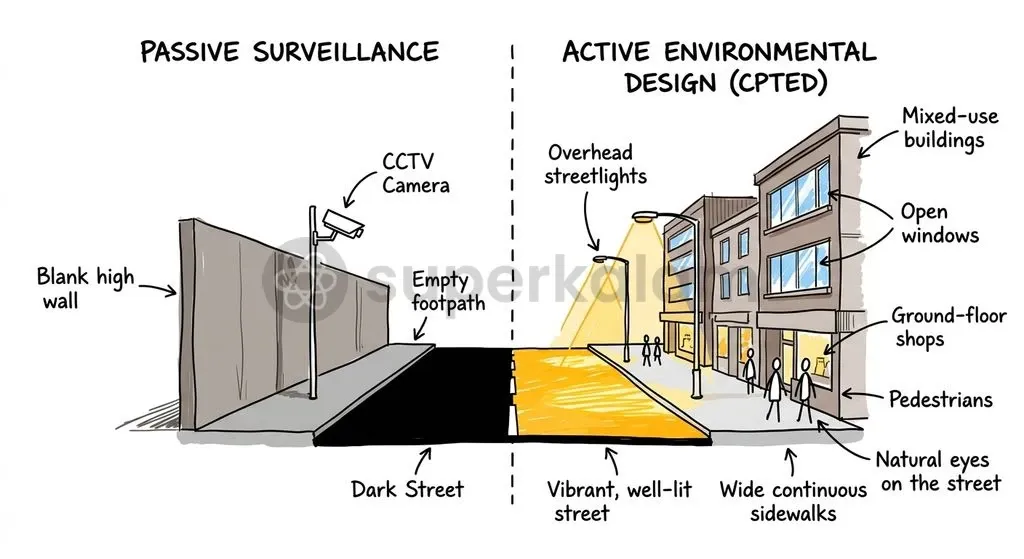
The National Institute of Urban Affairs recommends adopting Crime Prevention Through Environmental Design standards to replace passive surveillance with well-lit, active pedestrian infrastructure across Indian cities. Physical space must be planned to encourage natural surveillance and uninterrupted foot traffic.
Effective reform requires concrete actions across multiple governance layers:
- Environmental Design (CPTED): Mandate active street frontages, continuous footpaths, unobstructed sightlines, and accessible public toilets rather than relying on isolated camera towers.
- Police Sensitisation: Rebalance Nirbhaya spending to institutionalise mandatory gender-sensitisation training and expand the operational capacities of the 14,650 Women Help Desks.
- Forensic Capacity Building: Modernise testing timelines in State Forensic Science Laboratories to eliminate investigative backlogs and raise evidentiary standards in court.
- Administrative Efficiency: Streamline State-level fund absorption under the Single Nodal Agency (SNA-SPARSH) framework to prevent procedural delays in releasing allocations.
Discuss with Superkalam
Should public safety policy prioritize technological surveillance or institutional police and judicial reforms to achieve genuine deterrence?
Ask NowKey Takeaways
- Administrative Structure: The Nirbhaya Fund is a non-lapsable corpus set up in 2013, administered by the Ministry of Finance and appraised by an Empowered Committee led ex officio by the Secretary, MWCD.
- Financial Scale: Out of ₹8,212.85 crore allocated since inception, ₹6,581.84 crore has been released to implementing bodies across Central Ministries and States.
- Core Interventions: Key schemes include Safe City Projects across 8 metropolitan hubs, over 926 One Stop Centres, ERSS-112, and 14,650 Women Help Desks.
- Structural Failure: The fund's heavy bias toward hardware has failed to raise all-India conviction rates above 25%–34%, while over 2.4 lakh POCSO and rape cases remain stalled in court.
- Judicial Directives: In Nipun Saxena (2018), the Supreme Court mandated NALSA's Model Scheme and operationalised the ₹200 crore CVCF for streamlined victim rehabilitation.
Mains Question
"High financial allocations and surveillance hardware under the Nirbhaya Fund framework have not translated into proportionate deterrence on the ground." Critically analyse the structural and administrative bottlenecks undermining women's safety outcomes in India. (15 Marks)
Evaluate NowMains Question
Evaluate the role of specialized institutional mechanisms—such as One Stop Centres and Fast Track Special Courts—funded under the Nirbhaya framework in improving access to justice and survivor care. (10 Marks)
Evaluate NowPractice MCQs
QUESTION 1
With reference to the institutional architecture and governance of the Nirbhaya Fund, consider the following statements:
- It is a non-lapsable corpus administered by the Department of Economic Affairs under the Ministry of Finance.
- Project proposals are appraised and recommended by an Empowered Committee of Officers chaired ex officio by the Secretary of the Ministry of Women and Child Development.
- The fund was established following the recommendations of the Justice J.S. Verma Committee.
Which of the statements given above are correct?
QUESTION 2
Consider the following statements regarding projects financed under the Nirbhaya Fund framework:
- The Safe City Project was approved for deployment across eight metropolitan cities under the Ministry of Home Affairs.
- Over 14,650 Women Help Desks have been sanctioned and established in police stations across 33 States and Union Territories.
- Fast Track Special Courts (FTSCs) are implemented and overseen primarily by the Ministry of Women and Child Development.
Which of the statements given above is/are correct?
QUESTION 3
Consider the following statements regarding the implementation and ground-level performance of safety mechanisms under the Nirbhaya Fund:
- National Crime Records Bureau (NCRB) data indicates that conviction rates for crimes against women remain between 25% and 34%, dropping below 5% in certain States.
- Over 2.4 lakh POCSO and rape cases remain pending nationwide despite the operationalisation of Fast Track Special Courts.
- Procedural delays in submitting Utilisation Certificates and onboarding onto the Single Nodal Agency (SNA-SPARSH) module have hindered the release of subsequent funding tranches.
Which of the statements given above are correct?
QUESTION 4
In the context of the Nirbhaya Fund framework, the Supreme Court ruling in Nipun Saxena v. Union of India (2018) specifically dealt with which of the following issues?
QUESTION 5
Consider the following pairs of initiatives funded under the Nirbhaya framework and their corresponding descriptions:
- One Stop Centre Scheme: Integrated medical, legal, psychological, and police assistance under one roof.
- ERSS-112: Pan-India emergency response number with dedicated women SOS features.
- Safe City Project: Tech-enabled surveillance, smart lighting, and AI video analytics in 8 metropolitan cities.
How many of the pairs given above are correctly matched?





