NFHS-6 and India's Fertility Paradox: Why Contraceptive Shifts Anchor TFR Decline
India’s fertility fell below replacement level even as modern contraceptive use dipped, exposing structural shifts in female agency and public health delivery.
Sep, 2026
•9 min read

Overview
According to the National Family Health Survey-6 released by the Ministry of Health and Family Welfare, India has maintained a sub-replacement Total Fertility Rate of 2.0 children per woman. Alongside this trend, the Modern Contraceptive Prevalence Rate fell to 52.7%. This divergence shows that structural socio-economic progress and evolving family preferences now anchor India's demographic transition rather than clinical supplies alone.
Broader social shifts sustain this fertility decline. Key drivers include rising female literacy, delayed marriage age, and expanding digital access. However, female sterilisation continues to shoulder an overwhelming portion of family planning across states. Balancing this shift requires moving away from terminal female methods toward reversible modern contraception and genuine male engagement.
Why in the News?
The Ministry of Health and Family Welfare recently released the national fact sheet for the National Family Health Survey-6 (NFHS-6, 2023-24), documenting demographic shifts across states. As of May 2026, survey data shows that India's national Total Fertility Rate (TFR) has stabilized at 2.0 children per woman, remaining firmly below the replacement threshold.
The data also revealed an unexpected trend. The Modern Contraceptive Prevalence Rate (mCPR) among married women dropped, while reliance on traditional family planning methods increased noticeably.
Understanding the Fertility Paradox
NFHS-6 highlights a counter-intuitive divergence: fertility continued to decline even as modern contraceptive use contracted across married cohorts. In standard demographic theory, a falling TFR correlates directly with an expanding uptake of modern clinical contraceptives like pills, intrauterine devices, injectables, and condoms.
Data from the International Institute for Population Sciences reveals a clear pattern on the ground:
- Sub-Replacement Fertility: India's TFR of 2.0 sits below the replacement-level fertility of 2.1, which is defined as the exact level at which a population replaces itself from one generation to the next without migration.
- Overall Contraceptive Prevalence: The broad Contraceptive Prevalence Rate (CPR) among currently married women aged 15–49 rose from 66.7% in NFHS-5 to 69.1% in NFHS-6.
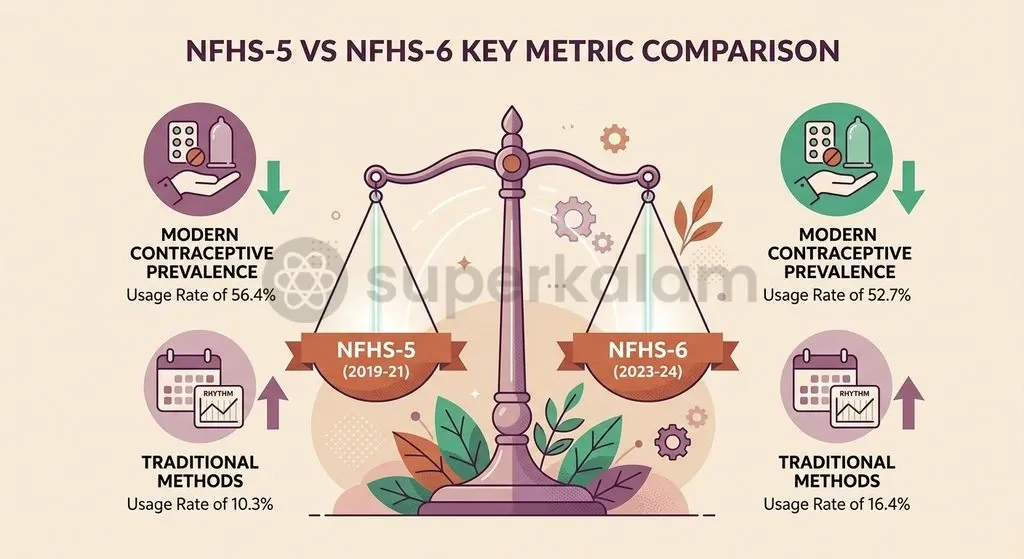
- Contraction of Modern Methods: Despite overall CPR growth, the Modern Contraceptive Prevalence Rate (mCPR) declined from 56.4% in NFHS-5 (2019-21) to 52.7% in NFHS-6 (2023-24).
- Surge in Traditional Methods: Reliance on traditional methods, such as rhythm, periodic abstinence, and withdrawal, surged from 10.3% in NFHS-5 to 16.4% in NFHS-6.
- Declining Unmet Need: Total unmet need for family planning dropped from 9.4% to 8.5%, showing that fewer couples experience an unresolved barrier to limiting or spacing births.
| Demographic Indicator | NFHS-5 (2019–21) | NFHS-6 (2023–24) | Direction of Shift |
|---|---|---|---|
| Total Fertility Rate (TFR) | 2.0 | 2.0 | Stable below replacement (2.1) |
| Overall Contraceptive Prevalence Rate (CPR) | 66.7% | 69.1% | Increased (+2.4 percentage points) |
| Modern Contraceptive Prevalence Rate (mCPR) | 56.4% | 52.7% | Decreased (-3.7 percentage points) |
| Traditional Contraceptive Methods | 10.3% | 16.4% | Increased (+6.1 percentage points) |
| Unmet Need for Family Planning | 9.4% | 8.5% | Decreased (-0.9 percentage points) |
This divergence illustrates that clinical distribution of modern spacing methods is not driving fertility decline alone. Instead, couples are combining traditional spacing techniques with structural social shifts to achieve smaller family sizes.
Discuss with Superkalam
Recall the exact Total Fertility Rate (TFR) and Modern Contraceptive Prevalence Rate (mCPR) figures recorded for India in NFHS-6.
Ask NowThe Structural Pattern: Female Sterilisation vs Reversible Modern Methods
Female sterilisation remains the dominant method of family planning in India. This reliance reflects an enduring structural imbalance across the public health architecture. Even though India introduced a cafeteria approach to offer multiple contraceptive choices, terminal female procedures continue to account for the vast majority of modern contraceptive use.
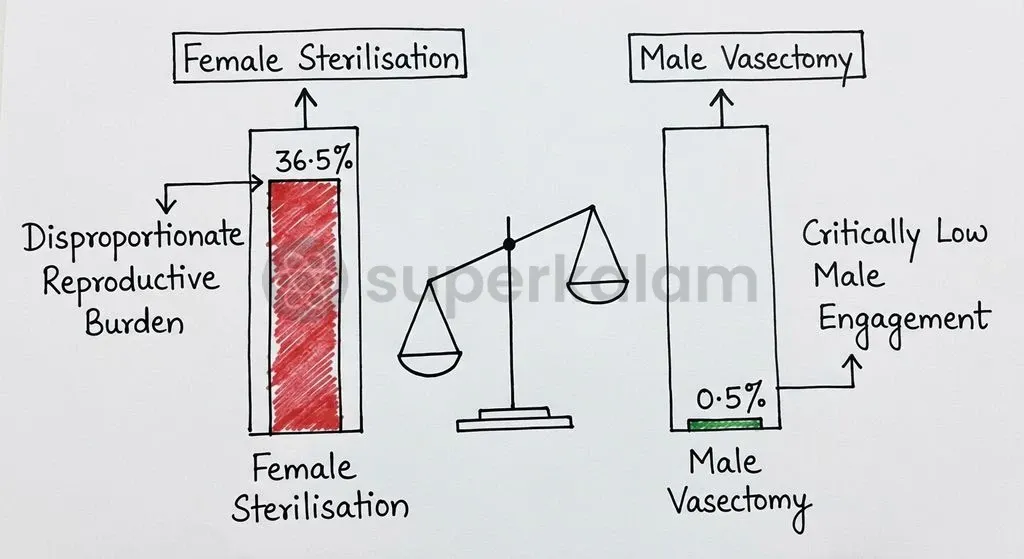
Ministry of Health and Family Welfare data shows that female sterilisation accounts for 36.5% of currently married women in NFHS-6, down only marginally from 37.9% in NFHS-5. By contrast, male sterilisation via vasectomy remains nearly non-existent at 0.5% in NFHS-6, despite being a simpler, less invasive clinical procedure. This continues a long-term decline from historical levels, such as the 3.4% vasectomy rate recorded during NFHS-1 in 1992-93.
The persistence of female tubectomy as the primary method creates specific operational challenges:
- Terminal Rather Than Spacing: Sterilisation is an irreversible terminal method adopted late in reproductive life, typically after women achieve their desired family size. It does not facilitate birth spacing for younger mothers.
- Skewed Method Mix: Reversible modern methods like oral contraceptive pills, intrauterine devices (IUDs), condoms, and newer injectables represent a comparatively modest fraction of overall usage relative to female tubectomy.
- Gendered Burden of Sterilisation: Family planning counselling and sterilisation targets have historically targeted women. This imbalance embeds socio-cultural misconceptions that vasectomy compromises male physical strength and earning capacity.
Beyond Contraception: Socio-Economic Drivers of Falling Family Size
Social determinants of health are exerting powerful downward pressure on Indian fertility independent of modern spacing commodities. Fertility outcomes reflect broader developmental changes across education, marriage patterns, and female autonomy.
Several distinct socio-economic shifts are driving this transformation:
- Reduction in Early Marriages: The proportion of women aged 20–24 years married before the legal age of 18 declined to 20.1% in NFHS-6, down from 23.3% in NFHS-5 and 47.4% in NFHS-3. Delaying marriage shortens the reproductive window and correlates with completed higher education.
- Surge in Digital Literacy: Adult women reporting internet usage surged from 33.3% in NFHS-5 to 64.3% in NFHS-6, representing an almost twofold increase in connectivity. This empowers women with greater agency in reproductive decision-making and career planning.
- Expansion of Institutional Touchpoints: Institutional deliveries reached 90.6% in NFHS-6, up from 88.6% in NFHS-5. More hospital births expand access to postpartum family planning counselling and skilled medical care.
Discuss with Superkalam
How does an increase in female digital literacy and institutional deliveries influence reproductive decision-making and fertility rates?
Ask NowEvolution of India's Family Planning Policy
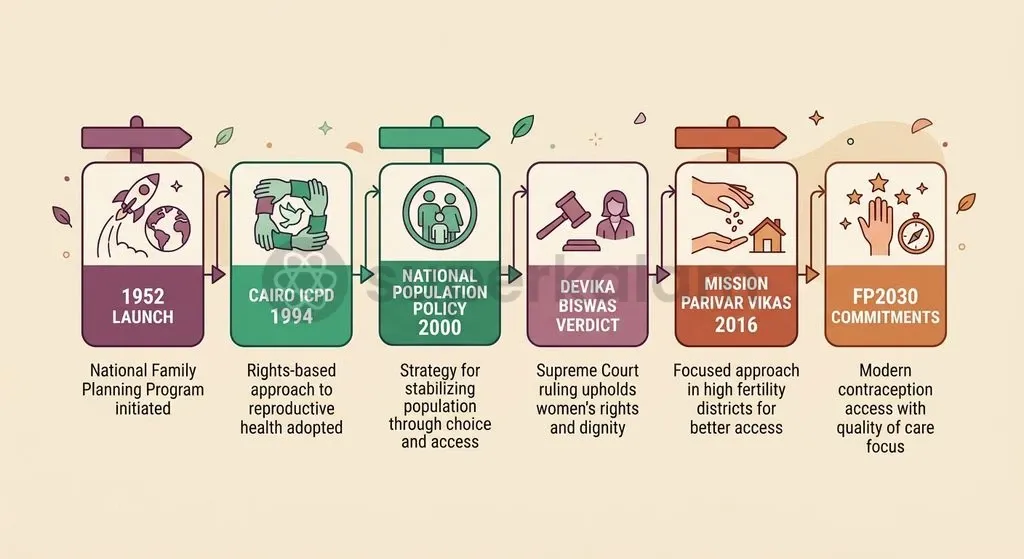
The National Programme for Family Planning was established by the Government of India in 1952, making India the first country globally to institute an official state-sponsored population programme. Over subsequent decades, the national approach transitioned through several distinct strategic paradigms.
Following the 1994 International Conference on Population and Development (ICPD) in Cairo, India formally abandoned numerical sterilisation targets in 1996. The subsequent National Population Policy 2000 codified a voluntary, target-free, and client-centred framework focused on reproductive rights rather than coercive population control.
Judicial oversight further reshaped clinical sterilisation standards. In Devika Biswas v. Union of India (2016), the Supreme Court directed state governments to abolish mass sterilisation camps within three years, establishing strict quality protocols and mandating genuine informed consent.
- 1952: First National Programme for Family Planning launched globally.
- 1994–1996: Post-Cairo shift abandoning numerical sterilisation targets.
- 2000: National Population Policy introduces a rights-based cafeteria approach.
- 2016: Supreme Court bans mass sterilisation camps (Devika Biswas ruling).
- 2016: Mission Parivar Vikas targets 146 high-fertility districts.
- 2023+: FP-LMIS roll-out and global FP2030 reproductive commitments.
To address regional disparities, the Ministry of Health and Family Welfare launched Mission Parivar Vikas in 2016 across 146 high-fertility districts in seven states exhibiting a TFR of 3.0 or higher. Under this initiative, the national contraceptive basket was expanded to include Antara (an injectable Medroxyprogesterone Acetate contraceptive effective for 3 months) and Chhaya (a non-hormonal, non-steroidal oral pill containing Centchroman).
To prevent stock-outs across rural facilities, the Ministry operates the Family Planning Logistics Management Information System (FP-LMIS). This digital platform tracks the real-time supply of commodities down to Accredited Social Health Activist (ASHA) workers in village health sub-centres.
Discuss with Superkalam
Compare the public health implications of relying on terminal female sterilisation versus promoting reversible modern spacing methods.
Ask NowGender and Ethics in Public Health
The National Family Health Survey highlights enduring ethical questions regarding the asymmetric distribution of bodily autonomy and reproductive responsibility. Family planning in India has historically operated with a structural gender bias that places the burden of contraception overwhelmingly upon women.
Key ethical and administrative dimensions include:
- Asymmetric Physical Burden: The marginal 0.5% rate of male sterilisation compared to 36.5% female sterilisation highlights a failure of shared reproductive responsibility. Non-scalpel vasectomy is an outpatient procedure with negligible risk, whereas tubectomy involves invasive intra-abdominal surgery with higher complication rates.
- Entrenched Patriarchal Attitudes: Normalising female bodily interventions over male vasectomy treats contraception solely as a female obligation, reinforced by myths regarding loss of male physical strength.
- Informed Consent and Quality Care: Under the right to bodily integrity, target-driven service delivery compromises individual autonomy. The Supreme Court in Devika Biswas (2016) underscored that offering a complete basket of reversible modern methods without coercive incentives is a fundamental necessity.
Discuss with Superkalam
Propose three structural interventions to increase male participation in family planning and reduce the gender imbalance in sterilisation.
Ask NowWay Forward: Building a Rights-Based Reproductive Health Model
The Ministry of Health and Family Welfare can build upon sub-replacement fertility by accelerating the transition toward a comprehensive, gender-equal reproductive healthcare system. Achieving long-term demographic balance requires improving the accessibility, quality, and inclusivity of family planning services.
- Rebalancing the Contraceptive Method Mix: Expanding awareness and availability of reversible spacing methods like sub-dermal implants, modern IUDs, Antara injectables, and Chhaya oral pills helps couples space births without resorting solely to terminal sterilisation.
- Institutionalising Male Engagement: Public health communication must actively address myths surrounding vasectomy. In alignment with global FP2030 commitments, district health societies should deploy targeted incentives, male health mobilisers, and workplace-based reproductive counselling.
- Strengthening Supply Chain Reliability: Expanding the reach of the Family Planning Logistics Management Information System (FP-LMIS) prevents localized stock-outs of reversible spacing methods among frontline ASHA workers.
- Youth-Friendly Reproductive Services: With the age of marriage rising and female digital access reaching 64.3%, reproductive health education must be integrated into adolescent health programmes and digital platforms to provide accurate, stigma-free guidance.
Key Takeaways
- India's national Total Fertility Rate stands at 2.0 children per woman, remaining below the replacement threshold of 2.1.
- Modern Contraceptive Prevalence Rate dropped to 52.7% in NFHS-6, while traditional method reliance rose sharply to 16.4%.
- Female sterilisation continues to dominate India's method mix at 36.5%, whereas male vasectomy remains critically low at 0.5%.
- Rising age of female marriage, higher institutional births (90.6%), and surging female internet access (64.3%) serve as primary socio-economic drivers of fertility decline.
- In Devika Biswas v. Union of India (2016), the Supreme Court mandated the closure of mass sterilisation camps to safeguard quality care and informed consent.
Mains Question
"India's demographic transition has achieved sub-replacement fertility, yet the method mix of contraception reveals persistent gender asymmetry and clinical imbalances." In light of NFHS-6 findings, examine the factors contributing to this fertility paradox. (10 Marks)
Evaluate NowMains Question
"The transition from target-driven family planning to a rights-based reproductive health framework remains incomplete in practice." Critically analyse the evolution of India's family planning policies from the 1952 National Programme to the post-Devika Biswas (2016) era. (15 Marks)
Evaluate NowPractice MCQs
QUESTION 1
With reference to the findings of the National Family Health Survey-6 (NFHS-6), consider the following statements:
- India's Total Fertility Rate (TFR) has dropped below the replacement level of 2.1 children per woman.
- The Modern Contraceptive Prevalence Rate (mCPR) increased alongside a sharp decline in reliance on traditional family planning methods.
- The total unmet need for family planning among married women witnessed a decline compared to NFHS-5.
Which of the statements given above are correct?
QUESTION 2
Consider the following statements regarding contraceptives introduced under the Government of India's family planning initiatives:
- 'Antara' is an injectable contraceptive containing Medroxyprogesterone Acetate effective for 3 months.
- 'Chhaya' is a non-hormonal, non-steroidal oral contraceptive pill containing Centchroman.
- Mission Parivar Vikas was launched to expand the contraceptive basket specifically across high-fertility districts.
Which of the statements given above is/are correct?
QUESTION 3
With reference to the Supreme Court of India's judgment in Devika Biswas v. Union of India (2016), consider the following statements:
- The Court directed state governments to abolish mass sterilisation camps within three years.
- The ruling emphasized the necessity of strict quality protocols and genuine informed consent for clinical sterilisation.
Which of the statements given above is/are correct?
QUESTION 4
With reference to the structural patterns of contraception in India documented in NFHS-6, consider the following statements:
- Female sterilisation continues to account for over 35% of contraceptive use among currently married women.
- Male sterilisation via vasectomy has increased significantly due to widespread adoption of non-invasive techniques.
Which of the statements given above is/are correct?
QUESTION 5
In the context of India's public health administration, what is the primary function of the 'Family Planning Logistics Management Information System' (FP-LMIS)?





