National Supercomputing Mission: India's Push for Sovereign Compute
India's supercomputing pivot from imported clusters to sovereign silicon and servers holds decisive weight for AI, climate modelling, and national security.
Oct, 2026
•9 min read
Overview
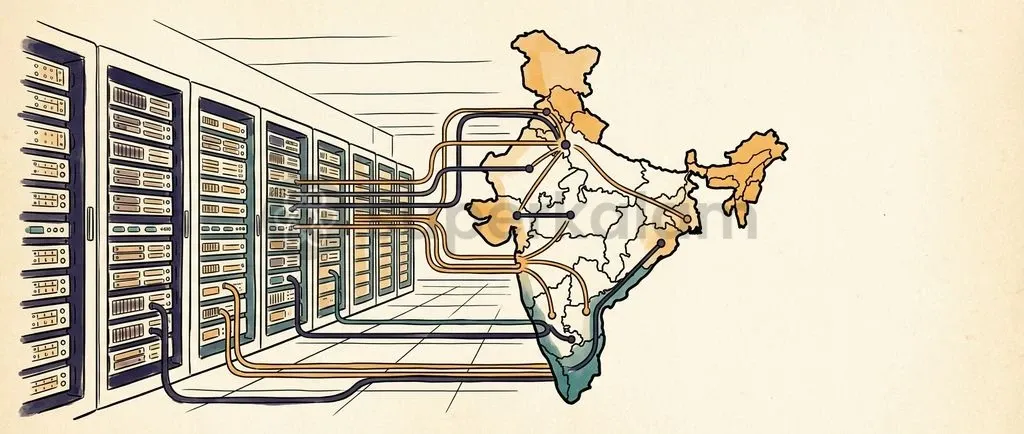
The National Supercomputing Mission marks India's pivot from assembling foreign parts to building sovereign computing capabilities. The initiative integrates domestic server manufacturing, open-standard processor design, and federated high-speed networking across premier academic institutions.
Jointly steered by DST and MeitY, it tackles computational deficits across artificial intelligence, molecular biology, and climate modelling. While early phases achieved motherboard fabrication and direct liquid cooling, complete autonomy hinges on mastering advanced semiconductor fabrication.
Why India's Compute Race Has Shifted from Raw Petaflops to Sovereign Silicon
India has reoriented its High Performance Computing strategy from purchasing foreign computing clusters to engineering domestic hardware architectures. High-Performance Computing (HPC) aggregates processing power to solve complex scientific calculations at scale. Computational capacity is now a recognised instrument of geopolitical leverage and state autonomy.
As of September 2026, according to a Press Information Bureau Release on India's Rising Supercomputing Ecosystem, the National Supercomputing Mission (NSM) has deployed 40 supercomputers delivering an aggregate capacity of 68 PetaFLOPS. A single PetaFLOPS equals one quadrillion (10^15) floating-point operations per second.
Discuss with Superkalam
Recall the computational scale of a PetaFLOPS and the aggregate capacity deployed under the National Supercomputing Mission as of September 2026.
Ask NowYet raw processing speed alone cannot shield national systems against supply chain chokepoints or foreign export embargoes. True computational sovereignty requires control across four distinct layers:
- Silicon Design: Custom CPU and GPU microarchitectures tailored for strategic workloads.
- Firmware & Interconnects: Proprietary board-level logic and low-latency networking switches.
- Thermal Architecture: High-efficiency direct contact liquid cooling for dense data centres.
- Foundry Access: Guaranteed domestic fabrication independent of foreign export controls.
Heavy concentration in global semiconductor foundries leaves import-reliant states exposed. Consequently, India's national strategy under NSM has moved from chasing benchmark speeds to securing full hardware and software autonomy.
How the National Supercomputing Mission Works: The Joint DST-MeitY Mandate
The Cabinet Committee on Economic Affairs approved the National Supercomputing Mission in March 2015 with an outlay of ₹4,500 crore.
The institutional structure unifies scientific research governance with domestic industrial policy. According to a Press Information Bureau Release on India's Rising Supercomputing Ecosystem, the mission is jointly steered by the Department of Science and Technology (DST) and the Ministry of Electronics and Information Technology (MeitY). Implementation is led by the Centre for Development of Advanced Computing (C-DAC), Pune, and the Indian Institute of Science (IISc), Bengaluru.
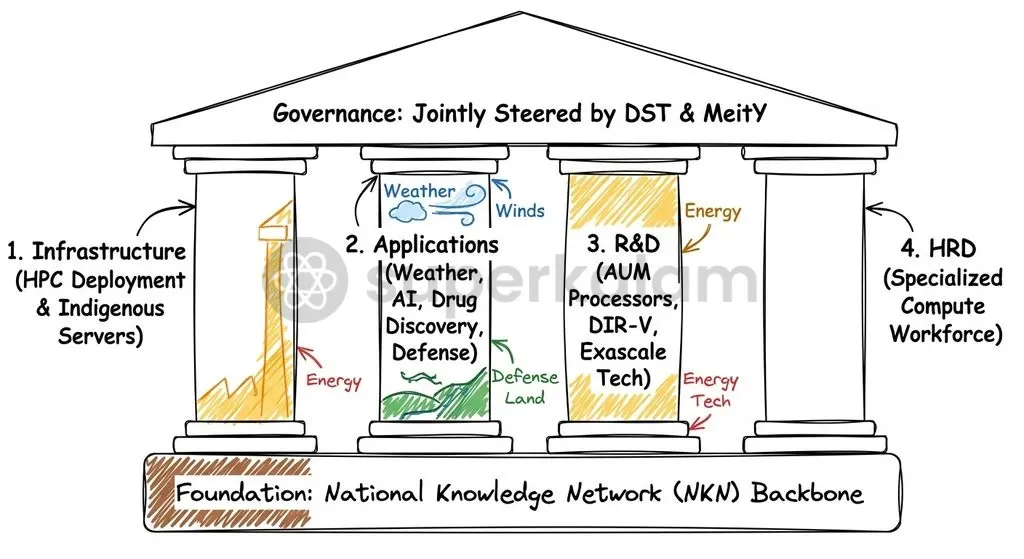
As outlined in an official Press Information Bureau Release on PARAM Ganga, the mission operates across four integrated pillars:
- Infrastructure: Deploying petascale and sub-petascale computing nodes across national research laboratories and central universities.
- Applications: Developing specialized computational software for climate forecasting, structural biology, aerospace engineering, and materials science.
- Research & Development (R&D): Engineering indigenous processor architectures, next-generation network switches, and thermal dissipation systems.
- Human Resource Development (HRD): Training advanced computational scientists and domain engineers across Indian universities.
The mission connects these facilities through the National Knowledge Network (NKN). This multi-gigabit optical backbone links academic institutions alongside Tier-II and Tier-III universities into a single computational grid. This federated network prevents regional siloing and broadens access to compute capacity nationwide.
From Imported Boxes to Indigenous Servers: Breaking Down the Three Phases of NSM
The National Supercomputing Mission adopted a phased model to transition domestic industry from component assembly to deep technology ownership.
| Phase | Strategic Focus | Primary Deliverables | Domestic Value Addition |
|---|---|---|---|
| Phase 1 | Infrastructure establishment & assembly | Assembling imported sub-systems; establishing basic national HPC footprint | Baseline assembly |
| Phase 2 | Domestic server manufacturing & software stacks | Indigenous 'Rudra' server platforms; domestic motherboard design | Approximately 40 percent |
| Phase 3 | Full-stack hardware indigenization | Indigenous 'AUM' HPC processor design; 'Trinetra' interconnects; liquid cooling systems | Comprehensive stack ownership |
Phase 1 focused on building baseline compute capacity quickly by assembling completely knocked-down imported sub-systems at IITs and IISc. This stage established operational and maintenance expertise across petascale infrastructure.
Discuss with Superkalam
Explain how the National Knowledge Network (NKN) enables a federated computational grid across Tier-I, Tier-II, and Tier-III institutions.
Ask NowPhase 2 introduced domestic server motherboards and indigenous software layers. According to a Press Information Bureau Release on the National Supercomputing Mission, this phase raised domestic value addition to approximately 40 percent.
A central milestone was 'Rudra', India's first indigenously designed HPC server platform. Developed by C-DAC, Rudra is manufactured through domestic Electronic Manufacturing Services (EMS) partners, including VVDN Technologies and Kaynes Technology.
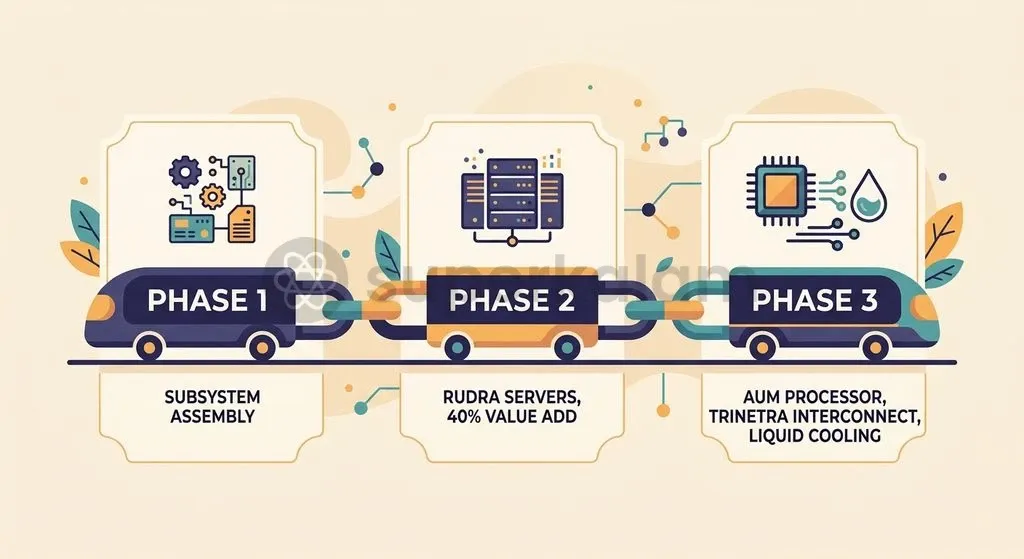
Phase 3 targets complete hardware indigenisation across processors, switches, and cooling systems. C-DAC developed 'Trinetra', an indigenous high-speed interconnect switch that manages low-latency, high-bandwidth communication across thousands of computing nodes.
Additionally, PARAM Rudra systems deploy indigenously developed Direct Contact Liquid Cooling (DCLC). This mechanism accommodates high compute density while cutting power consumption in high-density data centres.
Assembly vs True Indigenization: Where India Still Relies on Foreign Silicon
India's progress in fabricating server chassis, motherboards, and cooling loops contrasts with its persistent reliance on overseas semiconductor foundries and proprietary processor designs. Domestic EMS firms can assemble server racks and print circuit boards, but the underlying compute engines remain imported.
According to a Parliament Question Release on Indigenous Initiatives for AI Supercomputers, Indian HPC systems remain fundamentally dependent on foreign semiconductor foundries and proprietary CPU and GPU silicon from firms such as Intel, AMD, NVIDIA, and TSMC. The division between board assembly and semiconductor indigenisation lies in the intellectual property and fabrication of the microchip itself.
To bridge this gap, the government is executing two parallel processor initiatives:
1. The AUM Processor Initiative
C-DAC partnered with MosChip Technologies and Socionext Inc. to design the 'AUM' high-performance compute processor. The chip is built on the 64-bit Arm Neoverse V2 architecture using TSMC's 5nm fabrication node. This project deepens domestic capability in high-performance silicon design, though physical tape-out and fabrication still take place abroad.
Discuss with Superkalam
Analyse why motherboard fabrication and local server assembly (such as the Rudra platform) do not fully eliminate geopolitical supply chain vulnerabilities.
Ask Now2. The Digital India RISC-V (DIR-V) Program
MeitY launched the Digital India RISC-V (DIR-V) Program in April 2022 to develop open-standard, royalty-free processor architectures. RISC-V provides an open Instruction Set Architecture that removes licensing dependencies on proprietary cores. As documented in a Press Information Bureau Release on DIR-V MoUs Signed at SemiconIndia, the effort includes two flagship domestic processor families:
- SHAKTI: Developed by IIT Madras, targeting embedded systems and edge-computing applications.
- VEGA: Developed by C-DAC, using superscalar multi-core designs engineered for server-grade compute nodes.
What Compute Sovereignty Means for AI, Weather Forecasting, and National Security
Sovereign compute infrastructure underpins artificial intelligence training, high-resolution climate projections, and defence simulations. Scientific discovery and strategic capabilities require sustained access to dense parallel computing.
For artificial intelligence, the Union Cabinet approved the IndiaAI Mission in March 2024 with an allocation of ₹10,372 crore to democratise access to high-end GPU clusters. India's flagship AI supercomputer, 'AIRAWAT' at C-DAC Pune, secured the 75th global rank on the Top500 list at the International Supercomputing Conference (ISC 2023).
| Domain | Strategic Application |
|---|---|
| Atmospheric Sciences & Ocean Modelling | Bharat Forecast System (6 km resolution) via Arka & Arunika clusters (28 PF) |
| Biotechnology & Healthcare | Molecular dynamics, genomics pipelines, structure-based drug discovery |
| Strategic & Aerospace Engineering | Computational fluid dynamics, atomic physics & aerodynamic simulation |
Weather forecasting has expanded significantly through added computing capacity. According to a Parliament Question Release from the Ministry of Earth Sciences, national forecasting power reached 28 PetaFLOPS with the commissioning of the 'Arunika' and 'Arka' clusters at NCMRWF Noida and IITM Pune under Mission Mausam.
This infrastructure powers the Bharat Forecast System (BharatFS). The system executes coupled ocean-atmosphere numerical models at a 6-kilometre spatial resolution, refining monsoon projections and severe weather warnings.
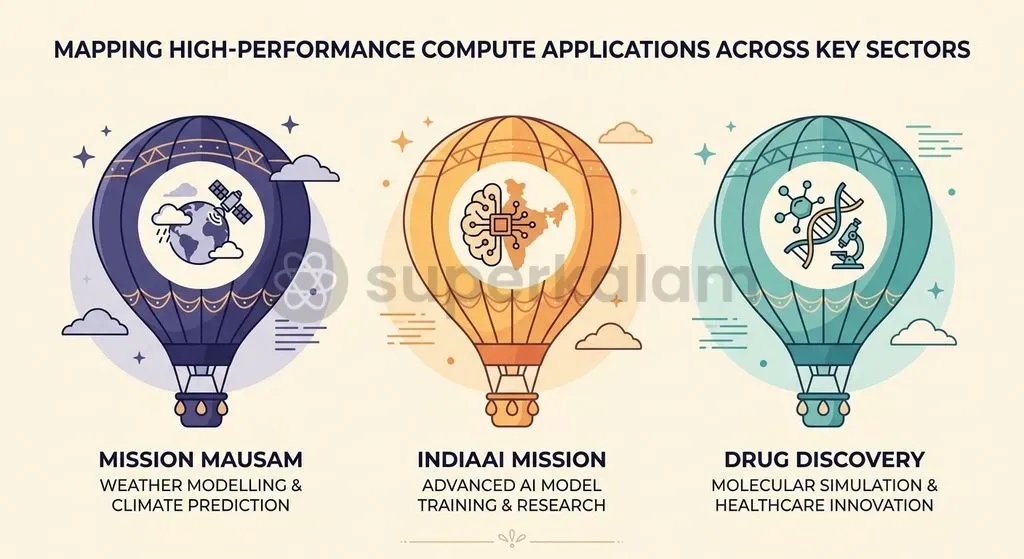
In life sciences, research teams use NSM infrastructure for molecular dynamics simulations, genomics workflows, and structure-based drug discovery against emerging pathogens. Similarly, NSM clusters handle non-linear mathematical modelling for computational fluid dynamics, aerospace structural analysis, and atomic physics.
The Road Ahead: Building a Full-Stack Indigenous Supercomputing Ecosystem
Developing a self-reliant supercomputing ecosystem requires integrating domestic chip design with physical semiconductor foundries, system software stacks, and sustained talent pipelines. India has made progress in server engineering, but technological sovereignty requires bridging the remaining manufacturing and software gaps.
Discuss with Superkalam
Weigh the strategic trade-offs between adopting open-standard RISC-V architectures versus licensed proprietary architectures (such as Arm) for sovereign computing workloads.
Ask NowKey priorities for the next stage of development include:
- Linking Chip Design to Domestic Fabrication: Design projects like AUM and DIR-V have made steady progress, but physical production remains offshore. Connecting C-DAC's processor blueprints with upcoming domestic fabrication units under the India Semiconductor Mission (ISM) is critical for complete hardware self-reliance.
- Building Unified System Software Stacks: High-performance hardware requires optimized compilers, runtime libraries, and distributed middleware. Expanding open-source software stacks tuned for Rudra servers and Trinetra switches ensures domestic platforms operate at full computational efficiency.
- Expanding Research Utilisation and Talent: Compute hardware delivers impact only when researchers actively deploy it. According to a Press Information Bureau Release on PARAM Rudra, NSM training initiatives have upskilled over 26,000 students, researchers, and engineers in advanced HPC and AI. Furthermore, as reported in a Press Information Bureau Release on 37 Supercomputers Deployed Under NSM, Indian scientists have completed over one crore supercomputing jobs and published more than 1,500 peer-reviewed research papers.
Key Takeaways
- The National Supercomputing Mission was approved in March 2015 with an outlay of ₹4,500 crore, jointly steered by DST and MeitY and implemented by C-DAC Pune and IISc Bengaluru.
- As of September 2026, the national supercomputing network includes 40 supercomputers providing an aggregate computing capacity of 68 PetaFLOPS.
- NSM's three-phase progression moved from Phase 1 system assembly to Phase 2 domestic server manufacturing ('Rudra' servers, ~40% domestic value addition), and Phase 3 full-stack hardware indigenization ('AUM' processor, 'Trinetra' interconnects).
- India continues to rely on foreign semiconductor foundries and proprietary CPU/GPU architectures (such as Intel, AMD, NVIDIA, and TSMC), a gap being targeted via the AUM processor (TSMC 5nm node) and the DIR-V open-architecture initiative (SHAKTI and VEGA).
- Strategic applications include Mission Mausam's 28 PetaFLOPS capacity running the 6 km Bharat Forecast System, C-DAC Pune's AIRAWAT AI supercomputer (ranked 75th globally at ISC 2023), and the IndiaAI Mission backed by ₹10,372 crore.
Mains Question
'Raw processing speed alone cannot shield national systems against supply chain chokepoints and foreign export embargoes.' In light of the National Supercomputing Mission, examine the necessity of achieving full-stack computational sovereignty. (10 Marks)
Evaluate NowMains Question
The National Supercomputing Mission (NSM) adopted a phased transition from assembling imported sub-systems to indigenous technology ownership. Critically analyse the achievements of the mission across its three phases and highlight the challenges that remain in achieving complete hardware indigenisation. (15 Marks)
Evaluate NowPractice MCQs
QUESTION 1
With reference to the National Supercomputing Mission (NSM), consider the following statements:
- It is jointly steered by the Department of Science and Technology (DST) and the Ministry of Electronics and Information Technology (MeitY).
- The mission's implementation is led by C-DAC, Pune, and the Indian Institute of Science (IISc), Bengaluru.
- The computing infrastructure is interconnected nationwide through the National Knowledge Network (NKN).
Which of the statements given above are correct?
QUESTION 2
Consider the following statements regarding the indigenization milestones under the National Supercomputing Mission:
- 'Rudra' is an indigenously designed High-Performance Computing server platform introduced in Phase 2 of the mission.
- 'Trinetra' is an indigenous high-speed interconnect switch developed to manage inter-node communication across computing clusters.
- The 'AUM' HPC processor is designed using the open-standard RISC-V architecture and fabricated entirely in domestic Indian foundries.
Which of the statements given above is/are correct?
QUESTION 3
With reference to the Digital India RISC-V (DIR-V) Program, consider the following statements:
- It aims to develop open-standard, royalty-free processor architectures to eliminate licensing dependencies.
- 'SHAKTI' is developed by IIT Madras for embedded and edge-computing applications.
- 'VEGA' is developed by C-DAC as a superscalar multi-core design for server-grade nodes.
Which of the statements given above are correct?
QUESTION 4
Consider the following pairs regarding supercomputing and AI initiatives in India:
- AIRAWAT : Flagship AI supercomputer deployed at C-DAC Pune
- Arka and Arunika : Supercomputing clusters supporting the Bharat Forecast System under Mission Mausam
- PARAM Rudra : Incorporates indigenously developed Direct Contact Liquid Cooling (DCLC)
Which of the pairs given above are correctly matched?
QUESTION 5
In High-Performance Computing (HPC), which of the following correctly denotes the computational speed of one PetaFLOPS?





