Moon Nuclear Reactor: How Fission Power Supports Lunar Bases
A Moon nuclear reactor can supply power during long lunar nights. Read how fission surface power works and how it compares with solar energy.
Oct, 2026
•8 min read
Context
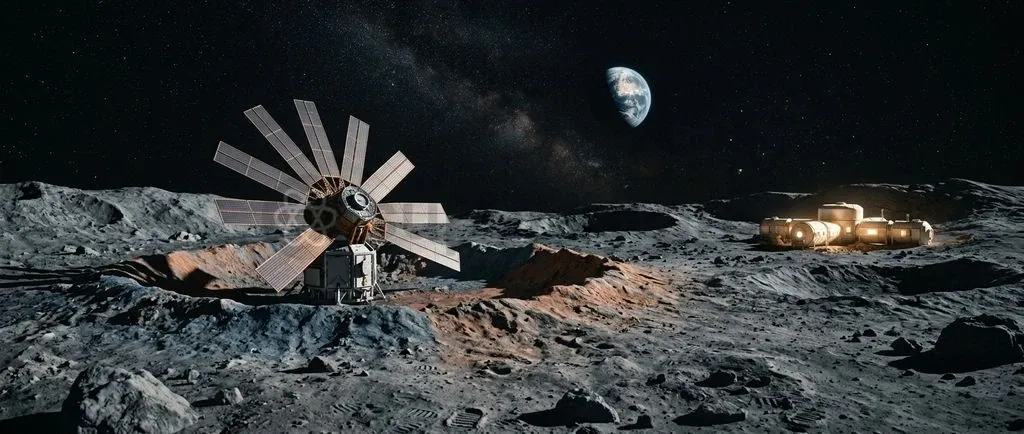
Deploying small nuclear fission reactors to the lunar surface represents a vital technological shift. It is essential to establish permanent human habitats, support autonomous mining, and sustain long-duration space exploration. The harsh lunar environment—defined by extreme cold and multi-week nights—makes photovoltaic arrays and chemical batteries operationally unviable for high-power exploration.
Under the Artemis campaign, space agencies are partnering with national nuclear laboratories to engineer compact, transportable fission surface power systems. These modular power plants deliver continuous electrical output regardless of solar illumination or dust storms. By solving the lunar energy bottleneck, fission technology bridges the gap between short robotic sorties and self-sustaining planetary exploration.
Why in the News?
NASA and the United States Department of Energy are advancing the Fission Surface Power Project to deploy an operational reactor on the Moon. As of February 2026, the agencies are preparing the next competitive flight phase following the completion of initial design contracts awarded to commercial consortia led by Lockheed Martin, Westinghouse, and IX, a joint venture between Intuitive Machines and X-Energy.
According to project mandates from the NASA Glenn Research Center, the initiative requires a fully integrated 40-kilowatt electrical class reactor capable of operating continuously for at least a decade on the lunar surface.
The Lunar Energy Challenge: Why Solar Power Falls Short
Solar energy systems face severe environmental constraints on the lunar surface that prevent them from supporting sustained base operations alone. According to data from the NASA Planetary Data System, the Moon undergoes a synodic day-night cycle lasting approximately 29.5 Earth days. This orbital cycle subjects surface installations at equatorial and mid-latitudes to roughly 14.5 Earth days of darkness (approximately 354 consecutive hours), during which solar panels produce zero electricity.
Thermal extremes compound this power deficit across the lunar terrain:
- Surface Temperature Swings: Measurements from the Diviner Lunar Radiometer on NASA's Lunar Reconnaissance Orbiter show temperatures soaring to 120°C at lunar noon and plunging to -130°C during the night.
- Deep Polar Freezes: Inside the permanently shadowed craters of the lunar poles, temperatures drop as low as -246°C.
- Mass Penalty of Energy Storage: Surviving a 354-hour lunar night on chemical batteries requires heavy storage systems that exceed the payload capacities of current commercial lunar landers.
- Regolith Dust Accumulation: Highly abrasive, electrostatically charged lunar dust coats photovoltaic surfaces, progressively degrading power generation efficiency over time.
Discuss with Superkalam
Recall the enrichment threshold and specific isotope used in High-Assay Low-Enriched Uranium (HALEU) for lunar fission reactors.
Ask NowHow Moon-Based Nuclear Fission Reactors Work
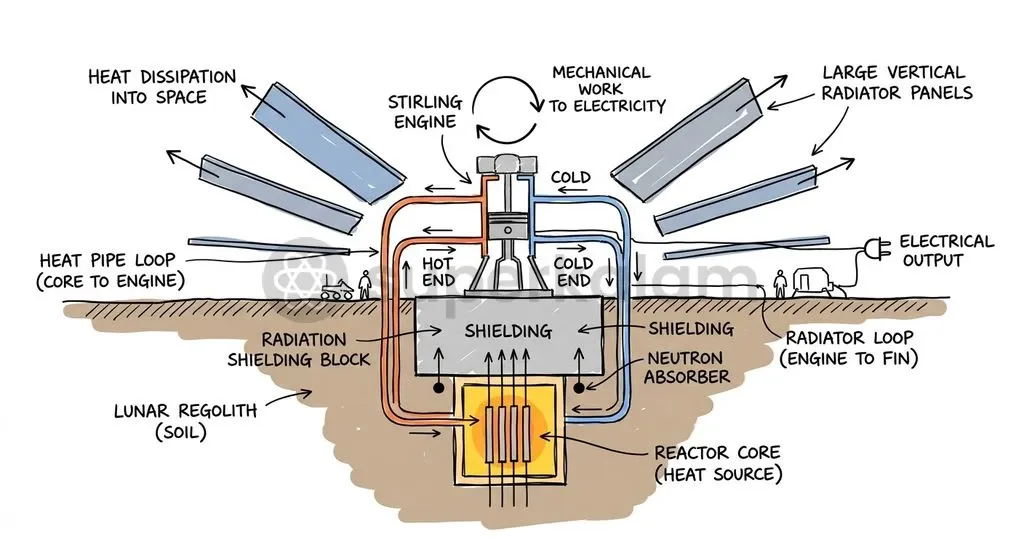
A space-qualified nuclear fission reactor generates continuous thermal energy through controlled uranium fission and converts that heat into usable electricity in a vacuum. The flight system design developed by NASA and the Department of Energy mandates a total mass under 6,000 kg to ensure compatibility with standard commercial launch fairings.
The baseline architecture incorporates several specialised engineering subsystems:
- Reactor Core and Fuel Selection: The reactor core uses High-Assay Low-Enriched Uranium (HALEU) enriched to under 20% Uranium-235, satisfying international non-proliferation safety standards while delivering high energy density.
- Dynamic Power Conversion: Thermal energy produced by the core is transferred via liquid metal or gas coolants to closed-loop Stirling converters or closed-Brayton-cycle turbines, which generate electricity with high thermodynamic efficiency.
- Radiative Thermal Management: Because a vacuum lacks atmospheric convection, surplus heat must be expelled entirely through radiative heat transfer using deployable panels emitting infrared radiation into space.
- Radiation Shielding and Separation: The system employs engineered beryllium, tungsten, and lithium-hydride shadow shields. System architecture specifications require that human crews stationed 1 kilometre away receive an annual radiation dose below 5 rem (0.05 Sv) above natural background levels.
The foundational physics for these space-bound systems was proven during the 2018 KRUSTY ground test at the Nevada National Security Site, which demonstrated self-regulating nuclear core control under flight-like operational conditions.
Powering the Moon: Nuclear Energy vs. Solar and Fuel Cells
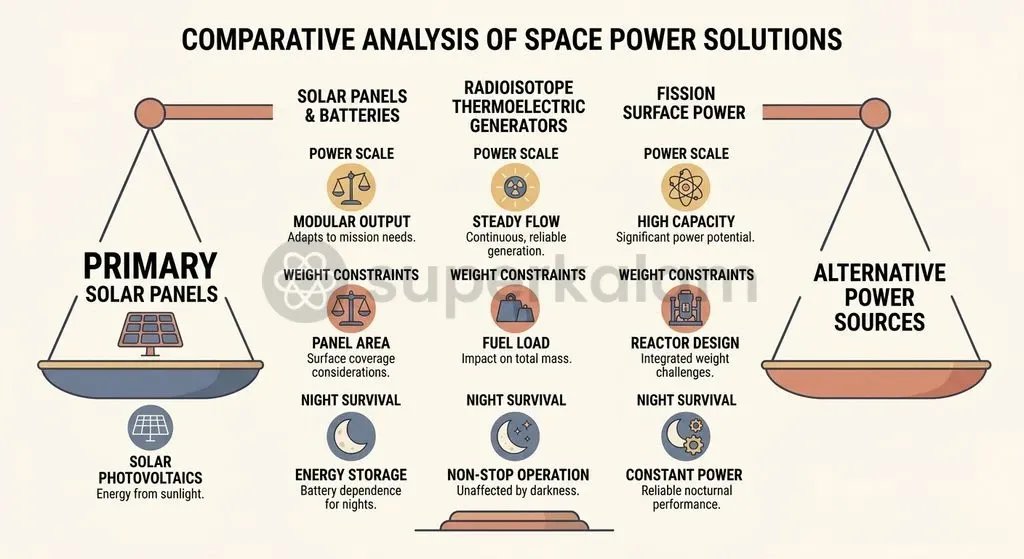
Choosing a primary energy architecture for permanent lunar installations involves balancing power density, system mass, and operational reliability across varying environments.
| Parameter | Solar Array with Battery Storage | Radioisotope Thermoelectric Generator (RTG) | Fission Surface Power (FSP) Reactor |
|---|---|---|---|
| Power Output Range | Variable (1 kW to 20 kW during daylight; 0 kW during darkness) | Low continuous (100 W to 500 W per unit) | High continuous (40 kWe class, scalable to megawatts) |
| Primary Fuel / Source | Solar irradiance and electrochemical cells | Alpha decay of Plutonium-238 | Controlled fission of HALEU (<20% U-235) |
| Day/Night Sensitivity | Severely impaired; requires massive battery reserves for 354-hour nights | Completely unaffected by day-night cycles | Completely unaffected by day-night cycles or sun angle |
| Location Flexibility | Restricted to illuminated crater rims and peaks of eternal light | Universal; operable on surface or inside shadowed craters | Universal; operable anywhere, including polar craters and lava tubes |
| Mass Efficiency | Low to moderate due to heavy energy storage requirements | High for milliwatt/watt systems; inefficient for high-kilowatt needs | High energy-to-mass ratio (<6 metric tons for 40 kWe) |
Discuss with Superkalam
Explain why radiative heat management is essential for operating a nuclear power plant in a lunar vacuum compared to Earth-based reactors.
Ask NowStrategic Role in the Artemis Program and Future Mars Exploration
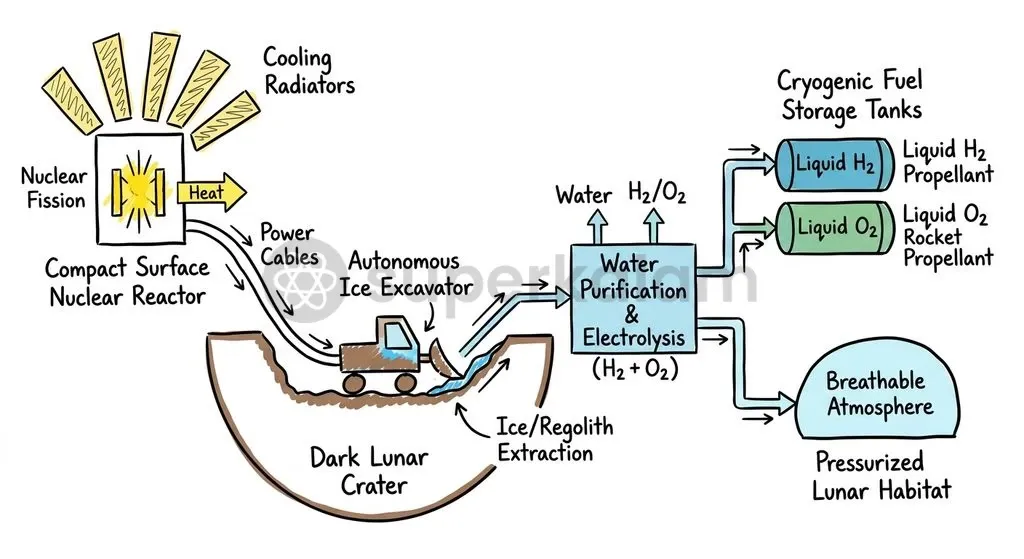
NASA's Artemis programme relies on surface fission power to transition from temporary lunar landings to industrial in-situ resource utilisation (ISRU). Surface nuclear reactors resolve foundational logistical barriers across deep space missions:
- In-Situ Resource Utilisation (ISRU): Permanently Shadowed Regions (PSRs) at the lunar South Pole contain substantial deposits of water ice. Fission reactors provide uninterrupted, megawatt-scale electricity inside sunless, sub-zero craters to extract water ice and refine it into liquid hydrogen and liquid oxygen propellants.
- Off-Earth Fuel Production: Processing lunar resources locally eliminates the need to lift heavy return fuels out of Earth's deep gravity well.
- Stepping Stone to Mars: Lunar fission power plants serve as direct operational testbeds for crewed missions to Mars, where frequent global dust storms and weaker solar flux make surface nuclear power indispensable.
Safety, Governance, and Outer Space Treaties on Nuclear Power
International space law establishes a clear legal regime governing nuclear fission sources on celestial bodies. The multilateral framework balances technological freedom with strict environmental protection and safety mandates.
- 1967 Outer Space Treaty: Article IV explicitly prohibits placing nuclear weapons or weapons of mass destruction in orbit or on celestial bodies. However, the treaty permits the peaceful utilisation of nuclear energy for scientific research and surface exploration.
- UN General Assembly Resolution 47/68 (1992): Adopted on 14 December 1992, the Principles Relevant to the Use of Nuclear Power Sources in Outer Space restricts nuclear sources to missions where non-nuclear options are technically unfeasible. Principle 4 obligates launching states to carry out detailed, documented safety assessments prior to launch and communicate the findings directly to the UN Secretary-General.
- 1972 Liability Convention: The Convention on International Liability for Damage Caused by Space Objects holds launching nations absolutely liable for damage caused by their space objects, including nuclear systems, on Earth's surface or to aircraft in flight.
Discuss with Superkalam
Analyse how the multi-week lunar night and extreme thermal swings constrain the payload efficiency of solar-plus-battery architectures.
Ask NowGlobal Space Race and Lessons for India's Future Lunar Outposts
India's long-term lunar roadmap requires scaling up indigenous space nuclear capabilities to ensure operational autonomy. According to official directives from the Prime Minister's Office, India plans to execute a lunar sample return through Chandrayaan-4 around 2028, establish the Bharatiya Antariksh Station by 2035, and land an Indian astronaut on the Moon by 2040.
To prepare for extended surface operations, the Indian Space Research Organisation (ISRO) and the Bhabha Atomic Research Centre (BARC) have initiated nuclear power development:
- Radioisotope Heater Units (RHUs): In 2023, ISRO successfully validated two indigenous 1-watt RHUs developed by BARC aboard the Chandrayaan-3 propulsion module in lunar orbit.
- Long-Duration Lander Survival: ISRO and the Department of Atomic Energy are developing scaled-up RTGs designed to keep future Indian landers operational across multiple 14-day nights, targeting survival spans of 100 to 200 Earth days.
- Transitioning to Fission: While RTGs provide sufficient heat to prevent instruments from freezing, establishing a permanent base will require India to transition toward compact fission reactors to power communications, drilling rigs, and habitat life support.
The Way Forward: Balancing Innovation, Safety, and Global Space Law
Securing the future of lunar surface nuclear power requires harmonising rapid technical development with responsible international oversight. Spacefaring nations must move beyond unilateral technology development by formalising multilateral verification protocols under the United Nations Committee on the Peaceful Uses of Outer Space (UN COPUOS).
Transparent safety frameworks must establish mandatory protocols for:
- Launch Abort Safety: Designing fail-safe reactor vessels that remain subcritical during catastrophic rocket launch or re-entry failures.
- Standardised Standoff Distances: Setting internationally accepted perimeter buffers to prevent uncoordinated radiation exposure between adjacent base operators.
- End-of-Life Decommissioning: Creating clear rules for defuelling, sealing, or entombing depleted space reactors to avoid radioactive contamination of pristine lunar science zones.
Discuss with Superkalam
Evaluate whether existing international treaties, such as the 1967 Outer Space Treaty and UN Resolution 47/68, provide sufficient governance for commercial and state-led nuclear deployments on the Moon.
Ask NowKey Takeaways
- The Energy Gap: The Moon's 14.5-day continuous night and -246°C polar crater temperatures make solar-plus-battery systems inadequate for powering permanent lunar outposts.
- FSP Technical Specifications: NASA's Fission Surface Power project specifies a 40-kWe class reactor under 6,000 kg utilising HALEU fuel enriched below 20% U-235.
- International Legal Governance: Article IV of the 1967 Outer Space Treaty allows peaceful nuclear power in space, while UN Resolution 47/68 mandates transparent pre-launch safety reviews submitted to the UN Secretary-General.
- Strategic Utility: Continuous nuclear power enables deep-crater water ice mining at the lunar South Pole to produce liquid oxygen and hydrogen rocket propellants.
- India's Roadmap: Building upon the 1-watt RHUs tested on Chandrayaan-3, ISRO and DAE are developing RTGs to support long-duration lunar landers and prepare for India's 2040 crewed lunar landing.
Mains Question
"Surviving the 354-hour lunar night and sustaining industrial In-Situ Resource Utilisation (ISRU) makes surface nuclear fission an indispensable technological imperative for long-duration lunar exploration." Elucidate. (10 Marks)
Evaluate NowMains Question
"While the peaceful deployment of nuclear power sources on celestial bodies is permitted under international space law, it operates within strict multilateral safety, notification, and liability frameworks." Critically examine. (15 Marks)
Evaluate NowPractice MCQs
QUESTION 1
With reference to the deployment of Fission Surface Power (FSP) systems on the Moon, consider the following statements:
- The reactor core utilizes High-Assay Low-Enriched Uranium (HALEU) enriched to under 20% Uranium-235.
- Excess thermal energy from the reactor in the lunar vacuum is primarily dissipated via atmospheric convective cooling.
- The engineered shadow shields are designed to limit annual radiation exposure for human crews stationed 1 kilometre away to below 5 rem (0.05 Sv) above natural background levels.
Which of the statements given above are correct?
QUESTION 2
Consider the following statements regarding the international legal frameworks governing the use of nuclear power in outer space:
- Article IV of the 1967 Outer Space Treaty completely prohibits the peaceful use of nuclear energy on celestial bodies.
- UN General Assembly Resolution 47/68 requires launching states to perform documented safety assessments and communicate findings to the UN Secretary-General.
- The 1972 Liability Convention imposes absolute liability on launching states for surface damage on Earth caused by space objects carrying nuclear systems.
Which of the statements given above is/are correct?
QUESTION 3
Consider the following statements regarding energy constraints on the lunar surface:
- Surface installations at equatorial and mid-latitudes face approximately 14.5 Earth days (354 consecutive hours) of continuous darkness.
- Inside permanently shadowed polar craters, temperatures can plunge as low as -246°C.
- Electrostatically charged regolith dust accumulation degrades the efficiency of photovoltaic arrays over time.
Which of the statements given above are correct?
QUESTION 4
Which of the following correctly distinguishes a Fission Surface Power (FSP) reactor from a Radioisotope Thermoelectric Generator (RTG)?
QUESTION 5
Consider the following statements regarding dynamic power conversion and testing of lunar fission reactors:
- Closed-loop Stirling converters and closed-Brayton-cycle turbines convert thermal energy from the core into electricity.
- The 2018 KRUSTY experiment in Nevada validated self-regulating nuclear core control under flight-like conditions.
- Baseline designs developed for lunar fission power mandate a total launch mass exceeding 15,000 kg.
Which of the statements given above is/are correct?





