MMDR Amendment Bill 2026: Federal Battle Over Mineral Wealth
Aug, 2026
•10 min read
Overview
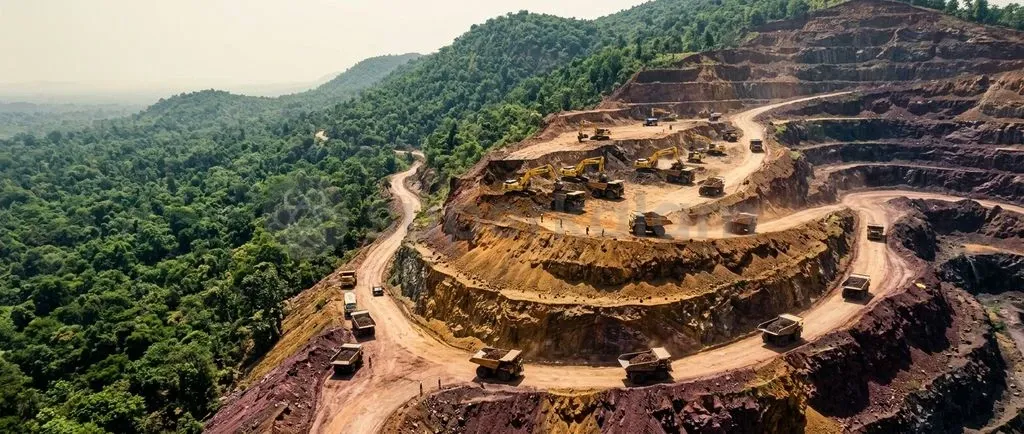
Fig: India's legislative framework for critical and strategic mineral development faces renewed constitutional debates over federal taxation power.
Parliament passed the Mines and Minerals (Development and Regulation) Amendment Bill 2026 on August 13, 2026. The legislation introduced Section 9D to restrict State Governments from levying unauthorised taxes on mineral rights and mineral-bearing lands, ensuring regulatory uniformity for critical mineral investment.
This legislative intervention directly addresses the fallout from the Supreme Court's 2024 ruling in Mineral Area Development Authority (MADA) v. Steel Authority of India. That judgment affirmed states' constitutional authority to tax mineral lands under Entry 49 of List II.
The Central Government argues that uncoordinated state cesses create wide price disparities and deter foreign capital. Conversely, mineral-rich states contend that Section 9D erodes fiscal federalism and strips them of essential revenues. The amendment sets up a major constitutional showdown over fiscal autonomy and natural resource governance in India.
Why the MMDR Amendment Bill 2026 is Making News
Parliament passed the MMDR Amendment Bill 2026 on August 13, 2026, following Lok Sabha clearance on August 12 and Rajya Sabha approval on August 13.
As of August 2026, this legislation fundamentally alters the legislative framework governing India's mineral sector. The primary statutory trigger was the Union Government's decision to neutralise the broader economic impact of a major judicial verdict.
Key judicial and statutory milestones behind the amendment include:
- Legislative Clearance: Lok Sabha approved the Bill on August 12, 2026, followed by Rajya Sabha on August 13, 2026.
- Supreme Court Ruling (July 25, 2024): An 8:1 majority of a 9-judge Constitution Bench in Mineral Area Development Authority (MADA) v. Steel Authority of India held that royalty payable under Section 9 of the MMDR Act, 1957 is not a tax. The Court affirmed that State Legislatures possess plenary authority under Entry 50 of List II to tax mineral rights.
- Retrospective Recovery Permitted: On August 14, 2024, the Supreme Court permitted states to recover retrospective mineral tax dues from April 1, 2005 onwards, staggered over 12 years starting April 1, 2026.
- Parliamentary Intervention: To prevent what the Ministry of Coal described as compounding tax burdens on mining enterprises, Parliament enacted the 2026 amendment. The new law explicitly brings mineral-bearing lands under Union regulatory control by amending Section 2 of the principal Act of 1957.
Discuss with Superkalam
Recall the specific constitutional entry under List II that grants states authority over taxes on lands and buildings.
Ask NowUnderstanding the Controversy Around Section 9D
Section 9D of the MMDR Act prohibits State Governments from imposing any tax, cess, or levy on mineral rights or mineral-bearing lands except under Central conditions.
The core debate centres on the specific provisions built into this new section:
- Invalidation of Uncollected Levies: Under Section 9D(2), the legislation includes a non-obstante clause declaring any state levy on mineral rights or mineral lands not collected prior to commencement as legally invalid.
- Protection of Past Collections: The Bill stipulates that state taxes or cesses already deposited with or recovered by State Governments prior to the amendment shall not be refunded.
- Delegated Regulatory Ceilings: Amendments to Section 13 grant executive rule-making power to the Union Government to prescribe statutory ceilings and conditions on state mineral levies.
Legal analysts note that Section 9D seeks to alter the legal foundation established in MADA v. Steel Authority of India. In that judgment, the Supreme Court ruled that mineral-bearing land falls under Entry 49 of List II (taxes on lands and buildings). This allowed states to use mineral yield or value as a measure for land taxation.
| Dimension | Supreme Court MADA Ruling (2024) | MMDR Amendment Bill 2026 |
Taxing Authority | Affirmed state plenary power under Entry 50 and Entry 49 of List II. | Restricts state levies, requiring Central approval under Section 9D. |
Status of Royalty | Held royalty under Section 9 is a statutory fee, not a tax. | Maintains royalty while capping additional state cesses. |
Retrospective Claims | Permitted states to collect retrospective dues from April 1, 2005. | Invalidates uncollected retrospective state tax demands via Section 9D(2). |
Land Regulatory Jurisdiction | Upheld state power to tax land using mineral yield as a measure. | Brings mineral-bearing lands under Union regulatory control under Section 2. |
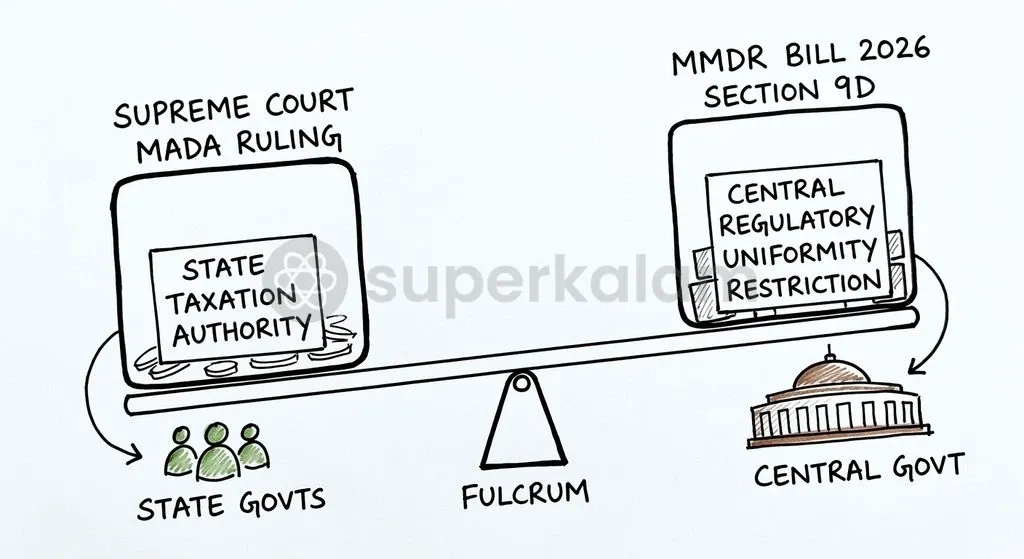
Fig: The legal conflict between State plenary taxing authority under List II and Union statutory control under Section 9D.
How the New Provisions Impact State-Centre Fiscal Federalism
State Governments view Section 9D of the MMDR Act as a severe encroachment on their constitutional taxation powers under the Seventh Schedule.
Chief Ministers of mineral-rich states, including Kerala and Jharkhand, publicly opposed Section 9D. They asserted that restricting state levies on mineral lands erodes state fiscal autonomy and undermines cooperative federalism. State budget projections in Jharkhand estimated an annual revenue impact exceeding ₹13,000 crore from mineral land cesses for 2026-27.
Constitutional friction revolves around the interaction between Union List and State List entries:
- Entry 50 of List II: Grants State Legislatures power to tax mineral rights, but this power is explicitly subject to any limitations imposed by Parliament by law relating to mineral development. The Union Government relies on this phrase as statutory backing for Section 9D.
- Entry 49 of List II: Grants states authority over taxes on lands and buildings. Legal scholars argue that Entry 49 carries no textual subordination to Union List entries, meaning restrictions on land taxation under Section 9D face potential constitutional challenges.
Balancing Private Investment Incentives with State Revenue Rights
The Union Government's Statement of Objects and Reasons notes that uncoordinated state levies create wide price disparities and render domestic mineral extraction unviable.
Following the 2024 Supreme Court verdict, retrospective tax liabilities spanning up to 15 years were reported to create potential tax demands of approximately ₹1.5 lakh crore on mining companies. The Union Government highlighted that such retrospective liabilities discourage capital investment from private and foreign sources in capital-intensive extraction operations.
Conversely, the Ministry of Coal clarified that major existing revenue streams to states remain intact. Preserved state streams include:
- Statutory Royalty: Direct payments under Section 9 of the MMDR Act.
- Auction Premiums: Revenue generated through competitive bidding for mining leases.
- District Mineral Foundation (DMF): Local development funds accrued directly to mineral-bearing districts.
- State GST Shares: Revenue shares from statutory indirect tax collections on mineral sales.
From a statutory standpoint, Parliament previously enacted the Mines and Minerals (Regulation and Development) Validation Act, 1992 to address similar state levy disputes. Under the doctrine established in Shri Prithvi Cotton Mills v. Broach Borough Municipality (1969), Parliament can legislatively overrule a judicial decision if it cures legal defects without violating separation of powers. The Supreme Court in Madras Bar Association v. Union of India (2021) reaffirmed that legislative overruling is permissible when retrospective statutory amendments cure the defect pointed out by the court.
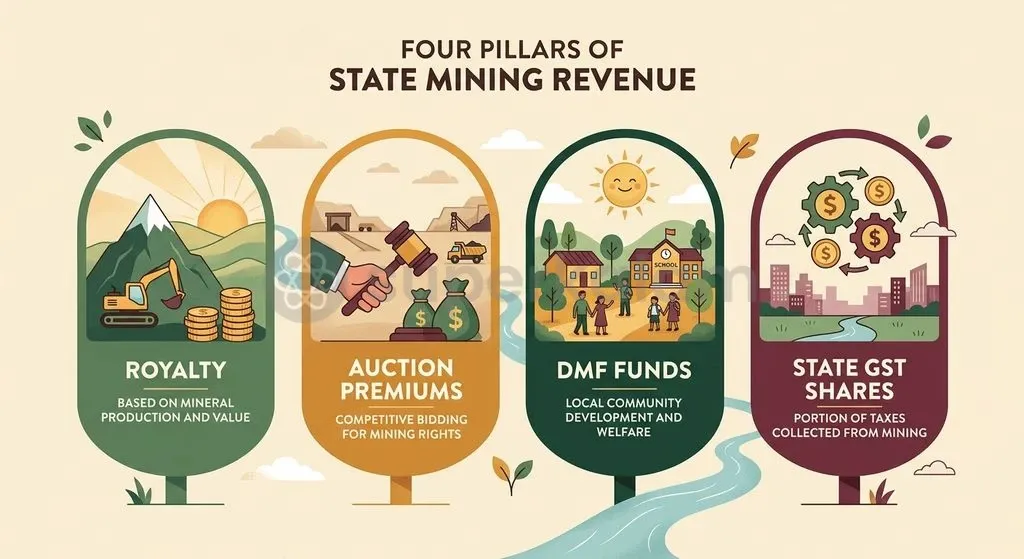
Fig: Preserved state revenue streams under the updated MMDR Act framework.
Discuss with Superkalam
Explain in your own words why uncoordinated state mineral levies cause price disparities across domestic supply chains.
Ask NowGlobal Supply Chain Vulnerabilities and Critical Mineral Security
Accelerating domestic exploration of critical minerals under the MMDR framework is designated by the Union Government as vital for national security and the green transition.
India remains dependent on external imports for processing critical minerals such as lithium, cobalt, nickel, and rare earth elements. Securing domestic supply chains addresses key operational priorities:
- Strategic Sector Growth: Supporting domestic manufacturing in electric vehicles, solar energy, and defence electronics.
- Market Harmonisation: Eliminating multi-layered, uncoordinated state taxes that cause price distortions across state boundaries.
- Investor Confidence: Setting central rules and ceilings under Section 13 to create a predictable regulatory environment for global capital and technology partners.
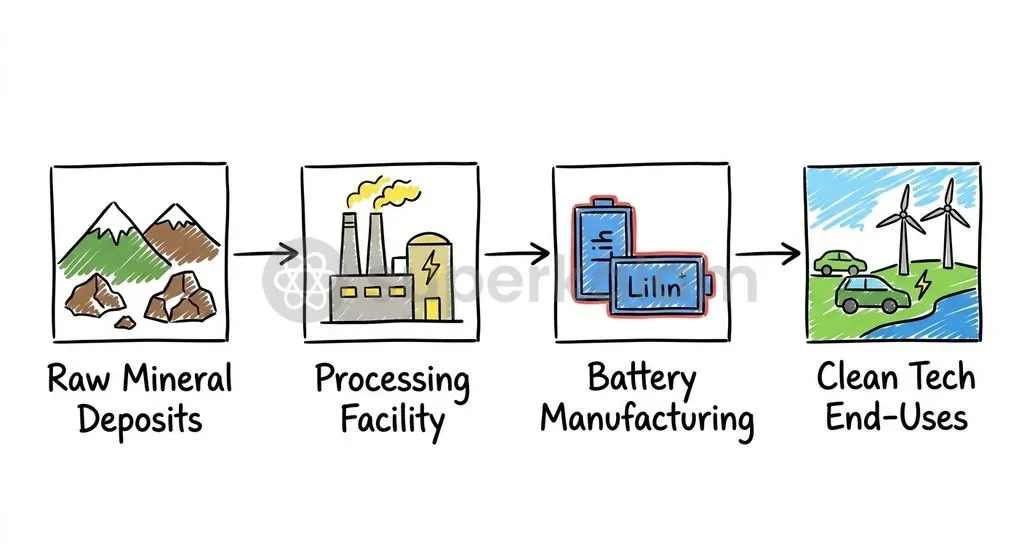
Fig: Strategic critical mineral security relies on domestic exploration, regulatory predictability, and supply chain integration.
The Path Forward: Resolving the Fiscal Impasse
Harmonising central investment imperatives with state fiscal autonomy under the MMDR Act requires structured institutional consultation.
To mitigate conflict between the Union and mineral-bearing states, key policy measures should be considered:
- Institutionalised Consultation: The Union Government can use its rule-making power under Section 13 to set up a joint fiscal council featuring state finance ministers, ensuring ceilings on state levies are established through consensus.
- Targeted Revenue Compensation: To cushion the impact on state budgets like Jharkhand and Kerala, the Centre can explore revenue-sharing adjustments from central mining auction premiums.
- Strengthening Local Governance: Enhancing District Mineral Foundation (DMF) disbursements ensures local communities benefit directly from mineral extraction while preserving fiscal stability.
Summary of Key Provisions
- Parliament passed the MMDR Amendment Bill 2026 on August 13, 2026, inserting Section 9D to restrict state levies on mineral rights and lands.
- Section 9D(2) invalidates uncollected retrospective state mineral tax demands, while protecting state tax revenues collected prior to the amendment.
- The amendment counters the Supreme Court's 2024 MADA ruling, which affirmed state legislative powers to tax mineral lands under Entry 49 of List II.
- Mineral-rich states like Jharkhand and Kerala oppose Section 9D, asserting that it erodes state fiscal federalism.
- The Ministry of Coal stated that primary state revenue sources—including statutory royalty, auction premiums, DMF funds, and GST shares—remain fully intact.
Mains Question
In light of global supply chain vulnerabilities, elucidate how the MMDR Amendment Bill 2026 seeks to balance critical mineral security with the constitutional boundaries of legislative overruling. (10 marks)
Evaluate NowMultiple Choice Questions
QUESTION 1
Medium
Indian Polity
Q1. With reference to the Mines and Minerals (Development and Regulation) Amendment Bill, 2026, consider the following statements:
- Section 9D of the Act invalidates any uncollected state tax levies on mineral rights or mineral-bearing lands created prior to the commencement of the amendment.
- The legislation mandates that state taxes or cesses already deposited with or recovered by State Governments prior to the amendment must be fully refunded to mining companies.
- The amendment brings mineral-bearing lands under Union regulatory control by amending Section 2 of the principal Act of 1957.
Which of the statements given above are correct?
Select an option to attempt
QUESTION 2
Medium
Indian Polity
Q2. Consider the following statements regarding the Supreme Court's ruling in Mineral Area Development Authority (MADA) v. Steel Authority of India (2024):
- An 8:1 majority held that royalty payable under Section 9 of the MMDR Act, 1957 is a tax.
- The Court affirmed that State Legislatures possess plenary authority under Entry 50 of List II to tax mineral rights.
- The Court held that mineral-bearing land falls under Entry 49 of List II, permitting states to use mineral yield as a measure for land taxation.
Which of the statements given above are correct?
Select an option to attempt
QUESTION 3
Medium
Indian Polity
Q3. Under the Seventh Schedule of the Constitution of India, Entry 50 of List II grants State Legislatures the power to tax mineral rights, subject to which of the following constitutional conditions?
Select an option to attempt