Legal Metrology IST Rules 2026: One Nation, One Time Mandate and Strategic Impact
As India mandates sovereign time across financial and digital grids, metrological shifts replace foreign GPS dependency with indigenous NavIC networks.
Sep, 2026
•8 min read
Overview
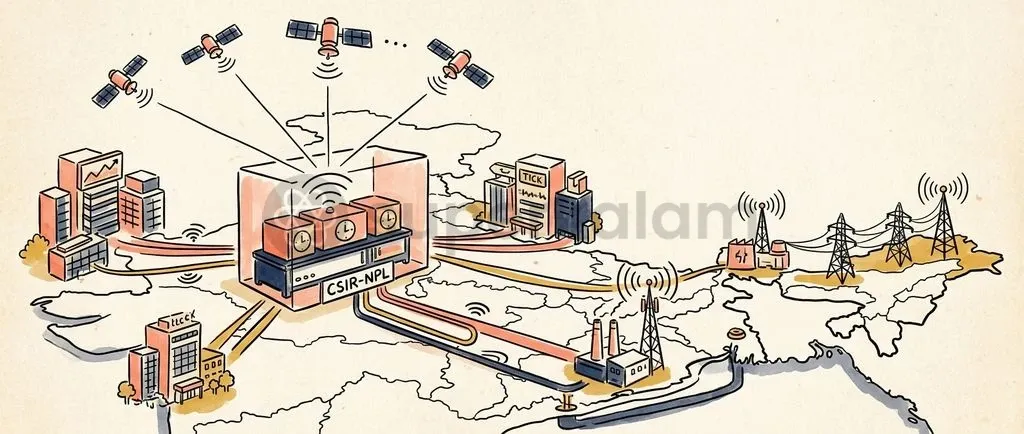
The Department of Consumer Affairs notified the Legal Metrology (Indian Standard Time) Rules, 2026 under Section 52 of the Legal Metrology Act, 2009. The rules mandate Indian Standard Time as the sole official time reference across digital networks, financial systems, power grids, and telecommunication infrastructure to secure national synchronisation.
India maintains its national time scale through CSIR-National Physical Laboratory's Cesium atomic clocks, synchronised within ±2.8 nanoseconds of Coordinated Universal Time. By linking statutory enforcement to ISRO's NavIC satellite constellation and terrestrial optical-fibre networks, the regulation eliminates operational reliance on foreign global positioning systems. Critical enterprise sectors have a 180-day transition window to align server logs, timestamping protocols, and hardware clocks with official dissemination nodes.
Why Are the Legal Metrology (IST) Rules, 2026 in the News?
The Department of Consumer Affairs notified the Legal Metrology (Indian Standard Time) Rules, 2026 on 27 August 2026 under the Legal Metrology Act, 2009.
Key timeline and rollout milestones include:
- Gazette Notification: Published on 29 August 2026 under G.S.R. 761(E), operationalising the 'One Nation, One Time' framework across critical commercial, administrative, and legal spheres.
- Statutory Window: Regulated entities receive a transition period of 180 days from gazette publication, setting an enforcement deadline for late February or March 2027.
- Current Baseline: As of September 2026, Indian critical sectors rely partly on unsynchronised network time servers or foreign navigation satellites.
The new mandate makes official time alignment a legally enforceable metric, preventing multi-sectoral systemic drift.
Understanding Indian Standard Time: How Is National Time Maintained?
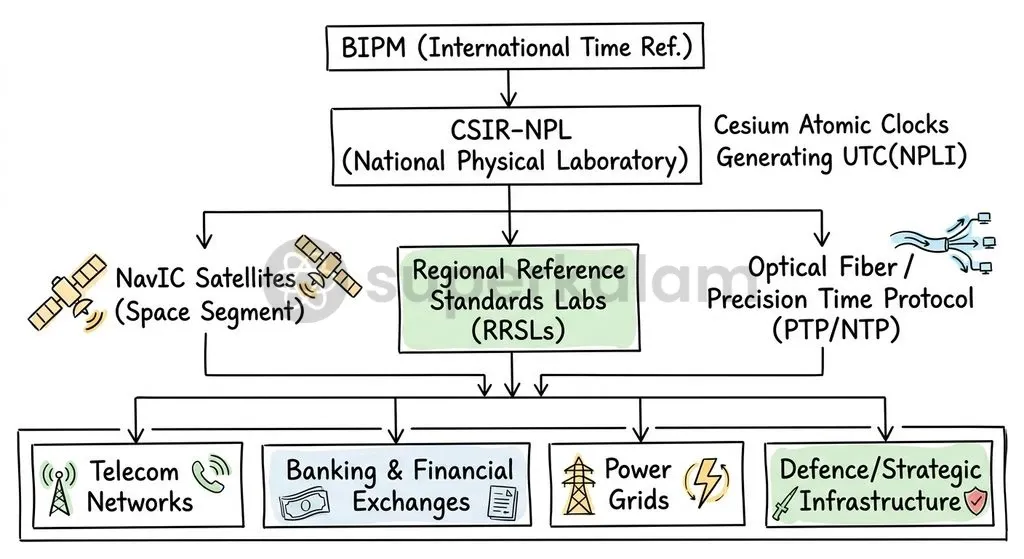
The CSIR-National Physical Laboratory in New Delhi acts as the statutory custodian responsible for generating and maintaining Indian Standard Time.
Indian Standard Time (IST) is scientifically defined as UTC(NPLI) plus 5 hours 30 minutes, derived from the standard meridian of 82°30' E passing through Mirzapur, Uttar Pradesh. CSIR-NPL generates this timescale using a high-precision bank of Cesium atomic clocks and Hydrogen masers. India's UTC(NPLI) stays synchronised with the International Bureau of Weights and Measures (BIPM) time within a narrow uncertainty of ±2.8 nanoseconds.
Geographic and measurement parameters of Indian time:
- Reference Meridian: 82°30' East longitude, setting IST at exactly UTC+05:30.
- Longitudinal Span: Approximately 30 degrees, stretching from Ghuar Mota in Gujarat (68°7' E) to Kibithu in Arunachal Pradesh (97°25' E).
- Solar Time Disparity: Nearly two hours of solar time difference across the eastern and western boundaries.
- Primary Metrology Facility: CSIR-NPL, New Delhi, using atomic resonance standards.
Discuss with Superkalam
Can you recall which standard meridian Indian Standard Time is derived from and the statutory body responsible for its physical generation?
Ask NowKey Provisions of the Legal Metrology (Indian Standard Time) Rules, 2026
Section 52 of the Legal Metrology Act, 2009 empowers the Central Government to prescribe Indian Standard Time as the mandatory national reference for all official operations.
The 2026 Rules establish strict compliance standards across digital systems, telecommunications, banking, and public utilities. Non-compliance, use of unapproved timing sources, or falsification of digital timestamps will attract statutory penalties under the parent Act once the transition period lapses.
Core regulatory provisions:
- Mandatory IST Usage: All legal, commercial, administrative, and official transactions must reference IST.
- Authorised Dissemination Sources: Critical entities must synchronise directly with CSIR-NPL, Regional Reference Standards Laboratories (RRSLs), NavIC-enabled timing receivers, or the National Informatics Centre (NIC).
- Statutory Transition Period: A 180-day window from gazette publication allows organisations to upgrade legacy hardware and software clocks.
- Permitted Sectoral Exemptions: Explicit exemptions apply to international civil aviation, maritime navigation, astronomy, scientific research, and multi-currency trading platforms displaying foreign time zones.
Institutional Framework: Roles of CSIR-NPL, MeitY, and ISRO
The National Physical Laboratory collaborates with ISRO, MeitY, and the Department of Telecommunications to establish a multi-layered national time dissemination architecture.
Physical timekeeping relies on distinct institutional responsibilities across the metrological, aerospace, and telecommunication sectors.
| Institution | Primary Statutory / Functional Mandate | Dissemination Mechanism |
|---|---|---|
| CSIR-NPL | National timekeeper; generates primary timescale UTC(NPLI) | Atomic clock ensembles, White Rabbit optical networks |
| ISRO | Sovereign satellite-based timing via NavIC constellation | Space-grade Rubidium atomic frequency standards |
| Department of Consumer Affairs | Regulatory enforcement under Legal Metrology Act, 2009 | Regional Reference Standards Laboratories (RRSLs) |
| MeitY & DoT | ICT network synchronisation, server log compliance, telecom licensing | Network Time Protocol (NTP) servers, 5G base-station standards |
In July 2026, the Department of Consumer Affairs commissioned a White Rabbit Technology (WRT) demonstration network at RRSL Bengaluru. This initiative completed a secure optical-fibre time transmission to the National Stock Exchange facility in Chennai alongside CSIR-NPL, ISRO, SEBI, and BSNL.
Discuss with Superkalam
How does sub-microsecond time synchronisation enhance cybersecurity and digital forensics under CERT-In guidelines?
Ask NowWhy Mandatory IST Matters: Strategic, Cyber, and Economic Significance
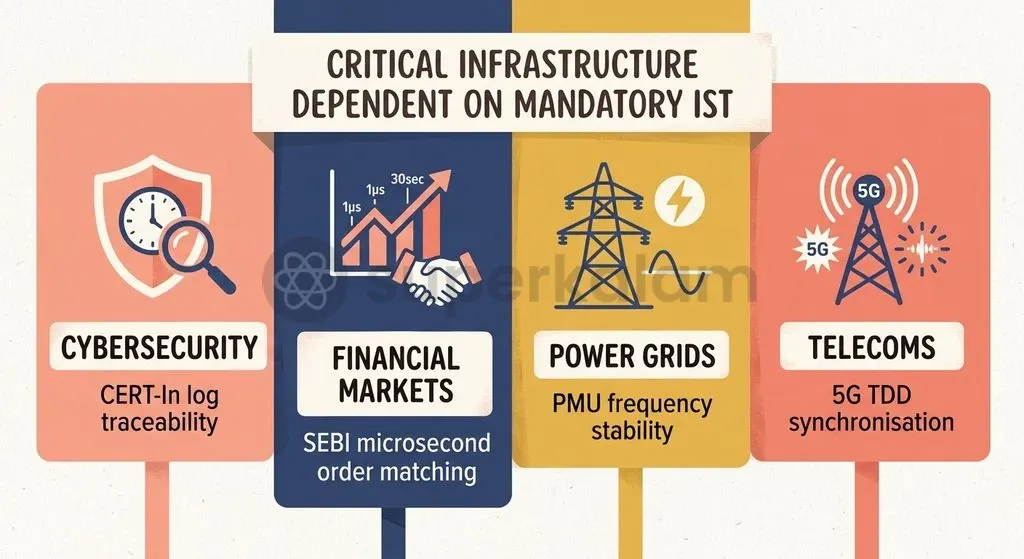
The Legal Metrology IST Rules strengthen critical national infrastructure across cybersecurity, financial markets, power grids, and telecommunication networks through sub-microsecond synchronisation.
Sovereign time synchronisation provides vital strategic protection against external vulnerabilities and operational failures:
- Cybersecurity and Forensic Traceability: Unified timestamps satisfy CERT-In Information Security Guidelines (2023), allowing investigators to correlate multi-server audit trails and trace advanced persistent threats.
- Financial Market Integrity: Microsecond-level timestamping prevents front-running in algorithmic trading, eliminates transaction reconciliation mismatches, and enforces SEBI trade-logging standards.
- Power Grid Stability: Synchronised time feeds into Phasor Measurement Units (PMUs) and Wide Area Measurement Systems (WAMS), maintaining grid frequency stability and averting cascade trips.
- Telecom Performance: Cellular 5G and future 6G networks require sub-microsecond synchronisation for time-division duplexing (TDD), coordinated beamforming, and cell handover.
- Strategic Sovereignty: Routing timing references through NavIC satellites ends dependence on foreign global navigation systems like the United States GPS.
Implementation Challenges: Infrastructure Gaps, Telecom Readiness, and Global Sync
Enterprise networks face significant technical hurdles in updating legacy hardware, mitigating packet-routing latency, and funding precision timestamping equipment across distributed Indian infrastructure.
Metrological studies highlight severe operational bottlenecks in rolling out universal IST across lower-tier industrial segments. Enterprise networks experience clock drift and asymmetric network jitter over standard internet routing paths.
Key implementation bottlenecks:
- Legacy Hardware Limitations: Older servers and programmable logic controllers lack support for hardware-assisted Precision Time Protocol (PTP), necessitating firmware or hardware replacement.
- Capital Expenditure in Smart Metering: Advanced Metering Infrastructure (AMI) and distributed IoT sensors across municipal utilities require dedicated capital outlays to integrate synchronised time receivers.
- Asymmetric Packet Routing: Commercial internet paths introduce variable latency, degrading Network Time Protocol (NTP) precision without dedicated optical or satellite synchronisation links.
Discuss with Superkalam
How might legacy financial or telecom operators address asymmetric internet routing jitter when complying with the 180-day IST transition window?
Ask NowThe Dual Time Zone Debate: Should India Have Two Time Zones?
The 82°30' East standard meridian creates a two-hour solar disparity across India, prompting recurring policy debates regarding dual time zones or daylight saving.
Geographic breadth generates structural lifestyle and productivity imbalances between western and northeastern states:
| Dimension | Single Time Zone (IST: UTC+05:30) | Dual Time Zone Proposal (IST-1 & IST-2) |
|---|---|---|
| Administrative Simplicity | Eliminates scheduling errors across railways, airlines, and financial exchanges | Requires complex multi-zone scheduling and dual administrative shift systems |
| Circadian and Daylight Efficiency | Northeast experiences early sunrise (4 AM) and early sunset (4 PM), causing energy loss | Optimises daylight, improves circadian health, and increases evening productivity |
| Historical Precedent | Maintained as unified standard since post-independence consolidation | Northeast tea plantations traditionally operated on informal 'Chai Bagan time' (UTC+06:30) |
| Safety and Operational Risks | Prevents train collision risks arising from human time-conversion errors | Demands fail-safe signalling automation to prevent cross-zone scheduling mishaps |
Way Forward: Building a Resilient National Time-Dissemination Network
The Department of Consumer Affairs is expanding regional calibration hubs and domestic atomic clock production to deliver secure, resilient time dissemination across India.
Long-term compliance requires strengthening national metrology infrastructure through decentralised secondary timing nodes.
Key components of the strategic roadmap:
- Regional Time Hubs: Operationalising primary time dissemination at Regional Reference Standards Laboratories (RRSLs) in Bengaluru, Ahmedabad, Bhubaneswar, Faridabad, and Guwahati ensures redundant terrestrial time feeds.
- Indigenous Atomic Standards: Expanding domestic manufacturing of space-qualified and ground-based Rubidium atomic clocks developed by ISRO-SAC and CSIR-NPL strengthens supply-chain sovereignty.
- Standardised API Architecture: MeitY and NIC must release open-source, certified synchronisation APIs to help micro, small, and medium enterprises (MSMEs) connect to official NTP servers without heavy software overhaul.
- Optical Fibre Resilience: Scaling White Rabbit optical links across power substations and stock exchanges ensures microsecond precision immune to satellite jamming or spoofing risks.
Discuss with Superkalam
What are the structural trade-offs between maintaining a unified single time zone and addressing the two-hour solar disparity across India's longitudinal extremes?
Ask NowKey Takeaways
- The Department of Consumer Affairs notified the Legal Metrology (Indian Standard Time) Rules, 2026 under Section 52 of the Legal Metrology Act, 2009, with a 180-day transition period ending in early 2027.
- CSIR-NPL generates India's official timescale, UTC(NPLI), using Cesium atomic clocks synchronised within ±2.8 nanoseconds of international UTC.
- Mandatory synchronisation addresses critical dependencies in cybersecurity log correlation (CERT-In), algorithmic trading (SEBI), power grid phasor measurements, and 5G telecommunications.
- Sovereign dissemination utilises ISRO's NavIC satellite constellation and terrestrial White Rabbit optical fibre networks to eliminate reliance on foreign systems like GPS.
- While India retains a single time zone along the 82°30' E meridian, daylight loss in the Northeast highlights continuing geographical trade-offs between administrative simplicity and circadian efficiency.
Mains Question
"Mandating a legally enforceable sovereign timescale is not merely an administrative exercise, but a vital cornerstone for national cybersecurity, financial market integrity, and critical infrastructure resilience." In light of the Legal Metrology (Indian Standard Time) Rules, 2026, elucidate. (10 Marks)
Evaluate NowMains Question
The enforcement of the 'One Nation, One Time' framework under the Legal Metrology (IST) Rules, 2026 aims to secure national synchronisation, yet faces notable technical, metrological, and geographic constraints. Critically examine. (15 Marks)
Evaluate NowPractice MCQs
QUESTION 1
With reference to the Legal Metrology (Indian Standard Time) Rules, 2026, consider the following statements:
- The rules were notified under Section 52 of the Legal Metrology Act, 2009.
- Regulated critical entities are provided a transition window of 180 days from gazette publication to align their timing systems.
- International civil aviation and maritime navigation are explicitly exempted from mandatory Indian Standard Time references.
Which of the statements given above are correct?
QUESTION 2
Regarding the institutional framework for maintaining and disseminating Indian Standard Time (IST), consider the following statements:
- CSIR-National Physical Laboratory (CSIR-NPL) maintains India's primary timescale UTC(NPLI) using Cesium atomic clocks.
- UTC(NPLI) is synchronised with the International Bureau of Weights and Measures (BIPM) within an uncertainty of ±2.8 nanoseconds.
- The Department of Consumer Affairs oversees sovereign space-based timing directly via the NavIC constellation.
Which of the statements given above is/are correct?
QUESTION 3
Consider the following statements regarding the geographic and technical parameters of Indian Standard Time (IST):
- IST is based on the 82°30' East longitude meridian passing through Mirzapur, Uttar Pradesh.
- India's longitudinal expanse spans approximately 30 degrees, leading to a solar time difference of nearly two hours between its eastern and western extremities.
- Authorised dissemination sources under the 2026 Rules include CSIR-NPL, Regional Reference Standards Laboratories, NavIC receivers, and the National Informatics Centre.
Which of the statements given above is/are correct?
QUESTION 4
In the context of the strategic and infrastructural significance of sovereign time synchronisation cited in the Legal Metrology IST Rules, 2026, consider the following sectors:
- Forensic audit trail correlation under CERT-In Information Security Guidelines
- Grid frequency stabilisation via Phasor Measurement Units (PMUs)
- Time-division duplexing and coordinated beamforming in 5G cellular networks
Which of the above sectors require sub-microsecond time synchronisation?
QUESTION 5
In July 2026, a demonstration network utilising White Rabbit Technology (WRT) for secure optical-fibre time transmission to the National Stock Exchange facility in Chennai was commissioned at: