Kuno Cheetah Coalitions: Spatial Ecology and Metapopulation Strategy
Male cheetah coalitions in Kuno need up to 400 sq km, exposing spatial bottlenecks that make an open metapopulation network central to Project Cheetah's future.
Sep, 2026
•7 min read
Overview
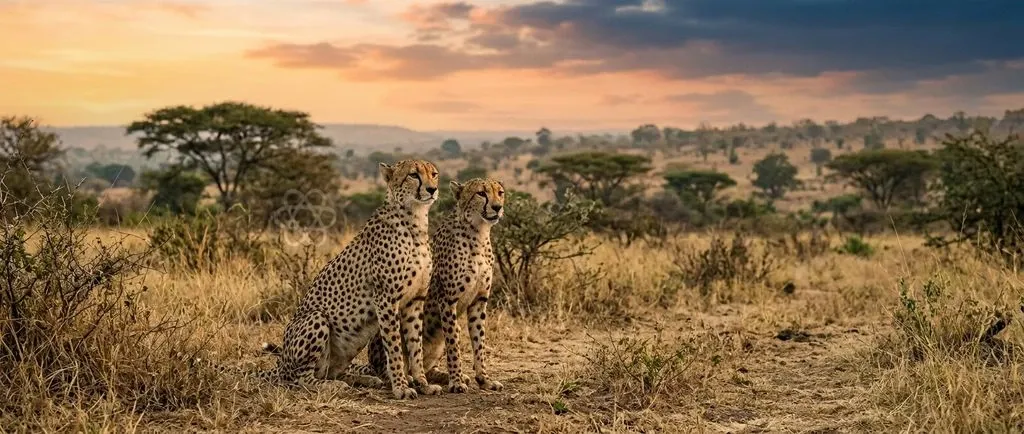
Male cheetah coalitions in Kuno National Park pose a distinct spatial puzzle. Their natural drive to claim communal ground runs headlong into the tight boundaries of unfenced reserves.
According to the National Tiger Conservation Authority, male cheetahs form lifelong bonds to secure exclusive mating access and hold prime ranges. In dry deciduous ecosystems, a single coalition requires between 100 to 400+ square kilometres.
This high land requirement makes territorial friction and wide exploratory dispersal inevitable. Resolving these spatial bottlenecks means moving past single-park management towards an interconnected metapopulation network.
Why in the News: Coalition Dynamics and Territorial Clashes in Kuno
Kuno National Park has seen intense intraspecific competition and territorial clashes among reintroduced African cheetahs. As of December 2025, tracking data compiled by project authorities reveals that territorial clashes and exploratory dispersal outside protected boundaries represent major operational challenges for Project Cheetah.
Field monitoring teams have recorded lethal mating and territorial interactions inside the park. According to the Madhya Pradesh Forest Department & NTCA Incident Statements, mating interactions and coalition aggression resulted in fatal injuries, including the May 2023 death of female cheetah Daksha.
Understanding the evolutionary biology behind male coalition formation helps wildlife managers anticipate these behavioural conflicts and plan adequate spatial corridors.
Discuss with Superkalam
What are the primary evolutionary advantages that male cheetahs gain by forming lifelong coalitions?
Ask NowEvolutionary Biology: Why Male Cheetahs Form Lifelong Coalitions
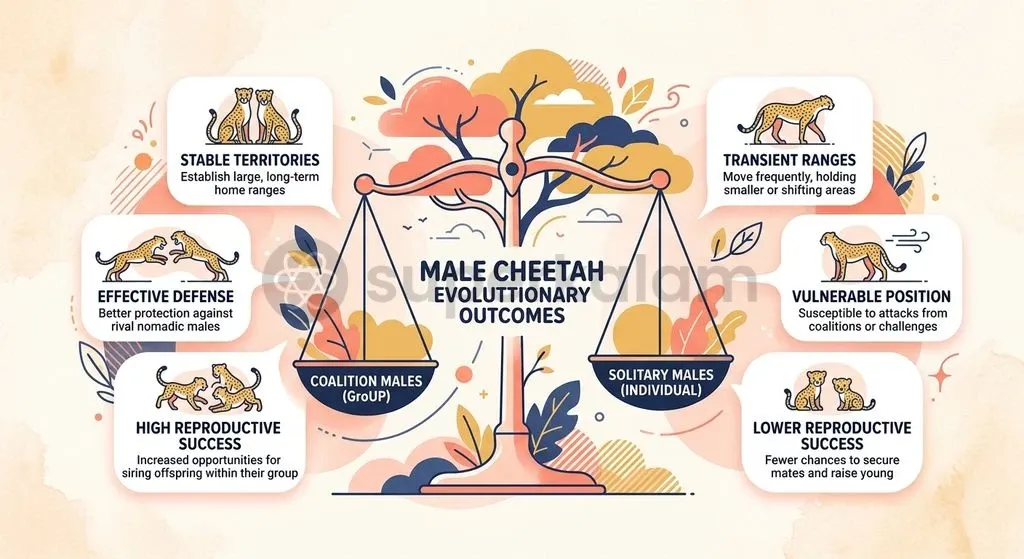
Male cheetahs display an unusual social organisation among solitary felids by forming permanent cooperative alliances. As documented in the Action Plan for Introduction of Cheetah in India, NTCA and Wildlife Institute of India, these groups typically consist of brothers from the same litter. Unrelated solitary males may also band together when territory acquisition demands greater collective numbers.
Forming a coalition provides distinct evolutionary advantages over solitary living:
- Territory Acquisition and Defence: Allied males maximise territory acquisition, hold resource-rich habitats for longer tenures, and defend core ranges against intruding rivals.
- Prey Capture and Safety: Cooperative hunting reduces the physical risk of subduing large prey animals.
- Predator Deterrence: Group vigilance deters kleptoparasitism and harassment from competing apex predators.
Coalitions vs Solitary Males: Hunting Efficiency, Mating Rights, and Dominance
Female and male cheetahs adopt divergent social systems and spatial utilisation patterns across dry deciduous landscapes. The CHEETAH - NTCA Technical Review & Progress Report highlights that female cheetahs maintain vast, non-defended home ranges that shift dynamically according to seasonal prey distribution.
Male coalitions pursue a different spatial strategy. Allied males defend smaller, strictly demarcated core territories that overlap with the wandering routes of multiple solitary females. Coalitions patrol and mark their borders using traditional scent-marking posts on trees and rocks to signal residency and repel transient rivals.
| Ecological Parameter | Male Cheetah Coalitions | Solitary Male Cheetahs (Nomads) | Solitary Female Cheetahs |
|---|---|---|---|
| Social Grouping | Bonded pairs or trios (often littermates) | Single adult males | Single adults (accompanied only by dependent cubs) |
| Spatial Strategy | Strictly defended, scent-marked core territory | Large, unstable, transient nomad ranges | Non-defended, dynamic home ranges tracking prey |
| Territory Retention | High tenure duration and sustained border defence | Frequent displacement by coalitions | No active defence of territorial boundaries |
| Mating Advantage | Priority access to overlapping females | Subordinate access; opportunistic mating | Selects mates across overlapping male territories |
Discuss with Superkalam
How does the spatial strategy of a male cheetah coalition differ from the movement patterns of solitary females?
Ask NowThe Spatial Bottleneck: Coalition Home Ranges vs Kuno's Carrying Capacity
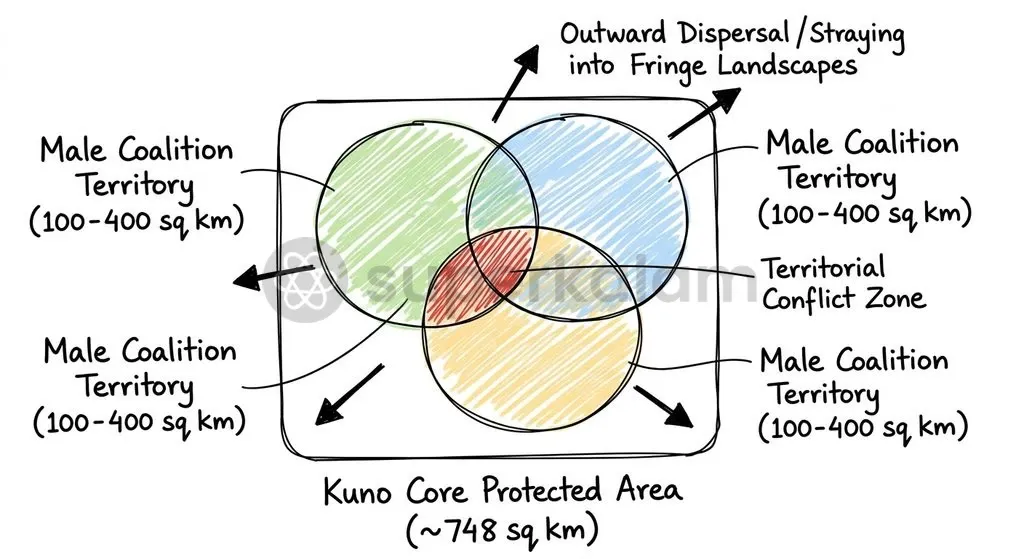
Kuno National Park faces a rigid physical ceiling when accommodating multiple male coalitions. The Action Plan for Introduction of Cheetah in India, NTCA and Wildlife Institute of India establishes that Kuno's notified core area spans approximately 748 square kilometres, which was originally calculated to sustain a baseline carrying capacity of up to 21 cheetahs based on prey assessments.
| Spatial Parameter | Spatial Extent |
|---|---|
| Kuno Core Notified Area | ~748 sq km |
| Per-Coalition Requirement | 100 to 400+ sq km |
According to the Introduction of Cheetah in India- Annual Report 2022-23, NTCA & WII, an individual male coalition requires a home range between 100 to 400+ square kilometres in dry deciduous savanna habitats.
Housing multiple rival groups triggers acute spatial saturation within Kuno's unfenced boundary. As resident coalitions expand their territorial borders to encompass optimal hunting grounds, weaker solitary males and dispersing animals are pushed towards the periphery.
Territorial Fights and Interstate Straying: Wildlife Management Dilemmas
Intraspecific conflict inside protected boundaries frequently forces cheetahs into long-distance exploratory movements through human-modified landscapes. Reintroduced animals regularly disperse through agricultural belts across Sheopur and Shivpuri in Madhya Pradesh and cross interstate borders into Baran district in Rajasthan.
Dispersal into agro-pastoral zones raises encounters with pastoralists, feral dogs, and transport corridors.
To mitigate these risks and prevent retaliatory actions against dispersing carnivores, project managers deployed over 450 local community volunteers known as 'Cheetah Mitras' across 80+ fringe villages around Kuno.
Discuss with Superkalam
How would you apply corridor-conservation principles to manage exploratory dispersals from Kuno into agricultural districts like Baran and Shivpuri?
Ask NowFenced vs Unfenced Landscapes: Lessons from Southern African Cheetah Reserves
South Africa manages its national cheetah metapopulation primarily inside small to medium-sized reserves protected by predator-proof electric perimeter fences. The Action Plan for Introduction of Cheetah in India, NTCA notes that the southern African approach relies on intensively managed artificial translocations between fenced reserves to mimic natural dispersal, control local density, and eliminate human-wildlife conflict along park borders.
India has adopted an unfenced, open-landscape metapopulation strategy to foster ecologically functional, free-ranging carnivore populations. While unfenced systems enable unhindered genetic mixing and landscape-scale movements, they expose dispersing individuals to human-dominated agricultural frontiers. This open model requires proactive corridor preservation and continuous monitoring to manage natural territorial friction.
| Management Feature | Southern African Fenced Model | Indian Open-Landscape Model |
|---|---|---|
| Enclosure Type | Predator-proof electrified perimeter fencing | Unfenced national parks and open sanctuaries |
| Dispersal Mechanism | Human-managed artificial translocations | Natural, self-directed wildlife movement corridors |
| Spatial Saturation Risk | Controlled via scheduled physical removals | Addressed through landscape connectivity and satellite sites |
| Human Interface | Minimal boundary interactions with local communities | High interaction requiring community volunteer networks |
Way Forward: Meta-Population Management, Gandhi Sagar, and Landscape Corridors
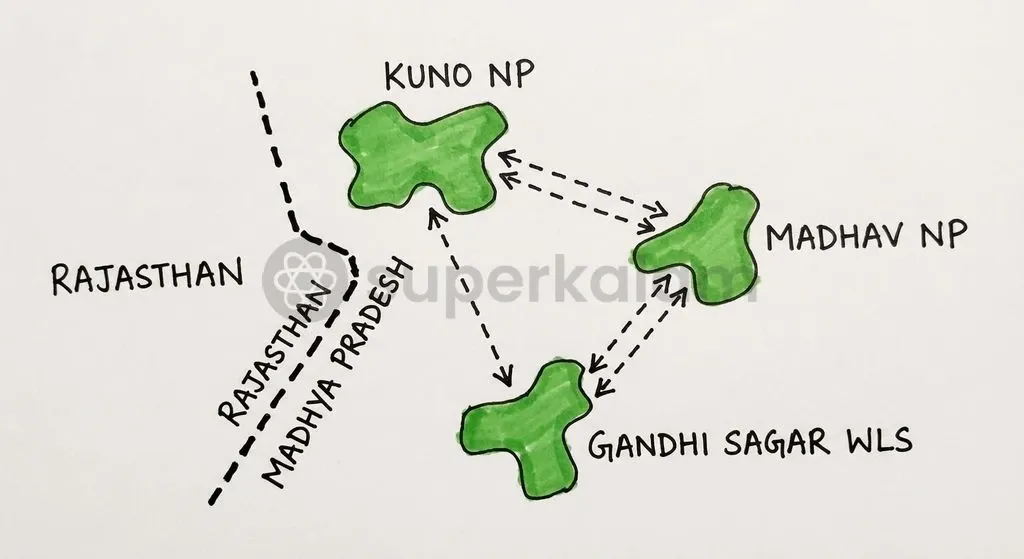
Establishing a viable cheetah population in India requires expanding conservation interventions beyond the geographic limits of Kuno National Park. Managing male coalition dynamics and alleviating spatial pressure relies on four strategic interventions:
- Operationalising Satellite Habitats: Forest authorities expanded the introduction network by operationalising Gandhi Sagar Wildlife Sanctuary as the second site, translocating male cheetahs Prabhas and Pavak in April 2025 and female cheetah Dheera in September 2025.
- Restoring Regional Corridors: Madhav National Park in Shivpuri district provides an essential eastern ecological corridor connecting Kuno to contiguous forest patches, facilitating safe dispersal and lowering intraspecific fighting.
- Targeting Landscape-Scale Metapopulations: Wildlife agencies are working toward establishing a viable metapopulation of 60 to 70 cheetahs across an interconnected ~17,000 square kilometre landscape across Madhya Pradesh and Rajasthan by 2032.
- Institutionalising Community Coexistence: Expanding the Cheetah Mitra network ensures rapid reporting of exploratory movements, preventing human-wildlife friction as coalitions expand into multi-use rural zones.
Discuss with Superkalam
Analyse the trade-offs between managing apex carnivores in predator-proof fenced reserves versus unfenced open landscapes.
Ask NowKey Takeaways
- Male cheetahs form lifelong coalitions—composed of littermates or bonded unrelated males—to secure prime territories, maintain dominance, and gain exclusive mating opportunities.
- Female cheetahs maintain dynamic, solitary home ranges governed by prey movements, whereas male coalitions fiercely defend fixed, scent-marked core territories.
- Individual male coalitions require between 100 to 400+ square kilometres, resulting in rapid spatial saturation inside Kuno National Park's approximately 748 square kilometres core area.
- Spatial pressure causes severe intraspecific territorial fights and drives long-range dispersal into agricultural districts across Madhya Pradesh and Rajasthan.
- Unlike South Africa's predator-fenced reserves, India utilises an open-landscape metapopulation model supported by over 450 Cheetah Mitras across 80+ fringe villages.
- Relieving carrying-capacity bottlenecks requires developing Gandhi Sagar Wildlife Sanctuary, securing the Madhav National Park corridor, and managing an interconnected ~17,000 square kilometre landscape.
Mains Question
"The high home-range requirements of male cheetah coalitions pose a spatial bottleneck within isolated protected areas." In light of this statement, examine the ecological dilemmas and management challenges confronting Kuno National Park. (10 Marks)
Evaluate NowMains Question
Contrast the fenced metapopulation strategy of Southern Africa with India's open-landscape cheetah reintroduction model. Critically analyse the strategic interventions needed to establish an interconnected, viable metapopulation across the central Indian landscape. (15 Marks)
Evaluate NowPractice MCQs
QUESTION 1
With reference to the spatial ecology and social behaviour of cheetahs in dry deciduous ecosystems, consider the following statements:
- Male cheetah coalitions defend strictly demarcated core territories marked by scent-marking posts.
- Female cheetahs maintain dynamic, non-defended home ranges that shift according to seasonal prey distribution.
- In dry deciduous savanna habitats, an individual male coalition requires a home range between 100 to 400+ square kilometres. Which of the statements given above are correct?
QUESTION 2
Consider the following statements regarding the management approaches for cheetah metapopulations:
- The Southern African model primarily relies on predator-proof electrified perimeter fencing and artificial translocations.
- India has adopted an unfenced, open-landscape model to facilitate natural dispersal and self-directed wildlife movement corridors.
- The baseline carrying capacity of Kuno National Park's notified core area was originally calculated for sustaining up to 50 cheetahs. Which of the statements given above is/are correct?
QUESTION 3
With reference to the regional conservation landscape for Project Cheetah, consider the following pairs:
- Gandhi Sagar Wildlife Sanctuary — Second introduction site receiving cheetah translocations
- Madhav National Park — Ecological corridor connecting Kuno to contiguous forest patches
- Baran District — Human-modified dispersal area located in Madhya Pradesh Which of the pairs given above is/are correctly matched?
QUESTION 4
In the context of wildlife management in Kuno National Park, the term 'Cheetah Mitras' refers to:
QUESTION 5
Consider the following statements regarding male cheetah coalition dynamics:
- Coalitions are formed exclusively by unrelated solitary adult males seeking territory.
- Cooperative living among allied males reduces the physical risk of hunting large prey animals.
- Formed alliances enhance deterrence against kleptoparasitism from competing apex predators. Which of the statements given above is/are correct?