Kishau Multipurpose Project: Six-State Pact Explained
A six-state agreement advances the Rs 15,000 crore Kishau project, with the Centre funding 90% and states sharing water and power benefits.
Sep, 2026
•8 min read
Context
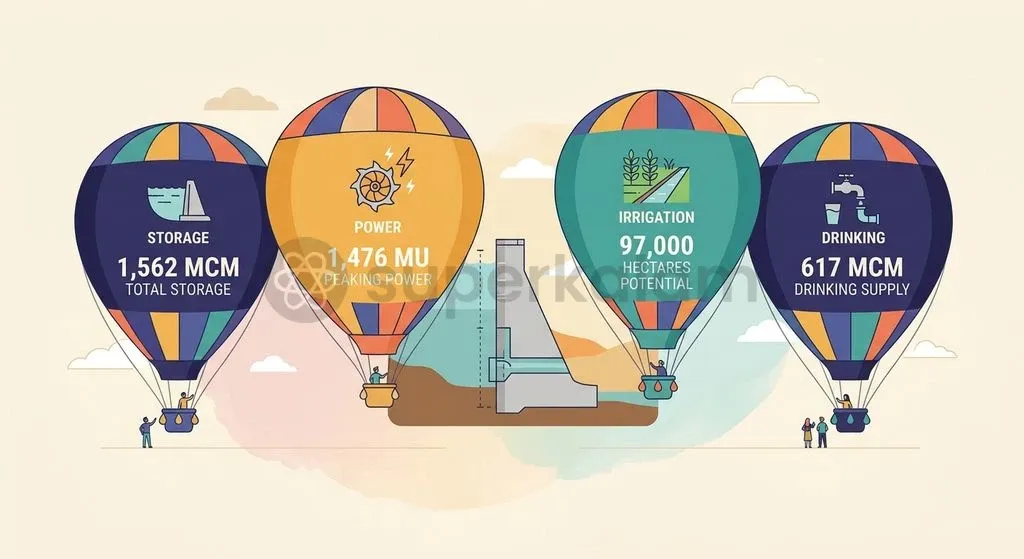
The Kishau Multipurpose Project unlocks a long-delayed strategic storage dam on the Tons River. It will supply 617 million cubic metres of drinking water, irrigate 97,000 hectares, and generate 1,476 million units of clean peaking power across six northern states.
Under the Upper Yamuna River Board framework, the initiative resolves decades of friction between upstream states facing submergence and downstream states needing water security. As of September 2026, the formal agreement unlocks central funding mechanisms under the National Project scheme, setting a practical precedent for cooperative federalism.
Why Kishau Multipurpose Project is Back in the News
Chief Ministers of six Upper Yamuna basin states signed a landmark inter-state agreement for the Kishau Multipurpose Project in New Delhi on 15 September 2026. The participating states include Himachal Pradesh, Uttarakhand, Uttar Pradesh, Haryana, Rajasthan, and Delhi.
According to a PIB Delhi press release, the signing formalises consensus across three core pillars:
- Financial commitments: Clear rules on project cost-sharing across all six participating states.
- Resource quotas: Binding volumetric terms on water distribution ratios for drinking and irrigation.
- Energy rights: Clear allocation parameters on power off-take terms.
The agreement allows the executing agency to submit the comprehensive project proposal for final Union Cabinet clearance. As reported by the Press Information Bureau, the project entails an estimated investment ranging between ₹15,000 to ₹15,624 crore.
This milestone operationalises an allocation framework first structured in 1994. The dam joins two other planned upstream storage facilities—the Lakhwar Dam on the Yamuna and the Renukaji Dam on the Giri River—aimed at regulating non-monsoon river flows across north India.
What is the Kishau Multipurpose Project?
The Kishau Multipurpose Project is a major water storage and hydro-energy infrastructure initiative planned on the Tons River. The project design features a 232.6-metre-high concrete gravity dam that creates a live reservoir capacity of 1,562 million cubic metres, as outlined in official project specifications.
The infrastructure delivers dual outputs: hydropower generation and regulated downstream water supply. Kishau Corporation Limited, incorporated in January 2017 as a 50:50 joint venture between the state governments of Uttarakhand and Himachal Pradesh, is the dedicated special purpose vehicle executing the project.
| Parameter | Project Specification | Strategic Impact |
|---|---|---|
| Dam Structure | 232.6-metre concrete gravity dam | Creates 1,562 million cubic metres of gross storage |
| River & Basin | Tons River (Yamuna River Basin) | Regulates seasonal runoff on the largest tributary of the Yamuna |
| Power Generation | 1,476 million units (MU) annually | Provides renewable peaking power for northern grid stability |
| Irrigation Potential | Approximately 97,000 hectares | Enhances agricultural productivity in downstream command areas |
| Drinking Water Supply | 617 million cubic metres annually | Assures municipal supply to Delhi NCT and the NCR |
| Executing Entity | Kishau Corporation Limited (KCL) | Joint venture of Uttarakhand and Himachal Pradesh governments |
Geography and River System: Tons River, Yamuna Basin, and Project Location
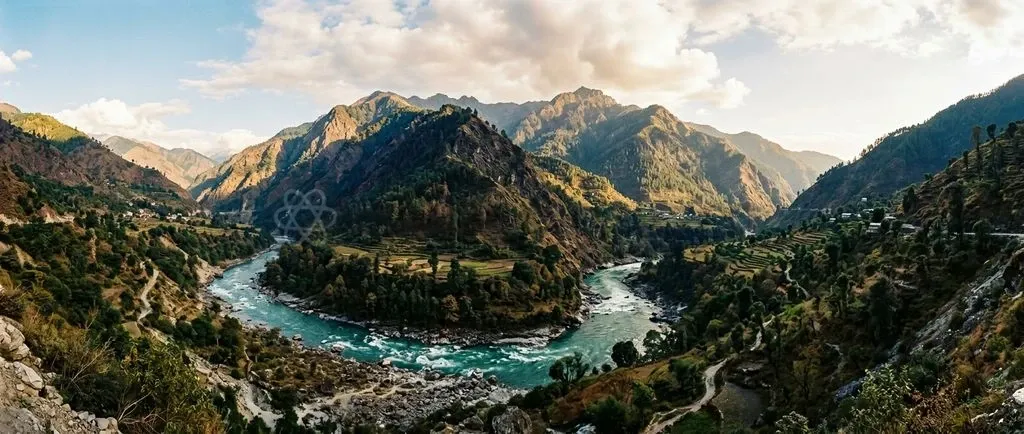
The Tons River is the largest tributary of the Yamuna River, originating in the Garhwal Himalayas. It carries more water volume than the main Yamuna stream prior to their confluence.
The Kishau Dam site straddles the inter-state boundary between the Dehradun district of Uttarakhand and the Sirmaur district of Himachal Pradesh.
The geography shapes the project's regional hydrography through distinct structural features:
- Inter-state Gorge: The Tons carves deep Himalayan gorges before converging with the Yamuna near Dakpathar in Uttarakhand, directly impacting both hill administrations through submergence and civil works.
- Flood Moderation: Storage capacity provides vital seasonal flood regulation during the intense South-West monsoon.
- Lean Season Rejuvenation: Regulated discharge sustains environmental flows (e-flows) in the downstream Yamuna, supporting river rejuvenation efforts toward the targeted 2029 Clean Yamuna objectives.
Discuss with Superkalam
Which two state governments established Kishau Corporation Limited as a 50:50 joint venture?
Ask NowPower, Irrigation, and Drinking Water: Who Gets What?
Resource allocations from the Kishau Multipurpose Project divide into hydroelectric energy and consumptive water components:
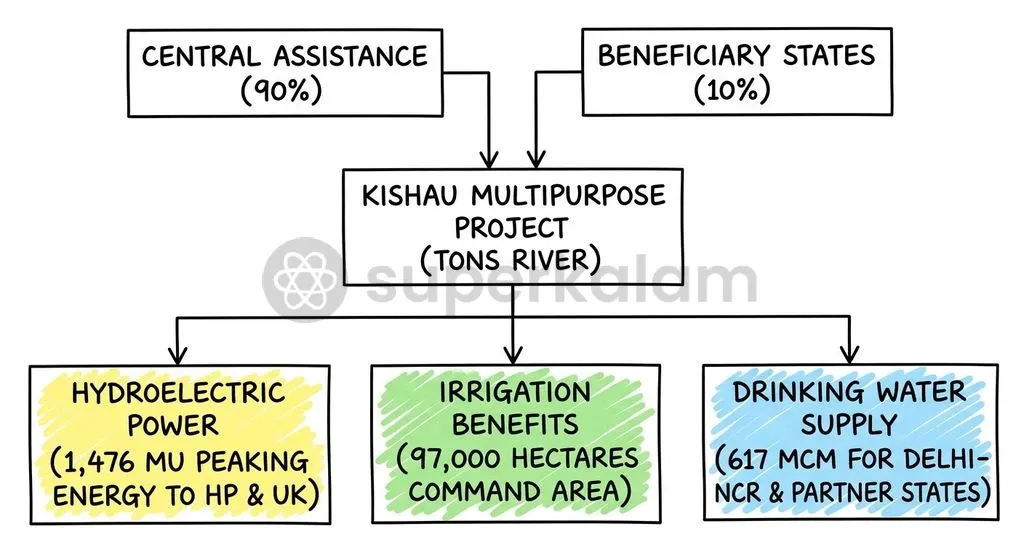
- Peaking Power: The project generates 1,476 million units of clean energy annually to help balance renewable grid integration in northern India.
- Downstream Irrigation: The reservoir creates 97,000 hectares of irrigation potential across beneficiary plains states, including Haryana, Uttar Pradesh, and Rajasthan.
- Municipal Water Supply: Consumptive storage reserves up to 617 million cubic metres of assured water annually for urban concentrations in Delhi and surrounding National Capital Region districts.
Under the declared National Project status, the Central Government provides 90% of the funding for the water component as central grant assistance. The remaining 10% is shared among the six beneficiary states based on their proportionate water quotas under the Upper Yamuna River Board framework.
Why Was the Kishau Project Delayed for Decades?
The Kishau Dam was originally conceptualised under the multi-state Memorandum of Understanding signed on 12 May 1994 for sharing the waters of the Upper Yamuna River basin. Despite its early conception alongside the Lakhwar and Renukaji dams, implementation stalled due to disagreements over structural cost-sharing between power and water components.
Key structural bottlenecks included:
- Submergence and Equity Costs: Upstream states—primarily Himachal Pradesh and Uttarakhand—faced severe displacement and land submergence burdens while struggling to fund statutory equity for power generation.
- Cost Allocation Disputes: Downstream agrarian and urban states sought firm drinking and irrigation quotas without funding the civil power infrastructure.
- Forest Land and Rehabilitation: Inter-state disagreements over forest diversion and rehabilitation obligations stalled joint venture operations by Kishau Corporation Limited.
Discuss with Superkalam
Explain how swapping power component liabilities for consumptive water quotas addresses the financial constraints of upstream hill states.
Ask NowThe Inter-State Dispute and How the New MoU Resolves It
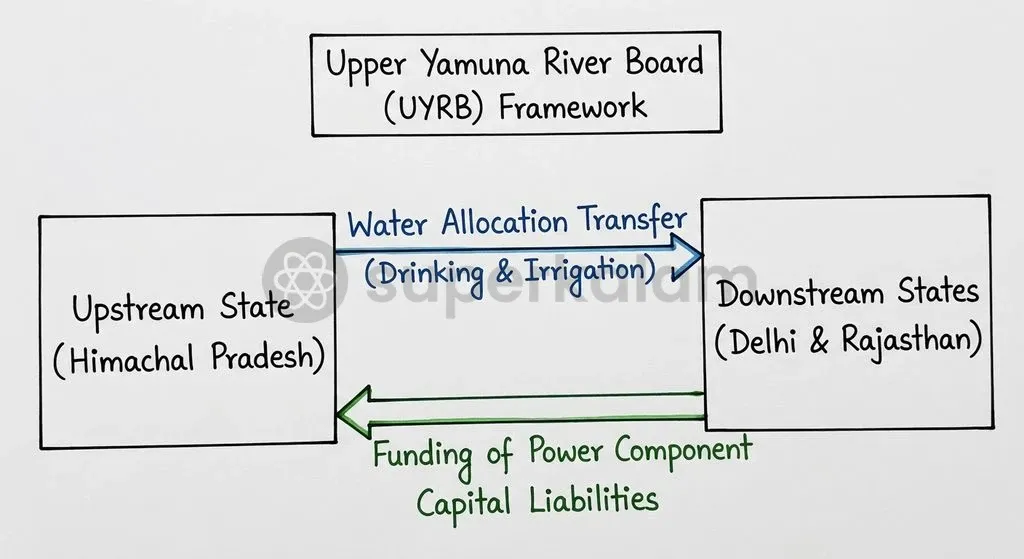
The 2026 inter-state agreement resolves the historical deadlock by unbundling power-house liabilities from state-level water allocations. Under the consensus brokered through the Ministry of Jal Shakti, downstream beneficiaries Delhi and Rajasthan agreed to absorb Himachal Pradesh's power component costs.
The breakthrough operates through a practical structural swap:
- Capital Liability Assumption: Delhi and Rajasthan take on the capital expenditure for the upstream power generation component.
- Consumptive Quota Transfer: In exchange, Himachal Pradesh transfers its proportionate consumptive water rights to the two downstream urban states.
- Fiscal & Municipal Relief: The arrangement spares the hill state capital strain while guaranteeing vital drinking water quotas to downstream urban centres.
The Upper Yamuna River Board, a subordinate office of the Department of Water Resources, River Development and Ganga Rejuvenation within the Ministry of Jal Shakti, oversees compliance with these updated volumetric quotas. This compromise removes unilateral state vetoes and secures a workable balance across the basin.
Environmental Clearance, Submergence, and Resettlement Concerns
Large-scale Himalayan storage dams present sensitive ecological and rehabilitation challenges:
- Submergence and Forest Diversion: The 232.6-metre-high Kishau dam impounds a large reservoir along the steep Tons valley, requiring forest land diversion and resettlement of riverine habitations across Sirmaur and Dehradun districts.
- Catchment Area Treatment (CAT): Project execution mandates comprehensive Catchment Area Treatment plans to mitigate high siltation rates common to young fold mountain hydrography.
- Downstream Environmental Flows: Regular water releases during lean winter and summer seasons are mandatory to sustain aquatic ecosystems and improve water quality downstream in the Yamuna.
- Statutory R&R Compliance: Resettlement and Rehabilitation (R&R) packages must adhere strictly to the Right to Fair Compensation and Transparency in Land Acquisition, Rehabilitation and Resettlement Act, 2013.
Discuss with Superkalam
Evaluate whether negotiated river board settlements are more effective than Article 262 tribunals in executing multi-state infrastructure projects.
Ask NowCooperative Federalism in Action: Lessons for National Water Projects
The Kishau agreement illustrates how institutional mediation resolves complex river disputes within Indian federalism. While Entry 17 of the State List gives states authority over water supplies, irrigation, and storage, Entry 56 of the Union List empowers the Centre to regulate inter-state rivers in the public interest.
The framework governed by the Upper Yamuna River Board provides an alternative model to litigious tribunal adjudication under Article 262 of the Constitution. Negotiated settlement platforms permit flexible commercial arrangements, such as swapping power liabilities for water rights, which formal tribunals cannot easily structure.
| Dimension | Cooperative Mechanism |
|---|---|
| Basin Regulatory Agency | Upper Yamuna River Board (UYRB) |
| Statutory Scope | Inter-state water accounting and seasonal flow regulation |
| Funding Model | 90% Central Assistance for water storage component |
| Dispute Resolution | Negotiated resource swaps (Power cost liabilities traded for drinking water) |
By leveraging the National Project funding formula, the Centre lowered capital hurdles for individual states, transforming a protracted regional dispute into a collective infrastructure programme.
Discuss with Superkalam
Propose a policy model incorporating Catchment Area Treatment and strict R&R compliance to sustainably develop future Himalayan storage dams.
Ask NowThe Way Forward: Accelerating Himalayan River Infrastructure Safely
Expedited execution of the Kishau project requires immediate Union Cabinet sanction for the revised cost estimate of up to ₹15,624 crore. Kishau Corporation Limited must secure remaining stage-II environmental clearances and expedite tender processing to prevent inflationary cost escalations.
Technical monitoring must incorporate seismic-resistant engineering and real-time geological sensors, accounting for the tectonic vulnerability of the Outer Himalayan belt. Coordinated water releases across the upstream storage trio—Kishau, Lakhwar, and Renukaji—should be synchronised through automated basin-wide decision support systems.
Finally, downstream states must modernise canal networks and municipal distribution systems to prevent conveyance losses. This step ensures that stored Himalayan waters achieve maximum agricultural and urban efficiency.
Key Takeaways
- The Kishau Multipurpose Project is a 232.6-metre concrete gravity dam located on the Tons River along the Uttarakhand-Himachal Pradesh border, creating 1,562 million cubic metres of water storage.
- Six basin states—Himachal Pradesh, Uttarakhand, Uttar Pradesh, Haryana, Rajasthan, and Delhi—signed an inter-state agreement on 15 September 2026 to resolve cost-sharing and resource-distribution mechanisms.
- Under its declared 'National Project' status, the Union Government funds 90% of the water component's capital cost as central grants, with the remaining 10% shared by beneficiary states.
- The breakthrough agreement allows Delhi and Rajasthan to fund Himachal Pradesh's power component liabilities in exchange for receiving Himachal Pradesh's allocated share of consumptive water.
- The project delivers 1,476 million units of annual hydroelectric peaking power, irrigates 97,000 hectares, and supplies 617 million cubic metres of drinking water to Delhi NCR, while sustaining Yamuna environmental flows.
Mains Question
"Institutional mediation under river basin frameworks provides a pragmatic alternative to litigious tribunal adjudication in resolving multi-state river disputes." In light of the 2026 inter-state consensus on the Kishau Multipurpose Project, examine how negotiated structural swaps can advance cooperative federalism. (10 Marks)
Evaluate NowMains Question
While large Himalayan storage projects like the Kishau Multipurpose Dam are vital for regional water security and clean peaking power, they introduce substantial socio-ecological vulnerabilities. Critically analyse this statement. (15 Marks)
Evaluate NowPractice MCQs
QUESTION 1
Consider the following statements regarding the Kishau Multipurpose Project:
- It entails the construction of a 232.6-metre-high concrete gravity dam on the Tons River.
- Kishau Corporation Limited is a 50:50 joint venture between Uttarakhand and Himachal Pradesh.
- Under the National Project scheme, the Central Government provides 90% grant assistance for the water component. Which of the statements given above are correct?
QUESTION 2
With reference to the inter-state dispute resolution mechanism established for the Kishau Multipurpose Project, consider the following statements:
- Delhi and Rajasthan agreed to absorb the capital expenditure of Himachal Pradesh's power component.
- Himachal Pradesh agreed to transfer its proportionate consumptive water rights to Delhi and Rajasthan.
- Compliance with the updated volumetric water quotas is overseen by the Upper Yamuna River Board. Which of the statements given above is/are correct?
QUESTION 3
Consider the following statements regarding the geography and hydrography of the Kishau Dam project:
- The dam site straddles the boundary between Sirmaur district of Himachal Pradesh and Dehradun district of Uttarakhand.
- The Tons River carries less water volume than the main Yamuna stream prior to their confluence at Dakpathar.
- The project operates in conjunction with the Lakhwar Dam on the Yamuna and the Renukaji Dam on the Giri River. Which of the statements given above is/are correct?
QUESTION 4
In the context of Indian constitutional provisions governing inter-state water infrastructure and resource allocation, which of the following is correctly matched?
QUESTION 5
Consider the following statements regarding the environmental and statutory compliance mandates for the Kishau Project:
- Catchment Area Treatment (CAT) plans are required to mitigate high siltation rates in the Himalayan basin.
- Regulated lean-season discharge is mandated to maintain environmental flows (e-flows) in the downstream Yamuna.
- Resettlement and Rehabilitation measures must comply with the Right to Fair Compensation and Transparency in Land Acquisition, Rehabilitation and Resettlement Act, 2013. Which of the statements given above are correct?