JJM 2.0 and SBM(G) 2.0 Convergence: Securing Rural Water
Why merging piped water delivery with liquid waste systems is essential for safeguarding groundwater tables and empowering Gram Panchayats.
Sep, 2026
•9 min read
Overview
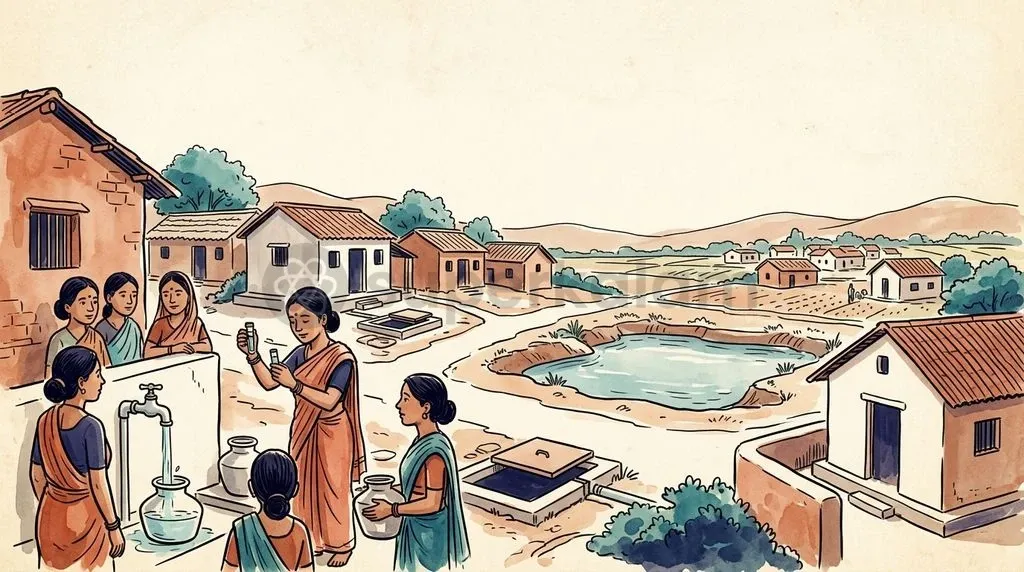
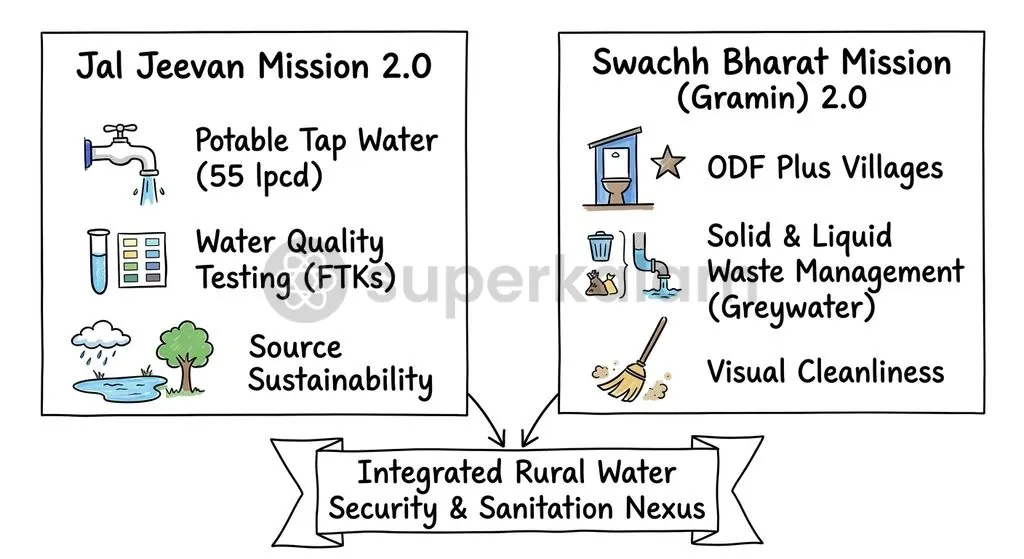
The convergence of Jal Jeevan Mission 2.0 and Swachh Bharat Mission (Gramin) 2.0 sets up an integrated rural utility framework. It synchronises household tap water delivery with decentralised wastewater treatment. This integrated setup shields local aquifers from contamination and secures rural drinking water supplies.
Joint directives from the Department of Drinking Water and Sanitation and the Ministry of Rural Development instruct Gram Panchayats to merge water delivery and liquid waste handling into single village plans. Pooling Fifteenth Finance Commission tied grants with rural employment works prevents unmanaged household runoff from polluting groundwater tables. Under this policy, village bodies operate as decentralised public utilities equipped to safeguard local water quality.
Why in the News: The Push to Merge Rural Water and Sanitation Planning
The Department of Drinking Water and Sanitation issued national directives instructing States and Union Territories to align Jal Jeevan Mission 2.0 with Swachh Bharat Mission (Gramin) 2.0. As of August 2026, this policy convergence operates under the statutory framework of the Viksit Bharat – Guarantee for Rozgar and Ajeevika Mission (Gramin) Act, 2025, linking physical asset creation directly with rural employment works.
The Union Government approved Jal Jeevan Mission 2.0 on March 10, 2026. Following this approval, the national programme shifted focus from basic pipeline laying to drinking water source sustainability, groundwater recharge, and greywater management. Supplying tap water without dedicated drainage causes wastewater to pool in village lanes. This stagnant runoff seeps into the shallow aquifers feeding rural drinking wells.
Convergence Framework Architecture
- Financing Source: 15th Finance Commission tied grants (₹1.42 lakh crore) pooled with rural employment works.
- Planning Level: Viksit Gram Panchayat Plans driven by geospatial water budgeting on the Yuktdhara portal.
- Twin Interventions: Pairing JJM 2.0 potable supply (55 lpcd) with SBM-G 2.0 greywater management.
- End Objective: Safeguarding local aquifer sustainability and rural public health.
Understanding the Two Schemes: Jal Jeevan Mission and Swachh Bharat Mission (Gramin)
Jal Jeevan Mission and Swachh Bharat Mission (Gramin) are the twin pillars of rural public health and environmental sanitation in India. Both programmes target village living standards, yet they historically ran along separate administrative lines, financing streams, and engineering wings.
| Dimension | Jal Jeevan Mission (JJM 2.0) | Swachh Bharat Mission (Gramin) Phase II |
|---|---|---|
| Primary Mandate | Provision of 55 litres per capita per day (lpcd) of potable tap water | Attaining ODF Plus Model status through total sanitation |
| Core Components | In-village water distribution, source strengthening, and water quality monitoring | Solid waste segregation, liquid waste management, and faecal sludge handling |
| Target Milestone | Universal functional household tap connections and source sustainability | Visual cleanliness, zero open discharge, and ODF sustainability |
| Technical Focus | Aquifer recharge, Field Test Kits (FTKs), and bulk water metering | Soak pits, waste stabilisation ponds, and constructed wetlands |
| Local Institution | Paani Samiti or Village Water and Sanitation Committee (VWSC) | Gram Panchayat and Swachhata Samiti |
Jal Jeevan Mission delivers safe drinking water to every rural home. Swachh Bharat Mission (Gramin) Phase II sustains open-defecation-free status while building solid and liquid waste infrastructure.
To qualify as an ODF Plus Model village, a habitation must maintain sustained open-defecation-free status, set up functional solid and liquid waste systems, eliminate stagnant water pools, and display public awareness boards per DDWS guidelines.
Discuss with Superkalam
What percentage of potable water supplied to a rural household is typically converted into greywater?
Ask NowWhy Integration Matters: The Water-Sanitation Nexus in Rural India
Providing piped water without liquid waste treatment endangers groundwater across rural settlements. As domestic water supply expands, household wastewater output climbs in direct proportion.
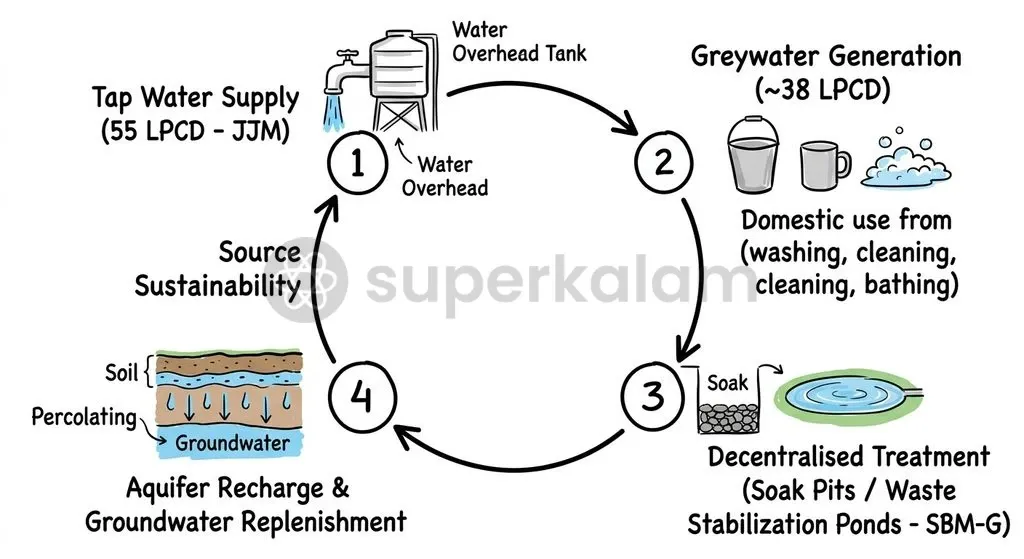
- Greywater Conversion: Approximately 65% to 70% of potable water supplied at 55 lpcd turns into greywater.
- Daily Waste Generation: An average rural resident produces 36 to 38 litres of liquid waste each day.
- Contamination Risks: Untreated runoff collects in unlined ditches, breeding disease vectors and leaching nitrates into shallow drinking aquifers.
To clear standing wastewater, the Ministry of Jal Shakti ran successive 100-day drives under the Sujalam campaign (Sujalam 1.0, 2.0, and 3.0) to build household and community soak pits. The convergence framework turns these temporary campaigns into permanent planning rules. Connecting supply lines with drainage networks blocks pathogens from entering drinking wells, completing a closed village water loop.
Key Institutional Changes: What Shifts for Gram Panchayats and Village Water Committees
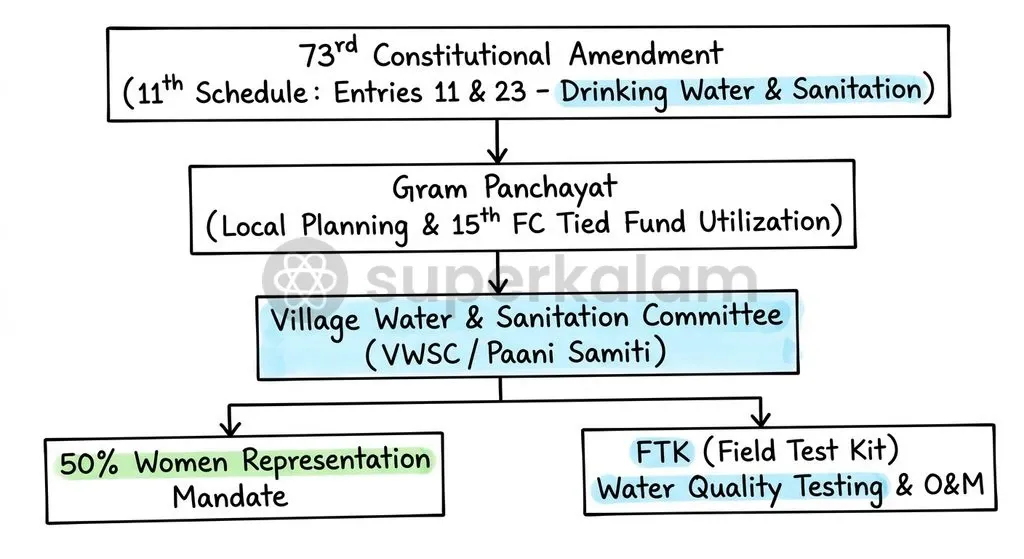
Gram Panchayats function as statutory local public utilities under the 73rd Constitutional Amendment Act. The Eleventh Schedule empowers Panchayats under Entry 11 (Drinking Water) and Entry 23 (Health and Sanitation) to manage rural health engineering assets directly.
Institutional Mandate and Committee Composition
- Constitutional Anchor: Entry 11 and Entry 23 transfer water supply and sanitation oversight to the Gram Panchayat.
- Gender Balance: At least 50% of committee members on Paani Samitis must be women.
- Social Representation: Committees must provide proportional seats to Scheduled Caste and Scheduled Tribe residents.
- Water Quality Surveillance: Gram Panchayats must train five women in every village to run chemical and bacteriological tests with Field Test Kits, recording results on the Water Quality Management Information System.
- Community Co-Financing: Local residents contribute 5% of capital expenditure in hilly, forested, and SC/ST-dominated villages, and 10% in general villages to build local ownership.
Discuss with Superkalam
Why does supplying piped tap water without dedicated liquid waste drainage lead to groundwater contamination in rural areas?
Ask NowPlanning and Financing: How 15th Finance Commission Grants and Tied Funds Work Together
The Fifteenth Finance Commission allocated ₹1,42,084 crore in tied grants to Rural Local Bodies for water and sanitation works. This ring-fenced fund gives local panchayats the fiscal backing needed for joint execution.
| Grant Category | Share of RLB Grant | Allocation Amount | Mandated Purpose |
|---|---|---|---|
| Untied Grants | 40% | ₹94,721 crore | Basic local administrative and civic requirements |
| Tied Grants (Water) | 30% (half of tied) | ₹71,042 crore | Drinking water supply, source recharge, and rainwater harvesting |
| Tied Grants (Sanitation) | 30% (half of tied) | ₹71,042 crore | Sanitation, ODF Plus maintenance, and greywater management |
| Total Allocation | 100% | ₹2,36,805 crore | Total Rural Local Body allocation spanning 2021–22 to 2025–26 |
Gram Panchayats combine these tied grants with a 40% labour component from rural employment schemes to build drainage channels and community stabilisation ponds.
To prevent overlapping works, States merge individual Village Action Plans (VAPs) into comprehensive Viksit Gram Panchayat Plans. Technical planning follows spatial mapping on the Yuktdhara geospatial portal alongside baseline water budgeting. Engineering staff from Rural Water Supply and Public Health Engineering departments also sit on District Steering Committees, securing inter-departmental alignment.
Greywater Management and Source Sustainability: Breaking the Siloed Approach
Swachh Bharat Mission (Gramin) Phase II sets out engineering measures to treat domestic greywater and replenish local water tables. Handling liquid waste as a hydrological resource directly reinforces village drinking water security.
Greywater Treatment Pathways
- Individual Household Mechanisms: Best for low-density settlements using soak pits, leach pits, magic pits, and kitchen garden drainage.
- Community-Scale Systems: Biological treatment setups like Waste Stabilisation Ponds (WSPs), constructed wetlands, Decentralised Wastewater Treatment Systems (DEWATS), or root-zone Phytorid beds.
- Resource Recovery: Channeling treated water into aquifer recharge or reusing it for irrigation and secondary community needs.
As reported on the SBM(G) Integrated Management Information System, 5,63,809 rural villages out of 5,86,944 have installed liquid waste management arrangements as of August 7, 2026. Treating runoff before it pools prevents pathogens from reaching tube wells, establishing a self-sustaining local water loop.
Discuss with Superkalam
How would a Gram Panchayat deploy 15th Finance Commission tied grants alongside rural employment works to design a village wastewater system?
Ask NowMajor Implementation Bottlenecks: Capacity Deficits, Operations, and Maintenance
Rural Local Bodies encounter practical hurdles in technical staffing, local revenue collection, and asset upkeep. Tackling these field challenges is vital to stop newly built infrastructure from falling into disrepair.
- Financial Sustainability Gaps: Gram Panchayats struggle to collect water and drainage user fees. As a result, untied funds drain quickly to pay recurring pump power bills.
- Technical and Operational Shortfalls: Paani Samitis often lack training in pump repairs, leak fixing, and pond desilting. Villages remain dependent on private mechanics for basic maintenance.
- Testing Reagent Shortages: Although guidelines mandate five trained women per village, reagent stock-outs interrupt bacteriological testing and push routine samples back onto regional laboratories.
- Administrative Friction: Jurisdictional overlaps between state line departments and Gram Panchayats slow down emergency repairs and fragment asset oversight.
Discuss with Superkalam
Compare the effectiveness of household-level soak pits versus community-level Waste Stabilisation Ponds in managing rural greywater.
Ask NowWay Forward: Building Lasting Community Ownership and Water Security
Jal Jeevan Mission 2.0 depends on active community oversight and real-time digital monitoring to sustain rural water delivery. Moving from pipeline construction to long-term reliability calls for focused action across three areas:
- Upgrading Grassroots Technical Capacity: State Rural Development institutes must train Paani Samitis and certify rural youth as local pump technicians. Partnering with Women Self-Help Groups under State Rural Livelihood Missions improves tariff collection and regular sanitary inspections.
- Unifying Digital Dashboards: Merging the JJM portal, the SBM(G) Integrated Management Information System, and the Water Quality Management Information System (WQMIS) gives district collectors a unified dashboard to monitor water balance, water quality alerts, and plant status.
- Institutionalising Aquifer Mapping: Gram Panchayats must include hydro-geological aquifer mapping in their annual Viksit Bharat planning cycles. Potable water delivery and liquid waste disposal must operate as a single circular cycle.
Key Takeaways
- Policy Convergence: Under directives from DDWS and the Ministry of Rural Development, JJM 2.0 and SBM-G 2.0 merge under the Viksit Bharat – Guarantee for Rozgar and Ajeevika Mission (Gramin) Act, 2025.
- Hydrological Nexus: Delivering 55 lpcd generates 36 to 38 litres of greywater daily per person (65% to 70% return rate), which contaminates shallow drinking water sources if left unmanaged.
- Tied Financial Architecture: The 15th Finance Commission earmarked ₹1,42,084 crore (60% of total RLB grants) as tied funds, split equally between drinking water/recharge and sanitation/ODF maintenance.
- Constitutional Mandate: Anchored in the 73rd Amendment (Eleventh Schedule, Entries 11 and 23), Gram Panchayats and Paani Samitis (with ≥50% women members) act as statutory local public utilities.
- Liquid Waste Progress: As of August 7, 2026, 5,63,809 out of 5,86,944 rural villages are mapped with functional liquid waste management arrangements on the SBM(G) IMIS portal.
- Quality Surveillance: Five women per village are mandated and trained to test local water using Field Test Kits integrated with the WQMIS database.
Mains Question
"Supplying potable piped water without synchronised liquid waste management endangers groundwater security in rural settlements." In light of the Jal Jeevan Mission 2.0 and Swachh Bharat Mission (Gramin) Phase II convergence, critically examine the significance of breaking administrative silos to protect village drinking water sources. (10 Marks)
Evaluate NowMains Question
The Eleventh Schedule of the Constitution empowers Gram Panchayats to act as local public utilities for public health and water engineering. Evaluate how the pooling of 15th Finance Commission tied grants with rural employment legislation enables sustainable decentralised water governance. (15 Marks)
Evaluate NowPractice MCQs
QUESTION 1
With reference to the financing and planning architecture of the JJM 2.0 and SBM(G) 2.0 convergence framework, consider the following statements:
- The Fifteenth Finance Commission allocated tied grants exclusively for drinking water supply, leaving sanitation works to be funded entirely by rural employment schemes.
- Planning under the convergence framework utilizes spatial mapping on the Yuktdhara geospatial portal to formulate Viksit Gram Panchayat Plans.
- Gram Panchayats are permitted to combine tied grants with a 40% labour component from rural employment schemes for building drainage infrastructure.
Which of the statements given above are correct?
QUESTION 2
Consider the following statements regarding the institutional guidelines for Village Water and Sanitation Committees (Paani Samitis) under Jal Jeevan Mission:
- At least 50% of the committee members on Paani Samitis must be women.
- Gram Panchayats are required to train five women in every village to conduct water quality testing using Field Test Kits.
- Community co-financing requires a mandatory 10% capital expenditure contribution across all villages, with no exemptions or concessions for hilly or Scheduled areas.
Which of the statements given above is/are correct?
QUESTION 3
With reference to greywater generation and rural sanitation dynamics under SBM(G) Phase II, consider the following statements:
- Approximately 65% to 70% of potable water supplied at 55 lpcd is converted into greywater in rural households.
- Waste Stabilisation Ponds and root-zone Phytorid beds are individual household-level mechanisms recommended for low-density settlements.
- To qualify as an ODF Plus Model village, a habitation must maintain sustained ODF status, eliminate stagnant water pools, and establish functional solid and liquid waste systems.
Which of the statements given above is/are correct?
QUESTION 4
Under the 73rd Constitutional Amendment Act, which entries in the Eleventh Schedule directly empower Gram Panchayats to administer rural water supply and liquid waste management engineering assets?
QUESTION 5
Consider the following statements regarding national rural development programmes in India:
- Jal Jeevan Mission 2.0 was approved by the Union Government in March 2026, shifting programmatic focus toward groundwater recharge and source sustainability.
- The statutory convergence of JJM 2.0 and SBM-G 2.0 operates under the Viksit Bharat – Guarantee for Rozgar and Ajeevika Mission (Gramin) Act, 2025.
Which of the statements given above is/are correct?