ITLA: Integrated Transport and Logistics Authority Explained
ITLA is a proposed SPV for multimodal transport planning. Read its functions, technical appraisal role and how it differs from PM Gati Shakti.
Oct, 2026
•10 min read

Context
The Union Cabinet approved the establishment of the Integrated Transport and Logistics Authority (ITLA) on 6 October 2026. Formed as a Special Purpose Vehicle (SPV), it institutionalises multi-modal planning, project appraisals, and network monitoring across India's transport landscape. ITLA serves as the apex institutional anchor for the PM GatiShakti National Master Plan and the National Logistics Policy.
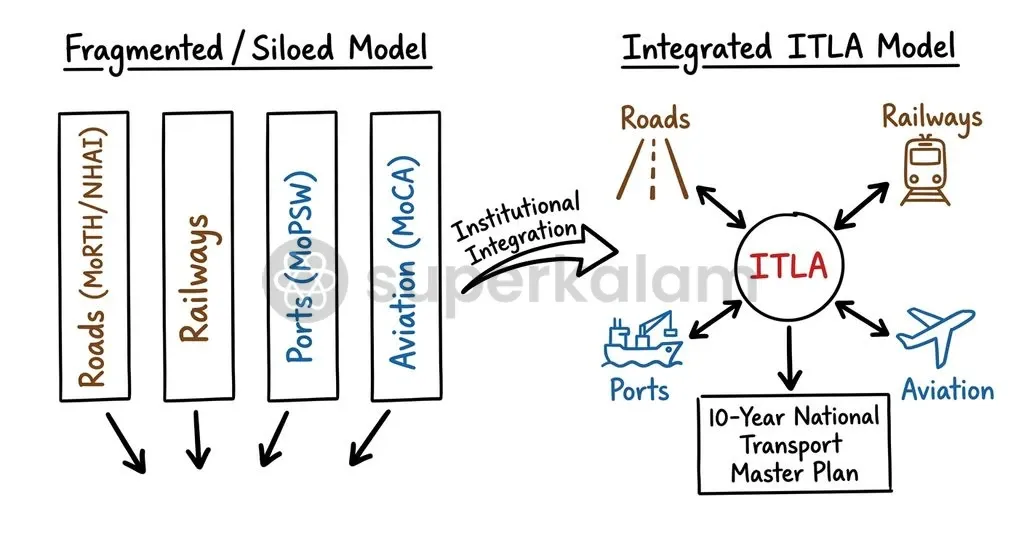
Its primary purpose is breaking entrenched departmental silos across roads, railways, aviation, and shipping. By mandating technical scrutiny for central projects costing ₹500 crore or more, ITLA targets duplicate capital expenditure. However, its structure as an executive corporate entity rather than a statutory regulator raises questions about its enforcement power over legacy modal authorities.
Why is ITLA in the News?
On 6 October 2026, the Union Cabinet cleared the creation of the Integrated Transport and Logistics Authority as an apex Special Purpose Vehicle. As of October 2026, this reform marks the central government's most ambitious effort to unify transport governance since rolling out the PM GatiShakti National Master Plan in October 2021.
The institutional move targets chronic bottlenecks in project clearances, multi-modal alignments, and corridor synchronisation across line ministries.
Discuss with Superkalam
What is the minimum project cost threshold that triggers a mandatory technical appraisal by ITLA?
Ask NowITLA steers national logistics strategy by formulating a rolling National Transport Master Plan spanning a horizon of 10 years or more. This long-range strategy encompasses roads, railways, civil aviation, ports, inland waterways, coastal shipping, urban transit systems, and multi-modal logistics nodes. Through this mechanism, ITLA aligns macro-level connectivity targets with local project execution.
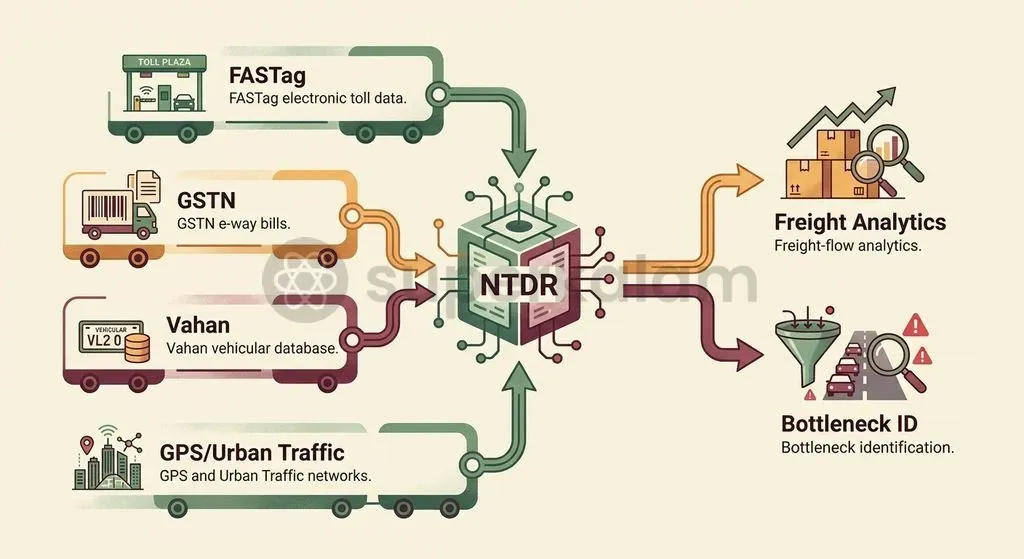
The authority also serves as a central intelligence hub. It manages the National Transport Data Repository (NTDR), aggregating real-time data feeds across major freight networks. By synthesizing records from GSTN e-way bills, FASTag tolls, Vahan vehicle registrations, GPS trackers, and urban traffic feeds, ITLA runs advanced freight-flow analytics.
| Feature / Dimension | Legacy Appraisal Framework | ITLA Framework |
|---|---|---|
| Planning Horizon | Fragmented 5-year ministerial plans | Rolling 10+ year National Transport Master Plan |
| Appraisal Focus | Isolated, mode-specific technical clearance | Mandatory multi-modal technical appraisal (≥₹500 crore) |
| Data Architecture | Disparate ministerial databases | Integrated National Transport Data Repository |
| Governance Structure | Independent sectoral boards (NHAI, Railway Board) | Single-window apex coordination via an SPV model |
| Post-Project Review | Limited, uncoordinated modal reviews | Structured bottleneck resolution and impact assessment |
How India's Transport Appraisal System Works Today: A Siloed Landscape
India's transport governance is divided across independent administrative ministries and statutory entities:
- Highways: Managed by the Ministry of Road Transport and Highways (MoRTH) through the National Highways Authority of India (NHAI).
- Railways: Controlled directly by the Ministry of Railways and the Railway Board.
- Maritime & Inland Water: Administered by the Ministry of Ports, Shipping and Waterways (MoPSW).
- Civil Aviation: Governed by the Ministry of Civil Aviation (MoCA).
This administrative division produces severe modal imbalances and misdirected capital allocation. Historically, individual ministries prioritised expanding their own asset bases over holistic network efficiency. Road corridors were frequently widened parallel to underutilised freight rail tracks, while major industrial corridors lacked last-mile links to maritime ports.
The National Transport Development Policy Committee (NTDPC), chaired by Dr Rakesh Mohan in 2014, documented these systemic distortions. The Mohan Committee highlighted several key structural failures:
- Isolated Capital Planning: Ministries expanded capacity in isolation, ignoring complementary infrastructure in other modes.
- Distorted Modal Split: Over-reliance on road transport increased national logistics costs compared to rail or coastal shipping.
- Severe Last-Mile Deficits: Critical manufacturing and export hubs suffered from disconnected multimodal freight linkages.
Core Mandate and Statutory Powers Proposed for ITLA
ITLA focuses on mandatory project screening, long-term spatial planning, and inter-agency coordination. It conducts mandatory technical appraisals for all central infrastructure projects costing ₹500 crore or more.
ITLA executes its core mandate through a four-stage appraisal sequence:
- Long-Term Strategy: Formulating a rolling 10+ year National Transport Master Plan across modes.
- Mandatory Technical Appraisal: Screening all central projects exceeding ₹500 crore for multi-modal alignment.
- Data Intelligence: Operating the National Transport Data Repository for corridor and load analytics.
- Bottleneck Clearing: Coordinating inter-ministerial resolutions and tracking post-completion impact.
The authority's institutional mandate encompasses five primary operational functions:
- National Transport Master Plan Formulation: Developing a cohesive 10-year rolling infrastructure roadmap across road, rail, air, and water corridors.
- Mandatory Technical Appraisal: Evaluating central transport projects over ₹500 crore to ensure multi-modal integration before financial appraisal.
- Sectoral Plan Alignment: Reviewing the 5-year strategies and annual capital expenditure plans of sectoral ministries.
- Data Analytics and Freight Modelling: Operating the National Transport Data Repository to detect corridor congestion and freight imbalances.
- Project Monitoring and Bottleneck Resolution: Tracking project execution for major assets and resolving inter-agency deadlocks.
Discuss with Superkalam
How does the separation between ITLA's technical appraisal and the Public Investment Board's financial appraisal function in practice?
Ask NowProject Appraisal Limits: What ITLA Can Clear and Where It Hits Ceilings
ITLA's design separates technical scrutiny from final financial sanction. Understanding this administrative boundary is essential for tracing project clearance pathways.
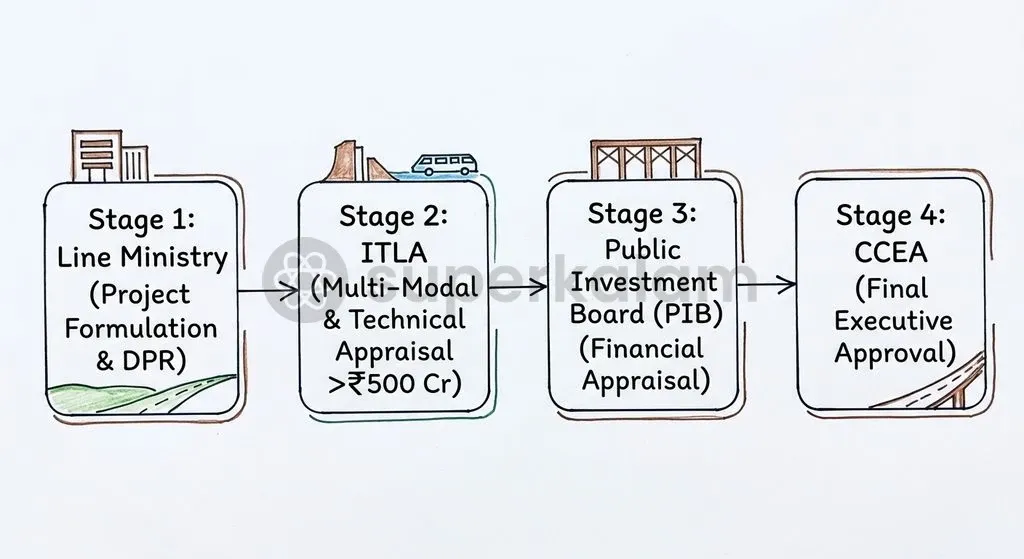
ITLA's authority is limited to mandatory technical appraisal. It checks whether a project aligns with the National Transport Master Plan, avoids duplicate infrastructure, and includes necessary multi-modal connectors. However, it cannot issue financial sanctions.
Project clearances follow a multi-tier appraisal pathway:
- Project Formulation: The sectoral line ministry or implementing agency prepares the project proposal.
- Technical Appraisal: ITLA performs mandatory technical scrutiny on projects costing ₹500 crore or more.
- Financial Appraisal: The Public Investment Board (PIB), chaired by the Expenditure Secretary, undertakes financial vetting.
- Final Sanction: The Cabinet Committee on Economic Affairs (CCEA) grants final investment approval.
Because ITLA is structured as an SPV rather than an independent statutory commission created by Parliament, its appraisal reports serve as advisory and technical inputs. It cannot exercise a binding statutory veto against projects backed by line ministries during Cabinet deliberations.
Global Precedents: How Other Nations Govern Multi-Modal Logistics
Advanced economies govern multi-modal transport through integrated administrative departments, dedicated statutory advisory commissions, and specialised transport tribunals.
In the United Kingdom, transport strategy is led centrally by the Department for Transport (DfT) alongside the independent National Infrastructure Commission (NIC). The NIC produces 30-year National Infrastructure Assessments. The government is legally required to accept these recommendations or explain publicly why it rejected them.
In the United States, inter-modal freight policy is coordinated by the US Department of Transportation (USDOT), while commercial disputes and inter-modal rates are adjudicated by an independent statutory body, the Surface Transportation Board (STB).
| Dimension | United Kingdom (NIC / DfT) | United States (USDOT / STB) | India (ITLA Framework) | | :--- | :--- | :--- | | Primary Apex Body | Department for Transport & NIC | US Department of Transportation | Integrated Transport Logistics Authority (SPV) | | Planning Horizon | 30-year National Assessments | Multi-year National Freight Strategic Plan | Rolling 10+ year Master Plan | | Institutional Form | Central Ministry & Statutory Advisory Body | Federal Department & Independent Agency | Special Purpose Vehicle (SPV) | | Appraisal Function | Systemic cross-sector assessment | Corridor-based federal grant appraisal | Mandatory technical appraisal (≥₹500 Cr) | | Dispute Adjudication | Departmental tribunals and regulatory boards | Surface Transportation Board (STB) | Inter-ministerial bottleneck resolution |
Key Structural Bottlenecks and Governance Risks
Despite its wide mandate, ITLA faces institutional and constitutional hurdles that may constrain its effectiveness across the logistics sector.
| Structural Challenge | Nature of Institutional Risk |
|---|---|
| Executive Corporate Status | As an advisory SPV, ITLA lacks statutory power over legacy boards created by Acts of Parliament. |
| Seventh Schedule Federal Divide | Ports and rail are Union subjects (List I), while state roads and urban transit fall under State (List II) or Concurrent (List III) remits. |
| Inter-Agency Data Sharing | Sustaining live data pipelines across municipal bodies and state transport corporations remains difficult despite ULIP. |
The first vulnerability lies in its corporate structure. Operating under executive orders leaves ITLA exposed to resistance from established statutory authorities like NHAI and the Railway Board. Without statutory backing, it cannot penalise non-compliance.
The second hurdle is the Seventh Schedule federal structure. Major ports, civil aviation, railways, and national highways are Union subjects (List I). However, state highways, feeder roads, intra-city transit, and logistics parks sit in the State List (List II) or Concurrent List (List III). Synchronising state-level spending with ITLA's national plans requires active cooperative federalism.
A third risk centres on data architecture. The Unified Logistics Interface Platform (ULIP) integrates APIs across more than 30 systems. Even so, maintaining continuous, verified data feeds from state road transport corporations and private logistics operators presents severe operational challenges.
Discuss with Superkalam
If a line ministry seeks to widen a highway running parallel to an underutilised freight rail corridor, how could ITLA use NTDR analytics to propose an alternative?
Ask NowWay Forward: Building Real Enforcement Teeth for Integrated Planning
To move beyond an advisory body, ITLA needs formal legal backing and structured ties with financial and state institutions.
Policy analysts identify five essential reforms to strengthen ITLA's governance architecture:
- Confer Statutory Authority: Enact dedicated legislation to give ITLA formal legal parity with statutory bodies like NHAI and the Railway Board.
- Establish Dispute Tribunals: Follow the Rakesh Mohan Committee (NTDPC) recommendations by setting up independent tribunals to settle modal turf wars, tariff disputes, and concession disputes.
- Link Appraisals to Budgetary Clearances: Require the Public Investment Board to make ITLA technical certification a mandatory precondition for financial appraisal of projects over ₹500 crore.
- Integrate State Logistics Councils: Build institutional links with State Logistics Coordination Committees to align sub-national capital spending with national master plans.
- Deepen Digital Analytics: Expand the National Transport Data Repository by fusing ULIP with PM GatiShakti GIS layers to automate corridor congestion detection.
India ranks 38th on the World Bank Logistics Performance Index 2023. Meeting its logistics targets will depend on whether ITLA's institutional setup can enforce disciplined multi-modal planning over entrenched departmental silos.
Discuss with Superkalam
Compare the institutional enforcement power of ITLA as a Special Purpose Vehicle with statutory bodies like the NHAI under the NHAI Act, 1988.
Ask NowKey Takeaways
- Union Cabinet Approval: The Union Cabinet approved the creation of the Integrated Transport and Logistics Authority (ITLA) as an SPV on 6 October 2026.
- Mandatory Technical Appraisal: ITLA conducts technical appraisals for all central infrastructure projects costing ₹500 crore or more, leaving final financial clearances to the PIB and CCEA.
- Long-Term Master Planning: ITLA will formulate a rolling National Transport Master Plan spanning 10 years or more across all major transport modes.
- Data Integration Hub: The authority will manage the National Transport Data Repository (NTDR), integrating FASTag, GSTN e-way bills, Vahan, and GPS data for freight analytics.
- Governance Challenge: Because ITLA is formed as an executive Special Purpose Vehicle rather than via an Act of Parliament, its technical recommendations remain advisory over legacy statutory bodies like NHAI and the Railway Board.
Mains Question
"Institutionalising multi-modal planning through an executive Special Purpose Vehicle addresses technical appraisal silos but leaves the fundamental challenge of statutory enforcement unresolved." In the context of the newly established Integrated Transport and Logistics Authority (ITLA), critically analyse this statement. (15 Marks)
Evaluate NowMains Question
The National Transport Development Policy Committee (2014) highlighted chronic modal distortions and isolated capital expenditure across India's transport landscape. Elucidate how ITLA's appraisal architecture seeks to rectify these legacy structural bottlenecks. (10 Marks)
Evaluate NowPractice MCQs
QUESTION 1
With reference to the Integrated Transport and Logistics Authority (ITLA), consider the following statements:
- It is established as a statutory regulatory body enacted through an Act of Parliament.
- It conducts mandatory multi-modal technical appraisals for central infrastructure projects costing ₹500 crore or more.
- It formulates a rolling National Transport Master Plan spanning a horizon of 10 years or more. Which of the statements given above is/are correct?
QUESTION 2
Regarding the project clearance pathway under the ITLA framework, consider the following statements:
- ITLA exercises a binding statutory veto over sectoral line ministries during Cabinet deliberations.
- ITLA handles mandatory technical appraisal, while financial vetting is conducted by the Public Investment Board (PIB).
- Final investment sanction for major central transport infrastructure projects rests with the Cabinet Committee on Economic Affairs (CCEA). Which of the statements given above is/are correct?
QUESTION 3
With reference to transport infrastructure governance in India, consider the following statements:
- The National Transport Development Policy Committee (NTDPC) was chaired by Dr. Rakesh Mohan in 2014.
- The National Highways Authority of India (NHAI) derives its autonomous project execution powers under the NHAI Act, 1988.
- The National Transport Data Repository (NTDR) integrates data feeds from GSTN e-way bills, FASTag tolls, and Vahan vehicle registrations. Which of the statements given above is/are correct?
QUESTION 4
In the context of global institutional frameworks for multi-modal logistics, consider the following pairs:
- National Infrastructure Commission (NIC) : United Kingdom
- Surface Transportation Board (STB) : United States
- Department for Transport (DfT) : Australia How many of the pairs given above are correctly matched?
QUESTION 5
What is the primary role of the National Transport Data Repository (NTDR) managed by the Integrated Transport and Logistics Authority (ITLA)?





