ITEP Explained: Four-Year B.Ed Programme Under NEP 2020
ITEP combines subject study and teacher training in a four-year degree. See its structure, admission route and the NEP 2020 transition target.
Oct, 2026
•9 min read

Overview
The Integrated Teacher Education Programme is a four-year dual-major undergraduate degree notified by the National Council for Teacher Education. It establishes a multidisciplinary qualification framework for school educators across India by 2030.
Replacing isolated training institutes with composite university departments, the curriculum links disciplinary specialisations with practical pedagogical training. This instruction aligns directly with school stages mandated by the National Education Policy 2020.
Admission occurs through a national entrance test, curbing sub-standard degree colleges while embedding early childhood care and inclusive schooling practices. As pilots expand across premier technical and central institutes, the transition drives a systemic regulatory overhaul.
Why in the News: The Rollout of the 4-Year Integrated Teacher Education Programme
The National Education Policy 2020 mandates that a four-year integrated multidisciplinary degree will become the minimal qualification for all school teachers in India by 2030. As of June 2026, the transition has gained renewed administrative scrutiny following the Department-related Parliamentary Standing Committee's 380th Action Taken Report submitted to the Chairman of the Rajya Sabha. The statutory rollout, initially notified by the National Council for Teacher Education on 26 October 2021, aims to phase out commercialised standalone colleges in favour of integrated university courses.
The Ministry of Education began testing this delivery model by introducing the pilot across 57 premier institutions during the 2023–24 academic session, according to official ministry announcements. Premier establishments including IIT Kharagpur, IIT Jodhpur, NIT Calicut, and several Regional Institutes of Education now offer these dual-major tracks.
Discuss with Superkalam
What is the targeted year under NEP 2020 by which the four-year integrated degree will become the minimal qualification for school teachers?
Ask NowBackground: The Crisis of Commercialisation and Standalone B.Ed Colleges
Teacher education in India historically operated in fragmented environments detached from mainstream universities. According to the National Education Policy 2020, over 90% of India's more than 17,000 Teacher Education Institutions operated as private standalone entities lacking multidisciplinary infrastructure. Many functioned as commercial enterprises, selling credentials rather than cultivating pedagogical competence.
A judicial reckoning arrived when the Supreme Court of India appointed the Justice J.S. Verma Commission to audit the sector. The Justice J.S. Verma Commission (2012) highlighted systemic breakdown across several operational areas:
- Severe commercialisation: Unchecked approvals turned teacher preparation into an unregulated marketplace.
- Compromised appointments: Substandard faculty selection diluted instructional standards.
- Systemic degree-selling: Commercial entities traded qualifications without genuine clinical training.
The Commission recommended halting unchecked approvals and transitioning professional teacher preparation directly into mainstream universities and composite colleges. The Delhi High Court reinforced this structural clean-up in Mehta Teacher Training College vs NCTE (August 2022). The court affirmed that the regulatory moratorium imposed by the National Council for Teacher Education against approving new standalone institutes was lawful and aligned with national policy goals.
What is ITEP: Understanding the Dual-Major Four-Year Curriculum
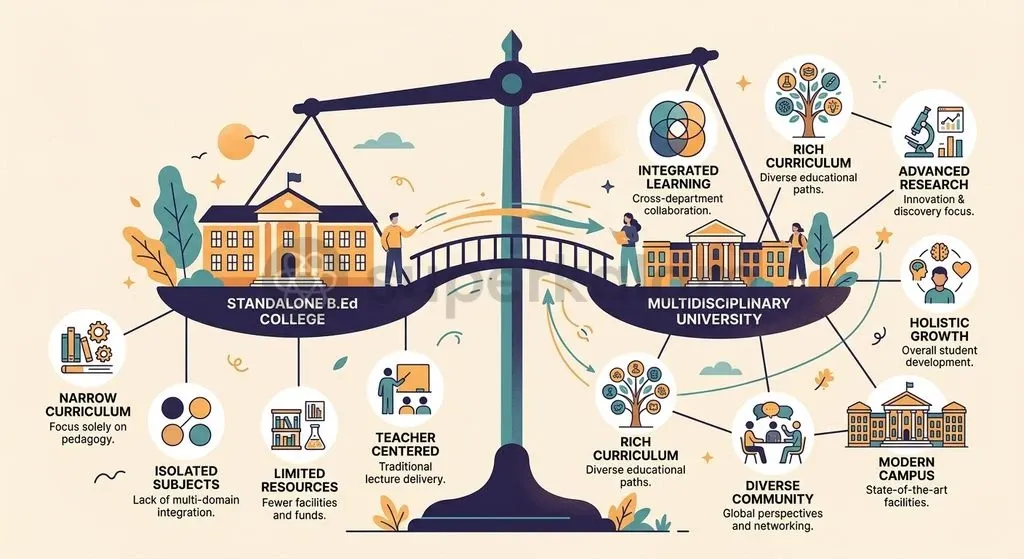
The Integrated Teacher Education Programme is an eight-semester undergraduate course designed to modernise pedagogical training. According to the Ministry of Education, the curriculum awards dual-major degrees including B.A. B.Ed., B.Sc. B.Ed., and B.Com. B.Ed. candidates. This structure allows secondary school graduates to complete graduation and professional educator qualifications concurrently, completing the combined credentials one year faster than the traditional five-year route.
Centralised admissions manage student entry to ensure institutional quality and merit-based access. According to the National Testing Agency, admissions across participating institutions are conducted through the National Common Entrance Test via Computer-Based Test mode. The examination offers testing across 13 regional languages, including Assamese, Bengali, Gujarati, Kannada, Malayalam, Marathi, Odia, Punjabi, Tamil, Telugu, Urdu, Hindi, and English.
Central reservation norms govern seat allocations across all participating Central Universities, IITs, and NITs. The reservation model guarantees statutory representation:
- 15% for Scheduled Castes
- 7.5% for Scheduled Tribes
- 27% for Other Backward Classes (Non-Creamy Layer)
- 10% for General Economically Weaker Sections
- 5% horizontal reservation for Persons with Disabilities
Pedagogically, the framework embeds specialised coursework alongside field immersion. According to the National Council for Teacher Education, trainees complete compulsory modules in Early Childhood Care and Education, Foundational Literacy and Numeracy, Inclusive Education, and Indian Knowledge Systems, accompanied by continuous school internships.
Discuss with Superkalam
How does the dual-major curriculum of ITEP bridge the gap between disciplinary depth and practical pedagogical training?
Ask NowComparing the Models: Traditional B.Ed vs Four-Year ITEP
The structural transition from standalone B.Ed programmes to the integrated framework alters curriculum design, institutional host environments, and entry criteria.
| Feature / Dimension | Conventional Standalone B.Ed Model | Four-Year Integrated Model (ITEP) |
|---|---|---|
| Course Duration | 5 years total (3-year Bachelor degree followed by 2-year B.Ed) | 4 years total (8 semesters dual-major integrated degree) |
| Institutional Setting | Isolated single-stream Teacher Education Institutions | Composite, multidisciplinary universities and colleges |
| Admission Mechanism | Decentralised state-level or private college-administered tests | Centralised National Common Entrance Test run by NTA |
| Pedagogical Alignment | Generic primary/secondary pedagogy without stage differentiation | Direct alignment with the 5+3+3+4 schooling stages |
| Specialised Modules | Often elective or missing foundational childhood pedagogy | Mandatory Early Childhood Care and Foundational Literacy |
| Regulatory Status | Phasing out toward the 2030 deadline per national mandates | Minimal degree qualification for school teachers by 2030 |
Key Structural Pillars: Multidisciplinary Campuses and Stage-Specific Specialisation
The National Council for Teacher Education designed ITEP around multidisciplinary academic environments to end institutional isolation. Rather than operating in physical and intellectual silos, prospective educators train alongside peers studying pure sciences, social sciences, and humanities.
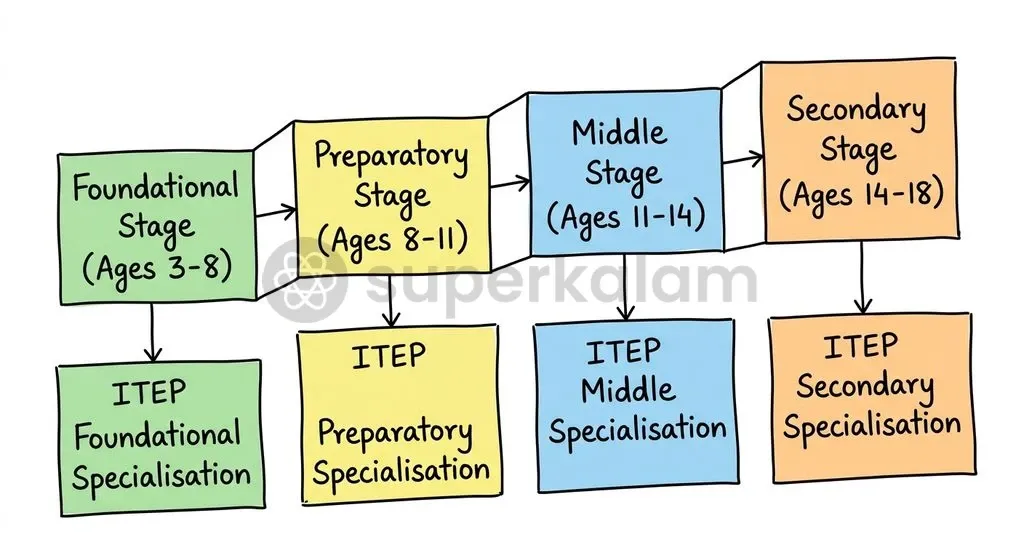
Curricular tracks correspond to the four pedagogical tiers defined under the 5+3+3+4 schooling structure:
- Foundational Stage: Covers teaching methodologies for children aged 3 to 8, bridging preschool classes and Grades 1 and 2.
- Preparatory Stage: Focuses on activity-based learning and literacy building across Grades 3 through 5 for children aged 8 to 11.
- Middle Stage: Imparts subject-oriented pedagogical instruction for Grades 6 through 8, introducing abstract concepts in mathematics, sciences, and humanities.
- Secondary Stage: Equips secondary educators for Grades 9 through 12 with disciplinary depth, critical reasoning, and multidisciplinary subject choices.
Professional benchmarks complement this institutional reorganisation. The National Council for Teacher Education formulated the National Professional Standards for Teachers and the National Mission for Mentoring to institutionalise career pathways, continuous professional development, and ethical standards across state and central cadres.
Discuss with Superkalam
If a state government currently recruits generalist teachers for Classes 1 to 5, how must its service rules adapt to accommodate graduates of stage-specific Foundational and Preparatory ITEP degrees?
Ask NowMajor Challenges in Implementation: Infrastructure, Faculty Shortages, and Transition Costs
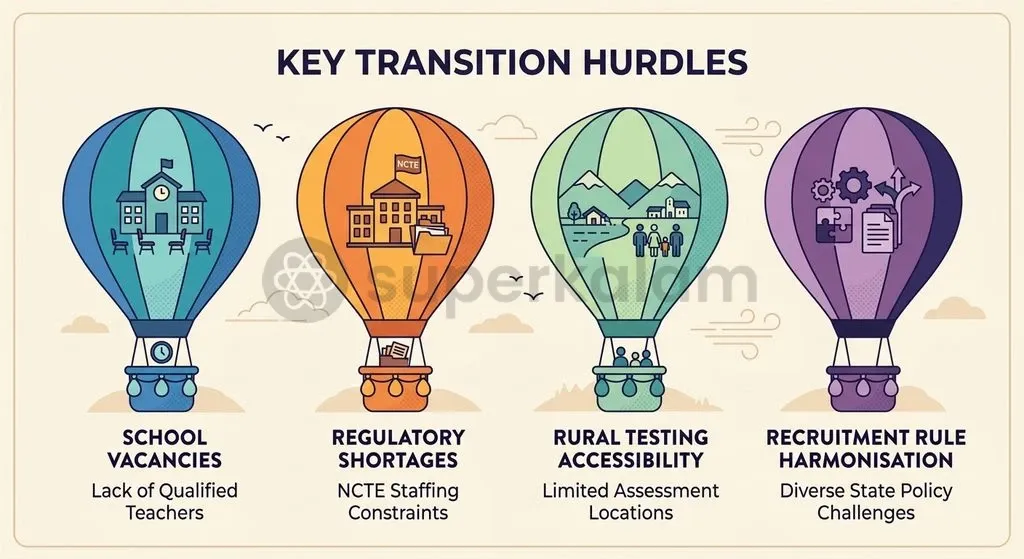
The Parliamentary Standing Committee on Education presented substantial operational warnings regarding the nationwide transition in its 368th Report in August 2025. Approximately 10 lakh teaching positions remain vacant across Indian schools, while Kendriya Vidyalayas and Navodaya Vidyalayas face 30% to 50% vacancies, relying heavily on temporary staff. Moving to an intensive four-year training track risks slowing replacement pipelines if university intake does not expand rapidly.
Administrative capacity at the central regulatory level exhibits severe constraints. According to the 368th Parliamentary Committee Report, the National Council for Teacher Education suffers an acute administrative deficit with 47% of sanctioned posts vacant and no permanent recruitment conducted since 2019. Furthermore, private entities still manage 92% of teacher training institutions, requiring significant capital investment to convert them into composite colleges.
State recruitment structures create immediate operational friction with the new stage-specific degrees:
- School Recruitment Mismatch: State recruitment frameworks typically hire generalist primary teachers to instruct all subjects across Classes 1 to 5, making the split between Foundational and Preparatory degrees impractical under existing state cadre rules.
- Phasing Out Proven Programmes: The Parliamentary Standing Committee opposed draft plans to phase out the four-year Bachelor of Elementary Education by the 2026–27 session, arguing against dismantling a thirty-year-old programme running in top women's colleges before evaluating new outcomes.
- Multiple-Exit Risks: Parliamentary reviewers cautioned against multiple-exit options after one, two, or three years, noting that partial exits risk injecting underqualified personnel into primary schools while wasting public subsidies.
- Digital and Financial Access: Education researchers and state officials have observed that conducting entrance tests solely via computer terminals imposes barriers on rural applicants, compounded by higher exam fees, per reporting in The Hindu (as reported on 11 May 2024).
Colleges face strict deadlines to reorganise their academic faculties. Existing colleges offering two-year courses must transition into composite multidisciplinary institutions or risk losing formal accreditation ahead of 2030, per reporting on draft regulations in The Hindu (as reported on 14 July 2025).
Global Benchmarks: How Leading Education Systems Train Teachers
Comparative education models demonstrate that teacher training quality depends on deep institutional integration. Leading international systems, including jurisdictions such as Finland and Singapore, require comprehensive university-based qualifications before granting classroom licences, treating teacher preparation as clinical practice.
These high-performing global systems consistently avoid isolating pedagogical training in sub-scale commercial colleges. Embedding teacher preparation within comprehensive university departments ensures candidates master both academic subject matter and verified pedagogical techniques.
Discuss with Superkalam
Contrast the structural efficacy of training teachers in standalone teacher education institutions against multidisciplinary university campuses like IITs and Central Universities.
Ask NowWay Forward: Building World-Class Teacher Education in India
The Department-related Parliamentary Standing Committee emphasised in its 380th Action Taken Report that federal harmonisation must guide the remaining rollout. State governments manage school cadres and service rules; therefore, teacher recruitment qualifications must formally realign before the National Council for Teacher Education closes legacy qualification tracks.
Key systemic reforms are essential to complete this institutional transition:
- Establishing District-Level Public Hubs: The central government should act on the parliamentary panel's recommendation to fund at least one well-resourced multidisciplinary public institution in every district, safeguarding rural enrolment and equity.
- Reforming State Service Rules: State education departments must adapt recruitment codes to recognise stage-specific degrees without penalising generalist school staffing models.
- Protecting Established Degree Programmes: Regulators should heed legislative recommendations to preserve high-performing elementary education courses like the Bachelor of Elementary Education alongside new offerings.
- Strengthening NCTE Oversight: Filling the 47% personnel vacancy within the National Council for Teacher Education is essential to enforce quality norms, audit fraudulent colleges, and administer the National Professional Standards for Teachers effectively.
Key Takeaways
- The National Education Policy 2020 makes the four-year multidisciplinary integrated degree the minimal qualification for school teachers in India by 2030.
- Structural reform targets governance failures identified by the Justice J.S. Verma Commission (2012), addressing a sector where over 90% of institutions were private standalone entities.
- Administered centrally by the National Testing Agency via computer-based testing in 13 languages, the integrated programme saves aspirants one academic year.
- The 368th Parliamentary Committee Report highlights critical bottlenecks, including 10 lakh vacant school posts, 47% staff vacancies in the regulatory council, and state-level recruitment misalignments.
Mains Question
"Over 90% of India's Teacher Education Institutions historically operated as private standalone entities, fostering commercialisation rather than pedagogical excellence." In light of the Justice J.S. Verma Commission findings, discuss the rationale behind transitioning to the Four-Year Integrated Teacher Education Programme (ITEP). (10 Marks)
Evaluate NowMains Question
The Parliamentary Standing Committee on Education (368th Report) raised critical warnings regarding the transition to the four-year multidisciplinary ITEP model. Critically analyse the structural and administrative bottlenecks confronting this nationwide reform. (15 Marks)
Evaluate NowPractice MCQs
QUESTION 1
With reference to the Integrated Teacher Education Programme (ITEP) under the National Education Policy 2020, consider the following statements:
- It is an eight-semester dual-major undergraduate degree that will become the minimal qualification for school teachers by 2030.
- Admissions to the programme are conducted through the National Common Entrance Test administered by the National Testing Agency in 13 regional languages.
- The curriculum directly replaces the five-stage school structure with a three-tier pedagogical track. Which of the statements given above is/are correct?
QUESTION 2
Regarding the recommendations and judicial pronouncements concerning Teacher Education Institutions (TEIs) in India, consider the following statements:
- The Justice J.S. Verma Commission (2012) recommended transitioning professional teacher preparation directly into mainstream universities and composite colleges.
- In Mehta Teacher Training College vs NCTE (2022), the Delhi High Court struck down the NCTE's moratorium on approving new standalone teacher training institutes as unconstitutional. Which of the statements given above is/are correct?
QUESTION 3
Consider the following statements regarding the structural pillars and curriculum of the Integrated Teacher Education Programme (ITEP):
- It includes mandatory coursework in Early Childhood Care and Education, Foundational Literacy and Numeracy, and Indian Knowledge Systems.
- The curriculum's Preparatory Stage specifically trains candidates to handle subject-oriented pedagogical instruction for Grades 6 through 8.
- The course allows secondary school graduates to complete graduation and professional educator certification one year faster than the traditional route. Which of the statements given above is/are correct?
QUESTION 4
According to the 368th Report of the Parliamentary Standing Committee on Education, which of the following is/are cited as operational challenges facing the implementation of ITEP?
- High teaching vacancies in Kendriya Vidyalayas and Navodaya Vidyalayas reaching 30% to 50%.
- A significant administrative deficit within the National Council for Teacher Education, with 47% of sanctioned posts vacant.
- Complete absence of reservation quotas in central institutions offering ITEP. Select the correct answer using the code given below:
QUESTION 5
Under the statutory admission framework for the Integrated Teacher Education Programme (ITEP) conducted by the National Testing Agency, what is the horizontal reservation percentage allocated for Persons with Disabilities (PwD)?
Discuss with Superkalam
Evaluate the trade-off between shutting down standalone private B.Ed colleges to maintain educational quality and the risk of exacerbating the 10 lakh school teacher vacancy crisis.
Ask Now