INS Nipun: Indigenous Diving Support Vessel and India's Undersea Salvage
By securing deep-sea saturation diving and submarine rescue on both coasts, INS Nipun eliminates India's reliance on ad-hoc civilian salvage vessels.
Sep, 2026
•7 min read
Overview
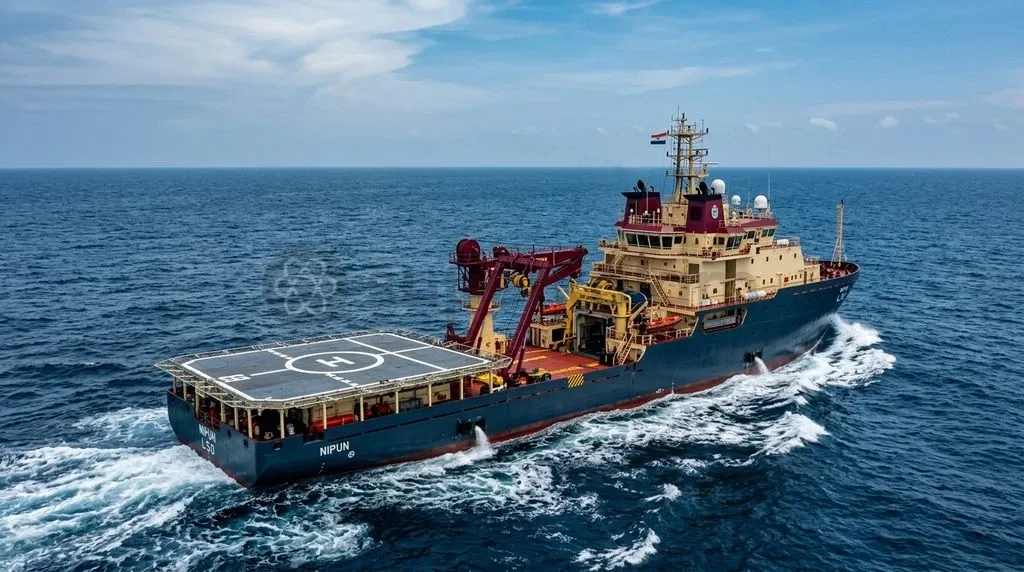
The Indian Navy commissioned INS Nipun at Naval Dockyard, Mumbai on 31 August 2026. This commissioning marks the operational induction of its second indigenously designed and built Diving Support Vessel. It establishes a permanent two-coast submarine rescue architecture across the Indian Ocean.
Designed by the Warship Design Bureau and built by Hindustan Shipyard Limited, the vessel achieves approximately 80% indigenous content with components from over 120 Indian MSMEs. Operating alongside lead ship INS Nistar, the platform delivers dedicated saturation diving down to 300 metres. It serves as a dedicated mothership for Deep Submergence Rescue Vehicles, which can evacuate personnel at depths reaching 650 metres.
Why in the News: India's Leap in Indigenous Diving and Salvage Capability
The Indian Navy commissioned INS Nipun on 31 August 2026 at the Naval Dockyard in Mumbai, completing the twin Diving Support Vessel project.
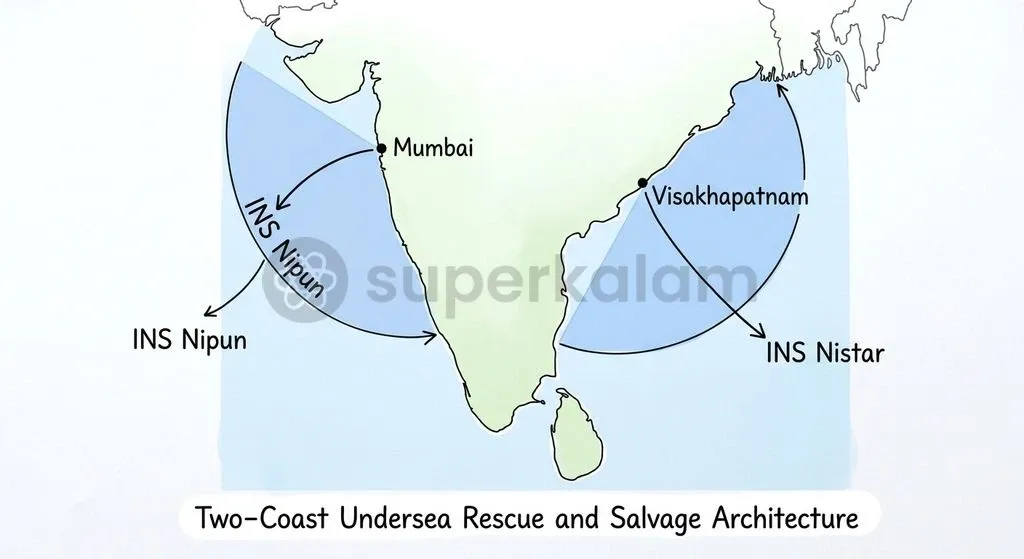
As of August 2026, this commissioning establishes a dedicated two-coast undersea rescue capability. Lead ship INS Nistar entered service on 18 July 2025 at Visakhapatnam, anchoring operations on the Eastern seaboard.
With INS Nipun deployed on the Western seaboard at Mumbai, the Indian Navy has eliminated its reliance on improvised civilian platforms. Both maritime frontiers now possess dedicated deep-sea salvage and emergency submarine response assets.
Discuss with Superkalam
Recall the maximum operational depths for saturation diving and DSRV rescue supported by INS Nipun.
Ask NowThe Undersea Salvage Deficit: Why India Commissioned Twin DSVs
The Indian Navy historically faced an operational gap in dedicated deep salvage platforms. Emergencies in deep waters previously required improvised civilian craft rather than military-grade rescue vessels.
Submarine operations carry severe risks, including underwater collisions, mechanical failure, and hull compromise under intense pressure. Executing deep-sea rescue demands ships with precise station-keeping systems, heavy-lift cranes, and specialised medical decompression chambers.
The twin Nistar-class project closes this salvage deficit through specific operational upgrades:
- Permanent Two-Coast Readiness: Basing INS Nistar at Visakhapatnam and INS Nipun at Mumbai secures rapid response coverage across both the Bay of Bengal and the Arabian Sea.
- Dedicated Mothership Architecture: Purpose-built launch and recovery systems replace the ad-hoc mobilisation of commercial vessels during critical search-and-rescue windows.
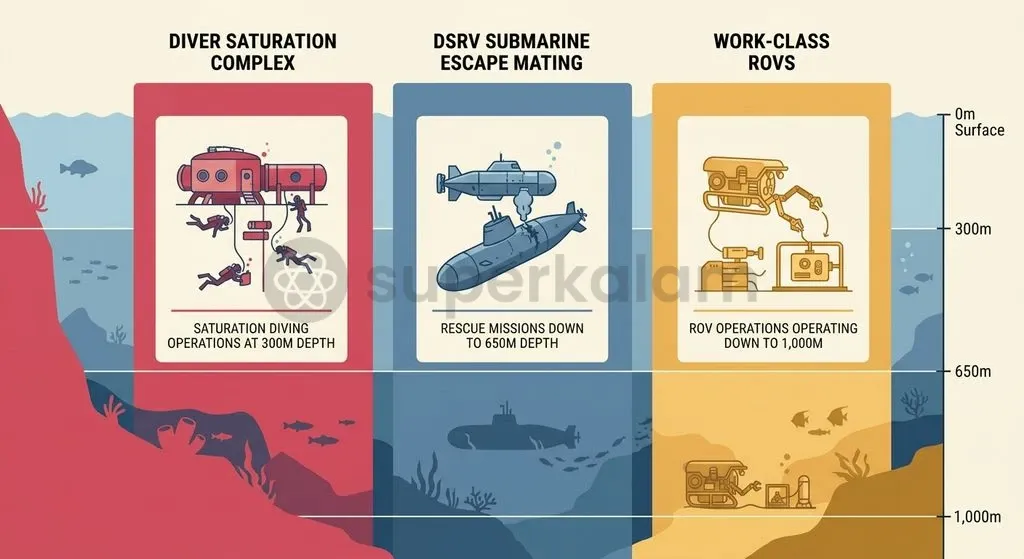
- Deep Diver Intervention: Onboard hyperbaric complexes support saturation diving to 300 metres, letting divers work at extreme ambient pressures without repeated decompression cycles.
Inside the Platform: Design, Deep Saturation Diving, and DSRV Integration
Hindustan Shipyard Limited built INS Nipun and INS Nistar to an indigenous design prepared by the Indian Navy's Warship Design Bureau.
Each vessel displaces over 9,350 to 10,500 tonnes and incorporates Dynamic Positioning (DP-II) systems. DP-II uses automated thrusters and main propellers to hold the ship in place above an undersea incident site, resisting strong currents without dropping anchor. The platforms sustain operational endurance exceeding 60 days at sea.
The onboard complex integrates specialised systems for multi-depth intervention:
- Saturation Diving Complex: Houses diving teams in pressurised hyperbaric chambers, deploying them via diving bells using heliox mixtures to execute interventions down to 300 metres.
- Self-Propelled Hyperbaric Lifeboats (SPHL): Ensures safe emergency evacuation of pressurised divers during shipboard emergencies without risking fatal decompression.
- Remotely Operated Vehicles (ROVs): Deploys observation and work-class unmanned submersibles for deep reconnaissance, seabed mapping, and mechanical salvage down to 1,000 metres.
- Deep Submergence Rescue Vehicle (DSRV) Integration: Operates as a Mothership (MoSHIP) for flyaway DSRVs, which dock with disabled submarines to extract personnel down to 650 metres using Transfer-Under-Pressure (TUP) systems.
Discuss with Superkalam
Explain how the DP-II system enables a Diving Support Vessel to execute deep salvage without dropping anchor.
Ask NowGenerational Shift: Comparing INS Nipun with the Legacy INS Nireekshak
The Nistar-class platforms mark a decisive technological leap from the Indian Navy's legacy diving tender, INS Nireekshak.
INS Nireekshak entered service in 1995 as a converted commercial diving craft. Although it set India's national operational dive record of 257 metres, its commercial hull lacked purpose-built military command suites, modern dynamic positioning, and organic hangars for modern rescue submersibles.
| Operational Parameter | Legacy Platform (INS Nireekshak) | Modern Platform (INS Nipun / INS Nistar) |
|---|---|---|
| Origin & Platform Type | Modified commercial vessel (commissioned 1995) | Purpose-built indigenous naval DSV |
| Operational Displacement | Modified light commercial hull | Over 9,350 to 10,500 tonnes |
| Station Keeping | Legacy positioning systems | Dynamic Positioning (DP-II) |
| DSRV Integration | Limited deck space, improvised handling | Dedicated Mothership (MoSHIP) with TUP capability up to 650 m |
| Saturation Diving Limit | 257 metres (national record) | 300 metres rated saturation complex |
| Deep Intervention Tools | Basic recovery and diving bells | Work-class ROVs (up to 1,000 m) and side-scan sonars |
| Aviation & Hangars | Basic landing platform | Helicopter landing deck and specialised hangars |
Strategic Context: Rising IOR Undersea Contestation and Submarine Proliferation
Undersea naval operations are multiplying across the Indian Ocean, sharpening the demand for Undersea Domain Awareness (UDA).
Key regional security drivers include:
- Subsurface Traffic Density: Heavily traversed regional sea lanes see growing conventional submarine traffic, raising the statistical risk of collisions and underwater accidents.
- Naval Force Expansion: Deployments by People's Liberation Army Navy submarines and dual-use oceanographic research vessels continue to increase across the Indian Ocean.
- Seabed Warfare Readiness: With side-scan sonars and deep-rated ROVs, INS Nipun gives the Navy the means to monitor critical seabed infrastructure, locate submerged objects, and recover sensitive hardware.
Discuss with Superkalam
Analyse the strategic drivers behind the rising requirement for Undersea Domain Awareness (UDA) in the Indian Ocean Region.
Ask NowRescue Diplomacy: DSRV Interoperability and India as a Net Security Provider
The Indian Navy employs its deep submergence rescue platforms as an instrument of regional maritime diplomacy under the SAGAR framework.
The Security and Growth for All in the Region (SAGAR) doctrine frames India as a primary First Responder across the Indian Ocean. Deep-submergence rescue systems demand massive capital investment and advanced technical skill. Consequently, most regional littoral navies operating diesel-electric submarines lack organic deep-sea rescue assets.
India has established this regional rescue architecture through formal agreements and operational exercises:
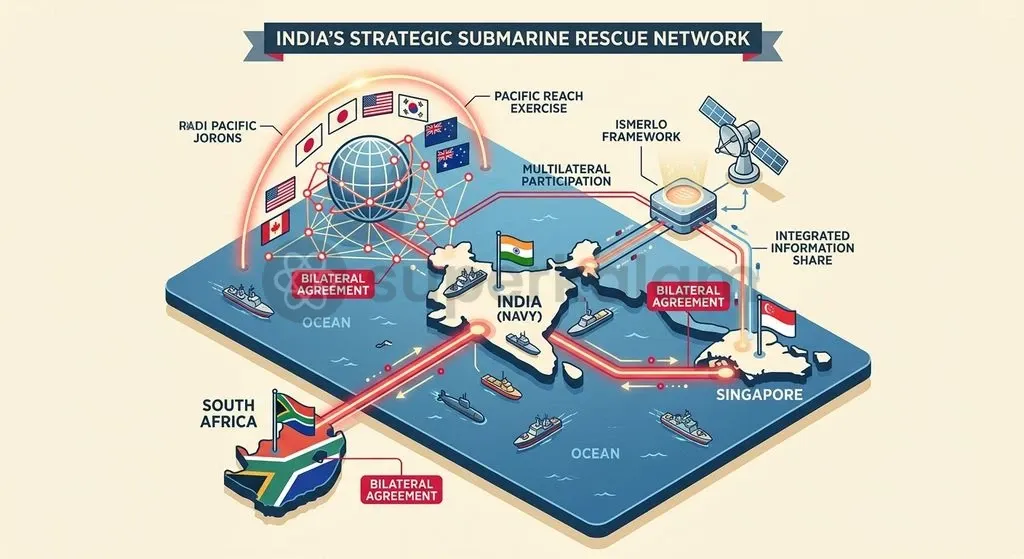
- Bilateral Submarine Rescue Pacts: India and Singapore signed the Implementing Arrangement on Mutual Submarine Rescue Support & Cooperation in January 2021. India also concluded a bilateral Submarine Rescue and Cooperation Implementation Agreement with South Africa in September 2024.
- Multinational Exercise Validation: INS Nistar participated in the multilateral Exercise Pacific Reach 2025 (XPR 25) hosted by the Republic of Singapore Navy in the South China Sea in September 2025, validating India's Submarine Rescue Unit (East).
- Standardised Global Protocols: The Indian Navy aligns its operational procedures with the International Submarine Escape and Rescue Liaison Office (ISMERLO) to guarantee mechanical and communication compatibility during international rescue emergencies.
Structural Challenges in Undersea Domain Awareness and the Way Forward
Inducting twin Diving Support Vessels solves India's core platform deficit. However, maintaining comprehensive undersea safety requires continuous institutional and technical upgrades.
Deep-sea salvage and submarine rescue depend on rapid response speeds. While DSRVs can fly to forward airbases, motherships like INS Nipun must sail long ocean distances to deploy heavy saturation diving systems and recovery spreads.
To maximise operational capability, India's maritime strategy focuses on three core priorities:
- Acoustic Seabed Mapping: Conducting systematic bathymetric and acoustic surveys along key chokepoints to enable rapid sonar tracking during emergencies.
- Sensor Network Integration: Feeding DSV survey data directly into the wider naval UDA architecture, linking surface vessels with maritime patrol aircraft and seabed sensors.
- Regional Interoperability Agreements: Signing rescue cooperation pacts with additional Indian Ocean littoral partners, consolidating India's role as a dependable security provider.
Discuss with Superkalam
Evaluate the effectiveness of using submarine rescue capabilities as an instrument of naval diplomacy under the SAGAR doctrine.
Ask NowKey Takeaways
- Commissioning Milestone: The Indian Navy commissioned INS Nipun on 31 August 2026 at Mumbai, completing the twin Nistar-class Diving Support Vessel project following the commissioning of INS Nistar at Visakhapatnam in July 2025.
- High Indigenisation: Designed by the Warship Design Bureau and constructed by Hindustan Shipyard Limited, the vessels achieved approximately 80% indigenous content with participation from over 120 MSMEs.
- Deep Intervention Capabilities: The platforms feature Dynamic Positioning (DP-II), endurance exceeding 60 days, saturation diving systems rated to 300 metres, and ROV operations down to 1,000 metres.
- Mothership for DSRV: The twin DSVs function as dedicated motherships for Deep Submergence Rescue Vehicles, enabling Transfer-Under-Pressure personnel rescue at depths up to 650 metres.
- Regional Rescue Diplomacy: The platforms operationalise the SAGAR doctrine and bilateral rescue agreements with partners such as Singapore and South Africa, backed by global coordination through ISMERLO.
Mains Question
"The induction of indigenous Diving Support Vessels establishes a permanent two-coast submarine rescue architecture, reinforcing India's posture as a First Responder in the Indian Ocean Region." Elucidate. (10 Marks)
Evaluate NowMains Question
In light of rising undersea contestation and submarine proliferation in the Indian Ocean Region, critically examine the strategic significance of the Nistar-class Diving Support Vessels and discuss the operational challenges in sustaining Undersea Domain Awareness (UDA). (15 Marks)
Evaluate NowPractice MCQs
QUESTION 1
With reference to the Indian Navy's Diving Support Vessels (DSVs) INS Nipun and INS Nistar, consider the following statements:
- Both vessels were designed indigenously by the Warship Design Bureau and constructed by Hindustan Shipyard Limited.
- The onboard hyperbaric complex supports saturation diving operations to a depth of up to 300 metres.
- The platforms operate as motherships for Deep Submergence Rescue Vehicles (DSRVs) capable of personnel evacuation down to 650 metres.
Which of the statements given above are correct?
QUESTION 2
Consider the following statements regarding India's undersea rescue diplomacy and international cooperation:
- India signed an Implementing Arrangement on Mutual Submarine Rescue Support & Cooperation with Singapore in January 2021.
- INS Nistar participated in the multilateral submarine rescue Exercise Pacific Reach 2025 held in the South China Sea.
- The Indian Navy aligns its emergency submarine rescue procedures with the International Submarine Escape and Rescue Liaison Office (ISMERLO) protocols.
Which of the statements given above is/are correct?
QUESTION 3
Consider the following statements comparing the legacy diving vessel INS Nireekshak with the newly inducted Nistar-class Diving Support Vessels:
- INS Nireekshak was originally inducted as a converted commercial vessel, whereas the Nistar-class platforms are purpose-built indigenous naval vessels.
- Unlike INS Nireekshak's legacy positioning systems, the Nistar-class incorporates Dynamic Positioning (DP-II) systems.
- The operational saturation diving depth limit of the Nistar-class is lower than the national record set by INS Nireekshak.
Which of the statements given above is/are correct?
QUESTION 4
With reference to the technological systems integrated into the Nistar-class Diving Support Vessels, consider the following pairs:
- Dynamic Positioning (DP-II): Maintains vessel station-keeping over incident sites without dropping anchor.
- Self-Propelled Hyperbaric Lifeboats (SPHL): Provides emergency evacuation for divers under pressure without fatal decompression.
- Remotely Operated Vehicles (ROVs): Undertakes deep seabed reconnaissance and salvage operations down to 1,000 metres.
How many of the pairs given above are correctly matched?
QUESTION 5
Which organisation is responsible for the indigenous design of the Indian Navy's Nistar-class Diving Support Vessels (INS Nistar and INS Nipun)?