INS Mangrol: Why India Is Ramping Up Shallow-Water ASW Capabilities
As regional subsurface threats mount, India's shallow-water ASW craft balance high-tech coastal acoustic defence with self-reliant naval manufacturing.
Aug, 2026
•9 min read
Overview
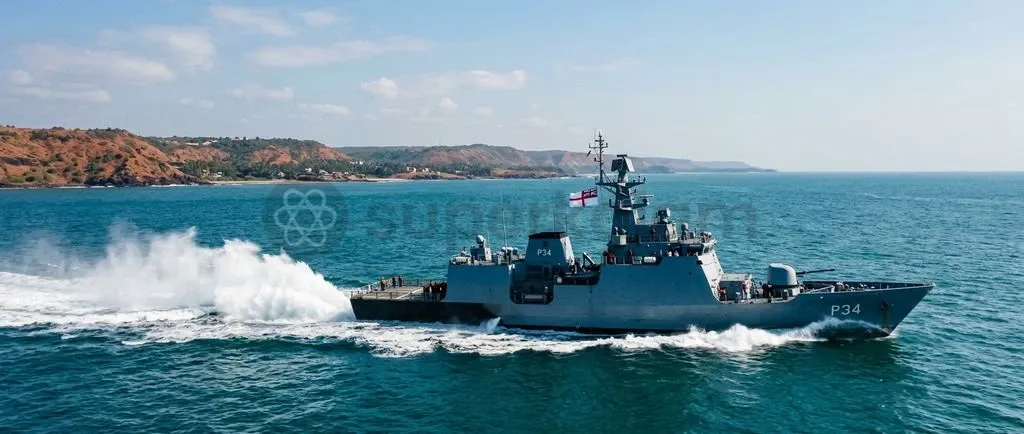
INS Mangrol marks a critical milestone in India's naval indigenisation by providing a custom-built, shallow-draught anti-submarine warfare platform designed specifically to detect quiet conventional submarines, secure vital coastal choke points, and replace the ageing Soviet-origin Abhay-class corvettes across the littoral zone. Delivered by Cochin Shipyard Limited under a sixteen-ship programme split equally with Garden Reach Shipbuilders & Engineers, the vessel achieves over 80 percent indigenous content. As of August 2026, the induction addresses growing subsurface traffic across the Indian Ocean Region while freeing frontline destroyers and frigates for extended blue-water power projection.
Why in the News: The Launch and Milestones of INS Mangrol
Cochin Shipyard Limited delivered Mangrol, the third vessel of the eight-ship Mahe-class project, to the Indian Navy on August 21, 2026. Classified as an Anti-Submarine Warfare Shallow Water Craft (ASW-SWC), the vessel carries Yard number BY 525 and represents a major milestone in India's coastal defence recapitalisation.
INS Mangrol derives its name from the historic maritime port town of Mangrol in the Junagadh district of Gujarat. The vessel inherits the battle honours and legacy of an erstwhile naval minesweeper that served the nation until its decommissioning in 2004.
The induction forms part of a broader structural procurement initiated when the Ministry of Defence signed contracts on April 30, 2019, for sixteen ASW-SWCs. This fleet is divided equally between Cochin Shipyard Limited (CSL, Kochi) and Garden Reach Shipbuilders & Engineers (GRSE, Kolkata), with each yard constructing eight vessels to accelerate fleet modernisation.
Understanding the ASW Shallow Water Craft (ASW-SWC) Programme
The ASW-SWC project encompasses sixteen specialised anti-submarine vessels contracted by the Ministry of Defence to safeguard India's coastal approaches and maritime infrastructure. The programme addresses the critical operational requirement of replacing the Indian Navy's ageing fleet of Soviet-origin Abhay-class corvettes, also designated as Project 1241 PE or Pauk II-class, which were commissioned between 1989 and 1991.
The sixteen-vessel acquisition is structured into two distinct but complementary design streams:
- Mahe-Class (CSL, Kochi): Eight vessels featuring a compact, agile hull form tailored for high-speed littoral interdiction and shallow acoustic tracking.
- Arnala-Class (GRSE, Kolkata): Eight vessels constructed under a collaborative shipbuilding framework designed for sustained coastal patrolling and anti-submarine sanitisation.
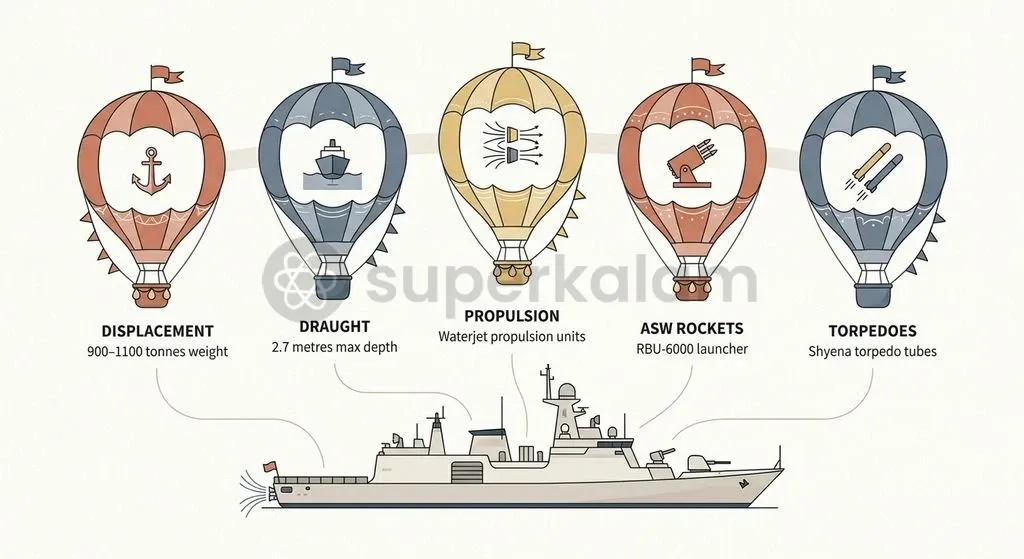
According to Ministry of Defence technical specifications, Mahe-class vessels displace approximately 900 to 1,100 tonnes and measure 78 metres in length. Designed with a shallow 2.7-metre draught, these vessels achieve a maximum speed of 25 knots and an endurance of 1,800 nautical miles, enabling agile operations across narrow channels and shallow continental shelves.
Discuss with Superkalam
Recall the name of the historic port town and district in Gujarat after which INS Mangrol is named.
Ask NowWhy Littoral and Shallow-Water Submarine Defence Is Different
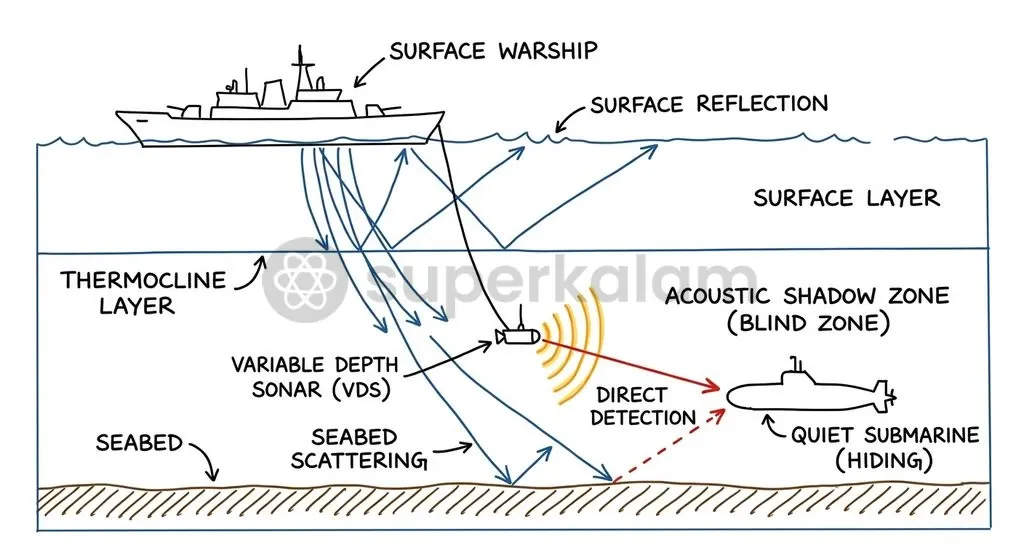
Littoral anti-submarine warfare presents unique acoustic obstacles that render deep-ocean sonar tactics ineffective in shallow coastal waters. The acoustic environment in continental shelf waters is governed by severe multi-path sound propagation, where emitted acoustic energy repeatedly bounces between the sea surface and the seabed.
Several dynamic oceanographic mechanisms degrade acoustic sensor performance in shallow zones:
- Bottom Reverberation and Scattering: Rough, sandy, or rocky seabeds reflect sonar pulses unpredictably, producing false returns that obscure target echoes.
- Sharp Thermocline Gradients: Coastal waters experience dramatic vertical temperature shifts (thermoclines) caused by solar heating and freshwater river run-off, creating acoustic shadow zones that bend sonar rays away from lurking submarines.
- Elevated Ambient Noise: Littoral seas suffer from intense acoustic clutter generated by heavy commercial merchant traffic, port operations, industrial machinery, breaking surf, and marine life.
To overcome these acoustic limitations, INS Mangrol incorporates waterjet propulsion systems driven by marine diesel engines. Waterjets eliminate the cavitation noise—the formation and collapse of vapour bubbles around rotating propeller blades—inherent to conventional screws. This low acoustic signature prevents the craft from masking its own onboard sonars while navigating waters as shallow as 2.7 metres.
The Strategic Threat: Subsurface Challenges Across the Indian Ocean Region
The Indian Ocean Region faces an expanding presence of quiet conventional submarines operating in critical maritime choke points and port approaches. The primary regional undersea challenge stems from the Pakistan Navy's procurement of eight Chinese-designed Hangor-class diesel-electric submarines, which are derived from the Type 039B Yuan class, per defence analyses (as reported by South China Morning Post and Naval News, April 2026).
These submarines incorporate Air-Independent Propulsion (AIP) based on Stirling-cycle technology. AIP allows conventional diesel-electric submarines to recharge their battery banks without surfacing or raising a snorkel mast to draw atmospheric oxygen. By remaining continuously submerged for weeks, AIP-equipped submarines eliminate their radar and thermal signatures, transforming shallow littoral approaches into lethal ambush points.
Simultaneously, China's People's Liberation Army Navy (PLAN) maintains regular submarine deployments, oceanographic intelligence missions, and hydrographic survey operations across the Indian Ocean. Operating out of regional logistics nodes like Djibouti, Gwadar, and Hambantota, foreign subsurface platforms actively map seabed topography and thermal layers. Neutralising this multi-directional undersea activity requires dedicated coastal assets capable of round-the-clock port-sanitisation patrols.
Discuss with Superkalam
Explain how thermocline gradients and bottom reverberation create acoustic shadow zones in shallow coastal waters.
Ask NowComparing Deep-Sea ASW Frigates with Shallow-Water Patrol Vessels
The Indian Navy differentiates between high-endurance blue-water frigates and agile shallow-water craft based on operational draught, acoustic profiles, and coastal combat missions. Deploying multi-billion-rupee destroyers to track midget or conventional submarines in shallow coastal waters is tactically inefficient and exposes capital ships to coastal missile batteries.
| Operational Dimension | Frontline ASW Frigates & Destroyers (e.g., P-17A / P-15B) | ASW Shallow Water Craft (e.g., Mahe & Arnala Classes) |
|---|---|---|
| Primary Operating Realm | Open-ocean blue waters and deep-sea sea lines of communication | Littoral waters, continental shelves, port approaches, and choke points |
| Displacement & Draught | 6,500 to 7,400 tonnes; draught exceeding 6.5 metres | 900 to 1,100 tonnes; shallow draught of 2.7 metres |
| Propulsion System | Combined Gas Turbine and Diesel (CODAG/COGAG) driving conventional propellers | Marine diesel engines driving waterjets for cavitation reduction |
| Acoustic Detection Focus | Deep-sea convergence zones and deep-towed active arrays | High-frequency hull sonars and low-frequency variable-depth sonars |
| Close-In Littoral Defence | Area air defence, long-range land strike, deep-sea ASW escort | Coastal submarine sanitisation, mine laying, and low-intensity operations |
Inducting the sixteen ASW-SWC corvettes relieves capital combatants, including Project 15B destroyers and Project 17A frigates, from routine coastal patrolling. Frontline task groups can consequently focus their operational availability on wide-area surveillance and blue-water deterrence across the wider Indo-Pacific.
Indigenisation and Defence Manufacturing Under the ASW-SWC Project
The ASW-SWC construction programme exemplifies self-reliance in naval shipbuilding under the Make in India and Atmanirbhar Bharat defence initiatives. Every vessel in the programme achieves over 80 percent indigenous content, integrating machinery, sensors, and structural materials manufactured by Indian defence industrial units.
The domestic supply chain for INS Mangrol incorporates critical equipment from leading public and private enterprises:
- Raw Structural Materials: Steel Authority of India Limited (SAIL) supplied approximately 3,500 tonnes of indigenous special-grade DMR 249A steel from its plants in Bokaro, Bhilai, and Rourkela.
- Major Industrial Suppliers: Key subsystems were manufactured by Bharat Electronics Limited (BEL), Larsen & Toubro (L&T) Defence, and Mahindra Defence Systems, supported by over two dozen micro, small, and medium enterprises (MSMEs).
- Public-Private Partnership Model: The parallel construction of the Arnala class by GRSE established India's first warship Public-Private Partnership (PPP), teaming the defence shipyard with L&T's Kattupalli shipyard to streamline delivery timelines.
The offensive punch of INS Mangrol relies on indigenous anti-submarine ordnance. The craft is fitted with an indigenously manufactured RBU-6000 rocket launcher, two triple-tube torpedo launchers deploying Advanced Light-Weight Torpedoes (Shyena), and mine-laying rails designed to deploy defensive minefields across maritime ingress corridors.
Discuss with Superkalam
How might a littoral adversary exploit shallow continental shelves using Air-Independent Propulsion (AIP) submarines against port approaches?
Ask NowOperational Hurdles: Sonar Limits, Coastal Clutter, and Sensor Integration
Operating sonars in congested coastal waters demands sophisticated sensor fusion to isolate hostile submarine contacts from ambient littoral clutter. Hull-mounted acoustic arrays often prove ineffective when quiet diesel-electric submarines sit on the seabed with their engines turned off.
To mitigate severe thermal refraction, the ASW-SWC platform combines the indigenously designed DRDO-NPOL Abhay Hull-Mounted Sonar with a towed Low-Frequency Variable Depth Sonar (LFVDS), as reported in naval technical reviews (Naval News and DRDO NPOL overview, June 2025). The LFVDS array can be lowered mechanically beneath warm surface water layers, placing the receiver directly into the acoustic channel where hostile submarine sounds propagate.
Beyond subsurface tracking, ASW-SWC vessels are tasked with multi-spectrum littoral responsibilities:
- Low-Intensity Maritime Operations (LIMO): Interdicting non-state asymmetric threats, smuggling networks, and sea-borne infiltration attempts.
- Defensive Minelaying: Seeding precision anti-submarine mine barriers across shallow straits and harbour mouths during hostilities.
- Search and Rescue (SAR): Providing day-and-night humanitarian assistance and coastal disaster relief capabilities.
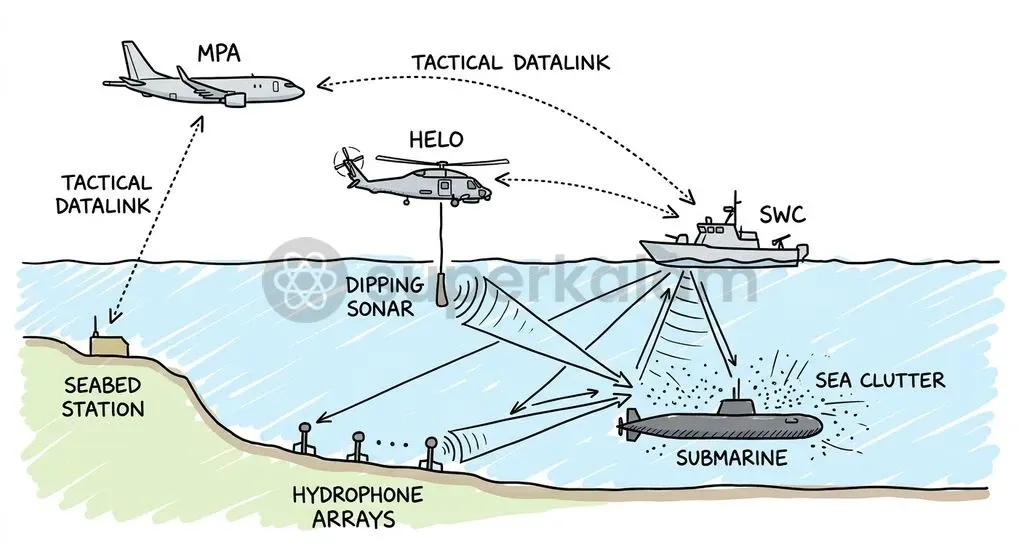
Operational effectiveness relies on data integration. Technical platform analyses indicate that ASW-SWCs integrate into a layered coastal battle network via tactical datalinks, sharing real-time tracks with Boeing P-8I Neptune long-range maritime patrol aircraft and shipborne Sikorsky MH-60R Seahawk helicopters (as reported by Naval Technology, May 2024).
Discuss with Superkalam
Compare the tactical trade-offs between deploying heavy multi-role frigates and dedicated shallow-water craft for coastal choke-point defence.
Ask NowWay Forward: Building a Multi-Layered Maritime Deterrence Architecture
Securing India's maritime perimeter requires linking shallow-water surface combatants with aerial surveillance and persistent underwater sensor networks. The induction of the sixteen ASW-SWC vessels addresses coastal surveillance gaps across India's 7,516.6 km coastline, 12 major ports, 184 intermediate and minor ports, and 1,197 island territories.
To consolidate coastal anti-submarine warfare capabilities, defence planners should prioritise four strategic pathways:
- Seabed Sensor Arrays: Deploying stationary undersea hydrophone networks and fiber-optic acoustic arrays along critical approaches, such as the Andaman and Nicobar chain, to create permanent tripwires.
- Manned-Unmanned Teaming (MUM-T): Pairing ASW-SWC corvettes with Extra-Large Unmanned Underwater Vehicles (XLUUVs) and autonomous surface vessels to expand sonar coverage without risking crewed platforms.
- Acoustic Intelligence (ACINT) Profiling: Continuously cataloguing coastal water temperatures, salinity gradients, and ambient noise levels to refine sonar signal-processing algorithms.
- Sustaining Public-Private Synergies: Institutionalising the defence shipyard and private shipyard partnership model pioneered in the ASW-SWC project to accelerate future naval construction programmes.
Key Takeaways
- The Milestone: INS Mangrol is the third of eight Mahe-class ASW-SWC corvettes delivered by Cochin Shipyard Limited to the Indian Navy on August 21, 2026.
- The Fleet Goal: The sixteen-ship ASW-SWC project, divided equally between CSL and GRSE, replaces the ageing Soviet-era Abhay-class corvettes commissioned between 1989 and 1991.
- Acoustic Optimisation: Designed with a shallow 2.7-metre draught and waterjet propulsion, the platform minimises cavitation noise to operate effectively amid coastal thermal layers and bottom reverberation.
- Strategic Driver: The induction counters proliferating AIP-equipped conventional submarines and foreign hydrographic mapping across the Indian Ocean Region.
- High Indigenisation: The vessel achieves over 80 percent domestic content, utilising SAIL's DMR 249A steel, BEL electronics, and the indigenous Shyena light-weight torpedo suite.
- Operational Synergy: Integrating ASW-SWCs into coastal battle networks frees blue-water frigates and destroyers for wide-area power projection.
Mains Question
"Littoral anti-submarine warfare presents unique acoustic and hydrographic obstacles that render open-ocean tactics ineffective." In light of this statement, examine the technical and operational significance of the Anti-Submarine Warfare Shallow Water Craft (ASW-SWC) project for India's coastal security. (10 Marks)
Evaluate NowMains Question
The Anti-Submarine Warfare Shallow Water Craft (ASW-SWC) programme represents a notable paradigm in indigenous defence manufacturing through Public-Private Partnerships and domestic supply chain integration. Elucidate. (15 Marks)
Evaluate NowPractice MCQs
QUESTION 1
With reference to the Anti-Submarine Warfare Shallow Water Craft (ASW-SWC) project of the Indian Navy, consider the following statements:
- The sixteen vessels under the project are divided equally between Cochin Shipyard Limited and Garden Reach Shipbuilders & Engineers.
- The craft are specifically built to replace the ageing Soviet-origin Abhay-class corvettes.
- The Mahe-class vessels utilize waterjet propulsion systems to minimize cavitation noise in shallow littoral environments.
Which of the statements given above are correct?
QUESTION 2
Consider the following statements regarding underwater acoustic propagation in shallow littoral waters:
- Multi-path sound propagation occurs when acoustic energy repeatedly reflects between the sea surface and the seabed.
- Sharp thermocline gradients in coastal waters eliminate ambient noise, aiding deep-sea active sonar detection.
- Bottom reverberation and scattering from uneven seabeds produce false returns that obscure target echoes.
Which of the statements given above is/are correct?
QUESTION 3
With reference to naval technology and propulsion systems mentioned in the context of regional submarine developments, consider the following statements:
- Air-Independent Propulsion (AIP) systems based on Stirling-cycle technology require conventional submarines to surface daily for atmospheric oxygen.
- Waterjet propulsion reduces cavitation noise compared to conventional propeller blades.
- DMR 249A is a specialized grade of indigenous steel utilized in modern Indian naval warship construction.
Which of the statements given above are correct?
QUESTION 4
In the context of the Anti-Submarine Warfare Shallow Water Craft (ASW-SWC) programme, the 'Mahe-class' and 'Arnala-class' vessels are being constructed respectively by:
QUESTION 5
Consider the following statements regarding the comparative operational parameters of ASW Shallow Water Craft and Frontline ASW Frigates/Destroyers:
- ASW Shallow Water Craft are designed with a shallow draught of under 3 metres to operate in continental shelves and port approaches.
- Frontline destroyers and frigates utilize marine diesel engines driving waterjets to achieve shallow acoustic sanitisation.
- Inducting dedicated ASW shallow-water vessels allows frontline combatants to focus on deep-sea escort and wide-area blue-water deterrence.
Which of the statements given above is/are correct?