India-UK CETA in Force: What the 16th JETCO Confirmed on Implementation
The 16th India-UK JETCO in New Delhi reviewed CETA's early implementation: first shipments, eCoO 2.0 self-certification, tariff preferences in use, and what remains on services mobility and investment.
Oct, 2026
•9 min read
Overview
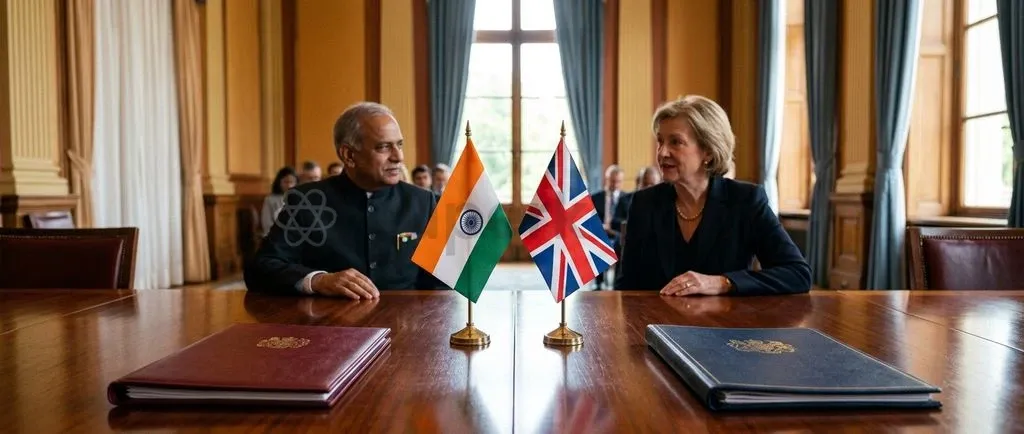
The India-UK Comprehensive Economic and Trade Agreement officially entered into force on 15 July 2026. It delivered substantial industrial tariff cuts, yet exposed sharp structural frictions over professional mobility, green border taxes, and investment safeguards.
India secured duty-free access across 99% of its tariff lines and granted phased concessions on British automobiles and Scotch whisky. However, the pact excluded broad immigration liberalisation for Indian IT and healthcare professionals.
Cross-border mobility was confined to temporary business visits and a 36-month National Insurance exemption under a parallel Double Contribution Convention. Delinking the Bilateral Investment Treaty and managing the upcoming United Kingdom Carbon Border Adjustment Mechanism show how trade deals extend far past simple border tariffs. Realising the bilateral target of doubling two-way trade to $120 billion by 2030 hinges on resolving regulatory divides.
Why in the News: 16th JETCO Reviews Early CETA Implementation
The 16th session of the India-UK Joint Economic and Trade Committee met in New Delhi on 12 October 2026 to review the newly implemented trade pact. Co-chaired by Indian Commerce and Industry Minister Piyush Goyal and UK Business and Trade Secretary Jonathan Reynolds, the ministerial forum was the first formal implementation review since the agreement took effect on 15 July 2026, as confirmed by the [Joint Statement of the 16th Meeting of the India–UK Joint Economic and Trade Committee (JETCO) - PIB Delhi].
Commerce Minister Piyush Goyal reaffirmed the India-UK Vision 2035 framework, which targets doubling bilateral goods and services trade from approximately $60 billion to $120 billion by 2030. Outcomes confirmed at the meeting included:
- First shipments under CETA: More than 50 consignments were shipped on the first day of implementation, including the first export of Joha rice from Assam to the United Kingdom.
- Commercial deals: Bilateral agreements totalling $1.32 billion across aviation, artificial intelligence, healthcare, and engineering, according to the UK Department for Business and Trade.
- Simplified origin certification: Rollout of eCoO 2.0, letting exporters self-certify certificates of origin and cutting compliance time for businesses.
- Tariff preferences in early use: Tariff-free Scottish salmon entering India, Scotch whisky at reduced duties, and the first British cars shipped under the new tariff-rate quota.
- Data exchanges: Mandatory annual data exchanges starting one year post-implementation to track tariff preference utilisation rates and tackle compliance bottlenecks.
- Institutional follow-through: CETA committees, working groups and contact points reviewed implementation, and both sides agreed the 17th JETCO will meet in the UK in 2027.
Both sides also recognised that whilst goods tariffs have fallen, further work remains on services market access and investment safeguards.
Discuss with Superkalam
Identify the specific article and requirement of the 2015 Indian Model BIT that British negotiators opposed during the investment talks.
Ask NowServices Mobility: What CETA Covers and Where Limits Remain
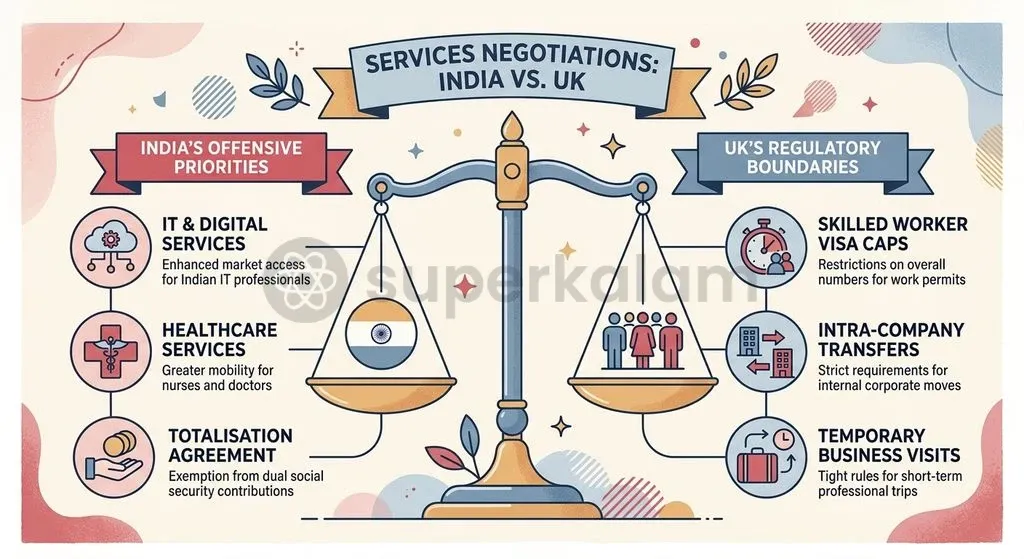
Mode 4 services trade under the General Agreement on Trade in Services represents India's primary offensive economic interest with the United Kingdom. Indian negotiators pushed for expanded temporary entry quotas and seamless cross-border deployment for software engineers, financial analysts, and healthcare specialists, seeking parity with goods liberalisation.
Domestic political commitments in Westminster strictly constrained British negotiators from granting broad immigration or work visa concessions, according to the UK Department for Business and Trade. British authorities explicitly restricted the services chapter to short-term business visitors and intra-company transferees, barring general employment visa quotas.
To resolve social security friction without amending British immigration statutes, the two nations concluded a parallel Social Security Double Contribution Convention. As noted in a release by the Ministry of Commerce and Industry, the convention exempts Indian seconded professionals working in the UK from National Insurance contributions for up to 36 months, preventing dual social security deductions.
A comprehensive social security totalisation agreement remains unfinalised and deliberately excluded from the core trade text, according to the Services Export Promotion Council. Without full totalisation, Indian professionals cannot aggregate contribution periods between jurisdictions to qualify for long-term UK pension entitlements.
| Dimension | Indian Offensive Stance | UK Concession in CETA | Residual Policy Friction |
|---|---|---|---|
| Visa Liberalisation | Expanded work visas for IT and healthcare cadres | Restricted to intra-company transfers and business visits | Absence of open numerical work visa quotas |
| Social Security Taxes | Totalisation agreement with pension aggregation | 36-month National Insurance double-contribution waiver | Contributions forfeited without long-term pension accrual |
| Professional Standards | Broad mutual recognition agreements for qualifications | Sector-specific regulatory dialogue mechanisms | Lengthy domestic accreditation requirements |
Tariff Concessions in Force: Whisky, Automobiles, and Labour-Intensive Goods
Industrial goods market access required calibrated reciprocal concessions across historically protected manufacturing and beverage sectors in both economies. The United Kingdom eliminated customs duties on 99% of Indian tariff lines upon entry into force, providing immediate duty-free treatment for Indian textiles, footwear, gems, and leather goods, as reported by the Ministry of Commerce and Industry.
In return, the Indian government agreed to phased tariff reductions across approximately 90% of British tariff lines while protecting agricultural producers. India maintained complete defensive carve-outs on basic farm staples, cereals, and sensitive dairy lines, insulating domestic smallholder farmers from foreign competition.
The phased tariff schedules span several sensitive sectors:
- Scotch whisky: India lowered its basic customs duty immediately from 150% down to 75% on 15 July 2026, establishing a 10-year glide-path toward a 40% terminal duty rate by 2036, according to official records published on GOV.UK.
- British automobiles: India agreed to lower tariffs on completely built-up vehicles from up to 110% down to 10% over a decade under a tariff-rate quota.
- Electric vehicles: Preferential tariff cuts on electric vehicles were explicitly deferred until year six to shield domestic manufacturing initiatives.
Discuss with Superkalam
How does the 36-month National Insurance contribution waiver differ in practical benefit from a comprehensive social security totalisation agreement?
Ask NowThe Investment Chapter: Why the BIT Was Delinked from CETA
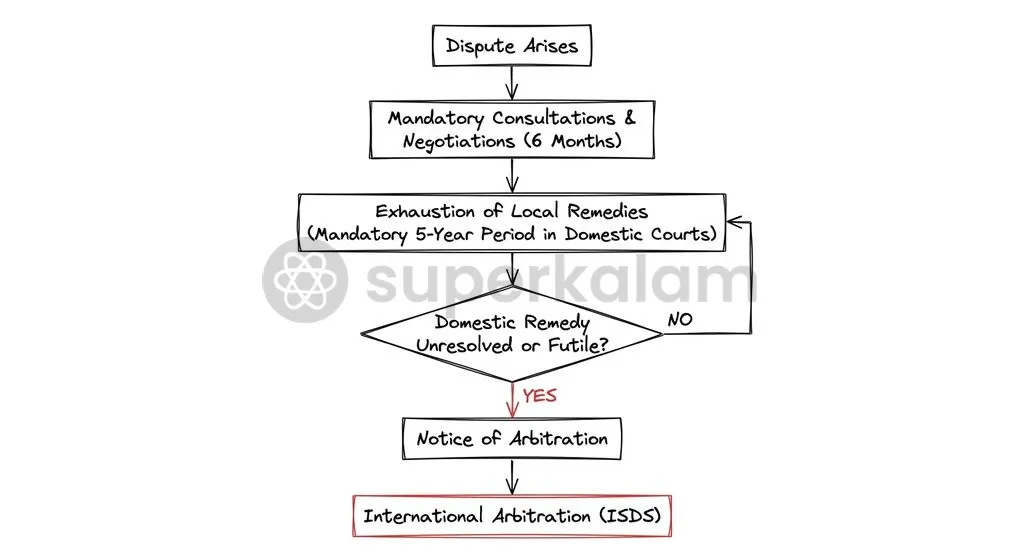
Bilateral Investment Treaty negotiations were formally delinked from the trade pact because of irreconcilable differences over investor-state dispute settlement. When India terminated dozens of first-generation investment treaties following adverse international arbitration rulings, the Department of Economic Affairs introduced the 2015 Indian Model BIT to protect sovereign regulatory space.
The investment negotiations stalled across several critical fault lines:
- Domestic remedy exhaustion: Article 15.2 of the 2015 Indian Model BIT mandates that foreign investors must exhaust domestic judicial and administrative remedies for at least five years before filing for international arbitration.
- British corporate objections: The British government opposed this clause, arguing that prolonged litigation cycles in Indian courts undermine swift capital recovery and commercially viable dispute resolution.
- Legal exposure: Delinking the investment chapter prevented an impasse from derailing goods tariff cuts, but British corporate investors committing long-term capital in Indian infrastructure and manufacturing continue to face legal exposure without standalone treaty protections.
Negotiators from the Ministry of Finance and the UK Department for Business and Trade continue parallel discussions. Without a compromise between international arbitration and local exhaustion requirements, cross-border corporate investments remain exposed to baseline domestic administrative law.
Regulatory Watch: UK Carbon Border Tax and Pharmaceutical Patent Standards
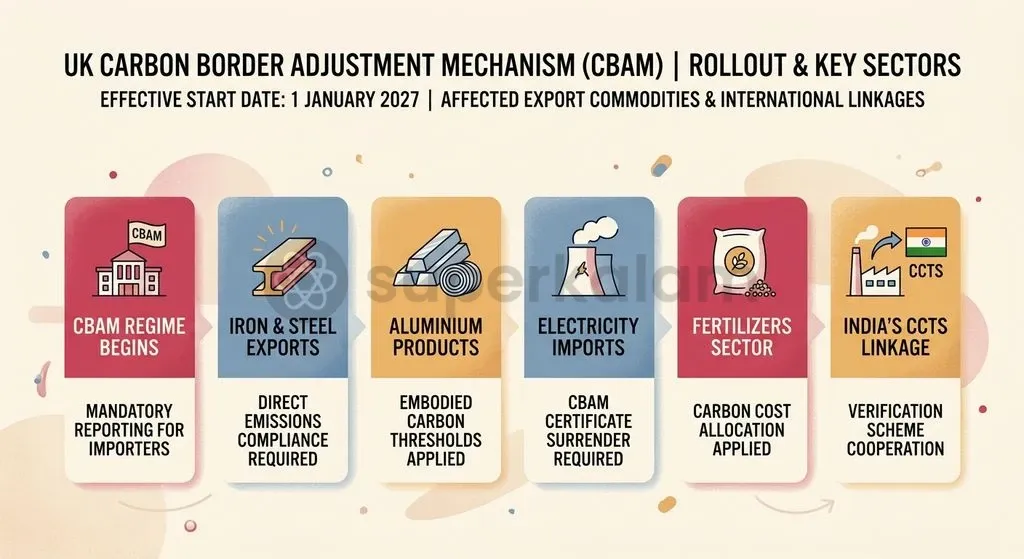
The United Kingdom Carbon Border Adjustment Mechanism introduces a significant unilateral regulatory hurdle for Indian industrial exports entering British ports. Legislated to take effect on 1 January 2027, the UK CBAM operates as a direct border tax administered by HM Revenue and Customs across iron, steel, aluminium, cement, fertiliser, ceramics, and hydrogen.
Indian exporters face notable friction across two distinct policy domains:
- Carbon border taxation: Indian iron, steel, and downstream steel product shipments to the UK totalled $893.4 million in FY 2025-26, all falling directly within the UK CBAM tax net, according to the Department of Commerce. Domestic compliance under India's Carbon Credit Trading Scheme qualifies in principle for deductions, but offsets remain contingent on stringent third-party verification that carbon prices were physically paid in India.
- TRIPS-plus patent standards: British pharmaceutical lobbies pushed for mandatory patent term extensions and clinical trial data exclusivity. Indian negotiators successfully excluded these provisions from the final text.
Indian public health safeguards were preserved by defending Section 3(d) of the Indian Patents Act, 1970. Reaffirmed by the Supreme Court of India in the landmark Novartis v. Union of India (2013) ruling, Section 3(d) prevents the evergreen extension of pharmaceutical patents by barring claims on new forms or derivatives of known substances lacking significantly enhanced therapeutic efficacy.
Discuss with Superkalam
If an Indian steel mill exports to the UK under the UK CBAM from 2027, what conditions must its domestic carbon credits satisfy to claim border tax offsets?
Ask NowStrategic Imperatives: Post-Brexit British Trade Ambitions vs. India's Diversification Push
Post-Brexit Britain pursued the trade agreement with India as an economic cornerstone of its 'Global Britain' foreign policy tilt toward the Indo-Pacific region. Following its accession to the Comprehensive and Progressive Agreement for Trans-Pacific Partnership, London prioritised bilateral market access in South Asia to offset European trade realignments, as outlined in the UK Cabinet Office Integrated Review Refresh 2023.
Both nations brought distinct strategic imperatives to the negotiating table:
- British export diversification: Securing commercial footholds in expanding developing markets provides British engineering, financial, and beverage sectors with vital export diversification away from the European single market. For Prime Minister Keir Starmer's administration, the New Delhi outcomes offered tangible evidence of an independent external trade strategy.
- Indian supply chain integration: For India, the agreement anchors domestic manufacturing within reliable international supply chains. By establishing preferential terms with the world's sixth-largest economy, India seeks to capture Western supply chain relocations while enforcing its 'Make in India' and Production-Linked Incentive frameworks.
- Defensive red lines: Defensive considerations guided India's posture throughout the 14 negotiating rounds. Indian policymakers insulated agricultural staples and protected emerging domestic clean-technology ecosystems, refusing to compromise rural livelihoods for industrial concessions.
The Way Forward: Balancing Mobility, Green Trade Rules, and Dispute Settlement
Tariff cuts alone cannot bridge emerging regulatory divides across carbon accounting and professional services. Realising the $120 billion bilateral trade target under Vision 2035 requires focused institutional cooperation across three areas:
- Technical carbon benchmarks: Coordinated technical benchmarks are required between India's Bureau of Energy Efficiency and HM Revenue and Customs before the UK CBAM launches on 1 January 2027. Both nations should formalise bilateral accreditation protocols so that emissions assessments under India's Carbon Credit Trading Scheme are accepted in the UK without costly secondary audits.
- Expanded social security coverage: Services mobility requires a pragmatic compromise beyond the Double Contribution Convention. The existing 36-month National Insurance waiver should be expanded into a bilateral pact that allows Indian corporate professionals to aggregate contributions toward long-term pension accrual.
- Commercial fast-track arbitration: Resolving the stalled Bilateral Investment Treaty demands innovative dispute mechanisms. Establishing dedicated commercial fast-track tribunals in India or defining specific fast-track bypasses in the 2015 Model BIT could satisfy British capital safeguards while protecting sovereign regulatory authority.
Discuss with Superkalam
Compare India's defensive carve-outs in agriculture with the deferred tariff concessions on electric vehicles: what distinct domestic policy objectives do they protect?
Ask NowKey Takeaways
- The 16th JETCO (New Delhi, 12 October 2026), the first implementation review since CETA took effect on 15 July 2026, confirmed early outcomes: 50+ first-day consignments including the first Joha rice export, eCoO 2.0 self-certification, tariff-free Scottish salmon, first British cars under the tariff-rate quota, annual preference-utilisation data exchanges, and the 17th JETCO set for the UK in 2027.
- The India-UK Comprehensive Economic and Trade Agreement took effect on 15 July 2026, reducing duties on 99% of Indian tariff lines and 90% of UK tariff lines.
- India reduced its 150% customs duty on Scotch whisky immediately to 75%, with a 10-year glide-path reaching 40% by 2036, while deferring electric vehicle tariff reductions until year six.
- Mode 4 professional services concessions were restricted to temporary business visits and intra-company transfers, leaving Indian professionals without general work visa quotas or full social security totalisation.
- Delinking the Bilateral Investment Treaty was forced by Article 15.2 of India's 2015 Model BIT, which mandates exhausting domestic legal remedies for five years before pursuing international arbitration.
- Indian industrial exports face carbon border taxes under the UK CBAM beginning 1 January 2027, with $893.4 million in iron and steel shipments exposed to carbon levies.
- Indian negotiators defended public health flexibilities by rejecting TRIPS-plus demands and upholding Section 3(d) of the Indian Patents Act, 1970 against pharmaceutical patent evergreening.
Mains Question
"Delinking bilateral investment treaties from trade agreements protects sovereign regulatory space but creates significant residual friction for cross-border capital." In the light of the 2015 Indian Model BIT and recent India-UK negotiations, critically analyse this statement. (10 Marks)
Evaluate NowMains Question
While tariff reductions across industrial goods form the bedrock of conventional free trade agreements, emerging non-tariff regulatory measures such as the UK Carbon Border Adjustment Mechanism (CBAM) and Mode 4 services mobility restrictions present complex challenges for developing economies. Examine with reference to the India-UK trade pact. (15 Marks)
Evaluate NowPractice MCQs
QUESTION 1
With reference to the India-UK Comprehensive Economic and Trade Agreement, consider the following statements:
- India secured immediate duty-free market access across 99% of its tariff lines into the United Kingdom.
- The agreement incorporates open numerical work visa quotas for Indian software engineers and healthcare cadres.
- The parallel Social Security Double Contribution Convention provides an exemption from UK National Insurance contributions for up to 36 months. Which of the statements given above is/are correct?
QUESTION 2
Regarding the tariff concessions under the India-UK trade pact, consider the following statements:
- India immediately reduced its basic customs duty on Scotch whisky from 150% down to 75%.
- Tariff concessions on electric vehicles were implemented immediately upon entry into force to promote clean mobility.
- India maintained defensive carve-outs on basic farm staples, cereals, and sensitive dairy lines. Which of the statements given above is/are correct?
QUESTION 3
Consider the following statements regarding the investment and intellectual property dimensions of India-UK bilateral negotiations:
- Bilateral Investment Treaty talks stalled primarily due to Article 15.2 of the 2015 Indian Model BIT requiring domestic remedy exhaustion for at least five years.
- Indian negotiators accepted TRIPS-plus patent standards, including mandatory patent term extensions.
- Section 3(d) of the Indian Patents Act, 1970 prevents the evergreen extension of pharmaceutical patents lacking significantly enhanced therapeutic efficacy. Which of the statements given above is/are correct?
QUESTION 4
Under the UK Carbon Border Adjustment Mechanism (CBAM) legislated to take effect on 1 January 2027, which of the following sectors are subject to the border tax?
- Iron and steel
- Aluminium
- Fertiliser
- Hydrogen Select the correct answer using the code given below:
QUESTION 5
What is the primary operational limitation of the Social Security Double Contribution Convention signed between India and the UK, as compared to a full totalisation agreement?