India's Military Theaterisation: Structural Challenges & Path Ahead - UPSC Notes
Discover how India's shift toward integrated theatre commands aims to overcome service silos and reshape modern defence readiness.
Aug, 2026
•12 min read
Overview
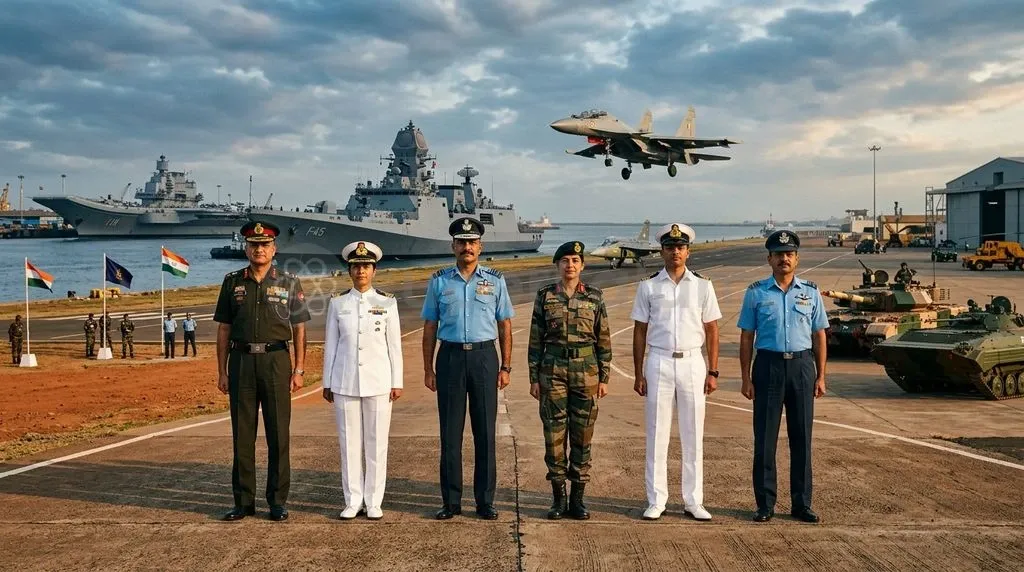
Fig: India's military theaterisation aims to integrate the Army, Navy, and Air Force into unified geographical commands for multi-domain operations.
India's military theatre commands aim to unify seventeen single-service operational units under unified theatre headquarters. This reform modernises command structures across air, land, and sea domains. According to reports from the Ministry of Defence, this structural transition replaces fragmented operational planning with joint geographical commands. The primary objective is enhancing combat capability against complex security challenges along India's land and maritime borders.
Enacted under the Inter-Services Organisations (Command, Control and Discipline) Act, 2023, the reform grants legal authority to theatre commanders across all three services. While structural realignment improves joint operational planning, long-term success depends on resolving inter-service asset scarcity and command-authority friction rather than merely restructuring administrative headquarters. Consequently, achieving true jointness requires systematic institutional reforms, cross-service career integration, and digital network unification alongside physical command restructuring.
Why Theaterisation is the Biggest Military Overhaul Since Independence
The Ministry of Defence initiated India's theatre command overhaul to replace seventeen legacy single-service headquarters with unified operational commands across geographical sectors. As of May 2024, the central government formally enforced the Inter-Services Organisations Act, 2023, establishing legal frameworks for cross-service command authority. Parliament passed the legislation with Presidential assent on 15 August 2023, while subordinate Rules under Section 11 were notified on 27 May 2025.
| Structural Component | Legacy System | Proposed Integrated Model |
Command Structure | 17 Independent Commands (7 Army, 7 Air Force, 3 Navy) | 3 Geographical Theatres |
Command Headquarters | Service-specific single-service silos | Northern (Lucknow), Western (Jaipur), Maritime (Thiruvananthapuram) |
This structural evolution builds upon administrative steps taken in December 2019, when the government created the Department of Military Affairs under the Allocation of Business Rules 1961. Headed by the Chief of Defence Staff as ex-officio Secretary, the Department of Military Affairs oversees joint procurement, training, and operational restructuring. Theaterisation represents the largest structural reform of the Indian Armed Forces since 1947, shifting the national defence apparatus from service-specific operational doctrines to integrated multi-domain operations.
How India's Legacy Single-Service Command Structure Works Today
India currently operates seventeen single-service operational commands alongside two functional tri-service commands under separate administrative hierarchies. The Indian Army and Indian Air Force each manage seven single-service commands, while the Indian Navy operates three. These seventeen commands function within geographic jurisdictions that frequently overlap without co-located headquarters.
- Indian Army Commands: Northern (Udhampur), Western (Chandimandir), Central (Lucknow), Eastern (Kolkata), Southern (Pune), Army Training Command (Shimla), and South Western (Jaipur).
- Indian Air Force Commands: Western (New Delhi), South Western (Gandhinagar), Central (Prayagraj), Eastern (Shillong), Southern (Thiruvananthapuram), Training Command (Bengaluru), and Maintenance Command (Nagpur).
- Indian Navy Commands: Western (Mumbai), Eastern (Visakhapatnam), and Southern (Kochi).
| Command Category | Component Units / Commands |
Single-Service Operational Commands (17 Total) | Indian Army (7), Indian Air Force (7), Indian Navy (3) |
Existing Functional Tri-Service Commands | Andaman and Nicobar Command (ANC), Strategic Forces Command (SFC) |
In addition to these single-service headquarters, India maintains two functional tri-service structures: the Andaman and Nicobar Command, established in 2001, and the Strategic Forces Command, formed in 2003. Under the current model, each service chief retains operational control over their respective forces. This setup forces joint operations to rely on voluntary coordination rather than unified operational command.
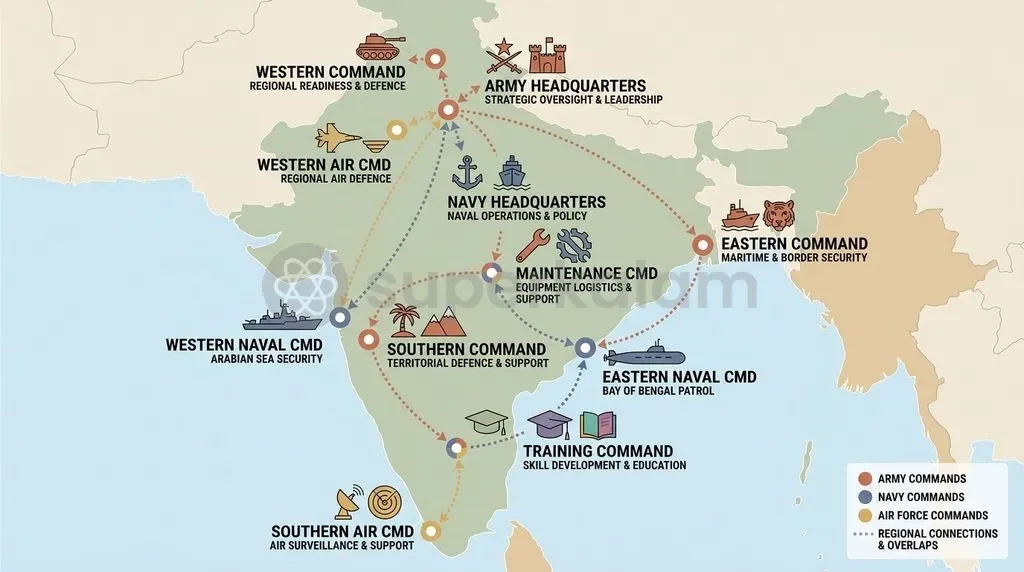
Fig: India currently relies on 17 single-service operational commands located across different regions, creating operational overlap.
Discuss with Superkalam
Can you recall the three landmark committees that recommended joint military command structures in 1999, 2011, and 2016?
Ask NowWhat Joint Theater Commands Mean and How They Differ From Legacy Models
Integrated theatre commands unify single-service operational assets under a single four-star theatre commander responsible for a specific geographical theatre of operations. Under the proposed structure reported by strategic reviews, theatre commanders will report directly to the Ministry of Defence, while Service Chiefs transition exclusively to Raise-Train-Sustain roles.
Per analysis by the Centre for Joint Warfare Studies, the central government plans to consolidate the seventeen single-service commands into three primary geographical commands:
- Northern Theatre Command: Planned to be headquartered in Lucknow to consolidate land and air assets covering the 3,488 km Line of Actual Control against China.
- Western Theatre Command: Planned to be headquartered in Jaipur to integrate land and air operations along the Pakistan border sector.
- Maritime Theatre Command: Planned to be headquartered in Thiruvananthapuram, merging Eastern and Western Naval Commands with the Andaman and Nicobar Command to secure the Indian Ocean Region.
| Dimension | Legacy Single-Service Model | Proposed Integrated Theatre Model |
Operational Command | Exercised by respective Service Chiefs | Delegated to Theatre Commanders |
Service Chiefs' Role | Operational control + administration | Focused on Raise-Train-Sustain functions |
Disciplinary Authority | Restricted strictly to own service personnel | Inter-service authority under ISO Act 2023 |
Asset Allocation | Managed separately by single-service HQs | Pooled dynamically under unified theatre HQs |
Command Infrastructure | 17 separate single-service commands | 3 adversary-centric theatres |
The Structural Failure Points: Where Integration Could Break Down
Structural failure points in theatre integration stem from command hierarchy overlaps, administrative disparities, and delayed digital network integration across the Indian Armed Forces. According to analysis by the Observer Research Foundation, creating four-star Theatre Commanders reporting directly to the Defence Minister risks operational authority overlap with the Chief of Defence Staff, Vice Chief of Defence Staff, and Service Chiefs during high-intensity military operations.
| Level / Position | Operational Role | Potential Friction Point |
Ministry of Defence | Administrative & Executive Oversight | Direct reporting lines |
Chief of Defence Staff & Service Chiefs | Raise-Train-Sustain (RTS) functions | Overlap with operational commanders |
4-Star Theatre Commanders | Direct Operational Execution | Authority friction during high-intensity operations |
Inter-service human resource friction presents another hurdle. Disparities in promotion timelines and rank equivalence between the Army, Navy, and Air Force complicate senior joint appointments. Furthermore, multi-domain integration requires connecting distinct digital networks. Linking the Army's ASTROIDS, the Air Force's IACCCS, and the Navy's NAVNET demands a robust, common data-link architecture.
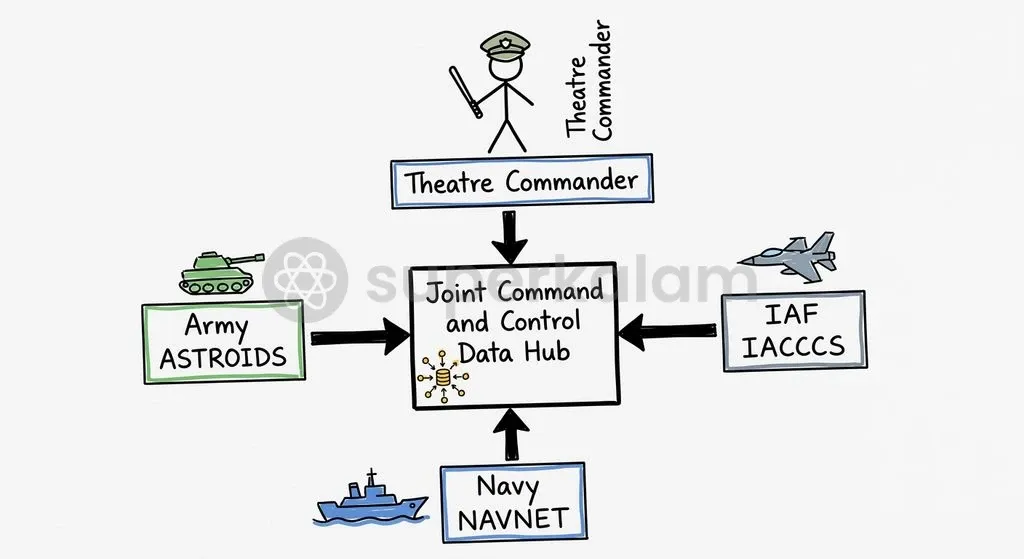
Fig: Integrating ASTROIDS, IACCCS, and NAVNET into a unified command network is essential for multi-domain joint warfare.
The Operational Advantages: Why Jointness Matters for Modern Warfare
Joint operational structures enable rapid multi-domain force application across land, sea, air, cyber, and space domains during two-front security contingencies. Combining ground and air capabilities under unified commands accelerates decision-making cycles along contested borders.
- Rapid Multi-Domain Application: Enables swift force deployment across land, sea, air, cyber, and space domains during two-front contingencies.
- Accelerated Decision Cycles: Combines ground and air capabilities under unified command for optimised force application along contested borders.
- Streamlined Logistics: Eliminates duplicate supply chains, sharing maintenance infrastructure and intelligence streams to optimise defence spending.
- Coordinated Precision Operations: Ensures air, ground, and naval assets execute coordinated precision strikes rather than isolated campaigns.
Institutional Resistance and Turf Wars: The Real Bottlenecks
Institutional resistance centres on the Indian Air Force's concerns regarding asset fragmentation and the structural distribution of air defence resources. Per reports from the Centre for Air Power Studies, the Indian Air Force maintains the doctrine of indivisibility of air power, arguing that permanently distributing air assets among geographical theatres risks dividing combat capabilities across multiple fronts.
Resource constraints aggravate these operational concerns. The Indian Air Force currently operates approximately 30 active fighter squadrons against a sanctioned strength of 42 fighter squadrons. Air Force leadership contends that dividing limited multi-role fighter squadrons across separate theatre commands limits tactical flexibility. Analysts from the United Service Institution of India also highlight debates over whether air defence resources should be consolidated under a Standalone Air Defence Command or decentralised into geographical theatre commands.
| Policy Review / Committee | Year | Key Recommendations |
Kargil Review Committee | 1999 | Recommended CDS and joint operational structures post-Kargil war gaps. |
Naresh Chandra Task Force | 2011 | Proposed Permanent Chairman CoSC and specialised tri-service hubs. |
Shekatkar Committee | 2016 | Recommended CDS and 3 Integrated Theatre Commands among 99 reforms. |
Stalled Reforms: From Shekatkar Recommendations to the 2023 Act
Military integration attempts faced persistent institutional inertia for decades. The Kargil Review Committee in 1999 and the Group of Ministers report in 2001 first recommended a Chief of Defence Staff to fix joint coordination gaps. In 2011, the Naresh Chandra Task Force advocated a Permanent Chairman of the Chiefs of Staff Committee alongside tri-service commands for Cyber, Space, and Special Forces.
In 2016, the Shekatkar Committee recommended 99 comprehensive reforms to improve combat capability, explicitly calling for a Chief of Defence Staff and 3 integrated theatre commands. Despite these official recommendations, structural implementation stalled for nearly a decade due to three primary bottlenecks:
- Lack of Legal Authority: Prior to 2023, senior officers from one service lacked statutory disciplinary power over personnel from another service under existing service-specific Acts.
- Service Silos and Asset Concerns: Single-service leadership resisted losing operational command, while asset shortfalls raised fears of resource misallocation during a two-front war scenario.
- Absence of an Empowered Execution Mechanism: Without an administrative body like the Department of Military Affairs, jointness relied on voluntary consensus among Service Chiefs.
Parliament resolved the primary legal bottleneck by passing the Inter-Services Organisations Act, 2023. Enforced in May 2024, the law empowers Heads of Inter-Services Organisations with administrative and disciplinary control over personnel from all three services.
Lessons From Global Militaries on Successful and Failed Theaterisation
Global militaries highlight legislative mandates and structural centralisation as key drivers of successful theatre integration.
| Country | Reform Framework | Key Structural Transformation |
United States | Goldwater-Nichols Act of 1986 | Stripped Service Chiefs of operational authority; transferred command to unified combatant commanders. |
China | 2015–2016 Military Reforms | Replaced seven military regions with five theatre commands under Central Military Commission control. |
Both models demonstrate that successful theaterisation requires statutory backing, clear operational authority, and strong political direction to overcome service resistance.
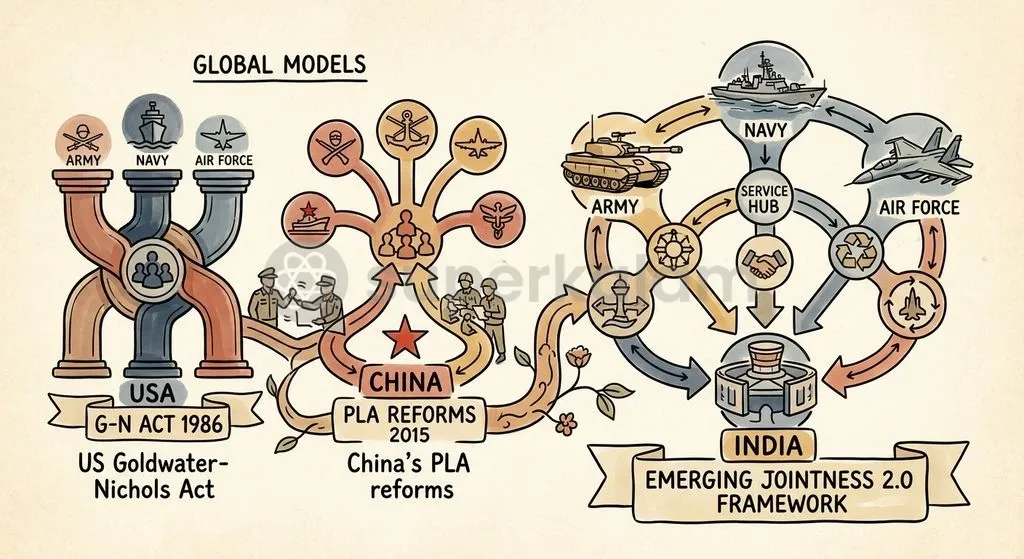
Fig: Global precedent shows that statutory authority and integrated command structures are vital for operational success.
The Road Ahead: What Needs to Change for Effective Military Integration
Effective military integration requires implementing Jointness 2.0 initiatives, harmonising inter-service administrative cadre rules, and establishing cross-domain operational doctrines. In May 2024, the Chief of Defence Staff launched Jointness 2.0, prioritising a unified Joint Culture across the armed forces.
| Phase | Focus Area | Action Items |
Phase 1: Statutory Authority | Legal Framework | Enforce ISO Act 2023 and subordinate Rules (Completed). |
Phase 2: Administrative Alignment | Institutional Structure | Harmonise promotion rules, ranks, and data architectures. |
Phase 3: Operational Jointness | Force Application | Dynamic pooling of assets and joint operational exercises. |
To ensure smooth theatre operations, policy execution should focus on three priorities:
- Clarifying the Command Hierarchy: The Ministry of Defence must publish clear operational directives defining authority limits between the Chief of Defence Staff, Service Chiefs, and Theatre Commanders.
- Harmonising Human Resource Cadre Rules: Equalising promotion timelines, rank structures, and cross-service postings will resolve inter-service administrative friction.
- Flexible Air Asset Allocation: Establishing dynamic asset-allocation mechanisms will address Air Force concerns regarding asset fragmentation during multi-front contingencies.
Key Takeaways
- Core Objective: Theaterisation merges India's seventeen single-service commands into three geographical, adversary-centric commands: Northern, Western, and Maritime.
- Statutory Basis: The central government enforced the Inter-Services Organisations Act, 2023 in May 2024, granting legal disciplinary authority to Heads of Inter-Services Organisations.
- Historical Context: Structural reforms stem from recommendations by the Kargil Review Committee (1999), Naresh Chandra Task Force (2011), and Shekatkar Committee (2016).
- Key Friction Points: Major operational bottlenecks include Air Force concerns over air power indivisibility, fighter squadron shortages, and command authority overlaps.
- Administrative Mechanism: The Department of Military Affairs, created in December 2019 under the Allocation of Business Rules 1961, manages joint operations under the Chief of Defence Staff.
Mains Question
"From the Kargil Review Committee (1999) to the Shekatkar Committee (2016), defence reform reports have consistently emphasized jointness as an operational imperative." Elucidate how the proposed integrated theatre commands enhance multi-domain operational capability along India's borders.
Evaluate NowMultiple Choice Questions
QUESTION 1
Q1. Consider the following statements regarding the Inter-Services Organisations (Command, Control and Discipline) Act, 2023:
- The Act empowers theatre commanders with inter-service disciplinary and administrative authority over personnel serving under their command.
- Subordinate Rules under Section 11 of the Act were notified in May 2025.
- It completely eliminates the administrative role of individual Service Chiefs in raising, training, and sustaining forces.
Which of the statements given above are correct?
QUESTION 2
Q2. Under the proposed integrated theatre command model for India's armed forces, what primary functional mandate is envisioned for individual Service Chiefs?
QUESTION 3
Q3. Consider the following statements regarding India's current legacy military command architecture and proposed geographical theatres:
- India currently operates 17 single-service operational commands and two functional tri-service commands.
- The Andaman and Nicobar Command was established in 2003, whereas the Strategic Forces Command was formed in 2001.
- The proposed Maritime Theatre Command plans to integrate the Eastern and Western Naval Commands along with the Andaman and Nicobar Command.
Which of the statements given above is/are correct?