India's 1,000-km QKD Network: National Quantum Mission Explained
As India validates its 1,000-km QKD network years ahead of schedule, quantum physics replaces mathematical ciphers to protect sovereign communication networks.
Sep, 2026
•11 min read
Overview
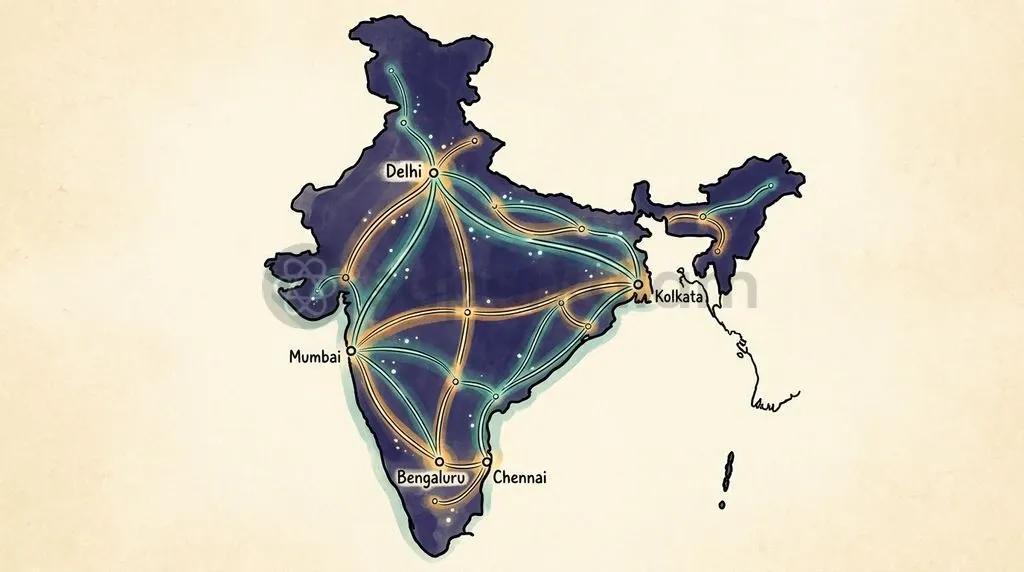
India achieved a major technological milestone by demonstrating an indigenous 1,000-kilometre Quantum Key Distribution network under the National Quantum Mission. This deployment establishes sovereign quantum-safe cryptographic capabilities ahead of projected national timelines. The breakthrough validates the practical coexistence of quantum key channels with high-speed commercial data traffic over standard optical fibre infrastructure.
Communications security in this network relies on the immutable laws of quantum mechanics rather than mathematical computational complexity. This design pre-empts emerging decryption threats posed by cryptographically relevant quantum computers. It strengthens domestic cybersecurity across strategic sectors, marking a transition from laboratory research to deployable national security infrastructure.
Why in the News: The 1,000-km QKD Network Milestone
The Department of Science and Technology announced on 8 April 2026 that India successfully validated a 1,000-km terrestrial quantum communication link under the National Quantum Mission. As of April 2026, the mission demonstrated this operational capability in under three years, well ahead of its original eight-year mandate. Official field trials confirmed the milestone by demonstrating secure key exchange alongside active commercial data streams, as documented in a PIB Delhi release.
Bengaluru-based deep-tech startup QNu Labs engineered the technical breakthrough. The enterprise was incubated at the IIT Madras Research Park and supported under the mission's startup funding framework. This demonstration proves that sovereign quantum cryptography integrates directly into existing terrestrial optical fibre networks without replacing legacy telecom physical hardware.
What Is Quantum Key Distribution (QKD) and How Does It Work?
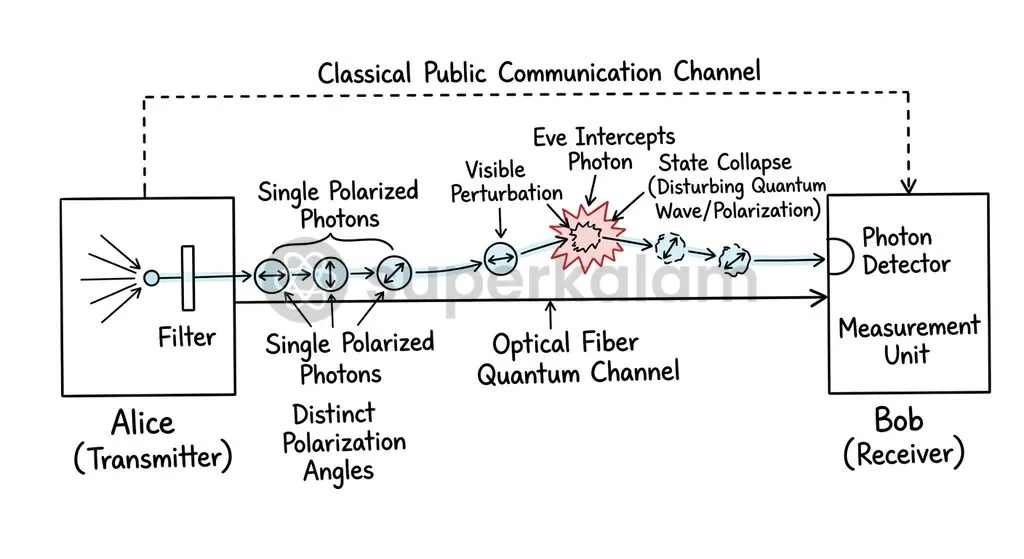
Quantum Key Distribution is a secure communication mechanism that uses the quantum states of light particles, called photons, to produce and distribute shared secret encryption keys between two parties. Classical communication transmits data as binary electrical or optical pulses representing zeros and ones. In contrast, QKD encodes cryptographic key data into quantum physical states such as photon polarisation or phase, according to the Department of Science and Technology.
The physical security of QKD rests on two fundamental principles of quantum physics:
- Heisenberg Uncertainty Principle: Certain pairs of physical properties cannot be measured simultaneously with arbitrary precision. Any eavesdropping attempt on a photon alters its physical quantum state.
- No-Cloning Theorem: Creating an identical copy of an unknown, arbitrary quantum state is physically impossible. An interceptor cannot duplicate flying qubits without introducing detectable transmission errors.
| Channel Type | Carrier Medium | Operational Role |
|---|---|---|
| Quantum Channel | Single photons | Generates and transmits raw quantum key material |
| Classical Public Channel | Standard optical/electronic signals | Handles key sifting, error correction, and encrypted data |
Note: The process uses a quantum channel for key generation and a classical public channel for verification and encrypted data transmission.
Interception attempts during transmission disturb the optical signal and alter the quantum properties of transmitted photons. Transmitting and receiving systems detect this disturbance instantaneously through an elevated Quantum Bit Error Rate. This alert allows operators to discard the compromised key before transmitting classified data.
The proven ARMOS system uses a decoy-state Differential Phase Shift protocol to maintain secure transmission across fibre spans exhibiting up to 40 dB channel loss while keeping error rates below 4%, according to the technical validation report by VIAVI Solutions and QNu Labs.
Discuss with Superkalam
Recall the two quantum physics principles that ensure eavesdropping cannot occur unnoticed in a QKD network.
Ask NowNational Quantum Mission: Core Pillars and Communication Goals
The Union Cabinet approved the National Quantum Mission on 19 April 2023 with a total budgetary outlay of ₹6,003.65 crore spanning eight years from 2023-24 to 2030-31. The initiative aims to seed, nurture, and scale scientific and industrial research and development across quantum technologies, as outlined in the official Cabinet notification.
The mission executes its strategic mandate through four dedicated Thematic Hubs (T-Hubs):
- Quantum Computing: Develops high-performance quantum computing systems and intermediate-scale processors.
- Quantum Communication: Builds secure ground and satellite quantum communication networks.
- Quantum Sensing and Metrology: Manufactures high-precision atomic clocks, magnetometers, and gravimeters.
- Quantum Materials and Devices: Creates novel superconductors, single-photon sources, and topological insulators.
IIT Madras hosts the Quantum Communication Thematic Hub in collaboration with the Centre for Development of Telematics (C-DOT), per a parliamentary report from the Department of Science and Technology. Under its mandate, the vertical must establish satellite-based quantum communications over a 2,000-km ground baseline and build a 2,000-km inter-city terrestrial quantum network across India by 2031. As of April 2026, the National Quantum Mission has expanded financial and institutional incubation backing to 17 domestic deep-tech startups to accelerate indigenous product deployment.
Conventional Encryption vs Quantum Key Distribution
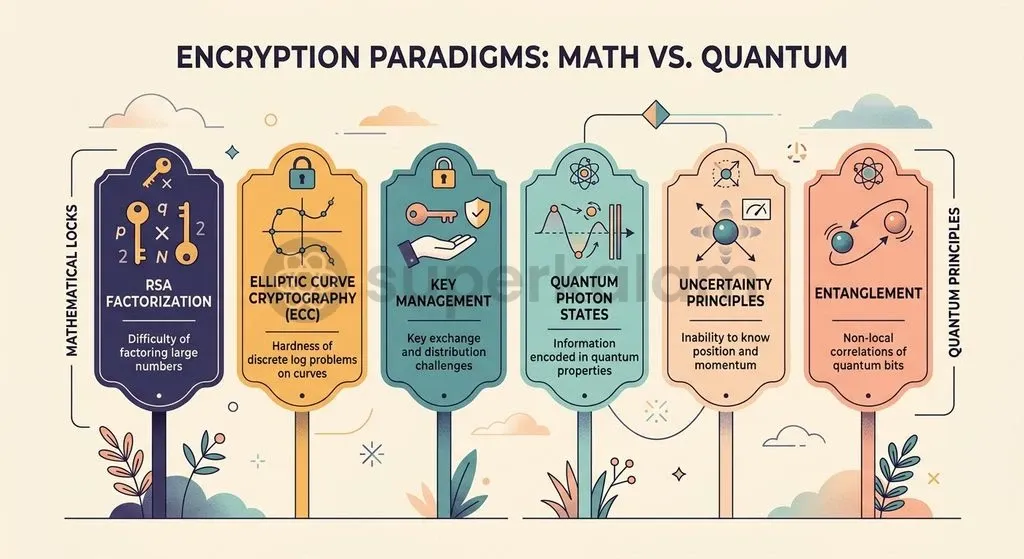
Modern digital communications rely on asymmetric public-key cryptography, whereas Quantum Key Distribution relies on the fundamental laws of quantum physics to ensure security. Traditional algorithms like RSA (Rivest-Shamir-Adleman) and ECC (Elliptic Curve Cryptography) derive their security from mathematical difficulty, such as factoring large prime integers or solving discrete logarithms.
These mathematical barriers remain vulnerable to future advancements in computing hardware. The emergence of Shor's algorithm running on a cryptographically relevant quantum computer can solve these mathematical problems in polynomial time. This capability renders conventional asymmetric ciphers obsolete, as highlighted by the Department of Science and Technology.
| Dimension | Conventional Encryption (RSA / ECC) | Quantum Key Distribution (QKD) |
|---|---|---|
| Security Foundation | Mathematical complexity and algorithmic hardness | Immutable physical laws of quantum mechanics |
| Vulnerability to Quantum Computers | Highly vulnerable; easily broken by Shor's algorithm | Information-theoretically secure against quantum decryption |
| Eavesdropping Detection | Silent interception remains undetected until data is decrypted | Any intercept perturbs photon states, alerting users instantly |
| Data Transmission Role | Encrypts and transmits the actual application data | Distributes symmetric encryption keys only |
| Transmission Medium | Works universally over classical copper, fibre, and wireless links | Requires dedicated dark optical fibre or direct line-of-sight laser links |
| Transmission Distance Limits | Unlimited range through classical electronic amplifiers and repeaters | Distance-limited by photon attenuation without trusted relays |
Discuss with Superkalam
Explain why the 'Harvest Now, Decrypt Later' strategy makes current mathematical encryption systems a vulnerability for national security.
Ask NowStrategic Significance: Defence, Banking, and Critical Infrastructure
Quantum Key Distribution protects critical national communication systems against emerging cyber intelligence threats. Foreign intelligence agencies actively deploy "Harvest Now, Decrypt Later" strategies. They intercept and archive encrypted government and military communications today to decrypt them once functional quantum computers become operational, as noted in the National Quantum Mission framework.
Implementing QKD provides immediate strategic advantages across high-security operational environments:
- Military and Strategic Defence: Hardens command-and-control links between naval fleets, air defence command centres, and border formations. The demonstrated technology is engineered for deployment across underground, terrestrial, and underwater optical fibre cables, according to a PIB release from the Ministry of Science and Technology.
- Financial and Banking Networks: Protects core banking settlement backbones, inter-bank clearing houses, and sovereign treasury transactions against illicit interception.
- Critical National Infrastructure: Secures supervisory control and data acquisition systems operating national power grids, nuclear installations, and satellite telemetry stations.
- Diplomatic and Government Channels: Prevents eavesdropping on high-level administrative channels and inter-ministry data exchanges.
Technical Challenges in Scaling Long-Distance QKD Networks
Deploying long-distance terrestrial quantum networks involves significant physics-based constraints and engineering challenges. The fundamental bottleneck in optical fibre transmission is exponential photon attenuation, which averages roughly 0.2 dB loss per kilometre in standard single-mode silica glass fibre, as detailed in the National Quantum Mission technical framework.
| Signal Transition Stage | Physical Process | Operational Consequence |
|---|---|---|
| Fibre Attenuation | Photons scatter and absorb across silica glass (~0.2 dB/km) | Exponential optical signal loss over distance |
| Amplification Constraint | Classical optical amplifiers copy photon properties | Violates No-Cloning Theorem; destroys quantum state |
| Bridging Mechanism | Requires trusted relay nodes or quantum repeaters | Adds hardware complexity or local vulnerability |
Note: Classical optical amplifiers cannot be used in QKD channels because amplifying a quantum signal violates the No-Cloning Theorem.
Key engineering bottlenecks include:
- Absence of Quantum Repeaters: Optical amplifiers boost attenuated signals along classical fibre spans. In contrast, quantum states cannot be cloned or amplified without destroying their quantum properties. True long-distance QKD without intermediate decryption requires all-optical quantum repeaters integrated with atomic quantum memories, which remain in experimental laboratory stages globally.
- Vulnerabilities in Trusted Relay Nodes: Current long-distance terrestrial networks bridge multi-hundred-kilometre spans by chaining intermediate trusted nodes. At each trusted node, the quantum key must be temporarily converted into classical electrical signals, creating a local physical security vulnerability.
- Coexistence with Classical Data: Merging single-photon quantum channels with multi-terabit classical traffic over the same commercial fibre induces spontaneous Raman scattering. This produces background noise that can overwhelm delicate quantum signals.
- High Deployment Costs: Fabricating cryogenic single-photon detectors and high-frequency pulsed laser sources requires specialised manufacturing facilities that demand substantial capital investment.
Discuss with Superkalam
Analyze the trade-offs between deploying intermediate trusted relay nodes and waiting for all-optical quantum repeaters in long-distance QKD deployment.
Ask NowGlobal Progress: How India Compares with China, the US, and the EU
Major global powers are investing heavily in national quantum communication networks to secure sovereign communications infrastructure.
| Country / Region | Key Quantum Infrastructure Milestone | Architecture Model |
|---|---|---|
| China | 2,000-km Beijing-Shanghai terrestrial backbone; Micius satellite | Integrated space-to-ground quantum network |
| European Union | European Quantum Communication Infrastructure (EuroQCI) | 27-nation hybrid terrestrial and IRIS² satellite grid |
| United States | Department of Energy national laboratory quantum testbeds | Post-quantum cryptography standards and regional testbeds |
| India | 1,000-km terrestrial link; NQM 2,000-km satellite-ground target | Indigenous terrestrial QKD with planned satellite baseline |
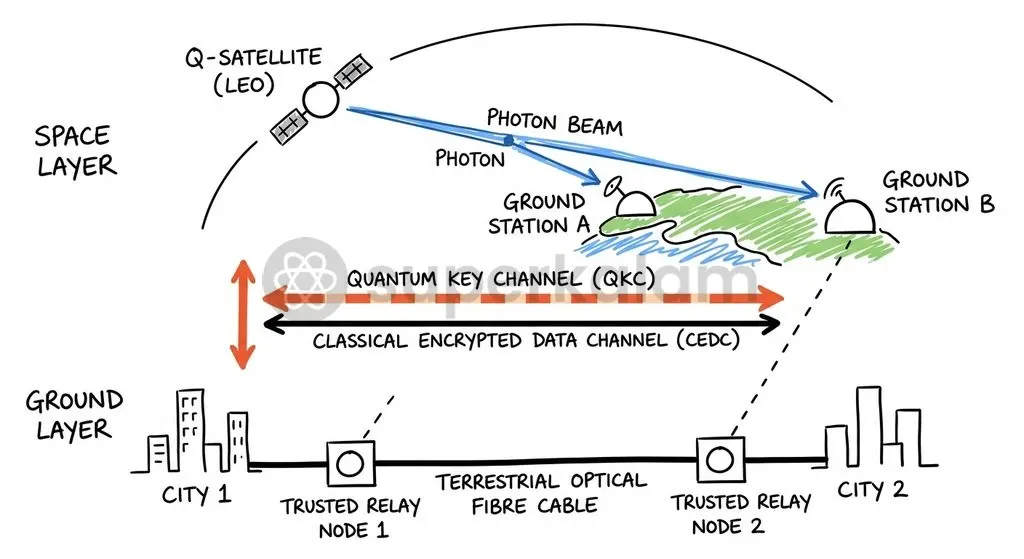
Note: Leading quantum programmes utilise a hybrid architecture combining terrestrial fibre links with low-Earth orbit satellite nodes.
International developments highlight distinct regional strategies:
- China: Completed the 2,000-km terrestrial Beijing-Shanghai quantum backbone and demonstrated space-to-ground quantum communications in 2016 using the dedicated Micius (QUESS) satellite, according to documentation from the Chinese Academy of Sciences.
- European Union: The European Commission is constructing the European Quantum Communication Infrastructure across all 27 member states, integrating national terrestrial fibre grids with the secure IRIS² satellite constellation.
- United States: Focuses primarily on post-quantum cryptographic standards while developing regional quantum testbeds through the Department of Energy's national laboratory network.
India's successful 1,000-km demonstration positions the country among a select group of nations capable of engineering end-to-end indigenous QKD hardware. Under the National Quantum Mission, India is working towards deploying a space-to-ground satellite QKD link across a 2,000-km baseline by 2031, matching international benchmarks.
Way Forward: Building an Indigenised Quantum Ecosystem
Transitioning India's experimental quantum milestones into a resilient national communication architecture requires continuous technical, institutional, and manufacturing interventions.
- Establishing Domestic Hardware Manufacturing: India remains reliant on imported components for advanced photon detectors and laser diodes. To build sovereign capabilities, the Department of Science and Technology is setting up central semiconductor and photonics fabrication facilities at IISc Bengaluru, IIT Bombay, IIT Kanpur, and IIT Delhi.
- Developing Quantum Repeaters: Research institutions must accelerate basic research into solid-state quantum memories. This will replace vulnerability-prone trusted relay nodes with fully optical quantum repeaters.
- Deploying Space-Based Quantum Links: Expanding terrestrial fibre links to cross-continental scales requires space-to-ground free-space optical payloads. Indian Space Research Organisation (ISRO) payloads must be integrated with ground stations to bridge remote island territories and forward military borders.
- Implementing Hybrid Cryptographic Architectures: National security guidelines recommend a defence-in-depth framework combining physical-layer Quantum Key Distribution with mathematical Post-Quantum Cryptography at the software layer, as highlighted in the National Quantum Mission framework.
- Scaling Startup Procurement: Expanding government procurement mandates across defence, public sector banks, and telecommunications will provide commercial stability for the 17 quantum startups supported under the mission.
Discuss with Superkalam
Evaluate the strategic necessity of integrating QKD capabilities into existing commercial fiber networks compared to laying dedicated dark fiber infrastructure.
Ask NowKey Takeaways
- The Department of Science and Technology demonstrated an indigenous 1,000-km Quantum Key Distribution link under the National Quantum Mission ahead of its eight-year roadmap.
- QKD relies on the Heisenberg Uncertainty Principle and the No-Cloning Theorem, ensuring that any interception attempt disturbs photon states and triggers immediate detection.
- The Union Cabinet approved the National Quantum Mission in April 2023 with a budget of ₹6,003.65 crore across four Thematic Hubs, including Quantum Communication hosted at IIT Madras with C-DOT.
- Exponential photon attenuation (~0.2 dB/km in silica fibre) remains the primary physical barrier to long-distance QKD, requiring trusted relay nodes until all-optical quantum repeaters are developed.
- National cybersecurity frameworks recommend a hybrid model combining physical-layer Quantum Key Distribution with software-layer Post-Quantum Cryptography to secure critical infrastructure.
Mains Question
"The transition from mathematical computational complexity to physics-based cryptographic security is vital against emerging quantum decryption capabilities." In this context, elucidate the strategic significance of the National Quantum Mission for India's critical communication infrastructure. (10 Marks)
Evaluate NowMains Question
"While Quantum Key Distribution provides information-theoretically secure communication, scaling it across extensive terrestrial networks presents formidable physical and engineering bottlenecks." Critically examine this statement in light of India's quantum communication targets under the National Quantum Mission. (15 Marks)
Evaluate NowPractice MCQs
QUESTION 1
Consider the following statements regarding Quantum Key Distribution (QKD):
- It utilizes the quantum states of single photons, such as polarization or phase, to distribute symmetric encryption keys.
- The security of QKD is guaranteed by the Heisenberg Uncertainty Principle and the No-Cloning Theorem.
- Standard optical amplifiers can be deployed along the quantum channel to boost attenuated signals without altering quantum states. Which of the statements given above are correct?
QUESTION 2
With reference to the National Quantum Mission (NQM), consider the following statements:
- It was approved with a budgetary outlay of ₹6,003.65 crore spanning an eight-year period.
- The mission establishes four dedicated Thematic Hubs (T-Hubs), including Quantum Computing and Quantum Communication.
- The Quantum Communication Thematic Hub is hosted by IIT Madras in collaboration with the Centre for Development of Telematics (C-DOT). Which of the statements given above is/are correct?
QUESTION 3
Consider the following statements comparing Conventional Encryption and Quantum Key Distribution (QKD):
- Conventional asymmetric encryption algorithms such as RSA and ECC rely on computational mathematical difficulty.
- Conventional public-key ciphers are vulnerable to Shor's algorithm running on cryptographically relevant quantum computers.
- QKD transmits the entire bulk application data directly through the quantum channel. Which of the statements given above is/are correct?
QUESTION 4
In the context of cybersecurity and quantum technologies, the term 'Harvest Now, Decrypt Later' refers to which one of the following?
QUESTION 5
Consider the following statements regarding the technical challenges in terrestrial QKD networks:
- Standard single-mode silica glass optical fiber introduces an attenuation of approximately 0.2 dB per kilometer.
- Chaining intermediate trusted nodes allows keys to remain in a pure quantum state without electrical conversion.
- Transmitting quantum channels over commercial optical fibers carrying classical traffic can cause noise due to spontaneous Raman scattering. Which of the statements given above is/are correct?