India's Phosphatic Fertiliser Imports and the 2026 Sulphur Shock
As clean energy transitions squeeze global sulphur supplies, India's high import reliance on fertiliser feedstocks threatens food security and fiscal health.
Sep, 2026
•8 min read
Overview
India faces a structural vulnerability in national food security. Domestic phosphatic fertiliser production relies almost entirely on imported rock phosphate, phosphoric acid, and fossil-derived elemental sulphur.
According to the Ministry of Chemicals and Fertilizers, India imports up to 90% of its rock phosphate, 70% of its elemental sulphur, and over 60% of its finished DAP. Global shifts toward decarbonisation squeeze worldwide sulphur supplies while battery-mineral refining escalates industrial demand. This raw material crunch threatens farm productivity, strains public finances under the Nutrient Based Subsidy (NBS) regime, and worsens severe soil nutrient imbalances across the country.
Why in the News: The Emerging Global Sulphur Shock and Fertiliser Supply
Global sulphur markets face acute supply constraints that directly threaten essential agricultural inputs worldwide. According to the U.S. Geological Survey, over 90% of global elemental sulphur is recovered as an involuntary by-product of fossil fuel refining and sour natural gas desulphurisation through the Claus process rather than extracted from primary mineral mines.
As of early 2026, global decarbonisation commitments and energy transition policies are gradually reducing long-term refinery throughput, as documented by SFA Oxford research. At the same time, clean energy supply chains demand more sulphuric acid for leaching critical battery minerals like nickel, cobalt, copper, and lithium.
Regional shipping vulnerabilities have worsened these structural supply constraints. Per trade assessments by AURONEX and S&P Global Fertilizer Analytics (as reported, May 2026), geopolitical friction and maritime transit disruptions across the Strait of Hormuz affected roughly 4 million metric tonnes per annum of Middle Eastern seaborne sulphur exports, pushing spot sulphur prices into the $350–$420 per metric tonne range.
Discuss with Superkalam
Recall the industrial chemical process responsible for recovering more than 90% of the world's elemental sulphur as a fossil fuel refining by-product.
Ask NowUnderstanding the Link: Why Phosphatic Fertilisers Depend on Sulphur
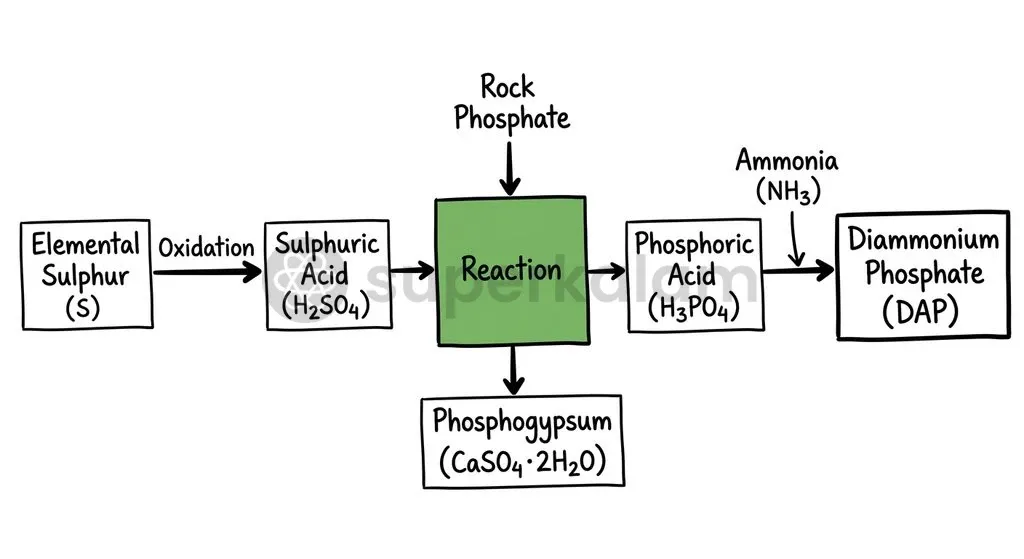
Phosphatic fertiliser manufacturing relies directly on sulphuric acid to break down insoluble natural minerals into plant-absorbable phosphorus compounds. In standard industrial wet-process production, raw rock phosphate containing insoluble tricalcium phosphate is digested with concentrated sulphuric acid.
According to agronomic production data from the University of Minnesota Extension, this chemical reaction produces wet-process phosphoric acid (H3PO4) and a solid by-product known as phosphogypsum (CaSO4·2H2O). The resulting phosphoric acid is reacted and neutralised with ammonia to synthesise high-analysis fertilisers such as Diammonium Phosphate [(NH4)2HPO4] and complex NPK formulations.
Chemical Digestion Pathway:
- Acidulation: Rock Phosphate + Sulphuric Acid → Phosphoric Acid + Phosphogypsum
- Ammoniation: Phosphoric Acid + Ammonia → Di-Ammonium Phosphate (DAP) / NPKs
Without affordable sulphuric acid, the conversion pipeline from raw phosphate ore to commercial crop nutrients halts. Any international price spike or physical embargo on elemental sulphur translates directly into higher production costs and local shortages of DAP across consuming nations.
India's Fertiliser Import Profile: Rock Phosphate, Phosphoric Acid, and Sulphur
Indian agriculture operates with near-total external dependence across every tier of the phosphatic nutrient value chain. While domestic plants produce substantial finished formulations, the essential precursor feedstocks originate almost entirely abroad.
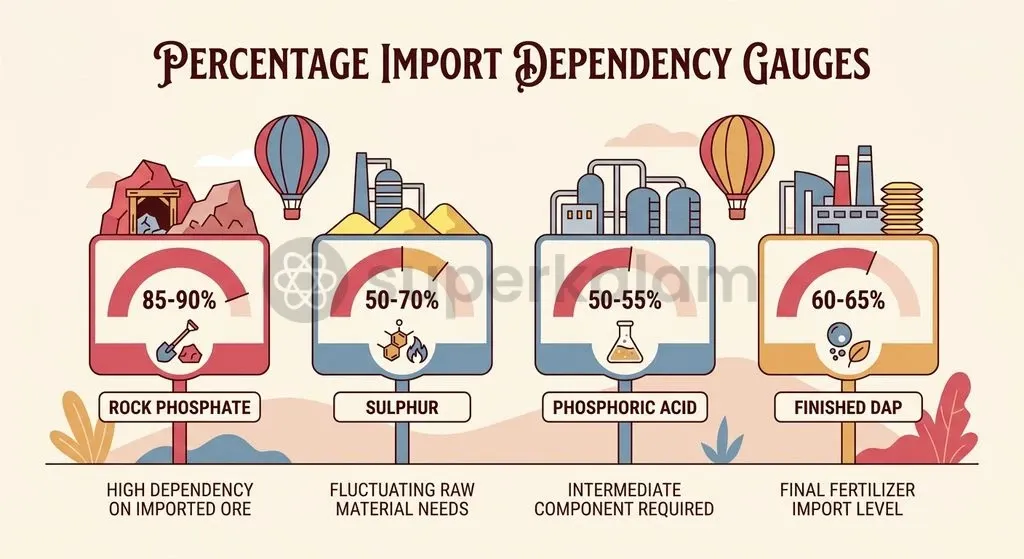
According to data presented by the Ministry of Chemicals and Fertilizers in Lok Sabha Unstarred Question No. 2145, the country relies on foreign suppliers for:
- 85% to 90% of its raw rock phosphate requirements,
- 50% to 55% of its merchant phosphoric acid demand,
- 50% to 70% of its elemental sulphur feedstock, and
- 60% to 65% of its finished Di-Ammonium Phosphate (DAP) consumption.
Domestic deposits offer limited relief. The Indian Bureau of Mines records that India's primary commercial rock phosphate resource is located at the Jhamarkotra mine in Udaipur district, operated by Rajasthan State Mines and Minerals Limited (RSMML). However, total domestic rock phosphate extractions satisfy less than 15% of national requirements, leaving domestic chemical complexes exposed to international price swings and maritime bottlenecks.
| Fertiliser Commodity / Precursor | Domestic Supply Share | Import Dependence Share | Primary Supply Sources / Constraints |
|---|---|---|---|
| Rock Phosphate | <15% (primarily RSMML Jhamarkotra) | 85% – 90% | Jordan, Morocco, Senegal, Togo, Tunisia |
| Phosphoric Acid | 45% – 50% | 50% – 55% | Overseas joint ventures & merchant suppliers |
| Elemental Sulphur | 30% – 50% (domestic refineries) | 50% – 70% | By-product of fossil fuel desulphurisation |
| Finished DAP | 35% – 40% (formulation plants) | 60% – 65% | Global seaborne chemical market |
Discuss with Superkalam
Explain the chemical mechanism through which sulphuric acid converts insoluble natural rock phosphate into plant-absorbable crop nutrients.
Ask NowEconomic and Agricultural Impacts of Supply Disruptions
Input supply squeezes and high global feedstock prices inflict simultaneous damage on India's macroeconomic balance and agronomic health. When raw material costs escalate abroad, the central government cushions farmers by raising budgetary subsidy outlays.
The Union Cabinet approved a financial commitment of ₹41,533.81 crore under the Nutrient Based Subsidy (NBS) framework for Phosphatic and Potassic (P&K) fertilisers for the Kharif 2026 season alone. The Department of Fertilizers fixed the per-kilogram subsidy rates for Kharif 2026 at ₹47.32 for Nitrogen (N), ₹52.76 for Phosphorus (P), ₹2.38 for Potash (K), and ₹3.16 for Sulphur (S).
Agronomic consequences are equally severe. Soil testing operations under the Ministry of Agriculture and Farmers Welfare's Soil Health Card initiative reveal that 40% to 46% of Indian agricultural soils suffer from critical sulphur deficiencies. Because sulphur is a vital secondary macronutrient required for nitrogenase enzyme activity and amino acid synthesis, acute deficiencies lower harvest yields and reduce the oil content of oilseeds and pulses.
Comparison: Urea vs Phosphatic and Potassic Fertilisers in India
The statutory pricing regime creates a stark regulatory division between nitrogenous urea and non-urea phosphatic and potassic fertilisers. While the retail price of urea remains under direct statutory administrative control, P&K fertilisers operate under the partially decontrolled Nutrient Based Subsidy regime.
| Dimension | Urea (Nitrogenous) | P&K Fertilisers (DAP, MOP, Complex NPKs) |
|---|---|---|
| Governing Regime | New Urea Policy / Statutory Control | Nutrient Based Subsidy (NBS) Policy |
| Retail Pricing Mechanism | Statutorily fixed farmgate Maximum Retail Price (MRP) | Decontrolled MRP; market-determined with fixed per-kg subsidy |
| Farmgate Price Benchmark | Highly subsidised, fixed central rate | DAP farmgate price held at ₹1,350 per 50 kg bag via dynamic subsidy |
| Import Dependence Profile | Moderate to low (expanding domestic gas-based capacity) | Extremely high (85-90% rock phosphate, 50-70% sulphur imports) |
| Raw Material Sensitivity | Natural gas feedstock pricing (domestic and pooled LNG) | Global rock phosphate, sulphuric acid, and ammonia spot prices |
Discuss with Superkalam
How might sustained maritime transit bottlenecks in key energy corridors impact the fiscal outlay of India's Nutrient Based Subsidy (NBS) regime during a major cropping season?
Ask NowKey Policy Challenges: Subsidy Burden, Pricing Distortions, and Geopolitics
Distortions in fertiliser retail pricing have undermined soil fertility and disrupted nutrient balance across Indian agriculture. To keep agricultural input costs manageable, the central government absorbs import price surges by expanding fiscal support, maintaining the farmgate price of DAP at ₹1,350 per 50 kg bag.
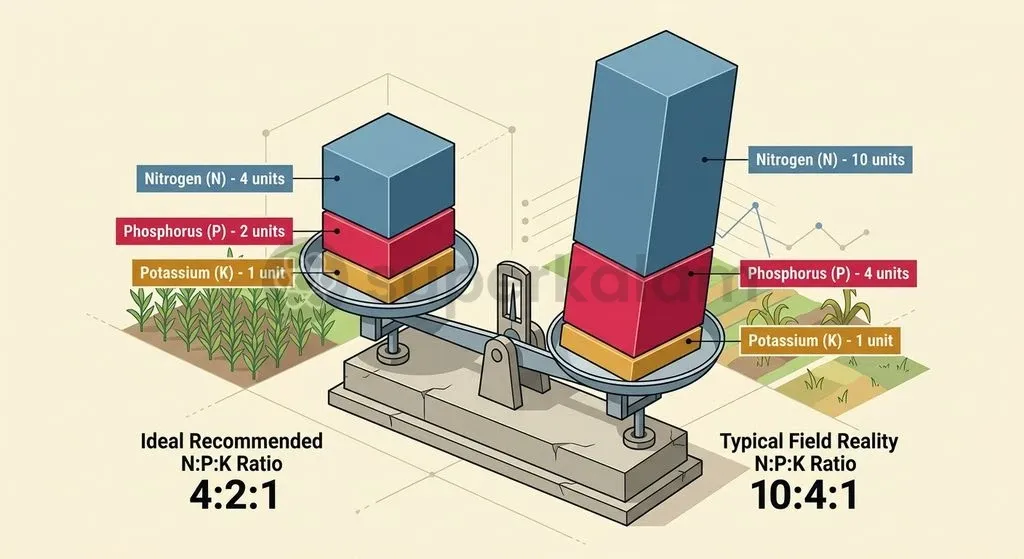
Data from the Economic Survey 2025-26 highlights that the wide price disparity between statutorily cheap urea and non-urea fertilisers has pushed India's aggregate national N:P:K application ratio to nearly 10:4:1. This wide skew departs significantly from the agronomically recommended balance of 4:2:1, degrading soil biology, diminishing nitrogen-use efficiency, and contaminating rural groundwater tables through nitrate runoff.
Geopolitical concentration presents an additional strategic challenge. To safeguard overseas supply lines, public and private domestic entities have negotiated joint ventures and long-term supply agreements with mining and processing corporations across Jordan, Morocco, Senegal, Togo, and Tunisia. However, supply chains running through volatile maritime corridors remain susceptible to sudden trade shocks and tariff fluctuations.
Way Forward: Building Strategic Reserves, Resource Diversification, and Nano Alternatives
Sustainable nutrient security requires combining domestic raw material beneficiation, alternative phosphatic carriers, and fiscal incentives for balanced crop nutrition. Strengthening domestic resilience reduces vulnerability to international chemical market volatility.
Policy interventions should focus on the following core pathways:
- Promoting Single Super Phosphate (SSP): SSP provides 16% available phosphate (P2O5), 11% elemental sulphur, and 16% calcium, making it a well-suited domestic alternative to imported DAP. Because SSP can be manufactured by acidulating indigenous, low-grade rock phosphate with sulphuric acid, expanding the dedicated freight subsidy on SSP under the NBS framework ensures broad rural market penetration.
- Expanding Domestic Rock Phosphate Beneficiation: Upgrading low-grade indigenous ore reserves at Jhamarkotra and exploring untapped phosphate beds through modern beneficiation technology reduces raw mineral import volumes.
- Scaling PM-PRANAM Incentives: The Cabinet Committee on Economic Affairs approved the PM-PRANAM scheme, under which 50% of the central fertiliser subsidy saved by a State through reduced chemical fertiliser consumption is returned as a development grant. States are mandated to deploy 65% of this grant toward capital expenditure, funding local organic infrastructure and soil rejuvenation.
- Deploying Advanced Fertiliser Technologies: Expanding field trials and distribution of efficient nutrient alternatives, such as Nano DAP and bio-fertilisers vetted by the Indian Council of Agricultural Research (ICAR), lowers bulk chemical application requirements while protecting baseline crop yields.
- Securing Overseas Equity Assets: Deepening resource diplomacy through government-backed sovereign investments in phosphate mining assets abroad secures long-term off-take rights and insulates domestic supply from spot-market spikes.
Discuss with Superkalam
Assess whether retaining statutory price controls on urea while partially decontrolling non-urea fertilisers under the NBS policy remains economically and agronomically viable.
Ask NowKey Takeaways
- Over 90% of global elemental sulphur is generated as an involuntary by-product of fossil fuel desulphurisation via the Claus process, creating supply vulnerabilities as refinery throughput adjusts to energy transition trends.
- In standard wet-process manufacturing, sulphuric acid is chemically indispensable for converting raw rock phosphate into phosphoric acid, the core precursor for Di-Ammonium Phosphate (DAP) and NPK fertilisers.
- India exhibits heavy structural import dependence: 85% to 90% for rock phosphate, 50% to 70% for elemental sulphur, and 60% to 65% for finished DAP.
- Distortions between statutorily cheap urea and non-urea fertilisers have skewed India's national N:P:K application ratio to nearly 10:4:1, far exceeding the recommended 4:2:1 agronomic benchmark.
- Single Super Phosphate (SSP), containing 16% phosphate and 11% sulphur, alongside resource diplomacy and PM-PRANAM state grant incentives, forms the primary strategy to mitigate external supply shocks.
Mains Question
"The wide disparity in retail pricing mechanisms between statutory urea control and the Nutrient Based Subsidy (NBS) regime has distorted India's NPK application ratio and heightened soil degradation." Critically examine. (15 Marks)
Evaluate NowMains Question
Discuss the strategic vulnerabilities in India's phosphatic fertiliser value chain arising from global energy transitions and raw material import dependencies. (10 Marks)
Evaluate NowPractice MCQs
QUESTION 1
With reference to the chemical manufacturing process of phosphatic fertilisers, consider the following statements:
- In standard industrial wet-process production, raw rock phosphate is digested with sulphuric acid to produce phosphoric acid and phosphogypsum.
- Diammonium Phosphate (DAP) is synthesized by directly reacting rock phosphate with anhydrous ammonia.
- The vast majority of global elemental sulphur is extracted directly from primary mineral mines rather than recovered as an industrial by-product. Which of the statements given above is/are correct?
QUESTION 2
Consider the following statements regarding fertiliser pricing and policy mechanisms in India:
- Non-urea Phosphatic and Potassic (P&K) fertilisers are governed under the Nutrient Based Subsidy (NBS) regime, where Maximum Retail Prices (MRPs) are decontrolled.
- Urea is subject to statutorily fixed farmgate retail pricing under direct administrative control.
- Under the PM-PRANAM scheme, 100% of the fertiliser subsidy saved by a State is transferred to farmers as direct income support. Which of the statements given above is/are correct?
QUESTION 3
Regarding the domestic sources and composition of non-urea fertilisers in India, consider the following statements:
- Single Super Phosphate (SSP) contains available phosphate, elemental sulphur, and calcium.
- India's primary domestic commercial rock phosphate mine is located at Jhamarkotra in Rajasthan.
- Domestic rock phosphate mining currently satisfies more than 50% of the country's total annual consumption. Which of the statements given above is/are correct?
QUESTION 4
With reference to the global supply chain dynamics of elemental sulphur, consider the following statements:
- The industrial Claus process is used for recovering elemental sulphur during the desulphurisation of sour gas and fossil fuels.
- Expanding clean energy supply chains has reduced global industrial demand for sulphuric acid. Which of the statements given above is/are correct?
QUESTION 5
According to the Ministry of Agriculture and Farmers Welfare's Soil Health Card data cited in the context of fertiliser use in India, what proportion of Indian agricultural soils suffers from critical sulphur deficiencies?