India-Mauritius Energy MoU: Strategic Security and Geoeconomics in the Indian Ocean
Beyond diaspora ties, India's energy pact with Port Louis anchors regional maritime security and hard geoeconomic influence in the Western Indian Ocean.
Aug, 2026
•8 min read
Overview
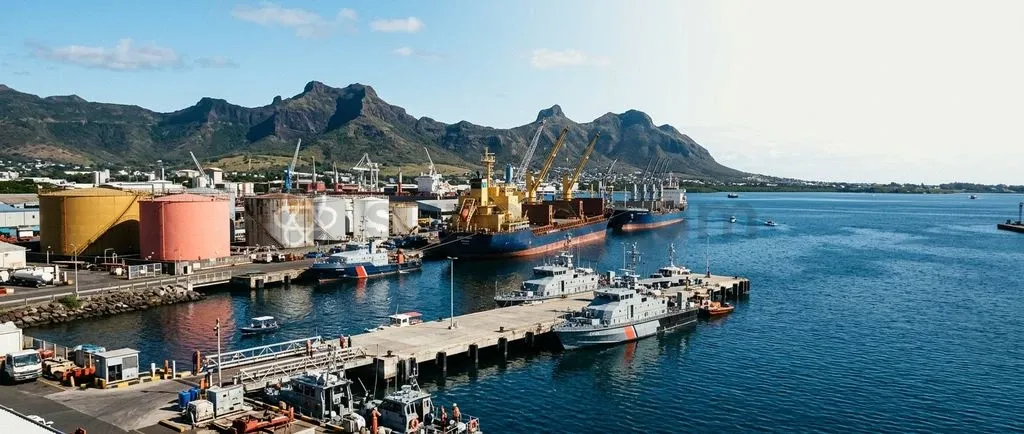
The India-Mauritius energy partnership, solidified through a Government-to-Government agreement in August 2026, marks a decisive shift in India's ocean diplomacy. It converts historical diaspora linkages into hard geoeconomic integration. This framework secures Southwest Indian Ocean sea lanes, powers regional maritime logistics, and anchors clean energy transition across Small Island Developing States.
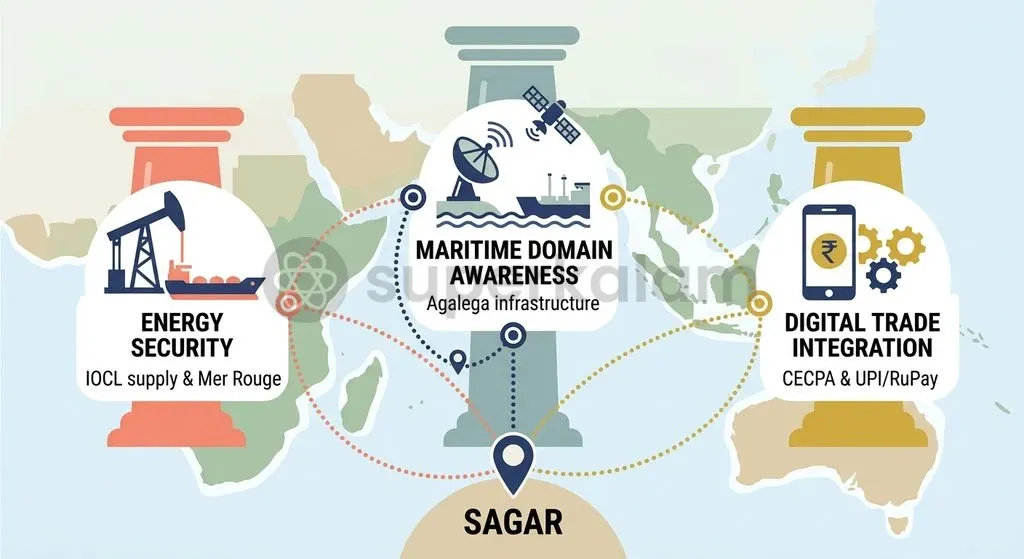
Under this bilateral pact, Indian public sector enterprises guarantee refined petroleum supplies to Port Louis. They are also constructing marine bunkering facilities at Mer Rouge. This collaborative architecture reinforces the Security and Growth for All in the Region (SAGAR vision) by embedding maritime security within resilient regional fuel supply chains.
Why in the News: The India-Mauritius Energy Partnership
Union Minister for Petroleum and Natural Gas Hardeep Singh Puri signed a comprehensive Government-to-Government Memorandum of Understanding with Mauritian leadership during an official visit to Port Louis on 20 August 2026. As of August 2026, this pact formalises long-term energy cooperation across hydrocarbon procurement, storage logistics, and clean fuel technologies, according to the PIB Press Release on the official visit.
Key components of the bilateral energy arrangement include:
- Total Import Coverage: Under a parallel five-year Sales and Purchase Agreement, Indian Oil Corporation Limited (IOCL) will meet 100% of Mauritius' domestic import demand for Motor Spirit, High Speed Diesel, and Aviation Turbine Fuel via the State Trading Corporation of Mauritius.
- Supply Security: The commercial framework eliminates third-party import vulnerabilities for Port Louis. It anchors national fuel reserves directly to Indian refining output.
- Institutional Interdependence: The agreement encompasses technical training and capacity building for Mauritian energy personnel. The Ministry of External Affairs notes that this institutional linkage elevates the relationship beyond traditional cultural diplomacy into hard infrastructure interdependence.
Discuss with Superkalam
What specific refined petroleum products does IOCL supply to Mauritius under the 2026 bilateral arrangement?
Ask NowStrategic Context: Mauritius as the Anchor of the Western Indian Ocean
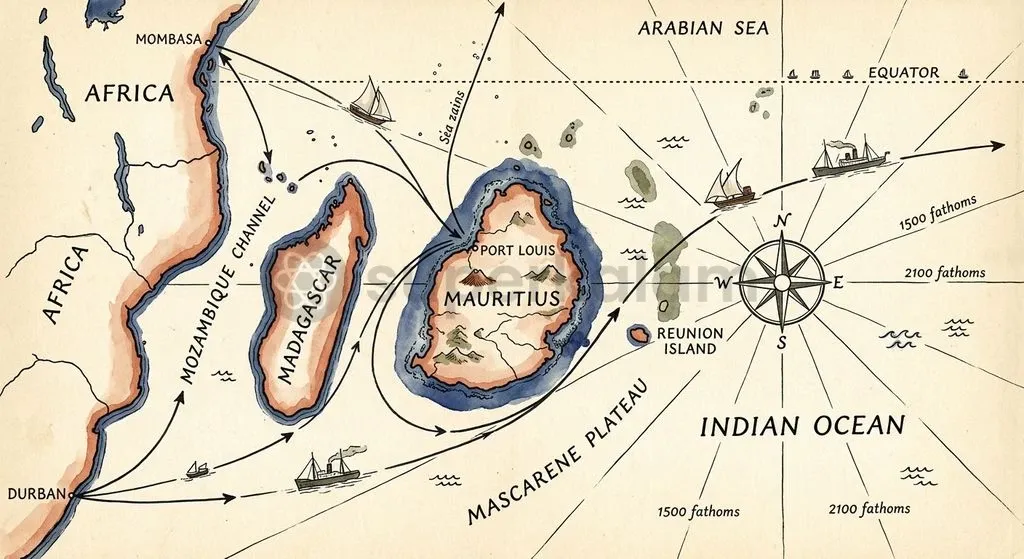
Mauritius holds a strategic geographic position in the Southwest Indian Ocean. It commands critical Sea Lines of Communication (SLOCs) that connect the Atlantic, Southern Africa, and Asia. Maritime stability around the island directly affects energy transit along the Cape route and the Mozambique Channel.
| Operational Track | Key Infrastructure Assets | Strategic Objective |
|---|---|---|
| Hydrocarbon Security | 100% refined product supply (IOCL); 27.5 TMT bunkering at Mer Rouge | Shield national reserves; refuel regional commercial vessels |
| Maritime Domain Awareness | Agalega Island 3,000m airstrip; St. James deep-water berth | Broaden regional surveillance; expand search-and-rescue interoperability |
India's engagement with Port Louis has evolved steadily through bilateral institutional agreements:
- The Comprehensive Economic Cooperation and Partnership Agreement entered into force on 1 April 2021 as India's first bilateral trade pact with an African nation.
- Mauritius became the first foreign country to adopt UPI and RuPay connectivity on 12 February 2024, integrating cross-border retail payments.
- Joint operationalisation of a 3,000-metre airstrip and the St. James Jetty on Agalega Island in February 2024 expanded regional surveillance capabilities.
Integrating energy infrastructure into this existing foundation converts bilateral goodwill into an enduring strategic partnership.
Key Pillars of the MoU: Hydrocarbons, Green Corridors, and Grids
The 2026 energy framework establishes a multi-sectoral supply and infrastructure model across conventional fuels, marine bunkering, and renewable energy policy.
| Cooperation Area | Primary Indian Entity | Mauritian Counterpart | Strategic Deliverable |
|---|---|---|---|
| Refined Fuel Supply | Indian Oil Corporation Limited (IOCL) | State Trading Corporation (STC) | 100% import coverage for petrol, diesel, and jet fuel over 5 years |
| Bunker Infrastructure | India Oil (Mauritius) Ltd (IOML) | Mauritius Ports Authority | 27,500 metric tonne bunker fuel storage at Mer Rouge harbour |
| Clean Fuels & Biofuels | Global Biofuels Alliance Secretariat | Ministry of Energy & Public Utilities | Biofuels Country Landscape Policy framework |
| Solar & Renewables | Ministry of External Affairs support | Central Electricity Board | 8 MW Henrietta Solar PV farm and floating solar studies |
The agreement operationalises four functional tracks:
- Supply Continuity: India guarantees uninterrupted delivery of refined petroleum products, drawing on its domestic refining base of 23 refineries with 267 MMT annual capacity.
- Marine Fuel Infrastructure: India Oil (Mauritius) Ltd broke ground on a USD 25 million marine bunkering facility at Mer Rouge in Port Louis harbour.
- Biofuels Landscape Policy: The Global Biofuels Alliance (GBA Secretariat) partnered with Mauritian authorities to formulate clean blending standards and bio-energy pathways.
- Institutional Skilling: Bilateral programmes provide technical instruction to Mauritian engineers in fuel management and safety compliance.
Bunkering and Maritime Security: Powering Critical Sea Lanes
India Oil (Mauritius) Ltd is constructing a 27,500 metric tonne bunker fuel terminal at Mer Rouge to service international merchant and naval shipping. This terminal expands marine fuel storage capacity at Port Louis, creating a dedicated refuelling hub for vessels traversing the Mozambique Channel SLOCs.
Commercial vessels and regional coast guards deployed across the Western Indian Ocean require dependable access to compliant bunker fuels. Developing Port Louis into a modern refuelling station reduces transit disruptions. It also enhances the commercial appeal of regional shipping lanes.
The bunkering supply chain operates across three operational stages:
- Transit Entry: Commercial and naval vessels enter the Cape Route and Mozambique Channel corridors.
- Port Louis Storage: Vessels access the Mer Rouge facility holding 27.5 TMT low-sulphur marine fuel.
- Fleet Deployment: Secured refuelling enables sustained patrolling and merchant voyages without diversion.
This bunkering infrastructure complements naval surveillance assets established at Agalega Island, where the 3,000-metre airstrip and St. James Jetty became operational on 29 February 2024. Combining deep-water maritime facilities with guaranteed fuel depots creates a resilient logistics backbone for Indian Ocean security operations.
Discuss with Superkalam
Explain how developing marine bunkering at Port Louis directly supports the SAGAR vision and maritime domain awareness.
Ask Now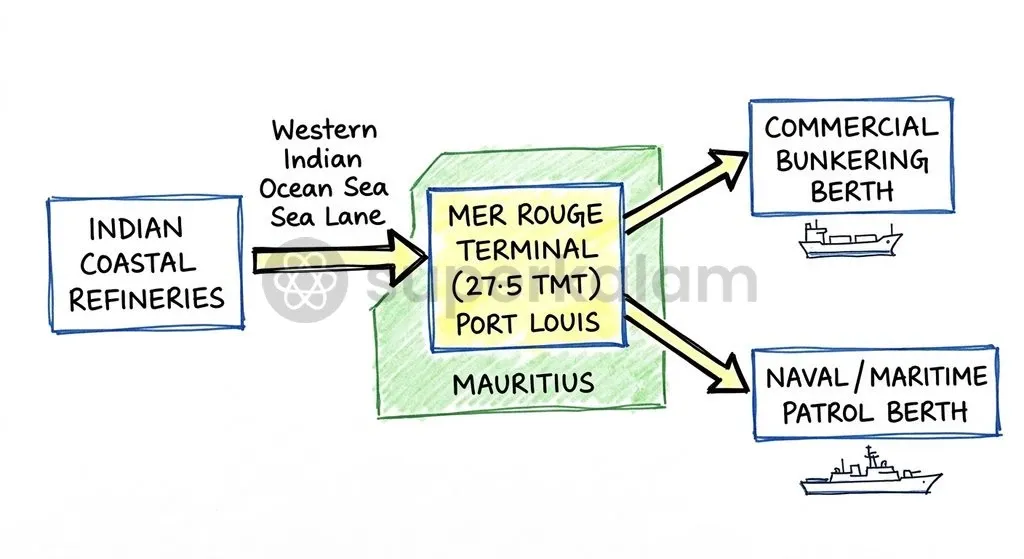
Renewable Integration: Linking SIDS Resilience with OSOWOG
Clean energy development in Mauritius connects Small Island Developing States (SIDS) with the International Solar Alliance and the OSOWOG initiative. Small island economies face high electricity costs due to heavy reliance on imported heavy fuel oils for domestic power generation.
India has supported island decarbonisation through the deployment of an 8 MW solar farm at Henrietta, alongside feasibility studies for floating photovoltaic systems. These projects expand daytime generation capacity while preserving scarce island land resources.
The Global Biofuels Alliance partnership builds upon this solar foundation by designing a Biofuels Country Landscape Policy. Establishing local biofuel blending mandates enables Mauritius to lower fuel import bills and build domestic energy resilience.
Discuss with Superkalam
Weigh the economic benefits of setting up a 27.5 TMT bunkering hub against the potential ecological risks to Mauritius' coral reefs and marine tourism.
Ask NowGeopolitical Stakes: Balancing Influence in Southwest Indian Ocean
Strategic maritime infrastructure in Port Louis provides India with an effective geoeconomic mechanism to support regional stability in the Western Indian Ocean. The Southwest Indian Ocean has seen growing extra-regional commercial port investments that carry potential dual-use applications.
| Geopolitical Objective | Mechanism | Strategic Value |
|---|---|---|
| Energy Supply Guarantees | Refined product continuity & Mer Rouge bunkering | Eliminates third-party supply vulnerabilities |
| Multilateral Cooperation | Colombo Security Conclave & IORA | Reinforces rules-based SAGAR maritime governance |
India's integrated energy and port logistics architecture provides a transparent, civilian-led alternative for island nations seeking infrastructure modernisation:
- Supply-Side Reliability: Meeting 100% of national liquid fuel requirements protects partner states from global market volatility.
- Multilateral Anchors: Projects link directly with the Colombo Security Conclave and the Indian Ocean Rim Association to support collective maritime governance.
- Rules-Based Presence: Bilateral infrastructure remains fully under Mauritian sovereign ownership while supported by Indian public sector technical expertise.
Structural Bottlenecks: Financing, Logistics, and Island Constraints
Implementation challenges in island energy diplomacy arise from geographical distances, capital constraints, and environmental vulnerabilities inherent to island economies.
- Logistical Supply Chains: Transporting refined petroleum over long maritime distances exposes island supply lines to weather disruptions, cyclonic activity, and freight rate spikes.
- Land Scarcity for Renewables: Expanding utility-scale solar installations is constrained by limited land availability, necessitating costlier floating photovoltaic platforms.
- Capital Expenditure Absorption: Constructing specialised infrastructure, such as the USD 25 million Mer Rouge terminal, requires concessional financing and steady off-take volumes to ensure commercial viability.
- Marine Environmental Risks: Bunkering hubs demand stringent environmental safeguards to prevent accidental oil spills that could devastate local coral reefs and tourism revenues.
Addressing these bottlenecks requires continuous technical collaboration, institutional risk sharing, and strict environmental monitoring protocols.
Discuss with Superkalam
How can India adapt its OSOWOG and green corridor frameworks to overcome the physical land constraints faced by Small Island Developing States in the Indian Ocean?
Ask NowThe Way Forward: Building an Integrated Maritime-Energy Grid
India must consolidate its island energy partnerships by linking fuel supply guarantees with green shipping corridors and long-term renewable connectivity.
- Expand Green Bunkering: Upgrade the Mer Rouge facility to handle alternative marine fuels, such as green methanol and biofuels, positioning Port Louis as a sustainable shipping hub.
- Operationalise OSOWOG Frameworks: Accelerate feasibility assessments for regional clean energy grids and floating solar installations to decrease base-load reliance on thermal generation.
- Deepen Technical Training: Institutionalise regular training programmes for Mauritian technicians through Indian public sector petroleum institutes.
- Harmonise Maritime Protocols: Integrate energy logistics planning into the Colombo Security Conclave to coordinate emergency fuel sharing and disaster response mechanisms.
Key Takeaways
- Union Minister Hardeep Singh Puri signed a comprehensive G2G energy MoU with Mauritius on 20 August 2026, establishing a 5-year supply framework via IOCL for 100% of the island's petrol, diesel, and aviation fuel imports.
- India Oil (Mauritius) Ltd broke ground on a USD 25 million, 27,500 metric tonne bunker fuel storage terminal at Mer Rouge to expand refuelling capacity along Southwest Indian Ocean trade routes.
- The bilateral energy partnership bridges civilian fuel security with maritime surveillance assets, including the 3,000-metre airstrip and St. James Jetty inaugurated on Agalega Island in February 2024.
- Clean energy initiatives, including an 8 MW solar farm at Henrietta and a Biofuels Country Landscape Policy, connect Mauritian energy planning with the International Solar Alliance and OSOWOG.
- Energy diplomacy converts traditional cultural goodwill into hard geoeconomic integration, reinforcing India's SAGAR framework across the Indian Ocean Rim.
Mains Question
"The transition from cultural diplomacy to hard geoeconomic integration under the SAGAR framework represents a paradigm shift in India's ocean diplomacy." In light of the recent India-Mauritius energy pact, examine how energy supply continuity and bunkering infrastructure enhance India's strategic footprint in the Western Indian Ocean. (10 Marks)
Evaluate NowMains Question
Small Island Developing States (SIDS) face acute structural bottlenecks in balancing conventional fuel security with decarbonisation goals. Critically analyse how India's bilateral cooperation with Mauritius addresses these vulnerabilities, while highlighting the operational and environmental challenges involved. (15 Marks)
Evaluate NowPractice MCQs
QUESTION 1
Consider the following statements regarding the bilateral energy and infrastructure arrangements between India and Mauritius:
- Indian Oil Corporation Limited (IOCL) is committed to supplying 100% of Mauritius' domestic import demand for petrol, diesel, and aviation turbine fuel over a five-year period.
- India Oil (Mauritius) Ltd is developing a 27,500 metric tonne marine bunkering terminal at Mer Rouge in Port Louis harbour.
- The Comprehensive Economic Cooperation and Partnership Agreement (CECPA) between India and Mauritius entered into force in 2024 alongside UPI connectivity.
Which of the statements given above are correct?
QUESTION 2
With reference to India's strategic infrastructure and clean energy cooperation with Mauritius, consider the following statements:
- India assisted Mauritius in commissioning an 8 MW solar photovoltaic farm at Henrietta.
- A 3,000-metre airstrip and the St. James Jetty were operationalised on Agalega Island to enhance maritime domain awareness.
- The Global Biofuels Alliance is partnering with Mauritian authorities to develop a Biofuels Country Landscape Policy framework.
Which of the statements given above are correct?
QUESTION 3
Consider the following statements regarding the maritime and energy dynamics in the Southwest Indian Ocean:
- The Mer Rouge bunkering terminal is designed to service commercial and naval vessels operating along the Mozambique Channel sea lines of communication.
- India's refining capacity of 267 MMT per annum across 23 refineries underpins its fuel supply guarantees to Mauritius.
- Mauritius' adoption of UPI and RuPay connectivity in 2024 marked it as the first foreign country to integrate these payment mechanisms.
Which of the statements given above is/are correct?
QUESTION 4
Which of the following multilateral regional groupings or initiatives are directly linked to India's maritime and clean energy engagement with Mauritius as mentioned in the context of the Southwest Indian Ocean?
QUESTION 5
Consider the following statements regarding structural bottlenecks in Small Island Developing States (SIDS) energy transitions such as Mauritius:
- High reliance on imported heavy fuel oil inflates domestic power generation costs in island economies.
- Severe land scarcity necessitates exploring higher-cost alternatives such as floating photovoltaic platforms.
- Marine bunkering hubs eliminate coral reef vulnerability and avoid the need for specialized environmental safeguards.
Which of the statements given above is/are correct?