Why Indian Railways Is Testing Dual-Fuel LNG Trains at 99.6% Electrification
Behind India's dual-fuel train trials lies a pragmatic strategy to decarbonise isolated spurs, protect strategic corridors, and cut diesel import costs.
Oct, 2026
•9 min read
Overview
Indian Railways has introduced a dual-fuel Liquefied Natural Gas (LNG) and diesel passenger train on the Sabarmati–Mahesana route in Gujarat to decarbonise residual non-electrified routes and safeguard operational resilience, even as national broad-gauge electrification approaches complete coverage. While overhead electric traction remains the core pillar of India's rail decarbonisation, specialised niches such as border spurs, industrial shunting yards, and emergency backup services require self-propelled traction. According to official data, retrofitting existing Diesel Electric Multiple Unit (DEMU) trainsets with cryogenic LNG substitution cuts particulate emissions significantly and lowers operating expenditures without requiring premature fleet scrapping. This dual-track strategy bridges the gap between near-total track electrification and the absolute decarbonisation demanded by India's climate commitments.
Why in the News: The Trial of India's First Dual-Fuel LNG DEMU
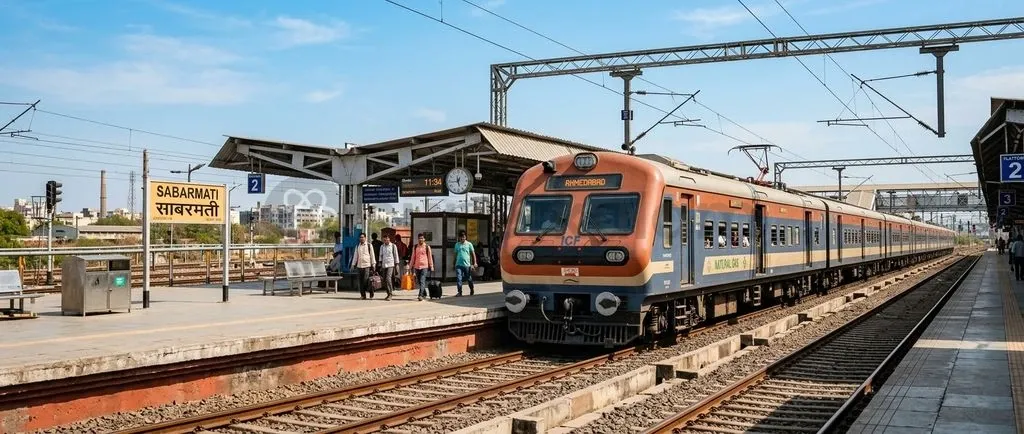
Indian Railways operationalised the country's first Liquefied Natural Gas-diesel dual-fuel DEMU train from the Sabarmati Integrated Coaching Depot in Ahmedabad, Gujarat, on the Sabarmati–Mahesana route. This operational milestone follows extensive validation across western regional routes.
Prior to entering commercial passenger service, the Sabarmati dual-fuel rake successfully completed over 2,000 kilometres of field trials and safety certifications conducted by the Research Designs and Standards Organisation.
As of July 2026, the national carrier achieved 99.6% electrification of its Broad Gauge network, having electrified 48,072 route kilometres between 2014 and 2026. This performance places India second globally in rail electrification density, trailing only Switzerland. Introducing an alternative hydrocarbon technology amidst this milestone highlights a targeted technical deployment rather than a nationwide propulsion pivot.
How the LNG-Diesel Dual Fuel System Works
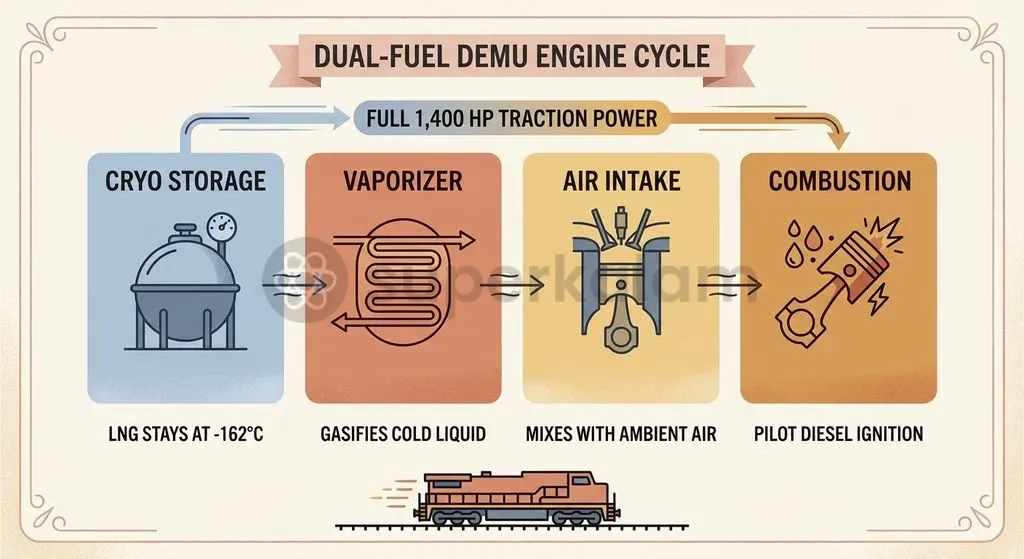
The dual-fuel DEMU retrofits two 1,400 Horsepower Driving Power Cars to substitute up to 40% of conventional diesel consumption with Liquefied Natural Gas without reducing traction output. The conversion adapts existing compression-ignition engine infrastructure through gaseous fuel injection.
Technical compendiums from the Indian Railways Institute of Mechanical and Electrical Engineering specify that natural gas enters through the intake air manifold while a pilot injection of diesel supplies the necessary compression ignition in the engine cylinders. This hybrid combustion cycle preserves standard engine thermal efficiency while cutting petroleum combustion volumes.
(Diagrammatic representation of manifold gas induction and compression ignition in retrofitted DEMUs)
Cryogenic fuel management is central to the system's operational viability:
- Cryogenic Storage: Each converted Driving Power Car carries a 2,200-litre vacuum-insulated cryogenic tank storing LNG at -162°C.
- Operating Range: The cryogenic storage volume delivers an operational range of approximately 1,600 kilometres per fill, exceeding standard daily DEMU requirements.
- Fail-Safe Operation: Guidelines from the Research Designs and Standards Organisation mandate an automatic fallback capability, enabling uninterrupted switching to 100% diesel should the LNG supply deplete.
Discuss with Superkalam
What storage temperature and operating range are achieved by the cryogenic tanks fitted on the retrofitted Sabarmati DEMU power cars?
Ask NowThe Strategic Puzzle: Why LNG When Broad Gauge Electrification Exceeds 95%?
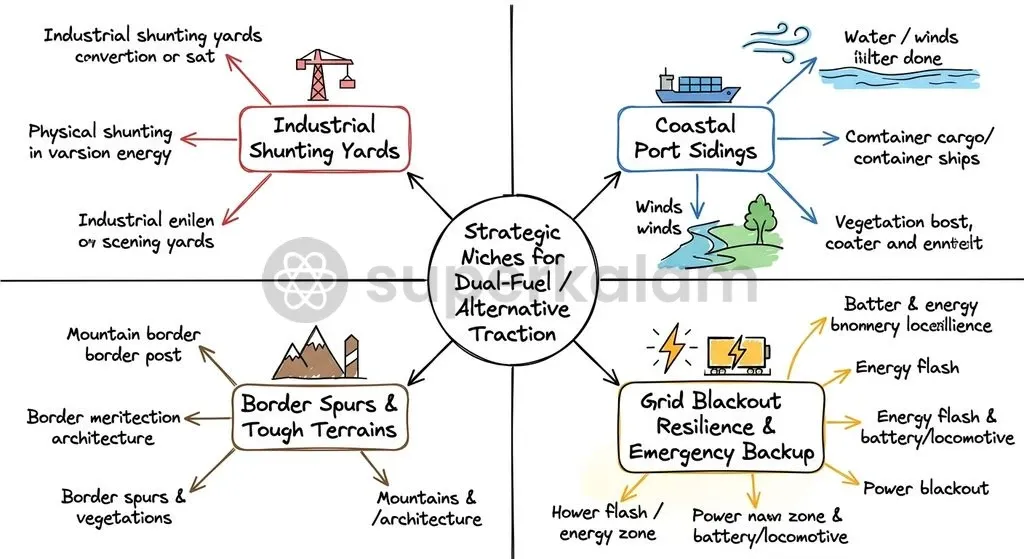
Indian Railways tests alternative fuels like LNG to decarbonise residual non-electrified branch lines, port sidings, industrial shunting yards, and border spurs where overhead equipment remains unviable. While overhead 25 kV AC catenary lines handle trunk corridor traffic, specific operating conditions prevent uniform overhead wire installation.
Infrastructure economics explains this selective approach. First, short-distance feeder lines and low-density branch routes often carry insufficient traffic volume to justify the heavy capital expenditure required for overhead traction lines. Second, port sidings and industrial shunting yards feature dynamic gantry cranes and loading infrastructure that conflict physically with high-voltage overhead catenary equipment.
Asset lifecycles reinforce the economic logic of dual-fuel conversions. As reported by The Economic Times Infrastructure Review (September 2026), retrofitting existing DEMUs allows Indian Railways to extract full economic value from rolling stock possessing 15–20 years of remaining design life instead of prematurely retiring functional diesel power assets.
Strategic national security considerations also support maintaining self-propelled traction capabilities. According to reporting by The Indian Express (September 2026), dual-fuel LNG trains provide vital disaster resilience during extensive electrical grid disruptions or severe catenary damage. Self-propelled assets ensure that strategic corridors and defence-sensitive border spurs remain operational when external electrical supplies fail.
Comparing the Options: Diesel vs LNG vs Overhead Electric vs Hydrogen
Traction technologies across Indian Railways present distinct trade-offs across capital intensity, operational readiness, energy density, and emissions profiles.
According to technical evaluations by the Research Designs and Standards Organisation, LNG provides nearly 2.4 times higher volumetric energy density than Compressed Natural Gas (CNG), which the national carrier piloted on DEMU rakes in 2015. Higher energy density permits compact onboard storage and avoids frequent refuelling delays.
| Traction Technology | Primary Energy Source | Infrastructure Capital Cost | Carbon and Local Emissions | Operational Feasibility & Density |
|---|---|---|---|---|
| Conventional Diesel | High-Speed Diesel | Low onboard cost; existing depots | High PM, SOx, NOx, and CO2 emissions | Proven global standard; zero grid dependency |
| LNG-Diesel Dual Fuel | 40% LNG + 60% Diesel | Low-to-medium retrofit; cryogenic bunkering | Up to 90% reduction in PM/SOx; lower CO2 | High energy density; 1,600 km operating range |
| Overhead Electric (25 kV AC) | Central Grid (Thermal / Renewable) | High fixed capital expenditure for catenary | Zero direct tailpipe emissions | Highest operational efficiency on trunk routes |
| Green Hydrogen Fuel Cell | Hydrogen + Fuel Cells | Very high capital cost for cells and electrolysers | Zero tailpipe emissions (water vapour only) | Emerging technology; low volumetric energy density |
Overhead electrification remains the primary choice for heavy-haul trunk routes. However, dual-fuel LNG provides an immediate, cost-effective bridge for residual diesel routes, offering greater range than CNG and avoiding the steep capital costs of hydrogen fuel cells.
Discuss with Superkalam
Explain how manifold natural gas induction combined with pilot diesel injection allows a standard compression-ignition engine to burn gaseous fuel.
Ask NowEnvironmental and Economic Benefits of LNG Rail Traction
Deploying dual-fuel LNG technology yields immediate air quality improvements and recurrent operational expenditure savings across secondary rail corridors.
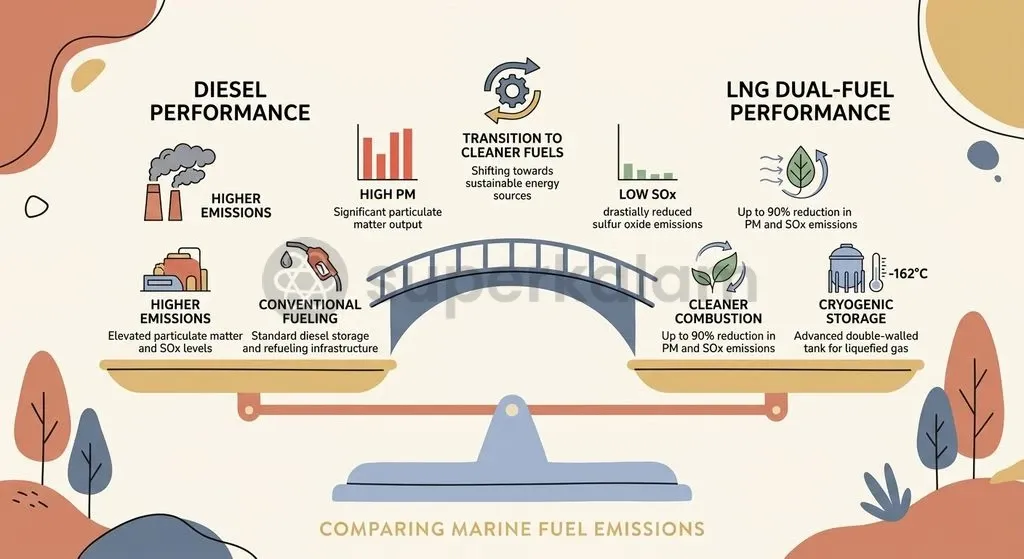
Emission testing reports from the Research Designs and Standards Organisation demonstrate that substituting 40% diesel with natural gas reduces particulate matter and sulfur oxides by up to 80–90%. Natural gas contains negligible sulfur and forms fewer carbon particulates during combustion, significantly lowering localized smog near passenger platforms. The dual-fuel process also lowers aggregate nitrogen oxide and carbon dioxide outputs relative to pure diesel combustion.
Financial reviews by the Ministry of Railways demonstrate clear operational gains:
- Locomotive Savings: Converting a Driving Power Car generates an estimated annual fuel cost saving of approximately ₹11.9 lakh.
- Rake Economics: An 8-coach DEMU rake powered by two converted Driving Power Cars delivers roughly ₹23.9 lakh in annual operational savings.
- Macro Fuel Reduction: Official data indicates that widespread electrification reduced annual railway diesel consumption from 293 crore litres in 2015-16 to 108 crore litres in 2024-25. Substituting LNG on remaining diesel routes further trims the national hydrocarbon import bill.
Discuss with Superkalam
Compare the technical and financial trade-offs between retrofitting existing DEMUs with LNG versus transitioning directly to Green Hydrogen fuel cells on non-electrified routes.
Ask NowKey Infrastructure and Safety Challenges in Scaling LNG
Cryogenic fuel handling introduces technical and logistical constraints that prevent rapid system-wide deployment of LNG locomotives across regional zones.
Bunkering logistics present the most substantial operational bottleneck. As noted in a report by NITI Aayog (August 2025), establishing vacuum-insulated cryogenic bunkering facilities and maintaining specialized cold-chain fuel logistics across regional rail depots requires substantial front-loaded capital expenditure. Unlike diesel, which can be stored in standard atmospheric tanks, LNG requires cryogenic storage infrastructure maintained at -162°C to prevent rapid boil-off gas losses.
Operational safety protocols demand rigorous engineering controls:
- Boil-Off Pressure Management: Extended locomotive idling venting requires controlled pressure-relief mechanisms to prevent explosive vapour accumulation in enclosed maintenance bays.
- Depot Refitting: Maintenance workshops require methane-detection sensors, non-sparking electrical installations, and specialized cryogenic personal protective equipment.
- Workforce Training: Depot technicians require specialized training to manage cryogenic bunkering safely and operate automated electronic gas-diesel injection control units.
The Broader Transition: How Dual-Fuel Fits into Indian Railways' Net Zero 2030 Target
Indian Railways has committed to becoming the world's first major Net Zero Carbon Emitter by 2030 through mass electrification, renewable energy integration, and modal share expansion. Dual-fuel technology acts as a supplemental transition mechanism within this comprehensive decarbonisation roadmap.
To meet the projected 2030 electrical traction and non-traction load of 8,200 MW, Indian Railways plans to install or procure approximately 30,000 MW of renewable energy capacity. Official releases confirm that over 1,260 MW of solar and wind power capacity was commissioned by July 2026 to supply clean traction power directly.
India's Nationally Determined Contributions (NDCs) under the Paris Agreement mandate expanding rail's modal share in total land freight movement from 36% to 45% by 2030. Shifting freight from road to rail delivers substantial national carbon savings. In support of this objective, the Dedicated Freight Corridor network is projected to abate approximately 457 million tonnes of CO2 emissions over its 30-year operational lifecycle by moving heavy freight onto high-capacity electric lines.
Within this broad sustainability framework, dual-fuel LNG DEMUs decarbonise the remaining 0.4% non-electrified broad-gauge lines and strategic spurs. This targeted deployment cuts fossil fuel intensity without misallocating capital toward unviable catenary projects.
Discuss with Superkalam
Propose an infrastructure strategy for Indian Railways to safely handle cryogenic bunkering and boil-off gas management across regional maintenance depots.
Ask NowWay Forward: Building a Balanced Clean Rail Fleet
Indian Railways must pursue a calibrated multi-traction fleet strategy that aligns technological deployment with corridor economics and geographic constraints.
Policy planning should focus on three strategic pillars:
- Targeted Deployment on Non-Catenary Spurs: Confine dual-fuel LNG conversions to specific shunting yards, port terminals, and border corridors where catenary electrification is physically impossible or economically unviable.
- City-Gas Distribution (CGD) Hub Synergies: Locate cryogenic bunkering stations at rail junctions adjacent to existing natural gas pipeline terminals to minimise fuel transport costs.
- Phased Green Fuel Transition: Treat LNG retrofits as an intermediate technology that lowers emissions immediately while technical trials progress on hydrogen fuel cells and battery-electric hybrid locomotives.
By combining nationwide overhead electrification with pragmatic dual-fuel retrofits for isolated corridors, Indian Railways creates a resilient, low-emission transport network that supports national climate commitments.
Key Takeaways
- Indian Railways operationalised its first LNG-diesel dual-fuel DEMU on the Sabarmati–Mahesana route in Gujarat, following more than 2,000 kilometres of rigorous field trials.
- The dual-fuel mechanism retrofits existing 1,400 HP Driving Power Cars to replace up to 40% of diesel fuel with LNG, cutting particulate matter and sulfur oxide emissions by up to 80–90%.
- Despite Broad Gauge electrification reaching 99.6% as of July 2026, alternative fuels remain essential for non-electrified branch lines, port sidings, shunting yards, and disaster-resilience fleets.
- Dual-fuel conversions generate an estimated annual saving of ₹23.9 lakh per 8-coach DEMU rake while extending the operational life of existing rolling stock assets.
- Scaling LNG traction requires overcoming logistical constraints, specifically high capital costs for cryogenic bunkering depots and cold-chain supply infrastructure.
- Alternative fuel trials support Indian Railways' broader objective to achieve Net Zero Carbon emissions by 2030 alongside 30,000 MW of planned renewable capacity.
Mains Question
"Near-total electrification of the Broad Gauge network does not eliminate the operational necessity of self-propelled clean traction technologies." In light of Indian Railways testing dual-fuel LNG trainsets, critically analyse the strategic, economic, and operational rationales for adopting alternative hydrocarbon traction. (15 Marks)
Evaluate NowMains Question
Highlighting the RDSO's technical parameters for cryogenic fuel retrofits, elucidate the environmental and financial viability of retrofitting DEMU fleets with LNG-diesel dual-fuel systems. (10 Marks)
Evaluate NowPractice MCQs
QUESTION 1
With reference to the dual-fuel Liquefied Natural Gas (LNG) DEMU trains tested by Indian Railways, consider the following statements:
- The system utilizes natural gas introduced via the intake air manifold, with a pilot injection of diesel for compression ignition.
- The retrofitted power car relies entirely on cryogenic storage maintained at approximately -162°C.
- The dual-fuel configuration lacks automatic diesel fallback and requires manual override if LNG runs out.
Which of the statements given above are correct?
QUESTION 2
Consider the following statements regarding gaseous fuels and rail traction in India:
- LNG provides nearly 2.4 times higher volumetric energy density compared to Compressed Natural Gas (CNG).
- Substituting 40% diesel with LNG in retrofitted DEMUs reduces particulate matter and sulfur oxide emissions by up to 80–90%.
- Indian Railways' broad gauge network had achieved less than 90% electrification by July 2026.
Which of the statements given above is/are correct?
QUESTION 3
Why is Indian Railways deploying dual-fuel LNG technology despite achieving over 99% Broad Gauge electrification?
- To avoid premature retirement of diesel rolling stock that still possesses 15–20 years of design life.
- To provide operational traction in industrial sidings and ports where gantry cranes physically conflict with overhead catenaries.
- To serve as a self-propelled backup for strategic border spurs and disaster resilience during grid disruptions.
Select the correct answer using the code given below:
QUESTION 4
Which of the following routes hosted the commercial trial of India's first Liquefied Natural Gas (LNG)-diesel dual-fuel DEMU train?
QUESTION 5
With reference to the operational challenges of deploying LNG in railway traction, consider the following statements:
- LNG bunkering requires specialized vacuum-insulated cryogenic storage facilities rather than atmospheric fuel tanks.
- Extended idling of LNG locomotives necessitates pressure-relief mechanisms to manage boil-off gas.
Which of the statements given above is/are correct?





