Thermal Power Coal Stocks: Why Summer Heatwaves Cause Energy Squeezes
As summer heatwaves push peak electricity demand to record highs, structural freight congestion and utility debts expose vulnerabilities in India's thermal grid.
Oct, 2026
•7 min read
Overview
India faces a recurring pre-summer energy squeeze. Thermal power plant coal inventories drop rapidly as cooling loads surge, exposing structural rail bottlenecks and state utility balance-sheet distress.
Pithead mining output is rising. Even so, generating units struggle to accumulate mandatory buffer reserves ahead of peak heat. Coal supplies roughly 70% to 75% of national electricity generation, anchoring the grid during non-solar evening hours. Grid reliability demands faster freight evacuation and the clearance of chronic distribution arrears.
Why in the News: Power Plants Face Coal Stock Depletion
Thermal station coal stocks tumbled to 18.6 million tonnes during recent seasonal crunches, marking an approximate two-thirds decline from national target reserves. As of June 2024, this depletion raised operational alarms across state utilities as early heatwaves accelerated power consumption months before the monsoon season.
Extreme weather pushed electricity demand across Northern and Central India to unprecedented levels:
- Record Summer Peak: The Ministry of Power reported an all-time record peak electricity demand of 250 GW on May 30, 2024.
- Space Cooling Strain: Surging household air conditioning penetration created sharp demand spikes that outpaced daily fuel delivery rates at non-pithead stations.
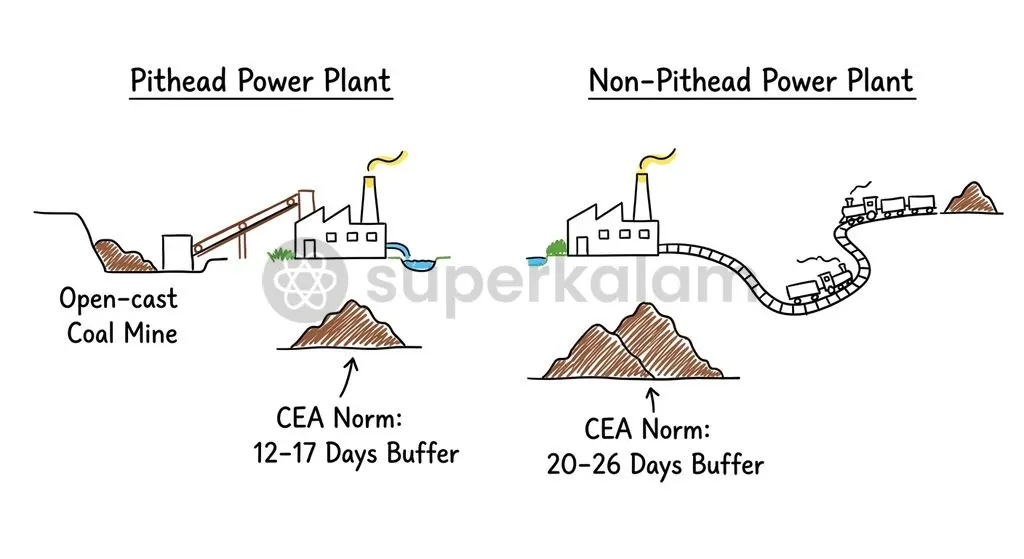
How Coal Stocking Works: Understanding CEA Buffer Norms
The Central Electricity Authority enforces dynamic fuel inventory rules to prevent sudden generation outages. These mandatory norms benchmark required coal reserves against a station's distance from supplying mines, calibrated at an 85% Plant Load Factor (PLF).
A plant enters the critical inventory category when on-site coal drops below 25% of the normative threshold, according to the Central Electricity Authority Daily Coal Stock Report. Pithead units manage with leaner stockpiles because dedicated conveyors feed them directly. Non-pithead facilities require larger fuel reserves to withstand railway transit delays.
| Parameter | Pithead Power Plants | Non-Pithead Power Plants |
|---|---|---|
| Proximity to Mine | Located at or within close radius of coal pithead | Located distant from fuel sources (often >500 km) |
| Mandatory Stocking Norm | 12 to 17 days of coal requirement | 20 to 26 days of coal requirement |
| Primary Transport Mode | Dedicated Merry-Go-Round (MGR) rail systems or conveyor belts | Indian Railways broad-gauge freight network and coastal shipping |
| Supply Disruption Vulnerability | Low vulnerability to long-distance transport bottlenecks | High vulnerability to railway rake shortages and track congestion |
Discuss with Superkalam
Recall the mandatory CEA coal buffer stock requirements (in days) for pithead versus non-pithead thermal stations.
Ask NowWhy Are Inventories Dropping Ahead of High-Demand Months?
Power plants burn fuel faster than freight trains deliver it. As ambient temperatures climb across Indian cities, commercial and residential air conditioners run continuously, accelerating stockpile depletion.
Two structural drivers intensify this inventory squeeze:
- Surging Space Cooling Demand: Space cooling appliances contributed approximately 60 GW to peak demand during summer 2024, as reported by the International Energy Agency (IEA) Electricity Analysis.
- Structural Grid Expansion: The 20th Electric Power Survey published by the Central Electricity Authority projects national peak electricity demand to reach 334 GW by 2029-30, with total electrical energy requirement expanding to 2,279 billion units.
Generating companies run at elevated utilisation to meet these spikes. This depletes stockpiles months before monsoon rains flood open-cast mines.
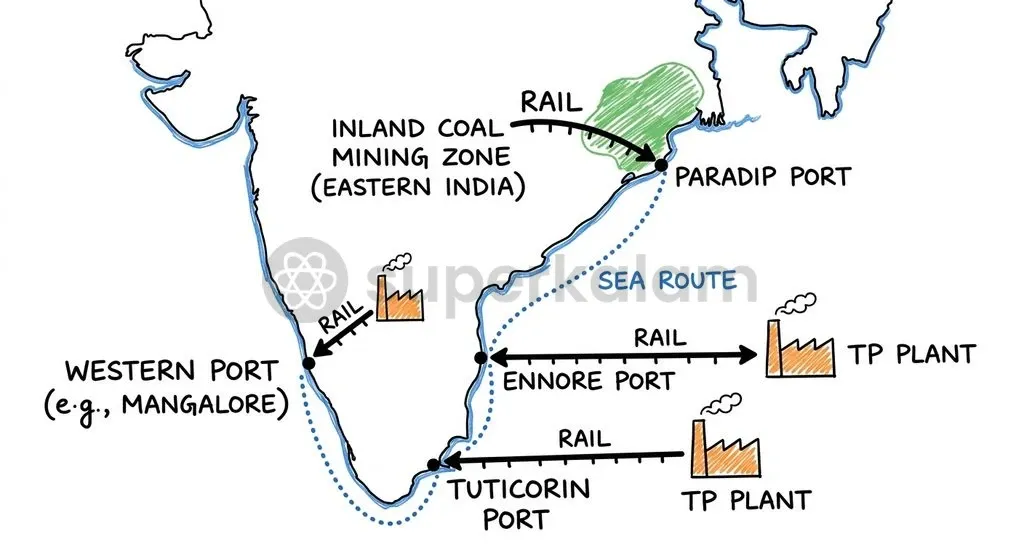
The Transport Bottleneck: Rake Shortages and Evacuation Constraints
Railway tracks connecting eastern coal basins to western and northern demand centres suffer from heavy congestion. Captive and commercial coal output expanded to 153 million tonnes in FY25 from 117 million tonnes in FY24, yet physical evacuation from pitheads remains constrained.
To prevent plant trips, an Inter-Ministerial Sub-Group comprising representatives from the Ministries of Power, Coal, Railways, and the Central Electricity Authority manages daily rake operational allocations. The Centre is diversifying transit corridors through three key logistics initiatives:
- Multimodal Rail-Sea-Rail (RSR) Route: Coal movement via coastal shipping reached 54 million tonnes in FY24, nearly doubling from 28 million tonnes in FY22. The Ministry of Coal targets evacuating 65 million tonnes via RSR by FY26 and 112 to 120 million tonnes by FY30.
- Telescopic Freight Rationalisation: The Ministry of Railways introduced a telescopic freight tariff structure for RSR movements, lowering split-leg rail charges to make coastal shipping viable for southern and western thermal stations.
- First-Mile Connectivity (FMC) Infrastructure: The Ministry of Coal sanctioned 139 mechanised projects with a cumulative capacity of 1,319 million tonnes per annum by FY 2029-30.
Mechanised FMC infrastructure replaces road transport between pitheads and sidings with covered conveyor belts, rapid loading silos, and automated wagon systems. Assessments by the National Environmental Engineering Research Institute (NEERI) show that FMC projects curb fugitive dust emissions while reducing rail rake loading turnaround cycles.
Discuss with Superkalam
Explain why solar energy generation cannot independently manage summer evening peak electricity demands without utility-scale storage.
Ask NowThe Base-Load Challenge: Balancing Summer Peaks and Green Energy
Coal-fired plants generate approximately 70% to 75% of India's total electricity, providing indispensable national grid frequency support. Solar output drops at dusk just as household cooling demand climbs. This evening drop creates a steep net-load ramp that only flexible thermal units currently stabilise.
Renewable power cannot provide standalone base-load supply without deep storage reserves:
- Storage Expansion Targets: According to the Central Electricity Authority's National Electricity Plan (Generation), India requires 82.37 GWh of energy storage (comprising 47.65 GWh Pumped Storage Projects and 34.72 GWh Battery Energy Storage Systems) by 2026-27, expanding to 411.4 GWh by 2031-32.
- Pumped Hydro Storage: The Central Electricity Authority identified 267 GW of on-stream and off-stream PSP potential, with 7 GW operational and over 12 GW under construction as of late 2025.
Until utility-scale storage rolls out widely, thermal units must carry adequate coal stocks to prevent evening outages.
Discuss with Superkalam
Analyze how First-Mile Connectivity (FMC) and Rail-Sea-Rail (RSR) routes help decouple coal evacuation from congested broad-gauge passenger corridors.
Ask NowFinancial Stress in the Power Chain: DISCOM Dues and Fuel Surcharges
Chronic distribution losses undermine upstream fuel procurement. Delayed tariff adjustments, high aggregate technical and commercial (AT&C) losses, and pending state subsidies choke utility cash flows. These deficits leave generating companies without the working capital needed for advance rail freight and pithead payments.
To restore payment discipline, the Ministry of Power notified the Electricity (Late Payment Surcharge and Related Matters) Rules, 2022. The framework enforces three key financial mechanisms:
- Instalment Restructuring: DISCOMs received approval to liquidate outstanding legacy generation dues in up to 48 equated monthly instalments (EMIs) without additional surcharge penalties.
- Strict Grid Access Disincentives: Defaulting distribution utilities face automated regulation and reduction of short-term open access to power exchange markets.
- Automatic Fuel Surcharge Pass-Through: State electricity regulatory commissions must implement monthly fuel and power purchase adjustment surcharges, enabling utilities to recover rising fuel costs without prolonged tariff filing delays.
Discuss with Superkalam
Propose structural policy measures to ensure DISCOM financial solvency while protecting end consumers from volatile monthly fuel surcharges.
Ask NowWay Forward: Building a Resilient Fuel Supply Chain
Securing India's fuel supply chain requires coordinated logistics, accelerated commercial mining, and distribution sector solvency. Managing peak electricity demand demands moving away from emergency summer firefighting towards structural supply chain resilience.
Policy execution should prioritise five key interventions:
- Accelerating Dedicated Freight Corridors: Indian Railways must fast-track east-coast freight connectivity to decouple bulk coal evacuation from high-density passenger train tracks.
- Deepening Coastal Rail-Sea-Rail Logistics: Coastal power plants in Gujarat, Maharashtra, and Tamil Nadu should maximise long-term supply contracts via Paradip, Dhamra, and Gopalpur ports using the telescopic freight framework.
- Operationalising Captive and Commercial Mine Blocks: The Ministry of Coal should streamline environmental clearances and land acquisition procedures to sustain the production gains seen in commercial mining.
- Scaling Pumped Storage and Battery Reserves: State power departments must fast-track off-stream hydro pumped storage tenders to absorb surplus afternoon solar generation and ease thermal base-load strain during evening peaks.
- Enforcing Strict DISCOM Payment Timelines: State regulatory commissions must ensure automated monthly pass-through of fuel surcharges so generating utilities can secure advance rail freight bookings.
Key Takeaways
- The Central Electricity Authority mandates 12 to 17 days of coal stocks for pithead power plants and 20 to 26 days for non-pithead stations, based on an 85% Plant Load Factor.
- India's all-time peak power demand reached 250 GW on May 30, 2024, driven by space cooling appliances that contributed an estimated 60 GW during summer heatwaves.
- Coal continues to provide 70% to 75% of total electricity generation, acting as the vital base-load source during non-solar evening peak demand periods.
- Rail-Sea-Rail coal evacuation reached 54 million tonnes in FY24, with national policy targets aiming for 112 to 120 million tonnes by FY30 to ease rail corridor congestion.
- The Electricity (Late Payment Surcharge) Rules, 2022 enable DISCOMs to clear legacy dues in up to 48 monthly instalments, improving generating companies' working capital for fuel advances.
Mains Question
"The structural bottleneck in India's thermal power sector is no longer mine-level output, but evacuation logistics and distribution-level financial distress." Examine the statement in light of recent pre-summer energy squeezes. (15 Marks)
Evaluate NowMains Question
Elucidate the role of Central Electricity Authority (CEA) buffer stocking norms and energy storage targets in ensuring national grid reliability during peak evening demand hours. (10 Marks)
Evaluate NowPractice MCQs
QUESTION 1
With reference to the Central Electricity Authority (CEA) coal stocking norms for thermal power stations, consider the following statements:
- Pithead power plants are mandated to maintain higher coal buffer reserves than non-pithead plants due to proximity to mining hazards.
- Stocking norms are calibrated on the basis of a standardized 85% Plant Load Factor (PLF).
- A thermal power plant is classified under the critical inventory category when its on-site coal stock falls below 25% of the normative threshold. Which of the statements given above are correct?
QUESTION 2
Consider the following statements regarding the logistics and evacuation of coal for thermal power generation in India:
- Under the First-Mile Connectivity (FMC) initiative, road transport between pitheads and sidings is replaced by mechanised conveyor belts and automated wagon systems.
- The Ministry of Railways introduced a telescopic freight tariff structure to facilitate Multimodal Rail-Sea-Rail (RSR) coal movements.
- Mechanised First-Mile Connectivity infrastructure has been assessed by NEERI to reduce rail rake loading turnaround cycles. Which of the statements given above is/are correct?
QUESTION 3
Regarding the Electricity (Late Payment Surcharge and Related Matters) Rules, 2022, consider the following provisions:
- Liquidation of outstanding legacy generation dues by DISCOMs in up to 48 equated monthly instalments.
- Mandatory annual fuel surcharge revisions to be conducted solely through Central Electricity Regulatory Commission public hearings.
- Automated regulation and reduction of short-term open access to power exchange markets for defaulting distribution utilities. Which of the provisions given above are implemented under the 2022 Rules?
QUESTION 4
According to the Central Electricity Authority's National Electricity Plan (Generation), what is the total projected energy storage capacity requirement for India by 2031-32 to balance renewable integration?
QUESTION 5
Consider the following statements regarding electricity generation and storage in India:
- Coal-fired thermal power supplies approximately 70% to 75% of national electricity generation, anchoring the grid during non-solar evening hours.
- The Central Electricity Authority has identified over 260 GW of on-stream and off-stream Pumped Storage Project (PSP) potential in the country. Which of the statements given above is/are correct?





