Hospital Bills in India: Cost Drivers, Markup Economics, and Tariff Regulations
As private clinical markups drive catastrophic out-of-pocket spending, federal friction stalls judicial efforts to standardize inpatient hospital charges.
Oct, 2026
•13 min read
Overview
Private hospital bills in India remain prohibitively expensive. Commercial clinical establishments leverage unregulated consumables, bundled procedural tariffs, and tiered room rents to generate wide operating margins. Statutory price controls cover only a narrow basket of essential medicines.
According to National Health Accounts estimates, out-of-pocket expenditure accounted for 39.4% of Total Health Expenditure in FY 2021-22. Inpatient medical purchases drive the bulk of this household financial distress.
The Supreme Court has pushed to standardise treatment tariffs under the Clinical Establishments Act, 2010. However, public health remains an Entry 6 State List subject. This division creates a fragmented regulatory landscape across Indian states.
Why in the News? The Crisis of Out-of-Pocket Medical Costs
The Supreme Court of India intervened in February 2024 to address escalating inpatient charges across private clinical establishments. A bench hearing Veterans Forum for Transparency in Public Interest v. Union of India issued a stern warning to the executive. It cautioned that it would enforce Central Government Health Scheme (CGHS) package rates nationwide if the Union government failed to notify standardised treatment charges under Rule 9(ii) of the Clinical Establishments (Central Government) Rules, 2012.
The escalating dispute involves key institutional developments across all three branches of state:
- Judicial Warning (February 2024): The Supreme Court threatened nationwide CGHS rate imposition under Rule 9(ii) if the executive failed to act.
- Executive Counter-Affidavit (August 2024): The Union Ministry of Health and Family Welfare defended Rule 9(ii) as a state duty under Article 47 of the Constitution, arguing clinical care cannot operate as an unfettered commercial enterprise.
- Parliamentary Scrutiny (August 2026): The 176th Report of the Parliamentary Standing Committee on Health and Family Welfare revealed that average private hospitalisation costs (₹50,508) are nearly eight times higher than public facility costs (₹6,631).
As of August 2024, the policy friction between judicial enforcement and private hospital viability remains unresolved.
National Health Accounts data shows Out-of-Pocket Expenditure (OOPE) dropped from 64.2% in 2013-14 to 39.4% in 2021-22. Even with that drop, unexpected medical emergencies remain a primary catalyst for household debt.
Discuss with Superkalam
Can you recall the percentage share that non-scheduled consumables and devices contribute to an average private hospital bill according to the NPPA?
Ask NowInside the Patient Bill: What Drives the Final Cost?
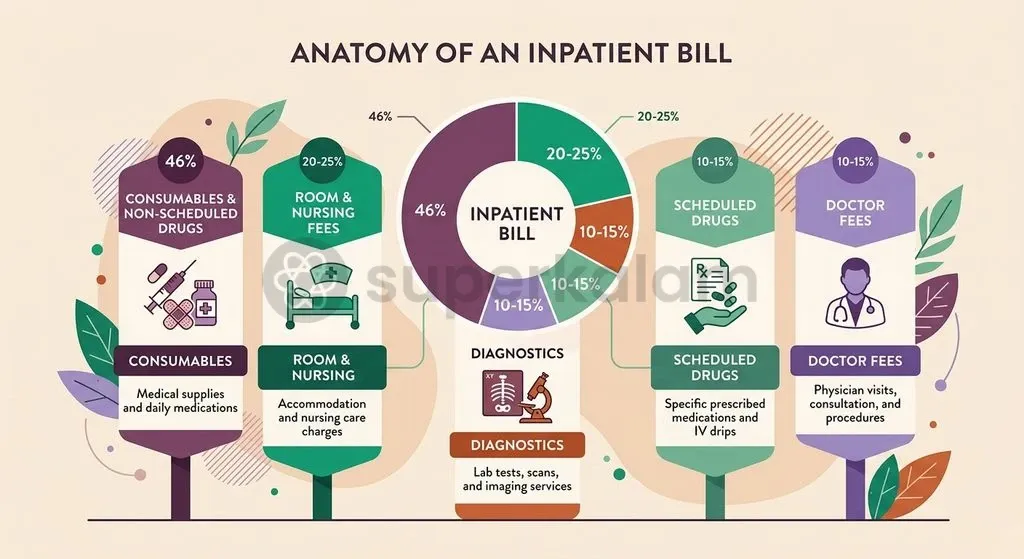
Inpatient bills in private tertiary hospitals stem mainly from pharmaceutical products, diagnostic investigations, and variable infrastructure fees. Direct doctor compensation accounts for only a minor share of the invoice. An investigation by the National Pharmaceutical Pricing Authority (NPPA) revealed that non-scheduled medicines, surgical devices, and consumables comprise an average of 46% of total hospital billing.
Private healthcare institutions operate as bundled service providers. When an individual undergoes surgical intervention, the final statement amalgamates procedural charges, pharmacy costs, biomedical waste handling fees, and nursing services.
| Billing Component | Proportion of Inpatient Bill | Primary Cost Driver | Regulatory Status |
|---|---|---|---|
| Non-Scheduled Consumables & Devices | ~46% | Syringes, gloves, IV sets, catheters, surgical packs | Uncapped retail margins; subject to 10% annual price-hike ceiling |
| Scheduled Essential Formulations | ~10%–15% | Basic antibiotics, analgesics, emergency cardiac drugs | Ceiling price fixed by NPPA under DPCO, 2013 |
| Room Accommodation & Nursing | ~20%–25% | Bed category tiers (General, Deluxe, Suite) | Entirely unregulated; acts as multiplier for clinical fees |
| Diagnostic & Laboratory Investigations | ~10%–15% | Imaging (MRI/CT), pathology tests | Unregulated at national level; facility-determined tariffs |
| Consultation & Surgical Fees | ~10%–15% | Operating surgeon, anaesthetist, daily rounds | Facility-dependent; professional fee schedules |
This structural breakdown demonstrates that institutional profits rely on consumable items and bed fees. Direct clinical care constitutes a minor fraction of the billing profile.
The Markup Machine: How Medicines and Consumables Inflate Inpatient Bills
Medical consumables and non-scheduled pharmaceuticals are primary profit centres for commercial hospital operators due to extreme retail supply chain margins. The NPPA revealed profit margins on non-scheduled consumables reaching up to 1,737% during an investigation into private billing. The agency documented a fatal dengue treatment case at Fortis Hospital Gurugram, where the patient's family was billed for 616 syringes and 1,500 non-sterile gloves over 15 days.
Hospitals secure substantial institutional discounts through bulk procurement from manufacturers. However, facilities print high Maximum Retail Prices (MRPs) on packaged consumables and bill inpatients at the full retail price. A market survey highlighted by the Maharashtra Food and Drug Administration (FDA) reported hospital markup ratios exceeding 2,800%. It cited intravenous infusion sets procured for ₹11.05 and billed to patients at an MRP of ₹325.
The Competition Commission of India (CCI) evaluated these commercial practices in May 2026. The commission closed a decade-long antitrust inquiry against 12 Delhi super-speciality hospitals in Vivek Sharma v. Becton Dickinson & Ors.. The CCI ruled that captive in-house pharmacies do not constitute a separate relevant market because hospitals deliver bundled clinical care. The Commission observed that high consumer costs stem from a regulatory vacuum, as no statutory statute mandates private providers to pass bulk procurement discounts to patients.
Where regulatory interventions have occurred, trade margin rationalisation has delivered measurable consumer relief:
- Cardiac Stents Price Caps (2017): The NPPA invoked public-interest emergency powers under Paragraph 19 of the Drugs (Prices Control) Order (DPCO), 2013. The regulator capped bare-metal stents at ₹7,260 and drug-eluting stents at ₹29,600, slashing prices by up to 85% after exposing supply chain markups exceeding 400%.
- Anti-Cancer Medicine Pilot (2019): Trade Margin Rationalisation (TMR) capped margins at 30% for 42 non-scheduled oncology drugs, reducing MRPs by up to 91% across 526 brands and yielding annual consumer savings of approximately ₹984 crore.
- Expanded Oncology Price Caps (October 2026): The Union Government decided to cap trade margins at 30% for 110 non-scheduled cancer drugs, but the list was still being finalised as reported on 8 October 2026.
Discuss with Superkalam
How does the unbundling of hospital fees from physical room lodging help prevent artificial cost inflation during inpatient stays?
Ask Now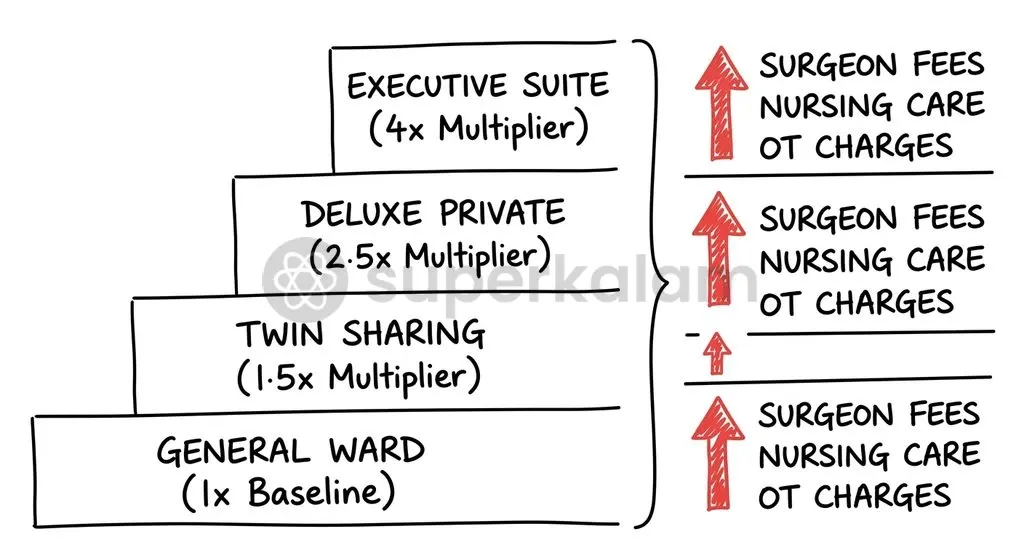
Existing Guardrails: How DPCO, NPPA, and the Clinical Establishments Act Function
Statutory oversight over medical billing is divided between national drug pricing regimes and fragmented state-level clinical establishment acts. The National Pharmaceutical Pricing Authority regulates essential medicines through the Drugs (Prices Control) Order, 2013, which is promulgated under the Essential Commodities Act, 1955.
For formulations listed in the National List of Essential Medicines (NLEM), the NPPA establishes ceiling prices based on the simple average of market brands that maintain at least a 1% value market share. Conversely, non-scheduled medicines and medical devices remain exempt from direct ceiling prices. Manufacturers and hospitals are permitted to raise their MRPs by up to 10% annually under Paragraph 20 of the DPCO.
| Regulatory Sphere | Primary Authority & Statutory Base | Core Powers & Enforcement Limitations |
|---|---|---|
| Union Government | NPPA via DPCO, 2013 (Essential Commodities Act, 1955) | Fixes ceiling prices on scheduled NLEM formulations; caps non-scheduled drug price hikes at 10% annually; no mandate to cap overall hospital procedure charges. |
| State Legislatures | State Health Departments via Clinical Establishments Act, 2010 | Empowered under Rule 9(ii) to enforce standard service rates; unenforceable in states that have not adopted the central statute (such as Maharashtra and Tamil Nadu). |
The primary legislative instrument for clinical tariffs is the Clinical Establishments (Registration and Regulation) Act, 2010. Under Rule 9(ii) of the Clinical Establishments (Central Government) Rules, 2012, registered facilities must levy charges within a rate band determined by the Central Government in consultation with State Governments.
However, Public Health is an Entry 6 subject under List II of the Seventh Schedule of the Constitution. Parliament enacted the Clinical Establishments Act under Article 252, which requires state legislatures to pass enabling resolutions before the statute takes effect. Major states with extensive private healthcare sectors—including Maharashtra, Karnataka, and Tamil Nadu—have not adopted the federal statute. These states maintain local legislation that rarely mandates standardised procedure rates.
Several regional regulatory frameworks have attempted alternative tariff models:
- West Bengal Regulatory Commission Model: Operating under the West Bengal Clinical Establishments Act, 2017, the West Bengal Clinical Establishment Regulatory Commission (WBCERC) issued Advisory No. 20/2020. This advisory capped doctor consultation charges and mandated minimum discounts of 10% on medicines and 20% on consumables relative to printed MRPs.
- Rajasthan Right to Health Framework: The Rajasthan Right to Health Act, 2023 established an enforceable statutory right to emergency medical treatment without out-of-pocket prepayment, requiring the state government to reimburse clinical facilities at fixed package tariffs.
Discuss with Superkalam
Why does the classification of public health under Entry 6 of the State List hinder the uniform nationwide rollout of Rule 9(ii) package tariffs?
Ask NowWhy Price Controls Fall Short in Regulating Private Hospitals
Uniform price ceilings frequently fail in private hospital settings because clinical providers bypass price caps through substitution and cost shifting. When the NPPA imposed statutory price caps on coronary stents in 2017, several hospitals increased charges for catheterisation laboratories, nursing care, and post-operative monitoring to protect aggregate procedural margins.
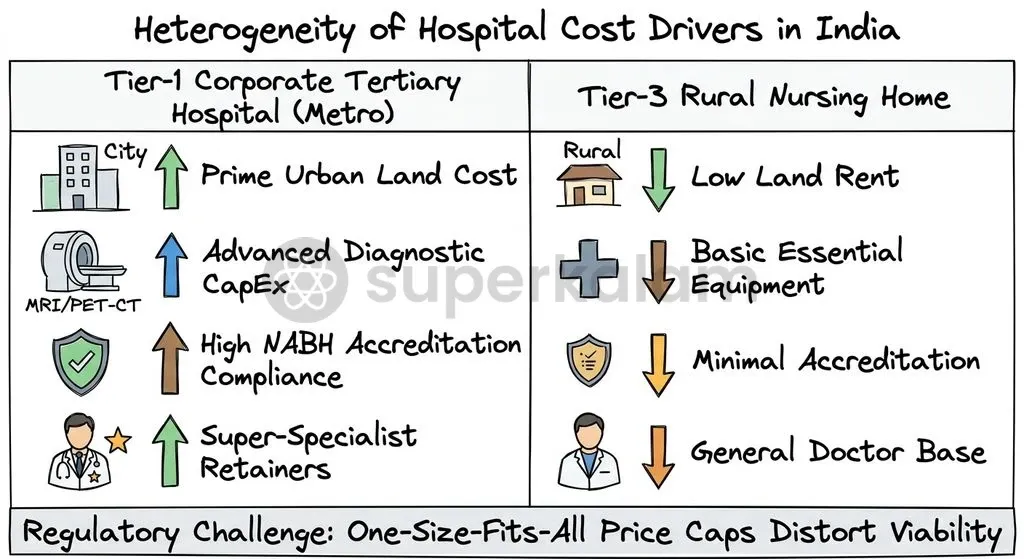
The Indian Medical Association (IMA) opposed rigid national procedural price ceilings before the Supreme Court in Veterans Forum for Transparency in Public Interest. The association argued that clinical operating costs vary substantially across geographical locations.
Operating expenses in Tier-1 metropolitan centres differ from Tier-2 and rural districts due to four distinct cost drivers:
- Real Estate Overheads: Higher land acquisition costs and steep commercial rentals in urban metros;
- Capital Expenditures: Heavy upfront investments in advanced diagnostic and therapeutic hardware;
- Accreditation Mandates: Rigorous compliance requirements for National Accreditation Board for Hospitals (NABH) standards;
- Specialist Compensation: Market-driven salaries necessary to recruit and retain super-specialist doctors.
A blunt national price ceiling risks discouraging capital reinvestment, lowering clinical standards, and encouraging the informal rejection of complex, high-risk surgical cases. Clinical care cannot be commoditised into rigid price bands without accounting for patient comorbidities and secondary complications.
Ethics and Governance: Information Asymmetry and the Right to Health
Market failures in private healthcare stem from severe information asymmetry between medical practitioners and vulnerable patients. In his 1963 economic treatise, Kenneth Arrow established that medical transactions deviate fundamentally from conventional competitive markets. Patients lack the specialised knowledge required to evaluate clinical recommendations during acute illness.
This dynamic generates supplier-induced demand, where the healthcare provider simultaneously dictates the demand for diagnostic services and supplies the paid treatment. Bereft of price transparency, distressed families cannot negotiate medical charges or question consumption volumes for consumables such as syringes, infusion sets, and laboratory profiles.
| Market Actor | Structural Position | Operational Consequence |
|---|---|---|
| Patient in Distress | Lacks diagnostic expertise; exhibits inelastic demand for survival | Incapable of price negotiation; absorbs arbitrary procedural costs |
| Healthcare Provider | Possesses clinical monopoly; acts as both advisor and merchant | Directs supplier-induced demand; bills for captive pharmacy consumables |
This commercial structure creates friction with Indian constitutional jurisprudence. The Supreme Court has repeatedly expanded the fundamental Right to Life under Article 21 to encompass healthcare access:
- In Paschim Banga Khet Majoor Samity v. State of West Bengal (1996), the Supreme Court ruled that providing timely medical treatment to preserve human life is an absolute obligation of the welfare state under Article 21.
- In Consumer Education & Research Centre v. Union of India (1995), the Court held that health and medical care represent fundamental rights under Article 21 read alongside Directive Principles Articles 39(e), 41, 43, and 48A.
Directive Principles under Part IV remain non-justiciable governance goals, but judicial interpretation has tied them to enforceable fundamental rights under Part III. Excessive hospital billing that deprives citizens of life-saving care directly undermines this constitutional framework.
Way Forward: Transparent Costing, Standard Packages, and Stronger Oversight
Addressing high hospital billing requires scientific costing methodologies, unbundled disclosures, and durable public health infrastructure rather than blunt price freezes.
The Union and State governments can implement structural reforms across five distinct policy levers:
- Adopting Empirical Cost Databases: Policymakers should utilise the National Health System Cost Database developed through the 'Cost of Health Services in India' (CHSI) multi-site study. Executed by the Department of Health Research (ICMR) and PGIMER Chandigarh, this platform established normative costs across 74 secondary and tertiary hospitals in 11 states, providing empirical reference rates for procedures.
- Transitioning to Bundled Case Rates: Regulators should adapt the Health Benefit Package (HBP) tariff model deployed under Ayushman Bharat PM-JAY. Managed by the National Health Authority, this framework bundles pre-operative, consumable, implant, and post-operative charges into single case tariffs across more than 1,900 procedures, limiting unbundled add-on billing.
- Mandatory Upfront Cost Disclosures: As recommended by the 176th Parliamentary Standing Committee Report, clinical establishments should issue binding upfront cost estimates prior to non-emergency inpatient admissions. Private hospitals must also unbundle nursing, accommodation, and procedural fees on final bills.
- Targeted Margin Rationalisation: The Ministry of Chemicals and Fertilizers should broaden Trade Margin Rationalisation (TMR) across all non-scheduled consumables and implantable devices, capping markups at the first point of sale to prevent artificial MRP inflation.
- Expanding Public Hospital Capacity: The National Health Policy 2017 targeted an increase in public health expenditure to 2.5% of GDP by 2025. However, actual Government Health Expenditure stood at 1.43% of GDP as of FY 2022-23. Enhancing investments in secondary and tertiary public healthcare is essential to provide high-quality alternatives and introduce natural market discipline into private pricing.
Discuss with Superkalam
Weigh the merits and drawbacks of enforcing fixed CGHS package rates nationwide versus applying Trade Margin Rationalisation across all medical consumables.
Ask NowKey Takeaways
- Private inpatient hospital bills in India remain elevated primarily due to unregulated medical consumables, tiered room rent multipliers, and unbundled service charges.
- The National Pharmaceutical Pricing Authority regulates ceiling prices for essential formulations under the DPCO, 2013, but non-scheduled consumables remain subject only to an annual retail price-hike ceiling of 10%.
- An NPPA billing study exposed hospital profit margins on consumables reaching up to 1,737%, with non-scheduled medicines and consumables comprising an average of 46% of total inpatient bills.
- Standardising private medical procedure charges under Rule 9(ii) of the Clinical Establishments Act, 2010 faces federal barriers because Public Health is an Entry 6 State List subject under the Seventh Schedule.
- The Supreme Court has repeatedly recognised healthcare and emergency preservation of life as integral to the fundamental Right to Life under Article 21 of the Constitution.
- Sustainable solutions require shifting toward standardised bundled packages, applying trade margin caps on hospital consumables, and increasing public health expenditure from 1.43% toward the National Health Policy target of 2.5% of GDP.
Mains Question
"The combination of uncapped retail markups on consumables and proportional room-rent multipliers illustrates a structural regulatory vacuum in India's private healthcare sector." Critically analyse in the context of out-of-pocket health expenditure and existing statutory frameworks. (15 Marks)
Evaluate NowMains Question
"Rule 9(ii) of the Clinical Establishments (Central Government) Rules, 2012, seeks to advance the constitutional mandate under Article 47, but encounters acute federal and commercial friction." Examine. (10 Marks)
Evaluate NowPractice MCQs
QUESTION 1
Consider the following statements regarding statutory price regulation in India's pharmaceutical and medical device sector:
- Under the Drugs (Prices Control) Order (DPCO), 2013, the NPPA fixes ceiling prices for scheduled formulations based on the simple average price of brands having at least a 1% value market share.
- For non-scheduled medicines and medical consumables, manufacturers and hospitals are permitted to increase Maximum Retail Prices by up to 10% annually.
- The National Pharmaceutical Pricing Authority derives its statutory price-fixing authority directly from the Clinical Establishments Act, 2010. Which of the statements given above is/are correct?
QUESTION 2
With reference to regulatory and antitrust oversight of private healthcare pricing in India, consider the following statements:
- In 2017, the NPPA invoked emergency powers under Paragraph 19 of the DPCO, 2013, to cap the ceiling prices of coronary stents.
- Under the Trade Margin Rationalisation (TMR) approach applied to non-scheduled oncology formulations, retail trade margins were capped at 30%.
- The Competition Commission of India directed super-speciality hospitals to mandatorily pass institutional bulk procurement discounts on consumables to admitted patients. Which of the statements given above is/are correct?
QUESTION 3
Consider the following statements regarding the economics of inpatient hospitalisation in India:
- According to National Health Accounts estimates, Out-of-Pocket Expenditure accounted for 39.4% of Total Health Expenditure in FY 2021-22.
- Non-scheduled medicines, surgical devices, and consumables account for nearly half of the average inpatient hospital bill in private tertiary facilities.
- Public health and clinical establishments fall under Entry 6 of the Union List in the Seventh Schedule of the Constitution. Which of the statements given above is/are correct?
QUESTION 4
Consider the following statements regarding the Clinical Establishments Act, 2010, and inpatient tariff regulation:
- Rule 9(ii) of the Clinical Establishments (Central Government) Rules, 2012, mandates the notification of standardised rates and charges for clinical services.
- The provisions of the central Clinical Establishments Act, 2010, apply uniformly and compulsorily across all states without requiring state-level adoption.
- In judicial proceedings before the Supreme Court, the Union Health Ministry defended Rule 9(ii) as an executive obligation grounded in Article 47 of the Constitution. Which of the statements given above is/are correct?
QUESTION 5
Regarding private hospital accommodation tariffs, the 176th Report of the Parliamentary Standing Committee on Health and Family Welfare recommended which of the following measures to prevent arbitrary cost escalation?