Himalayan Monal: Habitat, Status, Threats and Noise Study
While Schedule I status shields the Himalayan Monal on paper, expanding pilgrimage corridors and acoustic disturbance threaten its fragile alpine strongholds.
Sep, 2026
•7 min read
Overview
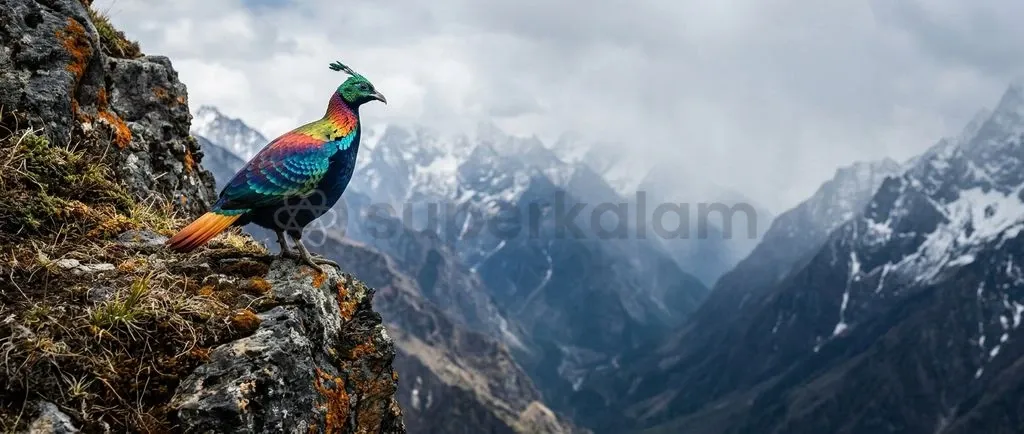
The Himalayan Monal (Lophophorus impejanus) is a high-altitude pheasant found across temperate and alpine zones. It occupies elevations between 2,100 and 4,500 metres across the Himalayas. The bird is an indicator of fragile montane health. It holds the highest domestic legal shield under Schedule I of the Wildlife (Protection) Act, 1972, alongside an Appendix I listing in CITES. Despite these safeguards, climate warming, infrastructure growth, and unregulated tourism place severe stress on populations.
Recent bioacoustic research shows that vehicular noise pollution forces shifts in vocal frequency and spikes physiological stress. This demonstrates that linear infrastructure causes severe disturbance even where forest cover appears physically intact.
Why in the News? Anthropogenic Soundscapes and Alpine Ecology
Motor traffic is reshaping mountain soundscapes. Recent bioacoustic investigations show that anthropogenic noise pollution disrupts wildlife across the Indian Himalayan Region. The Himalayan Monal alters its vocalisation frequency and call duration to cut through acoustic masking from vehicles and tourists.
As of March 2026, expanding pilgrimage and tourism infrastructure across Uttarakhand and Himachal Pradesh has brought heavy vehicular traffic into previously secluded subalpine zones. These studies add an acoustic dimension to high-altitude conservation. Habitat degradation is no longer just about deforestation—it is also about soundscape fragmentation.
Profile of the Himalayan Monal: Taxonomy and Morphology
The Himalayan Monal belongs to the family Phasianidae within the avian order Galliformes. The IUCN Red List Assessment for Lophophorus impejanus classifies it as one of the most prominent high-altitude galliform birds in Asia.
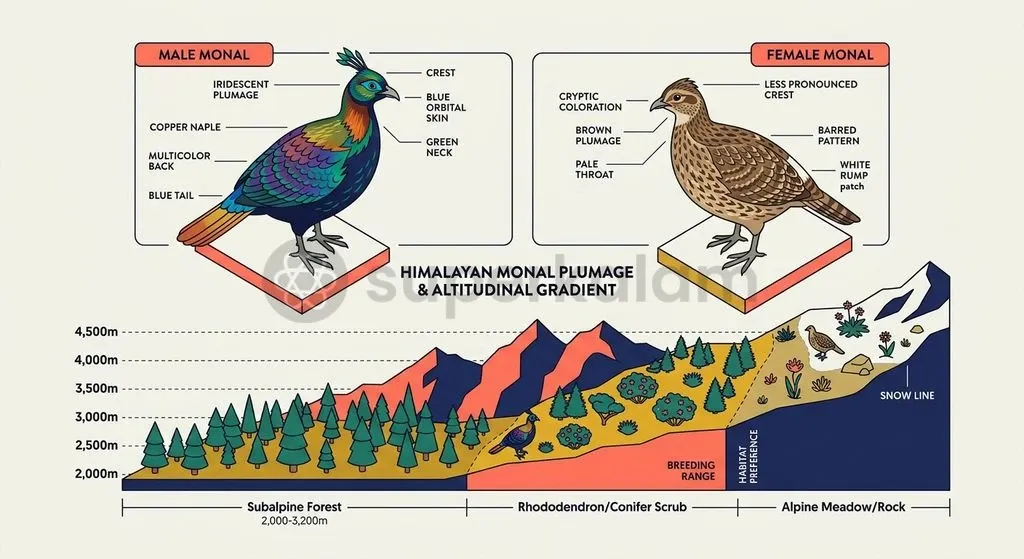
The species exhibits striking sexual dimorphism. Male and female adult birds show distinct physical traits, as documented by the West Bengal Zoo Authority Species Profile: Himalayan Monal.
| Morphological Feature | Adult Male Monal | Adult Female Monal |
|---|---|---|
| Plumage Colouration | Iridescent multicoloured (metallic green, purple, blue) | Mottled brown and buff for crypsis |
| Crest Structure | Elongated, metallic green spatula-tipped crest | Absent or rudimentary |
| Tail Characteristics | Bright rufous tail feathers | Muted brown tail with pale barring |
| Throat Patch | Glossy black throat | Distinct white throat patch |
| Primary Biological Role | Display, courtship, and territorial defence | Camouflage during ground nesting |
Dimorphism extends to acoustic traits. Research in the Proceedings of the Zoological Society notes that adult male territorial and advertisement calls show a peak frequency of 2470.43 ± 8.36 Hz. In contrast, female calls register a lower peak frequency of 1928.34 ± 18.19 Hz.
Geographical Distribution and Altitudinal Range
The native range of the monal spans the montane arc from Afghanistan and Pakistan to Nepal, Bhutan, and southern Tibet. In India, populations inhabit high-altitude tracts across Jammu & Kashmir, Himachal Pradesh, Uttarakhand, Sikkim, and Arunachal Pradesh.
Altitudinal distribution follows a defined vertical gradient:
- Primary Breeding Range: Oak-rhododendron forests, subalpine pastures, and alpine meadows located between 2,100 metres and 4,500 metres.
- Winter Descent: Seasonal altitudinal migration down to roughly 2,000 metres during heavy winter snowfall.
Discuss with Superkalam
Identify the altitudinal breeding range and the Indian states that form the native habitat of the Himalayan Monal.
Ask NowEcological Functions and Cultural Significance
The Himalayan Monal acts as an ecological engineer in high-altitude meadows through ground-foraging. Using its curved bill, the monal digs deep into alpine soil to unearth subterranean roots, tubers, and invertebrate larvae.
This digging behaviour delivers two key ecosystem functions:
- Topsoil Aeration: Soil churning prevents compaction and accelerates nutrient cycling in cold alpine soils.
- Seed Dispersal: Ground disturbance exposes buried seed banks, aiding subalpine plant regeneration.
Culturally, the bird holds a prominent place in Himalayan heritage. It is the official state bird of Uttarakhand and the national bird of Nepal, where it is known as Danphe. Himachal Pradesh previously designated the monal as its state bird before selecting the Western Tragopan (Tragopan melanocephalus).
Legal Status and Protection Framework
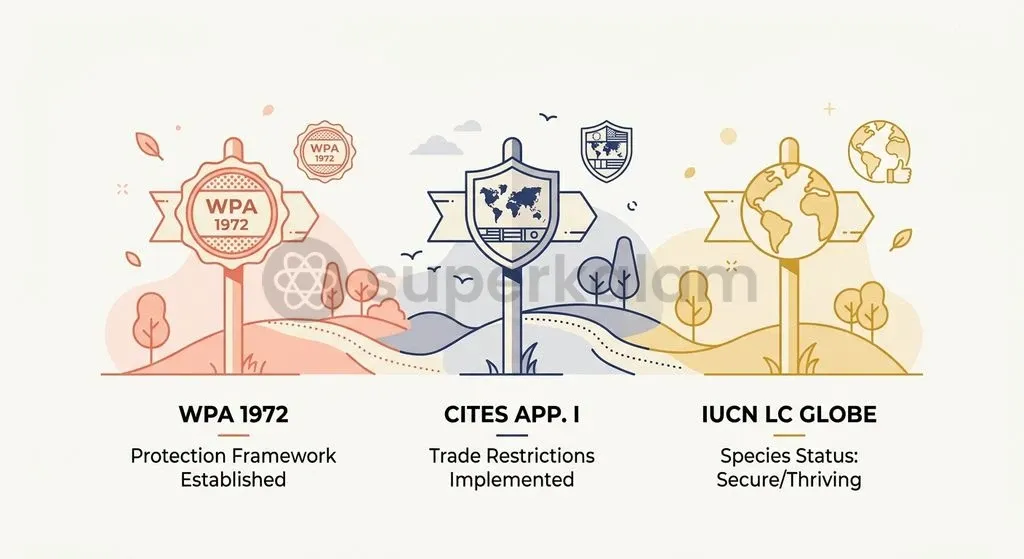
The Himalayan Monal receives strict statutory protection across its range. Under India's Wildlife (Protection) Act, 1972, as amended in 2022, the monal is listed in Schedule I, granting it the highest level of statutory protection and imposing severe penal sanctions against hunting or trade.
International agreements reinforce this protection:
- CITES Listing: Placed on Appendix I of CITES, banning international commercial trade in wild-caught specimens, feathers, or derivatives.
- IUCN Red List: Categorised globally as Least Concern (LC) because of its vast geographic distribution, though regional populations experience severe localised pressures.
Emerging Threats: Climate Pressures and High-Altitude Fragmentation
Poaching once posed the greatest danger to the species. Historically, hunters targeted males for their iridescent crest feathers to decorate traditional headgear like the Kullu cap, causing steep local declines before statutory bans took effect.
Contemporary threats stem from broad landscape pressures:
- Climate-Induced Habitat Shrinkage: Species distribution modelling projects that climate change could reduce stable core habitats in the Indian Himalayan Region by up to 14.6% by mid-century under low-emission scenarios (SSP126).
- Alpine Overgrazing: Unregulated livestock grazing degrades high-altitude meadows, stripping ground cover needed for nesting.
- Corridor Fragmentation: Highways and pilgrimage corridors slice through subalpine tracts, isolating fragmented populations.
Discuss with Superkalam
How does acoustic masking from mountain highways interfere with the biological communication and survival of high-altitude galliform birds?
Ask NowBioacoustic Research: How Noise Pollution Alters Monal Behaviour
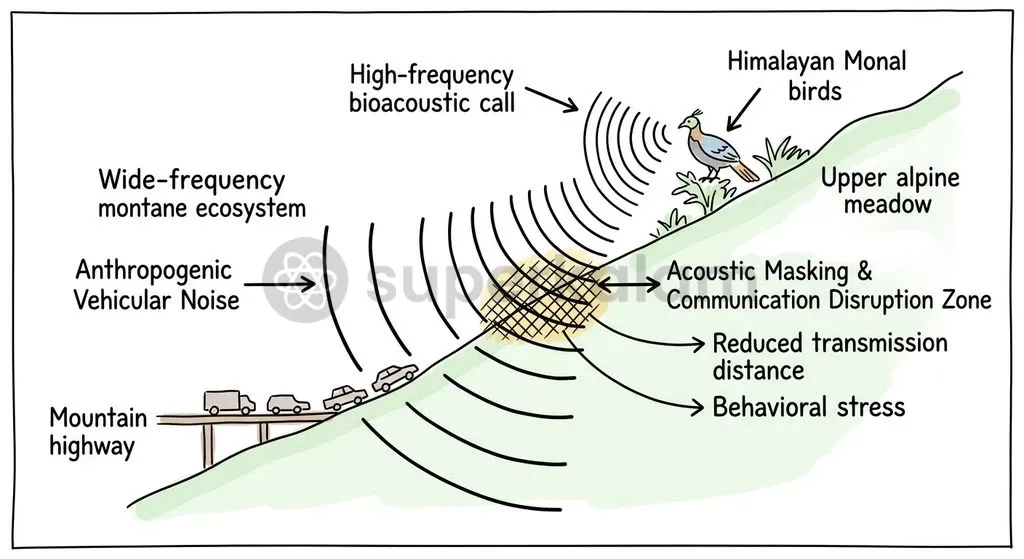
Engine noise directly impairs montane wildlife. Studies show that vehicular disturbance forces the Himalayan Monal to alter its acoustic signalling. Birds shift vocal frequencies and call lengths to overcome acoustic masking caused by traffic.
These acoustic modifications impose clear biological costs:
- Interrupted Communication: Masked mating calls and alarm signals undermine predator detection and lower breeding success.
- Foraging Displacement: Persistent noise drives birds away from roadside feeding sites into less productive terrain.
- Elevated Physiological Stress: Chronic noise triggers prolonged hormonal stress responses, lowering overall reproductive fitness.
Infrastructure Expansion versus Eco-Sensitive Governance
Linear infrastructure projects highlight an acute conflict between connectivity and alpine biodiversity. Highway expansions and pilgrimage corridors improve economic access. Yet, they bring heavy vehicular streams into fragile subalpine habitats.
This growth creates governance challenges across protected zones:
- Enforcement Gaps in Eco-Sensitive Zones: Guidelines from the Ministry of Environment, Forest and Climate Change mandate regulated activities within Eco-Sensitive Zones (ESZs). Even so, enforcement of vehicular noise and transit limits remains weak during peak tourist seasons.
- Soundscape Degradation: Environmental impact assessments routinely measure land clearance while ignoring acoustic pollution, which scatters ground-nesting birds across wide buffer zones.
- Balancing Pilgrimage and Ecology: Effective governance requires vehicular quotas, strict speed limits, and seasonal quiet periods to prevent the displacement of sensitive species.
Discuss with Superkalam
If you were tasked with designing an Eco-Sensitive Zone transit management plan during peak pilgrimage season, how would you regulate vehicular noise?
Ask NowConservation Strategy and the Way Forward
Conserving high-altitude pheasants demands a balance between ecological safeguards and regional development. Effective preservation requires targeted policy interventions that integrate protected area governance with grassroots community participation.
Key policy priorities include:
- Acoustic and Transit Regulation: Mandating speed caps, silent corridors, and bans on pressure horns along transit routes traversing Eco-Sensitive Zones.
- Eco-Development Committees (EDCs): Mobilising local mountain communities through Eco-Development Committees to monitor nesting grounds and deter illegal extraction.
- Climate-Resilient Corridors: Establishing vertical ecological corridors that let monal populations migrate upward as global warming shifts tree lines.
Discuss with Superkalam
Analyse the trade-offs between expanding high-altitude pilgrimage connectivity and preserving undisturbed alpine soundscapes in the Himalayas.
Ask NowKey Takeaways
- The Himalayan Monal (Lophophorus impejanus) is a high-altitude galliform bird inhabiting subalpine and alpine zones between 2,100 and 4,500 metres across the Himalayas.
- The species holds Schedule I status under India's Wildlife (Protection) Act, 1972, and is listed in Appendix I of CITES, with a global IUCN Red List status of Least Concern.
- Adult males possess iridescent multicoloured plumage, elongated crests, and higher vocal frequencies (2470.43 Hz), whereas females display cryptic brown plumage and lower vocal frequencies (1928.34 Hz).
- Bioacoustic research demonstrates that vehicular noise pollution triggers frequency shifts in calls, drives foraging displacement, and elevates physiological stress.
- Climate modelling projects a 14.6% reduction in stable core habitats across the Indian Himalayan Region by mid-century under the SSP126 scenario.
- Effective conservation requires strict implementation of Eco-Sensitive Zone (ESZ) rules, vehicular noise curbs on pilgrimage routes, and community-led habitat surveillance.
Mains Question
"Linear infrastructure development in fragile subalpine zones creates an invisible crisis of soundscape fragmentation that conventional environmental impact assessments often fail to capture." In the light of recent bioacoustic findings on the Himalayan Monal, critically examine the ecological impacts of noise pollution and suggest regulatory measures for Eco-Sensitive Zones. (15 Marks)
Evaluate NowMains Question
Highlighting the role of the Himalayan Monal as an 'ecological engineer' in high-altitude ecosystems, elucidate the compounded threats posed by climate change and habitat degradation to its conservation. (10 Marks)
Evaluate NowPractice MCQs
QUESTION 1
With reference to the Himalayan Monal (Lophophorus impejanus), consider the following statements:
- It is legally protected under Schedule I of the Wildlife (Protection) Act, 1972.
- In the IUCN Red List of Threatened Species, it is categorized globally as Critically Endangered due to acute habitat fragmentation.
- It exhibits sexual dimorphism, wherein only the adult male possesses an elongated, metallic green spatula-tipped crest.
Which of the statements given above are correct?
QUESTION 2
Consider the following statements regarding the ecological and behavioral characteristics of the Himalayan Monal:
- It functions as an ecological engineer by churning subalpine soil during foraging, which promotes topsoil aeration and nutrient cycling.
- Recent bioacoustic studies show that adult male advertisement calls have a lower peak frequency than those of adult females.
- Exposure to vehicular noise pollution forces the species to shift its vocalisation frequency and call duration.
Which of the statements given above is/are correct?
QUESTION 3
Consider the following statements regarding the geographical and altitudinal distribution of the Himalayan Monal:
- In India, its natural distribution spans Jammu & Kashmir, Himachal Pradesh, Uttarakhand, Sikkim, and Arunachal Pradesh.
- Its primary breeding range is restricted to tropical moist deciduous belts between 500 and 1,500 metres.
- During heavy winter snowfall, the species exhibits seasonal altitudinal migration down to roughly 2,000 metres.
Which of the statements given above is/are correct?
QUESTION 4
With reference to international and domestic wildlife protection frameworks, the Himalayan Monal is listed under:
QUESTION 5
Consider the following statements regarding high-altitude alpine ecology and conservation threats mentioned in the context of the Himalayan Monal:
- Under low-emission climate scenarios (SSP126), species distribution modelling projects a loss of stable core habitats in the Indian Himalayan Region by up to 14.6% by mid-century.
- Chronic vehicular noise triggers prolonged hormonal stress responses and acoustic masking, directly impacting reproductive fitness.
- The bird is currently the official state bird of both Uttarakhand and Himachal Pradesh.
Which of the statements given above is/are correct?